Categories
Science Scientists

 Feb 7, 1861- 161 years ago, a scientist identifies carbon dioxide as a greenhouse gas

On this day, in 1861, Irish scientist John Tyndall read his paper about carbon dioxide at the Royal Society at the annual Bakerian lecture. Tyndall was not, we now know, the first person to point out what he called carbonic acid had greenhouse water warming potential. That honour belongs to Eunice Foote in the United States a few years earlier. There’s an interesting and useful summary of this at the beginning of Alice Bell’s excellent 2021 book “Our Biggest Experiment.” And of course the idea that there must be something, some gas, keeping the planet warmer than it otherwise would be dates back to Fourier in 1824.

Tyndall did the research, reported it. It wasn’t for another 35 years that someone, Svante Arrhenius. said, “this is in fact going to be a thing (but not for centuries, and it will be a good thing.”. He was trying to distract himself from a messy divorce by doing laborious calculations, which your mobile phone could probably do in about three seconds now. 

Why this matters,

We’ve understood the science – this is 19th century physics – for a very long time. Unfortunately, we have not acted. And as I’ve said before, I will say again, that “we” first person plural pronoun is doing a lot of work in that sentence.

[On this question of ‘we’ see this 2018 piece by Genevieve Gunther – h/t Sam]

What happened next

The Tyndall Centre got set up in 2000.

Categories
IPCC United States of America

February 6, 2001: ExxonMobil Lobbyist Calls on White House to Remove Certain Government Climate Scientists

On this day, in 2001, the oil company Exxon was throwing its weight around trying to get specific scientists pushed off the Intergovernmental Panel on Climate Change.

In a memo to the White House Council on Environmental Quality (CEQ), ExxonMobil lobbyist Randy Randol denounces esteemed climate scientist Robert Watson, chairman of the Intergovernmental Panel on Climate Change (IPCC), as someone “handpicked by Al Gore” who is using the media to get “coverage for his views.

He asks “Can Watson be replaced now at the request of the US?” In addition to Watson, Randol names other climate experts who he wants “removed from their positions of influence.” 

You can read the document here, on climate files.

And they succeeded. Bob Watson only served one term where the normal expectation was two. And this is because he was too independently minded and wasn’t going to waffle about technology saving us. 

This is not a new story. Historically scientists have come under ferocious attack, not just for their climate work, but also ozone hole, asbestos, you name it. There’s a lovely example in An Enemy of the People, the play by Henrik Ibsen, which by the way, inspired the movie, Jaws… but I digress. 

Why this matters

We need to remember that a lot of what we see and hear and take as accepted fact, is actually constructed for us actively or passively, and that critical voices have been removed. For the benefit of continued capital accumulation. This is Gramsci in action, people. This is how hegemony is constructed and maintained. 

What happened next

The IPCC kept producing reports and is producing another one. Meanwhile, the carbon dioxide accumulates thanks to the actions and inactions of people like you and me who have failed to build the kinds of movements that could have made a difference despite having freedom of speech, freedom of assembly, freedom of information. It might be a good idea for us to look ourselves in the mirror.

Categories
Propaganda United States of America

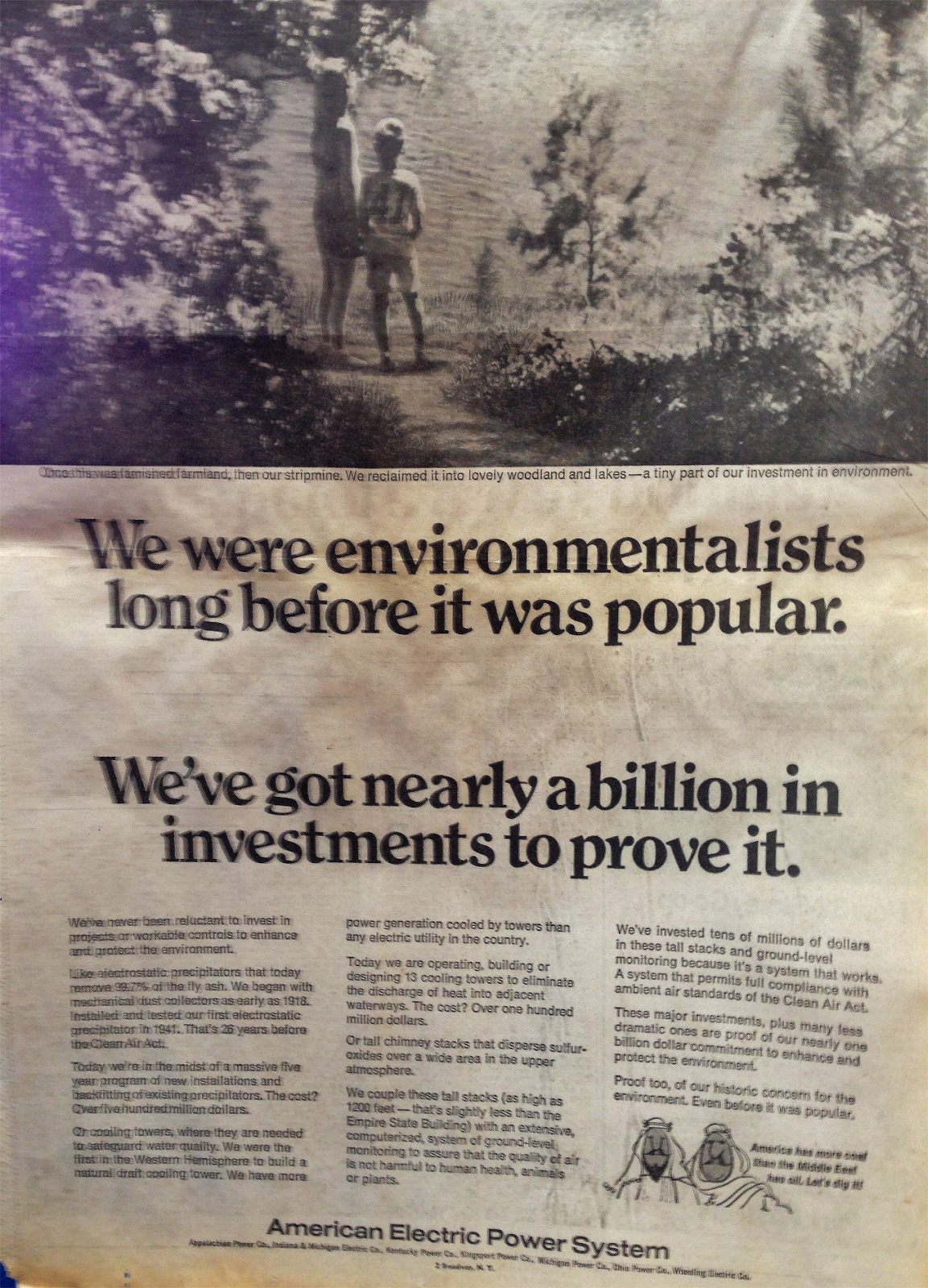
Feb 5, 1974 – Energy security, meet anti-Arab sentiment #propaganda

On this day, February 5 1974, the American Electric Power (AEP) ran the first of its advertising, cartoon campaigns, with Arab sheikhs, holding the US to ransom (Sethi, 1977). 

This is of course, part of the first energy shock, as it’s known, which had started in late 1973. With basically a quadrupling of petroleum prices and actual shortages at petrol pumps in the developed world, because the energy producer cartel OPEC, decided to punish those countries who had supported Israel in the Yom Kippur War. (This is not to say that there had not been concerns about energy before late 73.) 

What’s interesting is that the oil companies were able to, or keen to shift the blame and tap into, frankly, long established anti-Arab sentiment in the United States. 

Why this matters 

We need to understand that issues around energy and energy security are visceral. And that those who are benefiting like to find someone else for the anger, fear, uncertainty to be pinned on. A bit like the tactic of the drill sergeant in Full Metal Jacket, who picks on one soldier as the scapegoat, as the lightning rod. 

What happened next? 

President Nixon announced Project Independence which was going to see a huge growth in domestic energy production, especially coal. Prices sort of stabilised, but then we had in the 70s stagflation, the collapse of the Bretton Woods global consensus, . And by the end of the 70s, thanks to the dedicated efforts of some think tanks and politicians, and good luck, (but they were in the right place at the right time, which isn’t always easy) we have the coming of what we now call neoliberalism. This is, of course, antithetical to any form of collective provision or planning, which is what you would have needed to deal with a collective action  problem like climate change, but here we are. This is not to say that the AAP advert is responsible for all of that, to the removal of any doubt

Btw, AEP kept going with their campaign.  See also this advert on 31st July 1974

References

“Feb 5 1974 first advert in AEP campaign with the two sheiks appears in the “New York Times, Wall Street Journal, Washington Post, and 69 dailies and 192 weeklies in the area served by American Electric Power System’s group of companies.” Sethi, S. 1977. Advocacy Advertising and Large Corporations: Social Conflict, Big Business Image, the News Media and Public Policy. Lexington, MA: Lexington Books, p.115.

Categories
Predatory delay United States of America

Feb 4, 2002- Global Climate Coalition calls it a day (“Mission accomplished”)

On this day in 2002, the Global Climate Coalition shut up shop, basically declaring mission accomplished. Well, they’d probably done it a few days earlier, but Imma use this – Anon. 2002. Global Climate Coalition Bows Out. Chemical Market Reporter, , Vol. 261, Issue 5, 4 February – as the marker.

The friendly sounding coalition – actually, an industry group dedicated to stopping action on climate change – had been formed in 1989, when it looks like serious action was possible and even probable, with new US President George HW Bush, having declared on the campaign trail, that those who were worried about the greenhouse effect should not discount the White House Effect.

Even then moves were  well afoot within Bush’s administration, especially under Chief of Staff, John Sununu, to make sure that the environmentally concerned people were sidelined. And that the whole issue just got kicked into the long grass. There were those who would cast active actual doubt on the science but usually, the Global Climate Coalition was a little bit more subtle. 

However, in 1995/6, it had gone too far, launching full throated vociferous attacks on the IPCC second assessment report. In 1997 Shell had pulled out because of the reputational risk. And this was followed later, by other groups, including Ford and GM. By February 2002 it was no longer needed. Because the administration of George HW Bush’s son, George W. Bush, was clearly not going to do anything on climate, having already pulled out of Kyoto. The Global Climate Coalition had therefore, lived as long as it needed to.

Why this matters

Don’t be fooled by names. When they say they’re something they are usually the opposite. They’re very determined. They’re very clever. They’re very well funded. They stick around, they do the work. They get what they want, usually, not always, but often. 

What happened next

Although the Global Climate Coalition was dead, individual companies continued to finance both outright denial and also predatory delay. And they’re still at it, of course. Full stop.

Categories
Australia Social Movements Unsolicited advice

Feb 3, 2009 –  Physical encirclement of parliament easier than ideological or political. #auspol

On this day, in 2009, at the climax of their three day Climate Action Summit, protesters linked arms around Parliament House in Canberra. Climate activism had exploded in 2006 in Australia, with everything from marches to, in the following years, direct action attempts to prevent the export of coal from Newcastle. Activist group Rising Tide had held climate camps and with the new Rudd Government talking about climate action, the time seemed ripe with promise. 

However, by the end of 2008, it was obvious that the Labour government which had promised so much was going to deliver at best, very, very little. Activists had interrupted Rudd’s National Press Club presentation at the end of 2008. And economist Ross Garneau had denounced Rudd’s “carbon pollution reduction scheme” with the words “Never in the history of Australian public finance has so much been given without public policy purpose, by so many, to so few,”

So 2009 looked like it was going to be the year when citizens said enough. However, it was not to be. Protest movements struggle, once an issue is on the agenda, because many who would otherwise support it, say, “you’ve got to give the process time, you’ve got to see what emerges.” This, of course, plays into the hands of incumbents who know very well how to slow things down, how to sideline proposals, how to water down commitments, how to demand extensions, and special treatment.  If the insurgents don’t have a class interest that binds them together, they are even more vulnerable…

And of course, this was all happening in the middle of the global financial crisis. (But there is always some reason not to act on a long term problem, like climate change.) 

Why this matters? 

We need to understand that you can physically, symbolically encircle a parliament but actually restricting the ability of elected politicians to weasel out and to water down is a much tougher proposition requiring different skills, different capacities. 

What happened next?

Rudd’s CPRS failed to get through Parliament early in 2000. And in mid 2009, and failed again, in December of that year, when the Liberals revolted, the Greens refused to support it. And the rest of the story is horrible. But we know that.

See also

Greenpeace summary

Categories
United States of America

Feb 2, 1992- that “sarcastic” memo about exporting pollution…

On this day, February 2nd 1992, following a leak from Friends of the Earth, Jornal de Brazil breaks the story that a “sarcastic” memo was signed by Laurence Summers, then Chief Economist of the World Bank, about the economic good sense in off-shoring pollution.

“Just between you and me, shouldn’t the World Bank be encouraging more migration of dirty industries to the LDCs [less developed countries]?… The economic logic behind dumping a load of toxic waste in the lowest wage country is impeccable, and we should face up to that… Under-populated countries in Africa are vastly under-polluted; their air quality is probably vastly inefficiently low compared to Los Angeles or Mexico City… The concern over an agent that causes a one in a million change in the odds of prostate cancer is obviously going to be much higher in a country where people survive to get prostate cancer than in a country where under-five mortality is 200 per thousand.”

This just after the negotiations for a climate treaty to be signed in Brazil in 1992 had begun. Oops.

What happened next

It got mentioned during the Senate Hearings for Summers to get the Secretary of the Treasury gig in 1993. That’s about it.


Why this matters

As “satire” it wasn’t exactly Swift, now was it. And in the pre-Basel agreement world, many didn’t see the funny side.

See also – the wikipedia page, natch. 

Categories
United States of America

Feb 2, 1970 – For once, “Time is on our side”

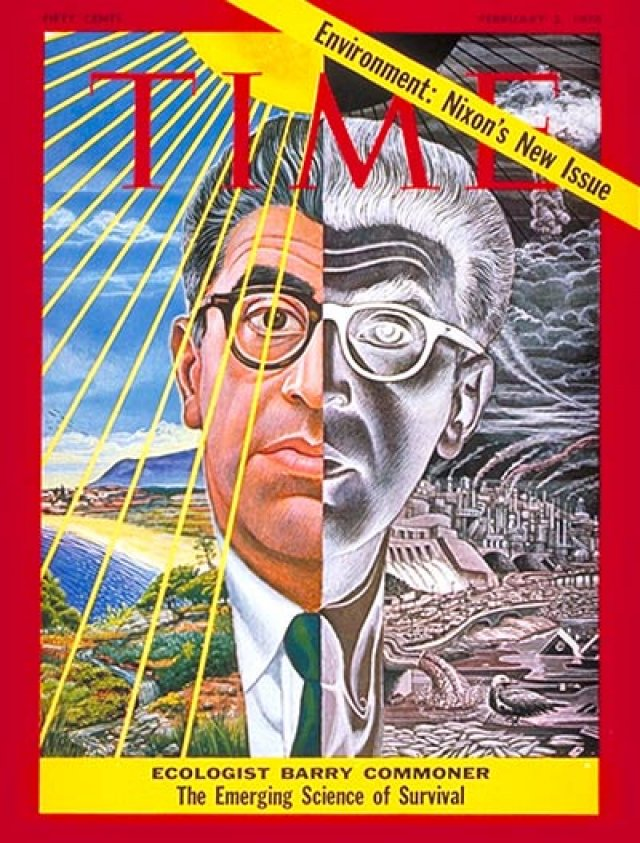
On 2 February 1970, TIME magazine’s front cover had a picture of ecological thinker Barry Commoner against two possible backdrops

According to Egan (2007) Time

“incorporated a new “Environment” section. The editorial staff chose for that issue’s cover a haunting acrylic painting by Mati Klarewein of Barry Commoner, its appointed leader in “the emerging science of survival.”  Commoner was set in front of a landscape half of which appeared idyllic and the other half apocalyptic, presumably suggesting the environmental choices facing humankind. The urgency of those choices was implicit.” (Egan, 2007:1) 

Commoner had already written a bunch of important books, and would write many more (see Egan, 2007) for more on this. While we are here though, Commoner’s four laws of Ecology deserve a mention –

  • Everything is connected to everything else
  • Everything must go somewhere,
  • Nature knows best
  • There is no such thing as a free lunch. 

Why this matters

We need to remember, imo, that the stark choice keeps getting put, and we keep resiling from it, but by not choosing, we are, in fact, choosing…

What happened next

The “Malthusian moment” passed by 1973. Commoner ran for President in 1980, but didn’t cost Carter the election the way Nader cost Gore in 2000.

Commoner died, aged 95, in 2012. See Green Left Weekly obituary here.

References

Egan, M. 2007 Barry Commoner and the Science of Survival: The remaking of American Environmentalism. Cambridge, MA: The MIT Press.

Categories
Monthly reports

January reflections

Hello!

So the first month of All Our Yesterdays was to be honest, a bit of a slog.

Reasons to be grateful

  • One is for fantastic guest posts by Chloe Jeffries, Grace Thomas, Hugh Warwick, and Sakshi Aravind.
  • Lots of positive feedback from people about the project
  • I’ve learnt some new tricks and shorthand including putting up a dummy PowerPoint template and then being able to use it to make the illustrations

Silly metrics

  • Viewing numbers were never very high (best day – yesterday – 99).
  • It’s very hard to build a Twitter following. I started the month at 47 and I now have 133. That’s not too bad – almost 3 a day.

Things I’ve done recently

  • Changed the banner headline on the Twitter account
  • Replaced the Polar Bear on the home page of the website
  • Set up a Facebook page
  • Refined/enunciated the production process. And if you’re interested, I will go through it another time. But this blog post is already quite long

For the coming month

The blog posts are almost all written

Every post will have a “trump card” and some posts will get extra publicity, (Twitter threads and maybe videos)

Please retweet content and share it please get in touch if you have suggestions for dates, events, themes.

Need to massively improve the navigation on the site (it is a mess)

Contact lots of academics to ask them to publicise it.

Categories
United States of America

Feb 1, 2007- Jeremy Grantham slams Bush on #climate

On this day in 2007 as the IPCC’s 4th assessment report was about to be released, Jeremy Grantham, chairman of a Boston-based fund management company, sent out another of his quarterly letter to clients. It included a commentary on the United States’ policy toward climate change, particularly that of the current administration. 

Its title was “While America Slept, 1982-2006: A Rant on Oil Dependency, Global Warming, and a Love of Feel-Good Data,”

It included the observation that 

Successive US administrations have taken little interest in either oil substitution or climate change and the current one has even seemed to have a vested interest in the idea that the science of climate change is uncertain.”

David Roberts of Grist called this a “four page assault on US energy policy.

Given Cheney/Bush’s enthusiasm for coal and oil, and hatred of all things environmental,, it was a fair cop.

Why this matters.

There’s this idea – carefully cultivated and promulgated – that the only people banging on about climate change are Luddites and “leftists.” As Grantham, and others, show, plenty of capitalists can see the nose on their face (n.b. that doesn’t mean capitalism is sustainable).

What happened next?

Grantham has kept it up. In November 2012 he wrote another piece, in Nature, that is well worth your time – “Be persuasive. Be brave. Be arrested (if necessary)

According to Wikipedia, that source of all reliable information “In August 2019, he dedicated 98% (approximately $1 billion) of his personal wealth to fight climate change. Grantham believes that investing in green technologies, is a profitable investment on the long run, claiming that decarbonizing the economy will be an investing bonanza for those who know it’s coming.[26
Oh, and he thinks the bubble is about to burst.

Categories
Environmental Racism, Guest post Social Movements

Environmental Racism – then and now… Guest post by @SakshiAravind

Sakshi Aravind is a PhD student at University of Cambridge. (see her review of Andreas Malm’s book “How to blow up a pipeline” here, and see an interview here) reflects on the 32 years since this-

1990 Shabecoff, P. 1990. Environmental Groups Told They Are Racists in Hiring. New York Times, 1 February. WASHINGTON, Jan. 31— Several members of civil rights and minority groups have written to eight major national environmental organizations charging them with racism in their hiring practices

After thirty-two years, it is a small relief that we do not have to write letters about discriminatory hiring practices in environmental organisations. We have traversed some distance. Let us make past this momentary sense of satisfaction. We can sit down for a hard-headed debriefing about whether this ‘distance’ was noticeably significant in any particular direction or just self-congratulatory posturing about having made it past our front yards. Since I am writing about a small but exceedingly significant letter written in the year I was born, I cannot dismiss all that peoples’ persistence has achieved in these years. The concept of ‘environmental justice’ has found a strong foothold and bided its time in the social, political, and juridical spheres. Social movements for environmental justice, fair and equitable environmental policies, and opportunities for democratic participation are very vibrant. The environmental organisations do not have visible and impenetrable walls obstructing BIPOC members. The phrases ‘diversity’ and ‘equality’ seem boundlessly desired even by vampiric corporations. While it is easy to pin down ‘what changed’, ‘what did not’ is worrying. What have we done with the achievements, transformations, and progresses of the last 32 years as the nature of planetary collapse worsens?

When the racist hiring practices were seemingly remedied, how did the people responsible for those changes define the problem? What did they imagine they were solving when they hired a more representative workforce and opened their membership for all? It is important to document and assess the changes we have witnessed in the last three decades to classify what problems are fully addressed and what others have shapeshifted into another version of themselves. Whilst environmental movements and groups appear to be more representative, ‘representation’ does not fill the shoes of ‘recognition’. Even ‘recognition’ can be a lopsided concept if it is not constructive and does not allow for a plurality of voices across race, class, gender, etc. The big question of what changed between then and now should be: whether the change of heart in environmentalism confronted the entrenched whiteness (and consequently coloniality) that underlies the collective understanding of environmental injustices, policy choices, and the general direction of environmental movements. The problem of racism and coloniality in environmental movements is also structural. Hence, cosmetic changes in representation can only have incremental benefits and not the epistemic shift we need to counter the rapid destruction of the planet. Mercifully, we did not regress. However, environmental organisations also did not build on their knowledge on a required scale. There are no visible and invisible forms of environmental racism and environmental colonialism. There are either visible aspects that are hard to deny or the aspects that are wilfully ignored and diminished without any accountability—through entrenched knowledge and epistemologies that are vital to the sustenance and reproduction of colonial, white supremacist, capitalist nations.      

If environmental movements and organisations had understood how ‘spaces’ (emphasis on structures as opposed to a handful of institutions) exclude BIPOC workers, activists, members, and environmentalisms, our responsibilities at the moment would have been lighter despite the number of challenges regarding environmental destruction and climate change. Something as simple as how wilderness is defined, what opportunities are available to benefit from the environment—even simple pleasures such as birdwatching—and what autonomy does BIPOC have on controlling and governing land, natural resources are steeped in relationships of expropriation and elimination. Therefore, it is still easy to please many people with Don’t Look Up as if it were the pinnacle of artistic expression. At the same time, Global South prepares for the worst of climate crises that have been building up due to imperialist plunder. In 1990, they were concerned about the absence of People of Colour in key organisations. Now, we are concerned about the absence of constructive voices that would define climate change as anything but a specific event; dismantle structures of accumulation, theft, and exploitation; demand reparations and imagine world-making practices in terms of kinship, care, cooperation, and justice.

If we think long and hard, a lot changed for the good. Nevertheless, the ways in which environmental injustices have been defined are still largely in the clutches of those who command the resources—social, political, capital et al. Effectively, the epistemic resources need redistribution along with material redistribution. Moreover, epistemic justice must follow environmental justice close at hand. Meanwhile, we keep writing and conversing in the hope that we might have done a little more towards the things we care for than what we inherited thirty years later.