Categories
Food

July 24,  2012 – Homer-Dixon on food

Fourteen years ago, on this day, July  11st, 2012,

2012 excellent  (imo – ymmv) piece on complexity of food productivity by Homer Dixon is published.

In the mid-1980s, when I was a doctoral student at the Massachusetts Institute of Technology and beginning to study climate change, I attended a lecture by a specialist in plant physiology at nearby Harvard University. He spoke about global warming’s impact on crop productivity. He was quite optimistic. More carbon dioxide in the air, he explained, causes certain kinds of plants to grow faster. So, on balance, food output should rise in a warmer and CO2-rich world.

I chased him down after the lecture and pressed him on things that could make plant response more complex. If plants absorb more CO2, I asked, won’t that change the nitrogen-carbon balance in their tissues and make them less nutritious? And what about other factors that might change in a warmer world, such as soil moisture and the distribution of weeds and pests – shouldn’t we take them into account, too?

He agreed that the issue was more complex than he’d suggested. “But we don’t have good data on these other factors yet,” he said, “so I didn’t talk about them.”

Almost three decades later, we have vastly more data, and the picture is far less rosy. We’ve learned that in the real world, unlike in experimental plots that control everything except ambient CO2 concentration, factors like drier soil and worse pest infestations can swamp carbon dioxide’s positive effect. And one thing that didn’t figure much in experts’ analysis in those days, and which I didn’t ask the Harvard speaker about, turns out to be a really big deal: heat shock.

The amount of carbon dioxide in the air was 395ppm. As of 2026, when this post was published, it is 430ppm. This matters because the more carbon dioxide in the air, the more heat gets trapped. The more heat, the more extreme weather events. You can make it more complicated than that if you want, but really, it’s not. Fwiw, I have a tattoo of the Keeling Curve on my left forearm.

The broader context was that biologists have known about carbon dioxide build-up as an issue since the 1940s (see Evelyn Hutchinson, of Yale, for example). From the mid-1960s, word was spreading. (It’s important not to restrict understanding of what was known about climate change to meteorologists and climatologists!)

The specific context was that Homer Dixon has written books that I think raise important questions and give useful (which is not automatically to say correct) answers.

What I think we can learn from this – in the 1980s, carbon dioxide build-up was not a contested topic in many circles.  People just got on with thinking what the implications would be building on work of people like Stephen Schneider, Robert Schware, Bert Bolin, William Kellogg etc etc.

What happened next – it all got politicised by the fossil fuel lobby in the late 1980s, for entirely predictable and cynical reasons.

On this topic, you might like these other posts on All Our Yesterdays

Xx

References

xx

You can see the chronological list of All Our Yesterdays “on this day” posts here.

What do you think? Does this pass the ‘so what?’ threshold? Have I got facts wrong? Interpretation wrong? Please do comment on this post, unless you are a denialist, obvs.

If you want to get involved, let me know.

If you want to invite me on your podcast, that would boost my ego and probably improve the currently pitiful hit-rate on this site (the two are not-unrelated).

Also on this day: 

July 24, 1977 – Climate change as red light? “No, but flashing yellow.” 

July 24, 1980 – “Global 2000” report released. 

July 24, 2001 – Running from the Storm? Nah, we’re slouching towards it 

July 24, 2011 – Rubbery numbers about Gillard’s carbon pricing proposal are disputed…
Categories
Agriculture Food United Kingdom

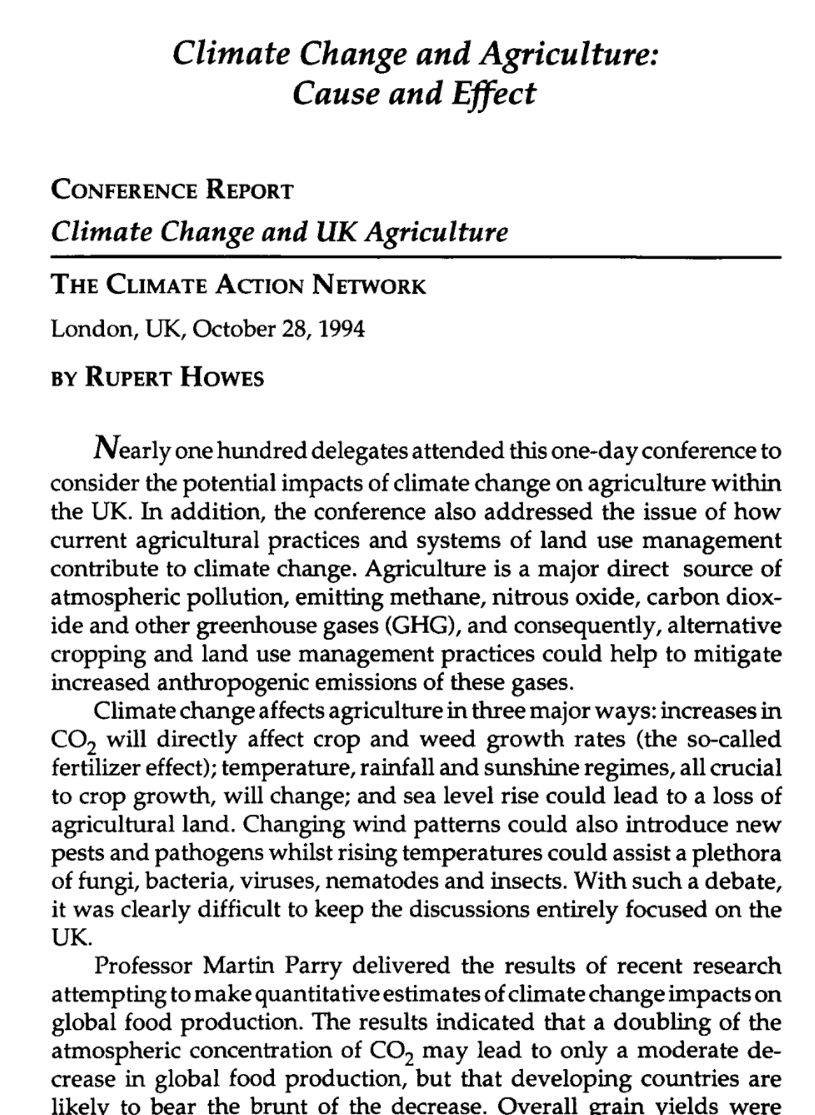
October 28, 1994 – UK agriculture and climate change workshop

Thirty years ago, on this day, October 28th, 1994, well, read it and weep

The amount of carbon dioxide in the air was roughly 359ppm. As of 2024 it is 422ppm, but check here for daily measures. 

The context was that there was a Climate Action Network and it was trying to get scientists and agriculture people and so forth thinking about the long-term impacts of climate change. The UK had ratified the UNFCCC, which would have its first meeting soon. And you know, agriculture was going to have to learn to adapt.

What we learn is we’ve been talking about adaptation for a very long time. It will be interesting to see how we do. Badly, I expect.

What happened next. Defra spent more money on climate change programmes and all the rest of it. But it’s not clear to me that anything meaningful is being done particularly that I could be wrong. And here we are.

https://lordslibrary.parliament.uk/impact-of-climate-change-and-biodiversity-loss-on-food-security

https://www.theguardian.com/environment/article/2024/jul/03/disastrous-fruit-and-vegetable-crops-must-be-wake-up-call-for-uk-say-farmers

https://www.theguardian.com/commentisfree/article/2024/may/08/british-farmer-food-climate-crisis-business

What do you think? Does this pass the ‘so what?’ threshold? Have I got facts wrong? Interpretation wrong? Please do comment on this post, unless you are a denialist, obvs.

Also on this day: 

October 28, 1906 – the birth of the Press Release

October 28, 1956 – New York Times reports “Warmer Climate on the Earth May Be Due To More Carbon Dioxide in the Air”

Categories
Food United States of America

June 5, 1974 – “Food, the Next Crisis”

Fifty years ago, on this day, June 5th, 1974 we start to wonder about how food production might be affected…,

1 Stephen Schneider, “Food: The Next Crisis,” The National Observer (5 June 1974): p. 18. This article appears to have been the first time that Schneider mentioned publicly the idea of a “genesis strategy” to deal with the potential long-term effects of climate on the global food supply.

(Henderson 2014, Dilemmas of Reticence)

The amount of carbon dioxide in the air was roughly 331ppm. As of 2024 it is 426ppm, but check here for daily measures. 

The context was some people were worrying about food running out as part of that Malthusian moment, and the Green Revolution hadn’t really kicked in. And past few years harvests had been weird, weird weather. Two months earlier Henry Kissinger had given his speech about the dangers of a change in the climate at the UN . And here’s Stephen Schneider talking about the impacts that changing climate will have. At this point, not everyone is entirely sure that the problem is going to be CO2 build up. That consensus doesn’t really start to firm up until ‘75 to ‘77. By ‘79, I think it’s fairly well accepted, except by a few idiots like Robert Jastrow and John Mason.

What we learn is that we’ve been worrying about where the food’s gonna come from, for a very long time. And it’s this sort of thing that we’ll have had Crispin Tickell pondering, ahead of his sabbatical at Harvard.

What happened next? There were more food and adaptation related issues. See The Great Adaptation: Climate, Capitalism and Catastrophe by Romain Felli for more details.

What do you think? Does this pass the ‘so what?’ threshold? Have I got facts wrong? Interpretation wrong? Please do comment on this post, unless you are a denialist, obvs.

Also on this day: 

June 5, 1990 – The Australian Capital Territory adopts the “Toronto Target”

June 5, 1993 and 2011- let’s have a march for #climate… It will make us feel good.

June 5, 2002 – John Howard says Australia won’t ratify Kyoto Protocol

Categories
Food Russia

August 15, 2010 – Russia halts grain exports because of droughts and heatwaves

On this day, August 15 2010, Russia announced it was halting grain exports because of drought and heat waves

The level of carbon dioxide in the atmosphere was 388.54ppm. Now it is 421ish- but see here for the latest.

Prices went up. The spark that lit the Arab Spring?  Food prices.

Why this matters. 

Fortunately it doesn’t, because a new era of justice, peace, love and understanding emerged, and nobody goes hungry anymore.

Mmkay.

What happened next?

We learned nothing.