Categories
CO2 Newsletter commentary

Professor Paul Edwards on CO2 Newsletter – “remarkable documents, capturing a crucial moment in the history of climate science and politics.”

Professor Paul Edwards (author of “A Vast Machine” – full bio at end) writes about Vol.2 no. 6 of William Barbat’s CO2 Newsletter

Professor Paul Edwards

William Barbat devoted half or more of each CO2 Newsletter to his own, greatly abridged versions of recent scientific articles, reports, and journalism. This format used to be called a “digest.” Younger folks coming up in the age of instant, effortless AI summaries will be unaware just how much digests could matter in the now-vanished world of paper publications. In that world, finding, obtaining, and understanding scientific work was harder than today. Digests like Barbat’s played a key role, especially in interdisciplinary fields such as climate science. I wish I had found it while writing my book A Vast Machine: Computer Models, Climate Data, and the Politics of Global Warming (MIT Press, 2010).

The September-October issue of CO2 Newsletter (Vol. 2 No. 6) appeared in the fall of 1981, just as I was starting graduate school. President Reagan was hitting the stride of his first term, backed by a Republican Senate majority – the party’s first in either house of Congress since 1953. Reagan’s anti-environmental positions were hardening into policies and rollbacks. His nominee to head the Environmental Protection Agency, Anne Gorsuch (mother of present-day Supreme Court Justice Neil Gorsuch), had been confirmed in May. She cut the agency’s budget by 22 percent and severely reduced regulation of polluters and pollutants. Reagan famously stripped the White House roof of the demonstration solar panels recently installed there by his predecessor, Jimmy Carter. His first Secretary of the Interior, James Watt, loosened strip-mining rules and quintupled the amount of land leased to coal-mining companies, “at a loss of $100 million according to the General Accounting office” (Time, “The Legacy of James Watt,” 1983).

Meanwhile, however, worries about the “carbon dioxide problem” had taken firm root among environmental activists and within Congressionally mandated government scientific advisory bodies. These included the White House Council on Environmental Quality (established in 1969 as part of the law creating the EPA) and the Office of Science and Technology Policy, created in 1976. The Department of Energy housed a CO2 Climate Effects Research and Assessment Program (discussed by Barbat in Vol. 2 No. 5). Journalists, led by the great New York Times science reporter Walter Sullivan, seemed to have finally zeroed in on the fundamental concern. As Barbat wrote in this issue,

“Newspapers and magazines are now publishing articles on the CO2 problem with greater frequency and with deeper understanding. Not long ago, editors seemed to print at least one article predicting the rapid return of an ice age climate for every article predicting CO2 greenhouse warming, and the CO2 articles often received less prominence. The public was confused about climate trends, the news media were confused, and the scientific community also gave the impression of being confused.”

Environmental activists, too, had begun to take the issue on board. Despite some quirks, Nathaniel Rich’s article and book Losing Earth covers the 1979-89 politics of climate reasonably well.

Even this meager amount of context greatly enriches a reading of this issue of the CO2 Newsletter. Barbat devotes most of it to two events whose groundbreaking quality is evident only in retrospect. First, he digests testimony from subcommittee hearings held in the House of Representatives on July 31, 1981. Titled “Carbon Dioxide and Climate: The Greenhouse Effect,” those hearings were co-led by a young Al Gore, then in his third term representing Tennessee. Barbat summarizes testimony by Joe Smagorinsky, head of the Geophysical Fluid Dynamics Laboratory: “despite the admitted existence of numerous uncertainties, the consensus on the nature and magnitude of the [CO2] problem has remained remarkably constant throughout this long worldwide process of study and deliberation.” Arguably the world’s most important organizer of climate science in the 1960s and 1970s, Smagorinsky was largely responsible for the Global Atmospheric Research Program (GARP) and the First GARP Global Experiment (discussed at length in A Vast Machine.)

My own mentor, colleague, and friend Stephen Schneider’s testimony also comes up for review: “perhaps the most dramatic, even if far off, potential event would be the breaking of part of the West Antarctic Ice Sheet, possibly resulting in a five- or so meter sea level rise….” Today, 45 years later, the grounding line of the Thwaites “doomsday glacier” – part of that very West Antarctic ice sheet – is being undermined from below by warming seawater. Barbat also quotes Schneider saying “… if we wait ten or twenty years before proceeding with… actions, then we will have to adapt to a larger amount of CO2 and its consequences than if actions were taken now to either increase our options to deal with CO2 in the future, or to eliminate CO2 emissions….” Among the saddest facts of our time is that despite remarkable progress toward increased efficiency, electrification, and renewable energy, annual global CO2 emissions have risen every year since then, with only two exceptions: 2009, following the 2008 recession, and 2020, the first year of the COVID pandemic.

As Barbat notes, the House subcommittees that took in Smagorinsky’s and Schneider’s testimony expressed skeptical views. Barbat: “The overall results of government-sponsored programs had to be defended vigorously, and the new administration wants assurance that sociological and political implications of the CO2 greenhouse problem were not derived ideologically. However, the net effect on future CO2 research may be very beneficial.” That assessment proved prophetic. Unable to completely suppress the climate issue, the Reagan administration found it most convenient to chant the mantra “more research is needed,” thus helping to create the seemingly endless cycle of ever more potent climate reports and assessments followed by little policy action.

Schneider would go on to found the interdisciplinary journal Climatic Change, co-found the IPCC, and win a MacArthur award. Al Gore relied on him as a key science informant, and the two became friends. By the 1990s, Gore was the most prominent American politician to take a strong stance on climate policy. Had he become president in the 2000 election, the world might have moved more swiftly toward decarbonization. Long after his stint as Vice President (1993-2000), Gore was still presenting his slide show to anyone who would hear it. He wrote two climate books, starred in a documentary about his work, An Inconvenient Truth (2006), and played a key behind-the-scenes role in the 2015 landmark Paris Agreement.

The second major “event” discussed in Vol. 2 No. 6 is an article in Science, “Climate Impact of Increasing Atmospheric Carbon Dioxide.” Its lead author: James Hansen, whose 1988 Congressional testimony would become one of the most iconic moments in climate politics. Barbat had already presented that article’s abstract in issue No. 5. By the time of No. 6, he would certainly have seen Walter Sullivan’s front-page article about it in the New York Times (August 22, 1981). At nearly 2400 words, Barbat’s digest version occupies most of two newsletter pages (out of eight); the full article in Science is just 8.5 pages, including numerous figures and charts.

By omitting its citations and nearly all of its math, Barbat brings out the article’s major findings for a more general audience. One is the equilibrium climate sensitivity of 3°C for doubled CO2 , a figure that has stood the test of time; the IPCC Sixth Assessment (Working Group I, 2021) narrowed the range of that value to 2.5-4°C. Second, and more significant for climate politics, Hansen and his co-authors projected warming of 3-4.5°C under a “fast growth” scenario, or 2.5°C under “slow growth” by 2100 – entirely in line with most present-day assessments. Finally, they predicted that “CO2 warming should rise above the noise level of natural climate variability” in the 1990s. And indeed, the CO2 “fingerprint” was detected in the early 1990s, underpinning the famous “balance of evidence” statement in the IPCC’s 1995 Second Assessment Report.

As a final, unrelated comment, I note that this period of time – not long after the Three Mile Island partial nuclear meltdown in 1979 – was the high-water mark of the anti-nuclear movement, especially in Germany, the UK, and the United States. In the “Feedback” section of this newsletter, a very annoyed Amory Lovins responds to Barbat’s article in the previous issue regarding his “Energy Strategy for Low Climatic Risks” (Report for the German Federal Environmental Agency, June 1981, co-authored with Hunter L. Lovins, Florentin Krause, and Wilfrid Bach). By then Lovins was already famous for his early book Soft Energy Paths: Toward a Durable Peace (1977), which dismissed nuclear power as not only too risky but also too expensive. He and his eventual Rocky Mountain Institute focused instead on reducing energy consumption through efficiency, passive heating/cooling, and other techniques, while rejecting fossil fuels in favor of solar and wind energy.

Barbat, by contrast, was strongly pro-nuclear – a position that remains quite common among geologists (Barbat’s own discipline) and climate scientists of my acquaintance. Probably no issue related to energy and environment has ever inspired stronger commitments pro and con. In his account of Lovins’ report, Barbat could not refuse himself a dig: “Thus when Amory Lovins states, ‘It is the empirical verdict of the capital marketplace…that has rightly sealed the fate of nuclear power,’ the only debatable point is his choice of the word ‘rightly’.” Lovins’ response was livid: your comments “added things that weren’t there, lifted concepts out of context…, and used our work as a vehicle for your own pro-nuclear polemics.” Barbat’s response was conciliatory, encouraging readers to read the Lovins report and “pursue a constructive course faithfully.”

William Barbat’s CO2 Newsletters are remarkable documents, capturing a crucial moment in the history of climate science and politics. As I’ve discussed, they’re most meaningful when placed in context, which can take a bit of effort. Highly recommended reading, especially for historians!

Paul N. Edwards
Collaborateur, Laboratoire de Population, Environnement, et Développement, Aix kMarseille Université, Marseille, France

Director (Emeritus), Program in Science, Technology & Society, Stanford University
Professor of History and Information (Emeritus), University of Michigan

Email: pedwards@stanford.edu

Categories
Science Scientists United States of America

July 19, 2010 – Stephen Schneider dies

Sixteen years ago, on this day, July  11st, 2010 scientist Stephen Schneider died.

Stephen H. Schneider 1945-2010

Dr. Stephen H. Schneider was the Melvin and Joan Lane Professor for Interdisciplinary Environmental Studies, Professor of Biology, Professor (by courtesy) of Civil and Environ mental Engineering, and a Senior Fellow in the Woods Institute for the Environment at Stanford University. Dr. Schneider received his Ph.D. in Mechanical Engineering and Plasma Physics from Columbia University in 1971. He studied the role of greenhouse gases and suspended particulate material on climate as a postdoctoral fellow at NASA’s Goddard Institute for Space Studies. He was awarded a postdoctoral fellowship at the National Center for Atmospheric Research in 1972 and was a member of the scientific staff of NCAR from 1973-1996, where he co-founded the Climate Project.

Internationally recognized for research, policy analysis and outreach in climate change, Dr. Schneider focused on climate change science, integrated assessment of ecological and economic impacts of human-induced climate change, and identifying viable climate policies and technological solutions. He consulted with federal agencies and/or White House staff in the Nixon, Ford, Carter, Reagan, G.H.W. Bush, Clinton, G.W. Bush, and Obama administrations.

[continues]

https://stephenschneider.stanford.edu/References/Biography.html

Trenbeth at American Meteorological Jan 2011.  

https://ams.confex.com/ams/91Annual/webprogram/Paper180230.html

The amount of carbon dioxide in the air was xxxppm. As of 2026, when this post was published, it is 430ppm. This matters because the more carbon dioxide in the air, the more heat gets trapped. The more heat, the more extreme weather events. You can make it more complicated than that if you want, but really, it’s not. Fwiw, I have a tattoo of the Keeling Curve on my left forearm.

The broader context was that Schneider’s first encounter with climate change/media had come in 1971, when he had co-authored a paper which got taken up as “an ice age is coming”. By the mid-1970s he was writing books like The Genesis Strategy and appearing on the Johnny Carson show

September 7, 1977 – #climate scientist Stephen Schneider on Carson for the last time…

. By the late 1970s he was giving clips to documentary makers like this –

Schneider was in Australia for the Greenhouse 88 conference(s), fielding media enquiries and generally doing a good job of being a public intellectual.

He was then first (iirc) ‘thinker in residence’ in South Australia.

Anyway, he died too young and there was a lot more he had to contribute.

On this topic, you might like these other posts on All Our Yesterdays

September 9, 1971 – Stephen Schneider’s letter, and a World Model

December 29, 1972 – Schneider meets Sullivan

November 1, 1975 – Stephen Schneider tries to clear up the “Carbon Dioxide Climate Confusion.”

January 28, 1990 –  Stephen Schneider and the dirty crystal ball.

References

xx

You can see the chronological list of All Our Yesterdays “on this day” posts here.

What do you think? Does this pass the ‘so what?’ threshold? Have I got facts wrong? Interpretation wrong? Please do comment on this post, unless you are a denialist, obvs.

If you want to get involved, let me know.

If you want to invite me on your podcast, that would boost my ego and probably improve the currently pitiful hit-rate on this site (the two are not-unrelated).

Also on this day: 

July 19, 1968 – “man has already rendered the temperature equilibrium of the globe more unstable.” 

July 19, 1976 – , Scientist warns “ “If we’re still rolling along on fossil fuels by the end of the century, then we’ve had it.” 

July 19, 1977 – American public hears from a climate scientist 

July 19, 1979 – “a political view on C02”

Categories
Science Scientists United Kingdom United States of America

January 28, 1990 –  Stephen Schneider and the dirty crystal ball.

Thirty six years ago, on this day, January 28th, 1990.

Another reviewer of the Gribbin book, William Goulding (The Sunday Times, 28 January, 1990), quotes the late climate scientist and climate science communicator Stephen Schneider as saying: “scientific predictions are like ‘trying to gaze into a dirty crystal ball. By taking time to clean the glass you can get a better picture; but at some point it is necessary to decide that the picture is good enough to alert policy makers and the general public to the hazards ahead. That point has certainly been reached with studies of the greenhouse effect and the prospect of rising sea levels in particular.’” Unfortunately, that point seems to be forever receding into the future… 

https://blogs.nottingham.ac.uk/makingsciencepublic/2018/08/11/groundhog-day-in-the-hothouse

The amount of carbon dioxide in the air was roughly 353ppm. As of 2026 it is 428ppm, but check here for daily measures. 

The broader context was that scientists had been measuring the impact of human activities, whether it was on air pollution, water pollution, ozone depletion, you name it, and had been trying to figure out how to raise the alarm without being called alarmist, and pondering where, when and how to speak out. 

So you have the famous Shelly Rowland quote 

“What’s the use of having developed a science well enough to make predictions if, in the end, all we’re willing to do is stand around and wait for them to come true?”

Stephen Schneider was among them. In 1971 famously, he had co-authored a paper that got taken up as a when’s the new ice age happening, kind of thing to the dismay of some of his colleagues. I think it’s fair to say that Schneider leaned in. In 1976 he published the Genesis Strategy, He’d been on Johnny Carson (TV show). See also his efforts around the First World Climate Conference (Science as a contact sport)

The specific context was that the IPCC’s first assessment report was due out. (The IPCC had had its first meeting in November 1988). Meanwhile negotiations were clearly at some point going to begin for an international climate treaty. So here is Schneider, who was a very smart man, very thoughtful, trying to figure out when you pull the big lever. 

You can also see him tackling the same issues about 10 years prior, in a 1979 Panorama video. I would love to know when this video was; I haven’t been able to track it down.

Stephen Schneider in 1979

What I think we can learn from this is that scientists get flattened by industry and their paid attack dogs (and also by useful idiots).

What happened next

Schneider kept on trucking – his death was a huge huge loss

See also this from July 14 1988 Los Angeles Times –

Ozone Warning : He Sounded Alarm, Paid Heavy Price – Los Angeles Times

The interest was gratifying but more than a little ironic. “They won’t admit it but this means some kind of ban has been lifted,” Rowland said.

For as Rowland and others recount it, ever since 1974, when he and UCI postdoctoral fellow Mario Molina first theorized that the Earth’s protective ozone layer was being damaged by synthetic chemicals called chlorofluorocarbons (CFCs), Rowland has paid a price for his ideas.

In part, that’s because Rowland didn’t just make his discovery, write up the results and quietly return to his lab.

Instead, shocked by the implications of his research, he took an unusual public stance–doggedly telling reporters, Congress, half a dozen state legislatures, and just about anyone who seemed interested that ozone loss could lead to skin cancer and catastrophic climatic change. And, again and again for more than a decade, he urged that CFCs be banned.

In doing so, Rowland took on a $28-billion-a-year industry whose products, ranging from home insulating materials to solvents for electronic equipment, have become an essential part of modern life.

What do you think? Does this pass the ‘so what?’ threshold? Have I got facts wrong? Interpretation wrong? Please do comment on this post, unless you are a denialist, obvs.

Also on this day: 

January 28, 1969 – Santa Barbara Oil spill

January 28, 1993 – Parliament protest – “Wake Up, the World is Dying” – Guest Post by Hugh Warwick

January 28, 2013 – Doomed “Green Deal” home insulation scheme launched in the UK

Categories
Denial United Kingdom United States of America

September 9, 1971 – Stephen Schneider’s letter, and a World Model

Fifty four years ago, on this day, September 9th, 1971 climate scientist Stephen Schneider wrote a letter to the New York Times about some industry bullshit that the Times had run as a n op-ed.

AND on the same day, things were a foot in the United Kingdom

“Whereas Bray had been highly sceptical of the World model, Cottrell had been enthused by its demonstration. Returning to Britain, he proposed that the British government develop a similar model, stating his belief that ‘Forrester’s approach is the most important development of its kind since Keynes’ general theory’.117

Given the centrality of Keynesianism in post-war economic policy, this was a significant claim. Heath, as his early enthusiasm for management science had revealed, had some interest in forecasting and simulation, and gave his permission for a scoping study on the feasibility of a British world model. Cottrell held a meeting on the subject at the Cabinet Office in September 1971, in which he had told the assembled civil servants that developing a global model for British purposes would require £50,000 and four staff. In response, an unnamed civil servant argued that the Treasury had a more sophisticated econometric model that it used for forecasting. Despite this criticism, the general idea of a global environmental model was well received, and further work was proposed.118 “

Histories of Technology, the Environment and Modern Britain

The amount of carbon dioxide in the air was 326ppm. As of 2025, when this post was published, it is 430ppm. This matters because the more carbon dioxide in the air, the more heat gets trapped. The more heat, the more extreme weather events. You can make it more complicated than that if you want, but really, it’s not. Fwiw, I have a tattoo of the Keeling Curve on my left forearm.

The broader context was that in the late 1960s people started worrying about the global impact of industrialisation and population growth (as distinct from concerns about localised pollution).

The specific context was that a) Schneider was already making a name for himself as combative and b) the British state was beginning to think about systems modelling (aware that the Club of Rome report was coming)…

What I think we can learn from this is that there was mention of carbon dioxide and limits to growth way back when. It had pushed out from the undergrowth in the late 1960s…

What happened next: By 1973, we were back to sleep, for the most part. A few new NGOs, a couple of magazines (Your Environment, The Ecologist).  It is very very hard to combat a world view.

What do you think? Does this pass the ‘so what?’ threshold? Have I got facts wrong? Interpretation wrong? Please do comment on this post, unless you are a denialist, obvs.

Also on this day: 

September 9, 1947 – The Daily Worker talks about melting the ice-caps

September 9, 1971 – of Australian Prime Ministers and American scientists…

September 9, 1990 – classic (?) film Mindwalk released

Categories
Media Science Scientists United States of America

December 29, 1972 – Schneider meets Sullivan

Fifty two years ago, on this day, December 29th, 1972,

In Baltimore in December 1972 I gave a talk on the issue of human weather control to the annual convention of the American Association for the Advancement of Science (AAAS). AAAS meetings are internationally known because they bring together research scientists and policy makers to discuss the societal implications of new knowledge…. After speaking for half an hour or so, on how various kinds of human activities could change the climate, I concluded that, unfortunately, only a relatively few people were aware of the possibilities. I then quipped: “Nowadays, everybody is doing something with the weather, but nobody is talking about it.”

At the front of the audience, a distinguished-looking gentleman was taking notes: he turned out to be the doyen of all science writers, Walter Sullivan of the New York Times….

Sullivan, W. 1972. Goals for US Urged on Weather Control. New York Times, Dec 29, p.50.

(Schneider, 1989: 200)

The amount of carbon dioxide in the air was roughly 327ppm. As of 2024 it is 425ppm, but check here for daily measures. 

The context was that Stephen Schneider is perhaps being a little naive here, because he’d already made headlines the previous year, thanks to a paper that he had co-written that had talked about the possibility of an ice age thanks to all the dust and smoke that was being put up. That paper turned out to be wrong and was used as a club by denialists to hit Schneider over the head with it for the rest of his life. Because that’s who they are. As for Sullivan, he had been aware of the CO2 possibility at the latest 1961 but much more likely, by 1957; he had after all written a book about the International Geophysical Year. 

What we learn is that by the early 1970s carbon dioxide buildup as a problem was getting more attention. There had been an article earlier the same year in May I want to say 1972 in The New York Times. There was of course by now, the United Nations Environment Program setting up shop. 

What happened next: The carbon dioxide build-up issue kept getting random reports all through the 1970s. Only in 1988 did it finally punch through.

What do you think? Does this pass the ‘so what?’ threshold? Have I got facts wrong? Interpretation wrong? Please do comment on this post, unless you are a denialist, obvs.

Also on this day: 

December 29, 1969 – AAAS symposium on “Climate and Man”

December 29, 1995 – Sydney Morning Herald points out year has been hottest yet…

Categories
Australia UNFCCC

Will Adelaide “do a Bradbury” in bidding to host COP 31?

Adelaide, is bidding to be host of the 2026 episode of the interminable climate soap opera known as the United Nations Framework Convention on Climate Change .(UNFCCC.  At stake an alleged $100-200m boost to the host city’s economy..

In what follows, I explain what’s a COP – hopefully telling you some things you don’t already know, offer a history of South Australian awareness of climate change, and then make some brief idle speculations on how Adelaide’s bid might fair – could it do a Bradbury?

Oh no, it’s the COPs!

COPs are the “Conferences of the Parties.” While there are plenty of parties at COPs, in this case the “parties” refers to the countries (almost the whole world) which have signed up to the UNFCCC;, which was one of the international treaties signed at the pivotal “Earth Summit” in 1992, held in Rio de Janeiro.

The first COP was in Berlin in March-April 1995 (a young Angela Merkel was a key player). There have been 28 since, and COP29 is starting today, in Azerbaijan 

The basic problem is that the original treaty never specified targets and timetables for emissions reductions by rich countries. The French and most European countries were keen, but Uncle Sam said “nope. Do that and we won’t come.”. That has meant a series of efforts to get emissions cuts agreed – Kyoto 1997  (agreed, but USA and Australia pulled out), Copenhagen 2009 (ended in tears and little else) and Paris in 2015 (warm words, no teeth). In the meantime,  the burning of oil, coal and gas has soared. This means that the amount of heat-trapping greenhouse gases in the atmosphere has gone way up (and is increasing faster and faster, as the things that take carbon dioxide out  of the atmosphere give up the ghost – or as the scientists call it – ‘sink failure’).

Of course, by the time Adelaide finds out if its bid is successful, the whole COP circus might be grinding to a halt, if Donald Trump repeats what he did last time round, and withdraws from negotiations.

Why Adelaide?

Anthony Albanese announced that Australia would bid to co-host COP31 with South Pacific Island nations in November 2022 (giving up on the idea of hosting it in 2024)].  It isn’t automatically capital cities that host the COP. For example when the UK hosted in 2021 Glasgow got the gig in any case.  Let’s start with the obvious reason why Adelaide might not succeed; it’s not on the Pacific Coast. However, unlike Sydney and Brisbane which are, Adelaide is not the capital of a state with an enormous coal export industry that has enraged the South Pacific Island states – “awks” as the kids used to say.

A history lesson

South Australians have always known that the weather matters, and is unpredictable. Go north of the Goyder line and you’ll see the abandoned buildings of those who thought they could buck the system. Over the last 55 years though, awareness has grown of man-made problems. 

In March 1970 a newly-elected Labor politician, Richard Gun, referred to carbon dioxide build up in his maiden speech (see this article on the Guardian website by Royce Kurmelovs).

In July 1970 as alarm at “ecology” (as it was then called) reached an early peak, a group of business leaders at an Adelaide luncheon were told the following

“And so the sprawling city, the maimed country, and even the air we breathe and the sea that gives us life, combine into what can only be described as a coming nightmare unless we as a people are prepared to become violently Australia-conscious and to replan, decentralise, preserve, prohibit and police. We won’t correct the situation unless first as individuals and secondly as a nation we are prepared to think, to take care and to spend money.” 

But this was not a protestor who’d stormed the stage. It was in fact Bede Callaghan, managing director of the Commonwealth Banking Corporation 

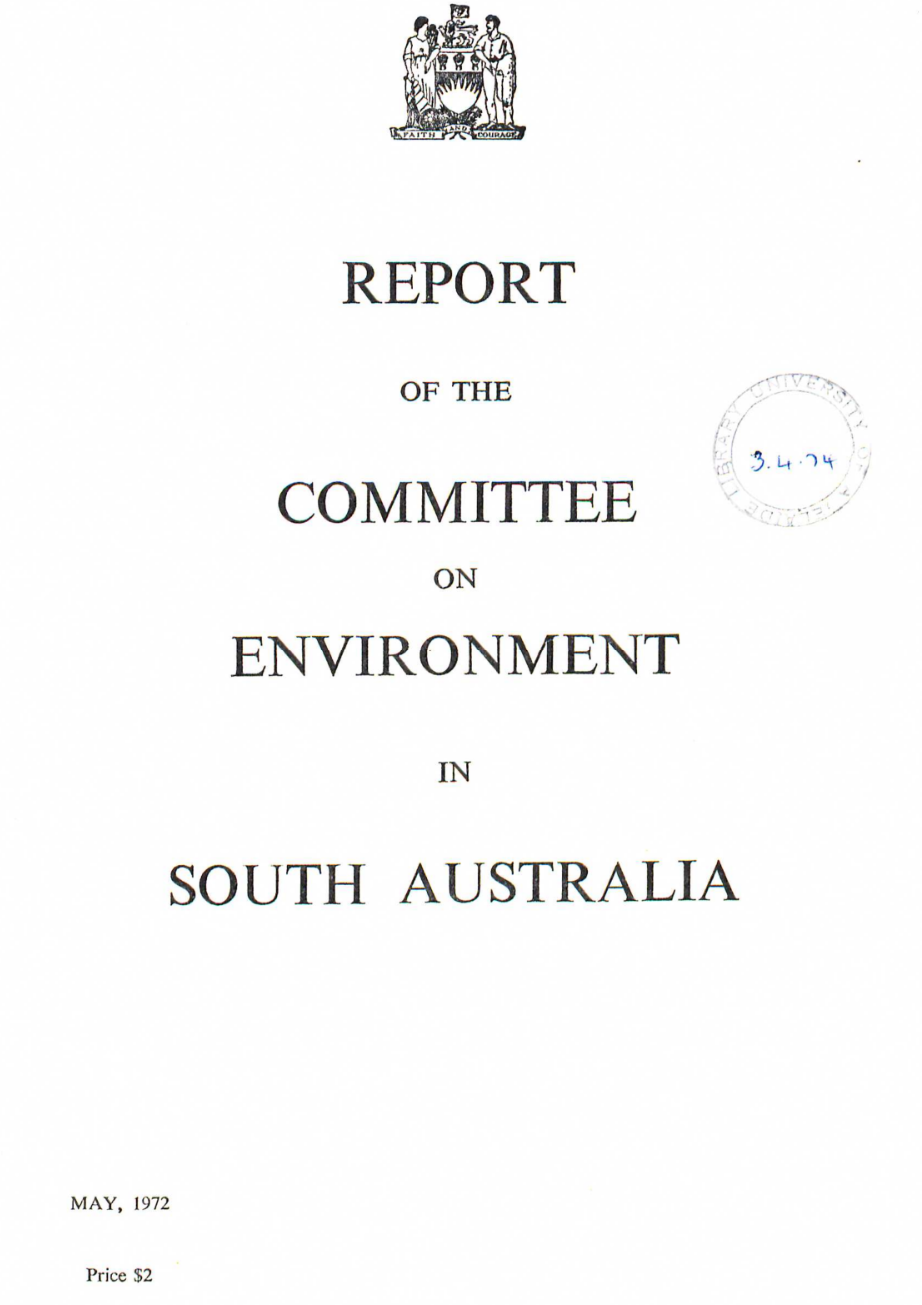
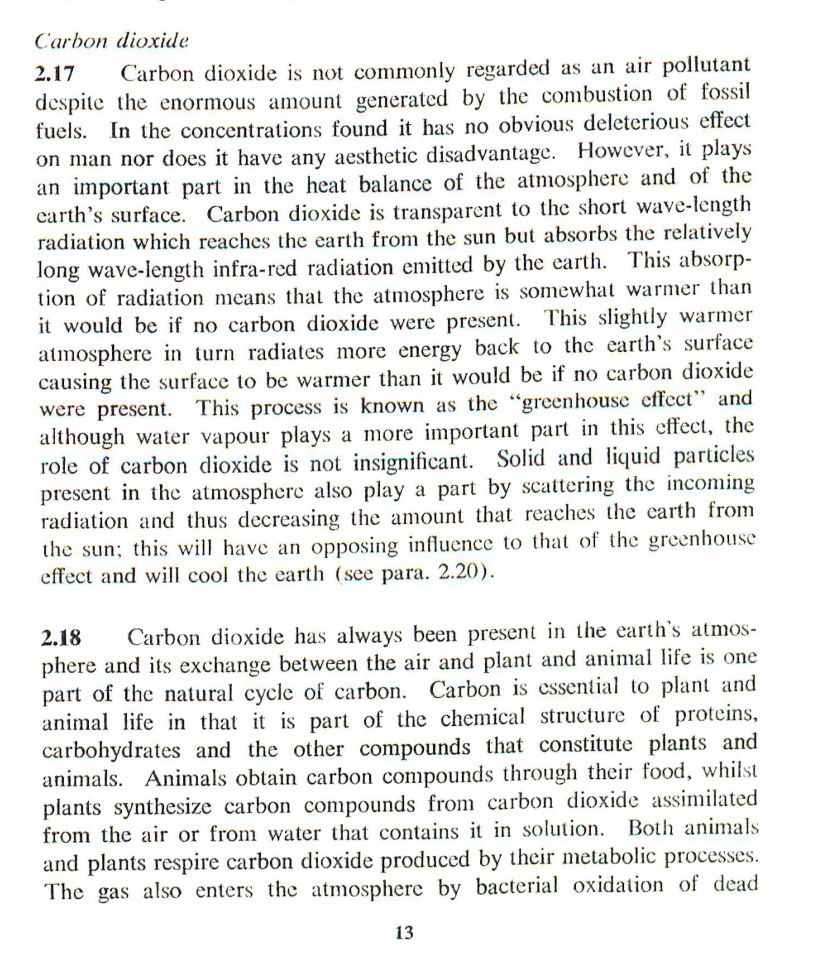
Already in February of that year the Liberal government of Steele Hall created a committee (of course!) on the environment. It held hearings and in May 1972 produced the “Jordan report,” which included a mention of C02, though largely a dismissive one. 

And yes, it included a section – albeit understandably equivocal – on carbon dioxide. 

As with other states and countries, a Department of the Environment was created.  But carbon dioxide was a distant and contested problem back then. It pops up in some places, such as a September 1972 Friends of the Earth seminar “Is technology a blueprint for destruction”  at Adelaide University. and in the work of hydrogen-advocating Professor John Bockris at Flinders University in 1973.

A South Australian senator, Don Jessop mentions it in Federal parliament, in November 1973

“It is quite apparent to world scientists that the silent pollutant, carbon dioxide, is increasing in the atmosphere and will cause us great concern in the future. 

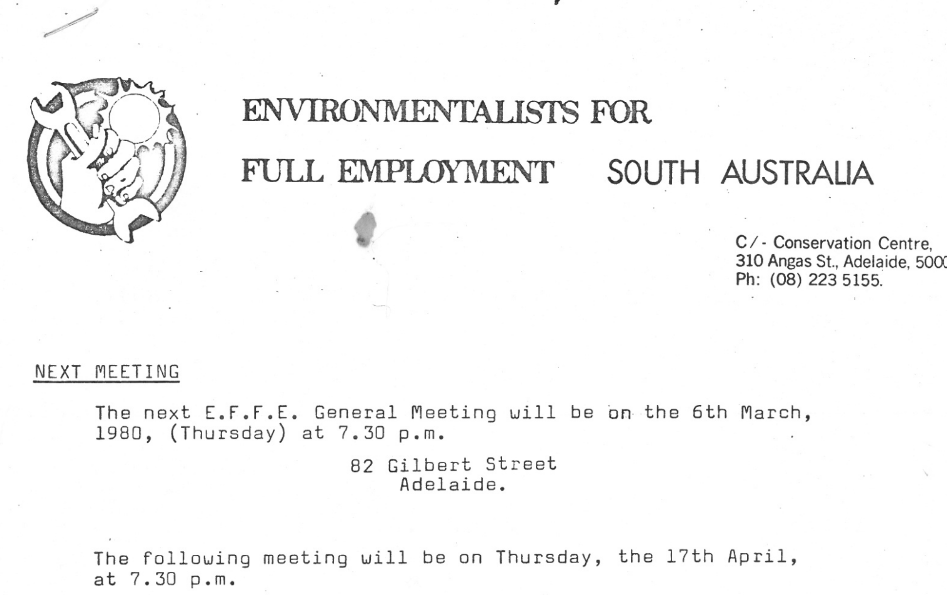
And while the warnings and alarms continued through the 1970s and 1980s, with visiting professors (including pro-nuclear ones), ABC documentaries, CSIRO documentaries, and mentions of the problem by groups such as  Environmentalists for Full Employment.

It is fair to say that policymaker awareness only took off in the second half of the 1980s. 

In 1985 atmospheric scientists met in Villach, a city in Austria. They realised they had underestimated the impact of gases other than carbon dioxide, and that the heating they had expected to arrive in several decades was likely to come much faster. They left Villach determined to warn policymakers. The Australian result of this was that CSIRO started briefing politicians, including the Australian Environment Council. After its June 1986 meeting, South Australia’s environment minister, Don Hopgood, went public with a stark warning about sea-level rise,

The following years saw a flurry of scientific and public/political conferences, promises, exhortations and committees, all about “the Greenhouse Effect.” Internationally this culminated with the climate treaty in Rio in June 1992. South Australia had set up committees and programmes, but all this was basically swept away with the disaster of the failure of the State Bank of South Australia, Premier John Bannon’s resignation and the enormous defeat Labor experienced.  The incoming Liberals paid lipservice at most, finding it easier not to kill anything off officially but let it instead die by neglect.

Climate change played little part in the debates over electricity generation that took up the second half of the 1990s.  However, a determined group of policy wonks were beavering away, keen to promote renewables and action on climate. The return of Labor in 2002 was a turning point. The first (tiny by today’s standards) wind farm went live the following year. Over the years, Premier Mike Rann skilfully found wiggle-room as the Federal government was forced to continue to offer policy support. As Tristan Edis put it in a 2014 article

“The way it works is SA public servants assess the likely amount of renewable energy that will be installed in the state within the next few years as a result of the federal government’s Renewable Energy Target. Then, the South Australian government take this projection of what will be achieved under business as usual a few years from now, and duly claim it as an ambitious target that they are setting for themselves, but push out the year a bit so they claim they’ve reached it ahead of schedule.”

But Rann had been attending to the broader cultural issues as well. He invited US climate scientist Stephen Schneider to be South Australia thinker in residence in 2006. Schneider’s message – that the Millennium Drought was a harbinger of problems to come and we’d better get preparing now, resonated.

The next Labor Premier, Jay Weatherill, accelerated Rann’s trajectory.  The 2016 blackout was perhaps pivotal.  Two events stand out – First, Weatherill dishing it out to Federal Environment Minister Josh Frydenberg and the latter just having to take it.

Second- the big battery of Elon Musk, back when progressives could look past some of his, shall we say, foibles. 

By the time Labor lost power, the energy transition had such momentum – and powerful people making money from it and popular support, that the state Liberals basically ignored their Federal counterparts. 

Labor has returned to power, with even bolder targets. It seems now somewhat starry-eyed about hydrogen, and alarmingly willing to do whatever Santos wants, before being asked.

What will happen?

Who knows? I’ve learned not to make confident predictions about anything other than “higher concentrations of carbon dioxide in the atmosphere next year.

We will all find out in a couple of weeks. Will Edis v2.0 work? It already has in once sense: Win or lose, Adelaide raises its profile and plays the ‘inward green investment’ vibes game. It’s a smart move from a political party that has shown alertness to the opportunities national and international policy games present niche actors.

Categories
Academia United States of America

July 19, 1977 – American public hears from a climate scientist

Forty seven years ago, on this day, July 19th, 1977 , Stephen Schneider lays it out.

Appearing on the Johnny Carson Show on July 19, 1977 a year after the original release of The Genesis Strategy, Schneider responded to a series of questions regarding the ability of scientists to predict the weather more than a few days in advance, a prospect that – given his experiences with Kellogg and Smagorinsky early in his career – appeared entirely possible. Other conversation topics ensued, including issues of drought, whether the climate was cooling or warming, and even whether a recent weather fluctuation caused a serious black out in New York City. Given what appeared to be signs that society was increasingly sensitive to even small-scale environmental challenges, Schneider argued for building further resilience into society. “The laws of nature frequently are not in line with some of our laws,” he stated in an attempt to distinguish between natural laws – which are stable and enduring – and man-made laws – which tend to be short-sighted, sporadic, and clumsy. Everything in human decision making, he believed, is a trade-off between risks and benefits and therefore decisions require the incorporation of value judgments to maximize margins of safety in spite of  existing uncertainties.55

 Henderson 2014 Dilemmas of Reticence

The amount of carbon dioxide in the air was roughly 332ppm. As of 2024 it is 426ppm, but check here for daily measures. 

The context was that Stephen Schneider was already well known because of his ice age prediction in 1971. He had just published The Genesis Strategy with co-author Lynne Merizow. Him being on Carson was a big deal, though. I think this is the first time he was on. 

What we learn is that a small number of scientists were trying to communicate this stuff. early on. 

What happened next: Schneider committed a faux pas by going off script and Carson never had him on again. Schneider kept being a public intellectual public figure. He was really good at what he did. RIP Stephen Schneider.

See also this excellent post – https://simpleclimate.wordpress.com/2014/01/04/when-the-climate-change-fight-got-ugly/

What do you think? Does this pass the ‘so what?’ threshold? Have I got facts wrong? Interpretation wrong? Please do comment on this post, unless you are a denialist, obvs.

Also on this day: 

July 19, 1968 – “man has already rendered the temperature equilibrium of the globe more unstable.”

July 19, 1976 – , Scientist warns “ “If we’re still rolling along on fossil fuels by the end of the century, then we’ve had it.”

Categories
Food United States of America

June 5, 1974 – “Food, the Next Crisis”

Fifty years ago, on this day, June 5th, 1974 we start to wonder about how food production might be affected…,

1 Stephen Schneider, “Food: The Next Crisis,” The National Observer (5 June 1974): p. 18. This article appears to have been the first time that Schneider mentioned publicly the idea of a “genesis strategy” to deal with the potential long-term effects of climate on the global food supply.

(Henderson 2014, Dilemmas of Reticence)

The amount of carbon dioxide in the air was roughly 331ppm. As of 2024 it is 426ppm, but check here for daily measures. 

The context was some people were worrying about food running out as part of that Malthusian moment, and the Green Revolution hadn’t really kicked in. And past few years harvests had been weird, weird weather. Two months earlier Henry Kissinger had given his speech about the dangers of a change in the climate at the UN . And here’s Stephen Schneider talking about the impacts that changing climate will have. At this point, not everyone is entirely sure that the problem is going to be CO2 build up. That consensus doesn’t really start to firm up until ‘75 to ‘77. By ‘79, I think it’s fairly well accepted, except by a few idiots like Robert Jastrow and John Mason.

What we learn is that we’ve been worrying about where the food’s gonna come from, for a very long time. And it’s this sort of thing that we’ll have had Crispin Tickell pondering, ahead of his sabbatical at Harvard.

What happened next? There were more food and adaptation related issues. See The Great Adaptation: Climate, Capitalism and Catastrophe by Romain Felli for more details.

What do you think? Does this pass the ‘so what?’ threshold? Have I got facts wrong? Interpretation wrong? Please do comment on this post, unless you are a denialist, obvs.

Also on this day: 

June 5, 1990 – The Australian Capital Territory adopts the “Toronto Target”

June 5, 1993 and 2011- let’s have a march for #climate… It will make us feel good.

June 5, 2002 – John Howard says Australia won’t ratify Kyoto Protocol

Categories
United States of America

February 1, 1978 – US TV show MacNeill Lehrer hosts discussion about climate change

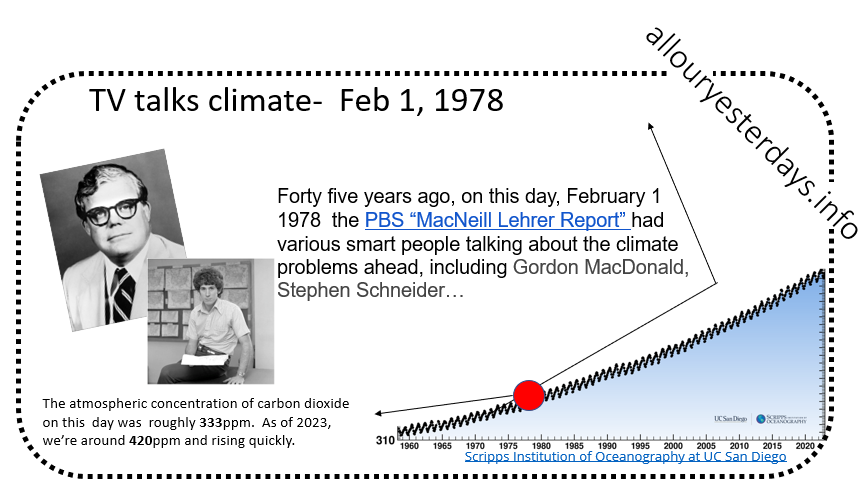
Forty five years ago, on this day, February 1 1978  the PBS “MacNeill Lehrer Report” had various smart people talking about the climate problems ahead (Robert Jastrow, Gordon MacDonald, Stephen Schneider, Clairborne Pell). They let Jastrow go first, shilling his Ice Age is Coming book. Then Gordon MacDonald, who had been warning about carbon dioxide build-up since 1968, and had helped write the first public facing report on it in 1970,  was able to respond –

“GORDON MacDONALD: Bob Jastrow talked about the natural fluctuations in climate. I think that basically the picture he drew is correct, except he left out one important factor, that is, man. Man has been doing lots of things that are going to change climate in very significant ways. For example, he`s burning oil, gas, coal, putting the carbon dioxide into the atmosphere. He`s also clearing forests, turning lands that were once covered with biologically active material into areas that are no longer biologically active. That means that the carbon that was once fixed in those forests is now released into the atmosphere. These two effects plus a very important effect, that is, natural gas coming from deep within the earth, coming into the atmosphere and being oxidized, all lead to the greenhouse that you described.”

https://americanarchive.org/catalog/cpb-aacip_507-ms3jw87f1f

And yes, that is Stephen Schneider with hair –

The amount of carbon dioxide in the air was roughly 333ppm. As of 2023 it is 419ppm, but check here for daily measures. 

The context was

In 1977 the National Academy of Sciences had released a big fat report saying there was probably a problem about carbon dioxide buildup, and other books had been written in the mid 70s (e.g. Wilcox). So television producers, who were always needing to fill up space and to seem to have their finger on the pulse, will have looked upon this as a good topic. Schneider was a no-brainer. MacDonald and Jastrow were among the JASONs who had been up to their necks as well in ozone discussions, and MacDonald was at the time of this television appearance leading work on a JASON Technical Report “The Long Term Impact of Atmospheric Carbon Dioxide on Climate.”

What I think we can learn from this

These sorts of chin-stroking documentaries and discussion panels have been going on a long time. And at one point, certainly up to this point, they had their place. But since then they have become an opportunity for middle-class people who don’t want to get off their fat asses to say “oh, there’s still a debate going on.”

What is amusing about some of the denialists is they don’t admit (or perhaps even know) that some of the people they pointed to as ‘Big Scientists Who Disagree’ in the 1990s were Ice Agers. That doesn’t fit their narrative (though they never forget to cite the paper Stephen Schneider co-authored with Rasool in 1971…)

What happened next

The contestation over whether carbon dioxide buildup mattered led to a process in 1979 known as the Charney report, which said there’s no reason to think otherwise.

What do you think? Does this pass the ‘so what?’ threshold? Have I got facts wrong? Interpretation wrong?  Do comment on this post.

Categories
Science Scientists United States of America

November 1, 1975 – Stephen Schneider tries to clear up the “Carbon Dioxide Climate Confusion.”

On this day, November 1 in 1975, climate scientist Stephen Schneider tried to keep folks eyes on the prize, given how many various books and hypotheses were already being thrown around

On the Carbon Dioxide–Climate Confusion  Stephen H. Schneider J. Atmos. Sci. (1975) 32 (11): 2060–2066.

The amount of carbon dioxide in the atmosphere was 331ppm. At time of writing it was 421ishppm- but for what it is now,well, see here for the latest.]

The context was this – 

By the mid 1970s, a cottage industry had grown up around “weird weather.”

Why this matters. 

We need to remember that there were claims and counter-claims, some outlandish

What happened next?

By the late 70s it was pretty damn clear that it was a carbon dioxide problem…