Categories
Papua New Guinea

 July 27, 1976 – Papua New Guinea paper says “Climate Research vital”

Fifty years ago, on this day, July 27, 1976,

The amount of carbon dioxide in the air was 332ppm. As of 2026, when this post was published, it is 430ppm. This matters because the more carbon dioxide in the air, the more heat gets trapped. The more heat, the more extreme weather events. You can make it more complicated than that if you want, but really, it’s not. Fwiw, I have a tattoo of the Keeling Curve on my left forearm.

The broader context was that from the late 1960s onwards, there was a marked uptick in work on global atmospheric change, especially in Europe and the US.

The specific context was that by about 1976 people on either side of the iron curtain were beginning to look closely at carbon dioxide build-up.

What I think we can learn from this –  fifty bloody years

What happened next. The 1979 First World Climate Conference could have been the tipping point, but it wasn’t. Oh well.

On this topic, you might like these other posts on All Our Yesterdays

Xx

References

xx

You can see the chronological list of All Our Yesterdays “on this day” posts here.

What do you think? Does this pass the ‘so what?’ threshold? Have I got facts wrong? Interpretation wrong? Please do comment on this post, unless you are a denialist, obvs.

If you want to get involved, let me know.

If you want to invite me on your podcast, that would boost my ego and probably improve the currently pitiful hit-rate on this site (the two are not-unrelated).

Also on this day: 

July 27, 1977 – Pro-nuclear professor cites #climate concerns at Adelaide speech 

July 27, 1979 – Thatcher’s Cabinet ponders burying climate report 

July 27, 1988 – The greenback effect 

July 27, 2001 – COP6-bis ends – the show is back on the road 

July 27, 2001 – Minerals Council of Australia versus the Kyoto Protocol 

Categories
Australia

July 27, 1976 – a South Australian Hudson speaks out on climate change!!

Fifty years ago, on this day, July 27, 1976, South Australian Labor minister Hugh Hudson (no relation) has this to say during a Parliamentary debate – 

“I have heard over the past few weeks environmental arguments against any form of providing energy. It is argued that, even if we use up our existing fossil fuel reserves, we are running serious environmental dangers through the excess emission of carbon dioxide, which may or may not increase the temperature of the earth. Of course, I believe it can be demonstrated that if the temperature of the earth rises by as much as one degree or two degrees, the ice caps will start to melt and cities such as Adelaide will turn out to be inappropriately located. It is important, in this energy debate, to recognise that we cannot discuss one form of energy in isolation.

Every form of energy creation has advantages and disadvantages, and a balance must be struck.”

The amount of carbon dioxide in the air was 332ppm. As of 2026, when this post was published, it is 430ppm. This matters because the more carbon dioxide in the air, the more heat gets trapped. The more heat, the more extreme weather events. You can make it more complicated than that if you want, but really, it’s not. Fwiw, I have a tattoo of the Keeling Curve on my left forearm.

The broader context was a huge uranium deposit had been discovered in South Australia’s mid-north and there was a lot of debate about whether uranium should be exported or not (fears of proliferation, safety etc etc).

What I think we can learn from this – carbon dioxide build-up was being spoken of even in the provinces (Hudson was no relation, btw).

What happened next. In 1982 a Labor politician switched sides on the vote, the legislation to let Roxby Downs get established passed, and the Opposition leader (John Bannon) flagged that a Bannon administration would not try to turn the clock back… 

xxx

On this topic, you might like these other posts on All Our Yesterdays

Xx

References

xx

You can see the chronological list of All Our Yesterdays “on this day” posts here.

What do you think? Does this pass the ‘so what?’ threshold? Have I got facts wrong? Interpretation wrong? Please do comment on this post, unless you are a denialist, obvs.

If you want to get involved, let me know.

If you want to invite me on your podcast, that would boost my ego and probably improve the currently pitiful hit-rate on this site (the two are not-unrelated).

Also on this day: 

July 27, 1977 – Pro-nuclear professor cites #climate concerns at Adelaide speech 

July 27, 1979 – Thatcher’s Cabinet ponders burying climate report 

July 27, 1988 – The greenback effect 

July 27, 2001 – COP6-bis ends – the show is back on the road 

July 27, 2001 – Minerals Council of Australia versus the Kyoto Protocol 

Categories
Activism United States of America

December 25, 1976 – The Nation investigates the assassination of Fred Hampton

Forty nine years ago, on this day, December 25th, 1976,1976 12 25 The Nation “Was Fred Hampton executed” – https://www.thenation.com/article/society/was-fred-hampton-executed/

The amount of carbon dioxide in the air was 332ppm. As of 2025, when this post was published, it is 430ppm. This matters because the more carbon dioxide in the air, the more heat gets trapped. The more heat, the more extreme weather events. You can make it more complicated than that if you want, but really, it’s not. Fwiw, I have a tattoo of the Keeling Curve on my left forearm.

The broader context was that the use of violence – up to and including assassination – against political opponents/”the rabble” is as American as apple pie. 

The specific context was that one of the key goals of the FBI’s COINTELPRO program was to prevent coalitions forming across race and class. Nightmare scenario is when you can’t divide and conquer. So, Fred Hampton, who eschewed the gun-toting of other Panthers, and was trying to build a Rainbow coalition with poor whites and Puerto Rican activists was a nightmare.

What I think we can learn from this – the Nation did (does) some good journalism.

What happened next

“The families of Hampton and Clark filed a $47.7 million civil suit against the city, state, and federal governments. The case went to trial before Federal Judge J. Sam Perry. After more than 18 months of testimony and at the close of the plaintiff’s case, Perry dismissed the case. The plaintiffs appealed, and the U.S. Court of Appeals for the Seventh Circuit reversed, ordering the case to be retried. More than a decade after the case had been filed, the suit was finally settled for $1.85 million.[77] The two families each shared in the settlement”

What do you think? Does this pass the ‘so what?’ threshold? Have I got facts wrong? Interpretation wrong? Please do comment on this post, unless you are a denialist, obvs.

Also on this day: 

December 25, 1988 – Queen Beatrix of the Netherlands says “the earth is slowly dying”

December 25, 1989 – business press pushback about Global Warning “panic” begins…

December 25, – the White Christmas myth…

Categories
United States of America

August 1, 1976 – Oak Ridge report on “The Global Carbon Dioxide Problem” released

Forty nine years ago, on this day, August 1, 1976, the Oak Ridge National Laboratory released a report titled “The Global Carbon Dioxide Problem.” The abstract is just a page – this leaps out

”estimates of the consequent warming … range from possibly acceptable to catastrophic.”

The amount of carbon dioxide in the air was 332ppm. As of 2025, when this post was published, it is 430ppm. This matters because the more carbon dioxide in the air, the more heat gets trapped. The more heat, the more extreme weather events. You can make it more complicated than that if you want, but really, it’s not. Fwiw, I have a tattoo of the Keeling Curve on my left forearm.

The broader context was that through the 1970s more and more scientists were looking at carbon dioxide levels and saying to themselves “yikes”…

The specific context was that the response to the 1973 Arab Oil Embargo had been the US announcing “Project Independence” – lots more coal and nuclear….

What I think we can learn from this is that we knew plenty, half a century ago. And here we are.

What happened next was that there was a push for the issue to be taken seriously. If Carter had got a second term, maybe. But that all ended with Desert One…

What do you think? Does this pass the ‘so what?’ threshold? Have I got facts wrong? Interpretation wrong? Please do comment on this post, unless you are a denialist, obvs.

References

Xxx

Also on this day: 

August 1, 1980 – Wall Street Journal does excellent #climate reporting

August 1, 2015 – World Coal Association tries to say coal is lifting people out of poverty.

August 1, 2016 – Anti-wind idiots step on their own rake – All Our Yesterdays

Categories
Italy

July 10, 1976 – Seveso

Forty nine years ago, on this day, July 10th, 1976,

The Seveso disaster was an industrial accident that occurred around 12:37 on 10 July 1976, in a small chemical manufacturing plant approximately 20 kilometres (12 mi) north of Milan in the Lombardy region of Italy. It resulted in the highest known exposure to 2,3,7,8-tetrachlorodibenzo-p-dioxin (TCDD) in residential populations,[1] which gave rise to numerous scientific studies and standardized industrial safety regulations, including the European Union‘s Seveso III Directive. This accident was ranked eighth in a list of the worst man-made environmental disasters by Time magazine in 2010.[2]

http://en.wikipedia.org/wiki/Seveso_disaster

The amount of carbon dioxide in the air was 332ppm. As of 2025, when this post was published, it is 430ppm. This matters because the more carbon dioxide in the air, the more heat gets trapped. The more heat, the more extreme weather events. You can make it more complicated than that if you want, but really, it’s not. Fwiw, I have a tattoo of the Keeling Curve on my left forearm.

The broader context was that post-war Europe reindustrialised at pace. The state wasn’t always so hot at spotting and doing anything about forms of pollution, which were largely seen as a regrettable but inevitable prie to be paid for capital-P Prosperity (which basically meant capital accumulation, obviously).

The specific context was that – oh, the usual…

“After the incident, ICMESA initially refused to admit that the dioxin release had occurred. At least a week passed before a public statement was issued that dioxin had been emitted, and another week passed before an evacuation began. Even then, the government was saddled with the responsibility of determining the boundaries of the evacuation area, and thereafter to organise the evacuation. This constituted a major imposition on the community as well as on government resources.”

What I think we can learn from this is that anyone who has fantasies about a competent regulatory state really needs to wake up and smell the coffee.

What happened next

The usual – court cases, no-one doing any serious chokey.

Follow-up health studies etc etc (check out the wikipedia article!)

Btw, Seveso ets a mention (oblique) in Ali Smith’s wonderful novel “Winter.”

What do you think? Does this pass the ‘so what?’ threshold? Have I got facts wrong? Interpretation wrong? Please do comment on this post, unless you are a denialist, obvs.

Also on this day: 

July 10, 1985 – French state commits terrorist act

July 10, 1996 – National Greenhouse Advisory Panel cops a serve

July 10, 2008 – first Australian #Climate Camp begins, near Newcastle

July 10, 2010 – Rio Tinto amplifies the message…

Categories
United States of America

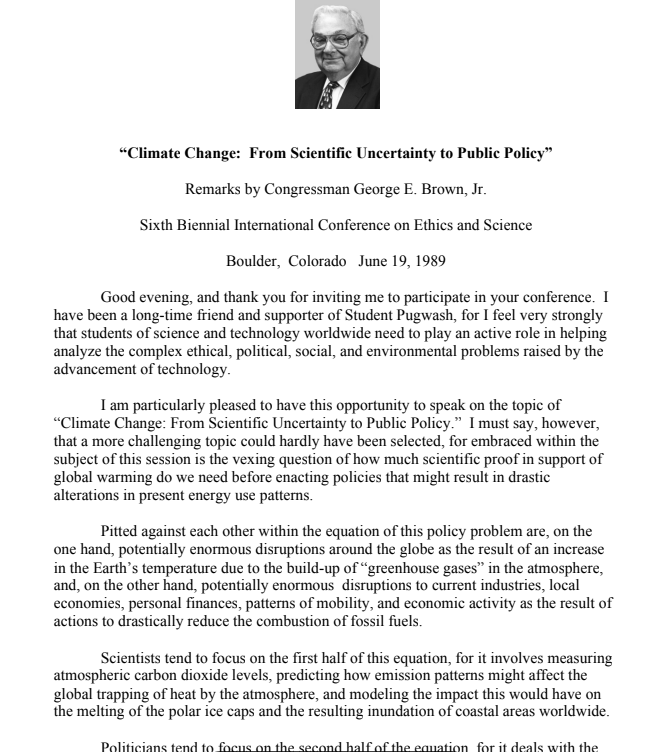
June 19, 1989 – George Brown speech to Student Pugwash

Thirty six years ago, on this day, June 19th, 1989  Senator George Brown gave a speech to Student Pugwash, and reminisced about his 1976 hearings.

“Faced with these conflicting predictions, in 1976, as Chairman of the House Subcommittee on the Environment and the Atmosphere, I convened the first congressional hearings ever to discuss the issue of climate research. Over the course of two weeks, our Subcommittee received testimony of relevance to a bill that some of my colleagues and I had introduced to coordinate and improve national climate research efforts. In large part as a result of those hearings, we succeeded in passing in 1977 the National Climate Program Act. Passage of that legislation was a classic example of how politicians tend to deal with scientific uncertainty: we initiate efforts to study the problem further.”

The amount of carbon dioxide in the air was roughly 353ppm. As of 2025 it is 430ppm, but check here for daily measures. 

The broader context was that the Greenhouse Effect had been “discovered” by the media and was omni-present. There were these sorts of “inter-generational” efforts going on…

What I think we can learn from this is that explaining the broad sweep, the patterns and the repetitions, is really hard, especially when we all want a simple victory narrative with us near the centre…

What happened next  The wave of concern crested by 1992, and the defeat of the proposal for targets and timetables in the text of the UNFCCC was, in retrospect, the last nail in the coffin for our species and so so many others. Oh well.

What do you think? Does this pass the ‘so what?’ threshold? Have I got facts wrong? Interpretation wrong? Please do comment on this post, unless you are a denialist, obvs.

Also on this day: 

June 19, 1997/2009 – children of colour used as propaganda tools by #climate wreckers/greens do “motherhood” – All Our Yesterdays

Categories
Austria Energy

December 8, 1976 – IIASA holds a workshop on climate and solar energy conversion

Forty-eight years ago, on this day, December 8th, 1976,

IASA workshop on climate and solar energy conversion. Report released in 1977.

The amount of carbon dioxide in the air was roughly 332ppm. As of 2024 it is 425ppm, but check here for daily measures. 

The context was that IIASA was a new outfit and needed to get hold of some issues that nobody else was really talking about, and to play to its strengths across the Iron Curtain. Climate was a good choice. They ran with it.

This is also in the context of Kissinger making his speech to the United Nations General Assembly and National Academy of Sciences pushing their Energy and Climate report and so forth. And the meeting in the UEA Climatic Research Unit in 75 that had said “yeah, it’s gonna get warmer.” I mean serious people were not doubting this at this point.

What we learn is that smart people have been thinking about it for a long time.

What happened next? The issue could have broken through in the late 1970s, but it would actually be 1988 before things got real.

What do you think? Does this pass the ‘so what?’ threshold? Have I got facts wrong? Interpretation wrong? Please do comment on this post, unless you are a denialist, obvs.

Also on this day: 

December 8, 1981 – Thames TV shows “Warming Warning” documentary

December 8, 2003 – Chief Scientific Advisor under microscope for Rio Tinto role

Categories
Science

November 12,1976 – “Greenhouse Effects due to Man-Made Perturbations of Trace Gases” in Science

Forty-eight years ago, on this day, November 12th, 1976, an article appears in the journal Science.

The amount of carbon dioxide in the air was roughly 332ppm. As of 2024 it is 423ppm, but check here for daily measures. 

The context was that more and more articles were getting published in especially Science more than Nature, because there was a proper research effort going on in the United States. And that was not the case in the United Kingdom.

What we learn is long before 1981 when Hansen got wrapped over the knuckles for telling the truth to a journalist, Walter Sullivan at the New York Times, Hansen was telling it like it was. It’s almost 50 years later now. And things have only gotten so much worse. 

What happened next. We were warned. We knew. Not enough of us could look into the abyss and also figure out how to do responsible citizenship in sustainable ways. And here we are.

What do you think? Does this pass the ‘so what?’ threshold? Have I got facts wrong? Interpretation wrong? Please do comment on this post, unless you are a denialist, obvs.

Also on this day: 

November 12, 1999 – John Howard and mates say “nope” to renewables

November 12, 2012 – Greenpeace smeared by Queensland extractors, of course

Categories
Academia United States of America

July 19, 1977 – American public hears from a climate scientist

Forty seven years ago, on this day, July 19th, 1977 , Stephen Schneider lays it out.

Appearing on the Johnny Carson Show on July 19, 1977 a year after the original release of The Genesis Strategy, Schneider responded to a series of questions regarding the ability of scientists to predict the weather more than a few days in advance, a prospect that – given his experiences with Kellogg and Smagorinsky early in his career – appeared entirely possible. Other conversation topics ensued, including issues of drought, whether the climate was cooling or warming, and even whether a recent weather fluctuation caused a serious black out in New York City. Given what appeared to be signs that society was increasingly sensitive to even small-scale environmental challenges, Schneider argued for building further resilience into society. “The laws of nature frequently are not in line with some of our laws,” he stated in an attempt to distinguish between natural laws – which are stable and enduring – and man-made laws – which tend to be short-sighted, sporadic, and clumsy. Everything in human decision making, he believed, is a trade-off between risks and benefits and therefore decisions require the incorporation of value judgments to maximize margins of safety in spite of  existing uncertainties.55

 Henderson 2014 Dilemmas of Reticence

The amount of carbon dioxide in the air was roughly 332ppm. As of 2024 it is 426ppm, but check here for daily measures. 

The context was that Stephen Schneider was already well known because of his ice age prediction in 1971. He had just published The Genesis Strategy with co-author Lynne Merizow. Him being on Carson was a big deal, though. I think this is the first time he was on. 

What we learn is that a small number of scientists were trying to communicate this stuff. early on. 

What happened next: Schneider committed a faux pas by going off script and Carson never had him on again. Schneider kept being a public intellectual public figure. He was really good at what he did. RIP Stephen Schneider.

See also this excellent post – https://simpleclimate.wordpress.com/2014/01/04/when-the-climate-change-fight-got-ugly/

What do you think? Does this pass the ‘so what?’ threshold? Have I got facts wrong? Interpretation wrong? Please do comment on this post, unless you are a denialist, obvs.

Also on this day: 

July 19, 1968 – “man has already rendered the temperature equilibrium of the globe more unstable.”

July 19, 1976 – , Scientist warns “ “If we’re still rolling along on fossil fuels by the end of the century, then we’ve had it.”

Categories
Australia

June 22, 1976 – climate truth reaches the provinces (i.e. Adelaide)

Forty-eight years ago, on this day, June 22nd, 1976, sleepy Adelaide warned of possible trouble ahead, when the CSIRO-made documentary “A climate of change” is shown on ABC in Adelaide 22 June 1976

The amount of carbon dioxide in the air was roughly 332ppm. As of 2024 it is 426ppm, but check here for daily measures. 

The context was that by this stage Australian elites were at least dimly aware of the possible problem of climate change there, most of them probably still thought it was going to be a new ice age. The World Meteorological Organisation was really looking at CO2 and saying “uh oh.”. Kenneth Hare was in Adelaide.

What we learn – we knew enough by the late 1970s to be seriously worried.

What happened next – it would be another 12 years before the issue properly finally broke through. And even then, most everyone went back to sleep…

Fun fact Hare had been there in 1938 when Guy Callendar had given his presentation to the Royal Meteorological Society.

[It would be fun to look at the Royal Meteorological Society archives for that moment] You could do a book about moments in climate history, specific events, and then you could link it with what else happened. So Calendar plus PLAs at AGU and 53. Maybe Conservation Foundation meeting in 63. Keeling speech in 69. Maybe Smic meeting in 71 Luxenberg in 78, Villach in 85. 

What do you think? Does this pass the ‘so what?’ threshold? Have I got facts wrong? Interpretation wrong? Please do comment on this post, unless you are a denialist, obvs.

Also on this day: 

June 22, 1970 – US Congressman talks about ‘the Imperilled Environment,’ including C02 build-up

June 22, 1976 – Times reports “World’s temperature likely to rise”

June 22 ,1988 – Roger Rabbit on forced consumption (and so on to #climate apocalypse)