Categories
United Kingdom

August 28, 1976 – Talking about the weather must be more than a national pastime.

Fifty years ago today, on August 28th 1976, someone writes some sense in the (pre-Murdoch) Times.

The amount of carbon dioxide in the air was 331ppm. As of 2026, when this post was published, it is 430ppm. This matters because the more carbon dioxide in the air, the more heat gets trapped. The more heat, the more extreme weather events. You can make it more complicated than that if you want, but really, it’s not. Fwiw, I have a tattoo of the Keeling Curve on my left forearm.

The broader context was that the Times had been reporting on carbon dioxide build up. The first big example I’ve been able to find is around the 1957 IUGG conference. They published a letter the following year from someone called Peter Ball. And The Times had, like all the other newspapers in the late 60s, early 70s, run series on various forms of pollution. 

The specific context was that there was a drought going on in the UK, and a heat wave. The Times had already reported on an earlier World Meteorological Organisation statement about carbon dioxide in the world getting hotter. And here we see the fact, the intriguing fact that Crispin Tickell’s document that he’d written while at Harvard on a sabbatical was circulating in Whitehall, and there was some effort – ultimately unsuccessful – to get policy makers interested in climate.

What I think we can learn from this is that 50 years ago the British state was beginning to think about this stuff. See also John Agar’s paper.

What happened next there was a push to get carbon dioxide discussed. That push was led by people like John Ashton, the chief scientific advisor, who was working within the CPRS. And this led to the climatic change report of 1980 or published in early 1980 but Thatcher and her fellow numbskulls decided that they were not interested, and so the whole issue kind of went back into the undergrowth and it was only revived after much more work by Tickle and other nations getting into it.

On this topic, you might like these other posts on All Our Yesterdays

Xx

References

xx

You can see the chronological list of All Our Yesterdays “on this day” posts here.

What do you think? Does this pass the ‘so what?’ threshold? Have I got facts wrong? Interpretation wrong? Please do comment on this post, unless you are a denialist, obvs.

If you want to get involved, let me know.

If you want to invite me on your podcast, that would boost my ego and probably improve the currently pitiful hit-rate on this site (the two are not-unrelated).

Also on this day: 

August 28, 1971 – snarky opinion piece in New York Times. Stephen Schneider rebuts days later

August 28, 1977 – First Australian“Greenpeace” action, against whaling 

August 28, 2000 – Victorian power generators refuse to sign up to reduction plan, because it is sticks as well as carrots.

August 28, 2003 – EPA says Carbon Dioxide is not a pollutant

Categories
Antarctica Arctic

October 8, 1978 – The Times runs an “ice caps melting” story

Forty five years ago, on this day, October 8, 1978, the Times ran an article, on page 15, about the ice caps melting, based on a Nature article.

The amount of carbon dioxide in the air was roughly 335.4ppm. As of 2023 it is 423ppm, but check here for daily measures. 

The context was that US scientists had produced lots of data and reports that really pointed to a warming world because of carbon dioxide. The World Meteorological Organisation and UNEP were doing the same. The First World Climate Conference was coming up in a few months …

What I think we can learn from this – the Times used to be a real newspaper.

What happened next

We did not act on climate change. And the Antarctic did indeed start to properly melt, as had been hypothesized in 1973. And the West Antarctic ice sheet is exquisitely vulnerable because it is sitting on mountain peaks rather than bedrock.

What do you think? Does this pass the ‘so what?’ threshold? Have I got facts wrong? Interpretation wrong? Please do comment on this post, unless you are a denialist, obvs.

Categories
United Kingdom

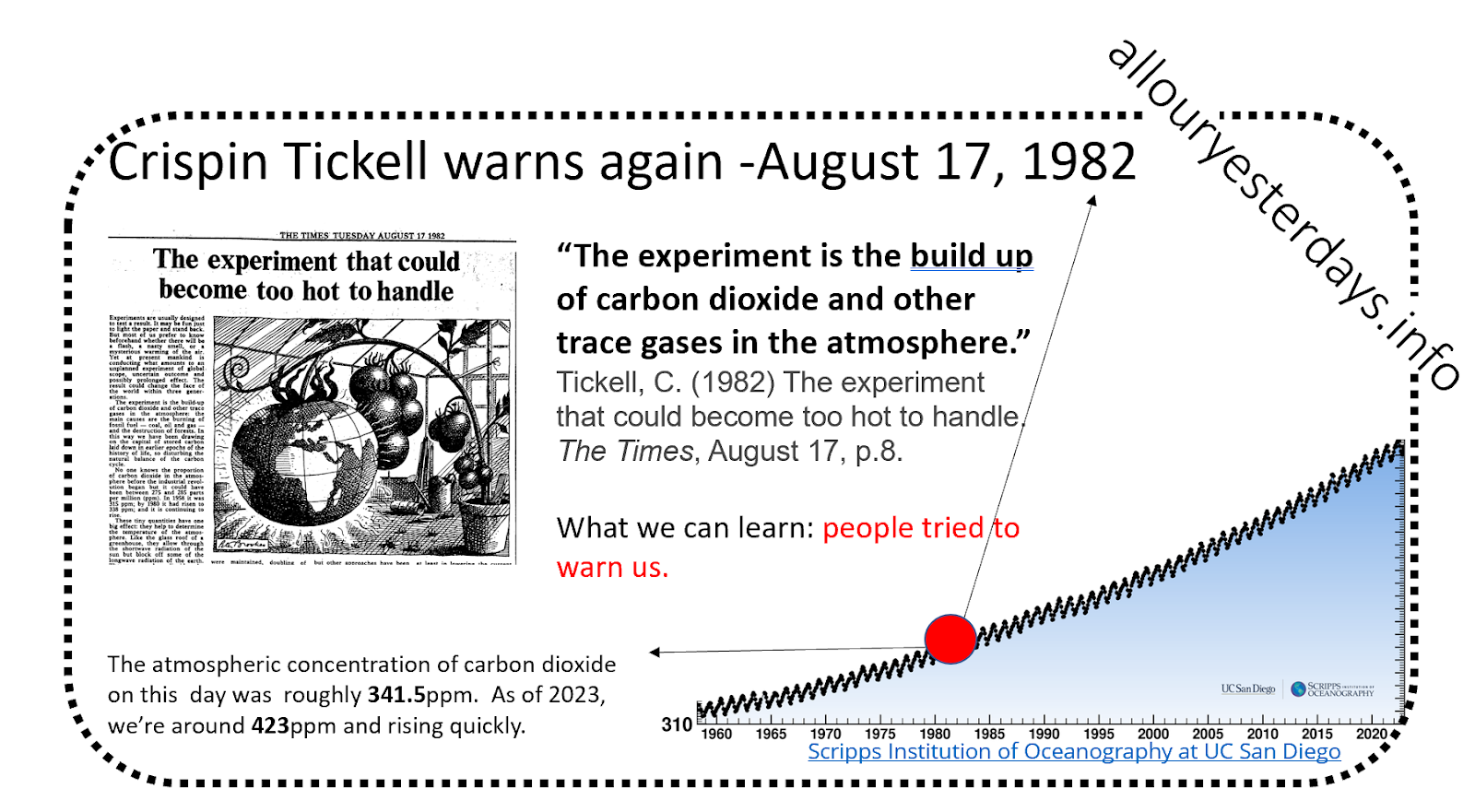
August 17, 1982 – Crispin Tickell sounds the alarm bell

Forty one years ago, on this day, August 17, 1982, UK diplomat Crispin Tickell warned us all we might get crispy…

Tickell, C. (1982) The experiment that could become too hot to handle. The Times, August 17, p.8.

The amount of carbon dioxide in the air was roughly 341ppm. As of 2023 it is 423ppm, but check here for daily measures. 

The context was that Tickell had been beavering away on the climate issue for seven years by this stage. And earlier in the year, James Hansen and Herman Flohn had made some pretty big bold statements at the American Association for the Advancement of Science meeting in Washington DC that had been reported in the New York Times. The IEA and the OECD, were continuing to hold workshops, so was the UNEP. And for Tickell the issue couldn’t wouldn’t go away because he understood what was at stake. Bless him. 

What I think we can learn from this

Elites really knew. And didn’t act. Some “elites” (the upper crust is just a bunch of crumbs sticking together).

What happened next

Tickell and others (John Houghton etc) finally got through to Thatcher in 1988. She gave her speech and that made it possible to talk about the issue/impossible not to…

What do you think? Does this pass the ‘so what?’ threshold? Have I got facts wrong? Interpretation wrong? Please do comment on this post, unless you are a denialist, obvs.

Categories
United Kingdom

May 13, 1991 – UK Energy minister fanboys nuclear as climate solution. Obvs.

Twenty seven years ago, on this day, May 13, 1991, a UK 

“Britain’s last Secretary of State for Energy wrote in May 1991 that ‘the environment has to be a priority in shaping global resources plans’ and expressed official support for nuclear power as an insurance policy against global warming, also pleading for higher prices for fossil fuels”

Boehmer‐Christiansen (1995; 184)- citing Wakeham, J. 1991. Nurturing a greener policy for world energy. The  Times, 13 May. 

The amount of carbon dioxide in the air was roughly 358.7ppm. As of 2023 it is 420ppm, but check here for daily measures. 

The context was  the United Kingdom was trying to paint itself as environmentally responsible both domestically and internationally, and also being a big fan of nuclear. So, nothing has changed.

What I think we can learn from this

The political games keep getting played. The players change often. The rules change slowly. Ultimately the game Remains the Same the losers future generations, other species.

What happened next

UK policy making on climate and energy remained pretty disconnected until the 2003 Energy White Paper and even then things have been seriously contested and a classic mess since then. The opportunities to invest in energy efficiency and renewable energy have been mostly missed, thanks to an ongoing obsession with nuclear power and generalised animosity towards the measures you would need to take to tackle climate change. This is hardly a surprise.

What do you think? Does this pass the ‘so what?’ threshold? Have I got facts wrong? Interpretation wrong?  Please do comment on this post, unless you are a denialist, obvs.

Categories
United Kingdom

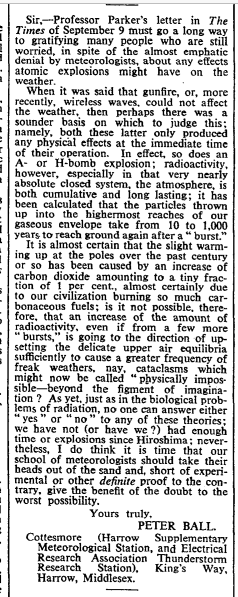
September 12, 1958 – Letter in The Times about … carbon dioxide build-up

On this day, September 12 1958, the Times newspaper carried a letter about … the build up of carbon dioxide…

As Hamblin, in his excellent “Arming Mother Nature,” notes

Peter Ball noted that “it is time that our school of meteorologists should take their heads out of the sand and, short of experiment or other definite proof to the contrary, give the benefit of the doubt to the worst possibility.” There might not be enough evidence to make the link, but equally so, there was not enough evidence to deny the possibility. Why take such a definitive stand? Ball pointed out that meteorologists already believed humans were having an effect on the climate. The slight warming in polar regions over the past century, he said, was undeniable, and it most likely was a result of humans burning up fossil fuels and releasing carbon dioxide to the atmosphere. Why was it so hard to accept that another human activity might have an effect as well?

(Hamblin, 2013: 124-5)

Peter Ball, letter to the Times, September 12 1958

On this day the PPM was 313.2

Now it is 421ish- but see here for the latest.

Why this matters. 

We knew C02 was building up. We knew it might well have implications.

What happened next?

We sat on our thumbs.