Forty five years ago, on this day, October 16th, 1981, the Financial Times reports on a warning by chief scientist of the Department of Energy, Hermann Bondi, about anti-nuclear protests and protestors.
The amount of carbon dioxide in the air was 339ppm. As of 2026, when this post was published, it is 430ppm. This matters because the more carbon dioxide in the air, the more heat gets trapped. The more heat, the more extreme weather events. You can make it more complicated than that if you want, but really, it’s not. Fwiw, I have a tattoo of the Keeling Curve on my left forearm.
The broader context was that the chief scientist at the Department of Energy, Herman Bondi, was very well aware of carbon dioxide build up, and didn’t want it to be a public issue per se. And he also wanted to try to win debates with the anti-nuclear crowd, and so here we see him reaching for the standard “you want black people to starve line,” which is pushed it out all the fucking time.
What I think we can learn from this – concern for the poor of the world is a tried and tested rhetorical flourish, from people who almost certainly do not give a rat’s arse.
What happened next ? Nuclear for dealing with greenhouse gas became a talking point again in 1988-89 and it’s still there to this day.
xxx
On this topic, you might like these other posts on All Our Yesterdays
Xx
References
xx
You can see the chronological list of All Our Yesterdays “on this day” posts here.
What do you think? Does this pass the ‘so what?’ threshold? Have I got facts wrong? Interpretation wrong? Please do comment on this post, unless you are a denialist, obvs.
If you want to get involved, let me know.
If you want to invite me on your podcast, that would boost my ego and probably improve the currently pitiful hit-rate on this site (the two are not-unrelated).
The tenth edition of the CO2 Newsletter, (Vol. 2, no. 4) published bi-monthly by American geologist William N. Barbat between 1979 and 1982 is live. You can download a pdf and see the full text here.
The eight page issue has a front page story that really pushes Barbat’s favoured solution to carbon dioxide build-up – the massive roll out of nuclear power across the world.
Rather than an editorial, Barbat replies to recent correspondence. He characterises the Newsletter’s stance in this manner-
Scientific opinion seems to agree that a continued CO2 buildup poses a serious threat to coastal habitations through polar icemelt and to the world’s food productivity, at least temporarily if not permanently. However, opinion seems to be sharply divided between complacency and alarmism over timing. Our studied view is alarmist, and we advocate corrective actions which do not in themselves create worse social and economic problems.
There is an article on Fourier, and the usual mix of “excerpts from recent reports” including one from the British journal Nature
‘Greenhouse Effect – Act now, not later’. by Wendy Barnaby, NATURE 19 February 1981:
47 years ago today, the Swedish Prime Minister decides on a referendum
“The nuclear policy controversy came to a head following the 1979 Three Mile Island accident. Olof Palme, the leader of the Social Democratic Party, had for a long time been a strong supporter of nuclear power and against a nuclear referendum. On April 4, 1979, however, after a week of intense media coverage of the nuclear accident, Palme, afraid of losing more antinuclear supporters to the Center Party in the upcoming September 1979 elections, announced that he was in favor of a nuclear referendum. Within hours the other parties agreed to Palme’s suggestion.” (Lofstedt 1992: 4)
The amount of carbon dioxide in the air was roughly 336ppm. As of 2026 it is 428ppm, but check here for daily measures.
The broader context was that Palme had been made aware about climate change from carbon dioxide quite some time ago. In April 1974 he had been briefed on it by Herman Flohn. In November 1974, Palme had spoken about it publicly.
The specific context was that energy politics is always messy!
What I think we can learn from this is that energy politics are always messy. And that some referenda matter more than others.
What happened next:
A non-binding referendum on nuclear power was held in Sweden on 23 March 1980.[1] Three proposals were put to voters. The second option, the gradual phasing out of nuclear power, won a narrow plurality of the vote, receiving 39.1% of the ballots cast to 38.7% for option 3.[2] Option 1 was the least popular, receiving only 18.9% of the votes.[2]
The actual long term result of the nuclear power politics in Sweden after the referendum has been most similar to option 1 which did not change ownership of nuclear power plants. Some were fully private and others owned by the government, and this did not change much. High profits in hydroelectric generation were not excessively taxed. Although some of the nuclear power plants were decommissioned, the Swedish government decided to reverse the policy.[3]
The amount of carbon dioxide in the air was roughly 337ppm. As of 2026 it is 428ppm, but check here for daily measures.
The broader context was there had been high hopes for nuclear in the 1950s – “electricity too cheap to meter” and all that. The coal industry had fought back, and so had, well, reality and economics.
The specific context was that the 1973-4 Oil Shock had concentrated everyone’s minds.
What I think we can learn from this is that every technology comes with costs.
What happened next – anti-nuclear activists highlighted the dangers. A few of those worried about carbon dioxide (especially William Barbat), tried to say there were bigger dangers.
What do you think? Does this pass the ‘so what?’ threshold? Have I got facts wrong? Interpretation wrong? Please do comment on this post, unless you are a denialist, obvs.
The amount of carbon dioxide in the air was roughly 310ppm. As of 2026 it is 428ppm, but check here for daily measures.
The context was that only one nation at that time had actual working nuclear weapons. Though, thanks to Russian scientists and Russian spies the Soviet Union would change that within a few years – “first we got the bomb, and that was good, because we love peace and motherhood.”
What I think we can learn from this is that the roots of atomic energy are in all sorts of soil.
And if you can’t face the horror of nuclear weapons, I suppose what you do is you gravitate towards the idea of “electricity too cheap to meter.” And atomic energy allows us to think of ourselves as being incredibly ingenious, being masters of all we survey, cracking open the secrets of the universe. Blah blah.
Solar and wind are about vulnerability and about begging and taking what’s on offer… but I have digressed.
What happened next
Commercial nuclear reactors, Windscale, various Soviet disasters, Three Mile Island, battles between nuclear and coal over who would have the power to power houses. And interestingly, by the mid late 1960s nuclear advocates were pointing to carbon dioxide emissions as an argument for rapid massive expansion of nuclear power.
What do you think? Does this pass the ‘so what?’ threshold? Have I got facts wrong? Interpretation wrong? Please do comment on this post, unless you are a denialist, obvs.
Sixty nine years ago, on this day, October 10th, 1957,
Problems of atmospheric diffusion and pollution were also tackled in the late 1950s, notably an investigation into the incidence of sulphur dioxide pollution near a generating station of the Central Electricity Authority. And a very serious occurrence was the serious fire that occurred in the nuclear reactor at Windscale in Cumbria on 10 and 11 October 1957. As a consequence of the release of radioactive material, a study was made of the Atomic Energy Authority’s requirements for meteorological observations and forecasts.
Source – Walker History of the Met Office
The amount of carbon dioxide in the air was 314ppm. As of 2025, when this post was published, it is 425ppm. This matters because the more carbon dioxide in the air, the more heat gets trapped. The more heat, the more extreme weather events. You can make it more complicated than that if you want, but really, it’s not. Fwiw, I have a tattoo of the Keeling Curve on my left forearm.
The broader context was that atomic energy was going to be too cheap to meter. There was nothing the men (and it was men) in lab coats could not do. Oh yes.
What I think we can learn from this – technology goes wrong. For many reasons, but there are such things as “normal accidents.”
What happened next – the British Government has spent further billions on nuclear power, for various reasons (hint – it’s about maintaining the “independent” nuclear deterrent).
What do you think? Does this pass the ‘so what?’ threshold? Have I got facts wrong? Interpretation wrong? Please do comment on this post, unless you are a denialist, obvs.
Nineteen years ago, on this day, January 12th, 2006,
“NUCLEAR power will be examined as part of the solution to global warming when ministers from six countries meet this morning in Sydney for talks on climate change…”
The amount of carbon dioxide in the air was roughly 382ppm. As of 2025 it is 425ppm, but check here for daily measures.
The context was that everyone knows there’s going to have to be a successor to the Kyoto Protocol, even though (because) t was far too weak. And so the proponents of action are talking about a stronger emissions trading scheme with fewer loopholes. And the opponents are, of course, talking about “technology.” The Bush and Howard governments had been banging on and creating these entirely fake and stupid bodies that would allow world leaders to stand at a podium in front of a new logo and declare “hydrogen” or “nuclear” or “CCS” or some other nonsense instead of any actual emissions cuts, And this is further examples of that.
What I think we can learn from this
Technology is always invoked as the get out of jail free card. Enough people find it convenient to believe, or easy enough to pretend to believe. And the emissions keep climbing.
What happened next
And the emissions kept climbing.
What do you think? Does this pass the ‘so what?’ threshold? Have I got facts wrong? Interpretation wrong? Please do comment on this post, unless you are a denialist, obvs.
Seventeen years ago, on this day, September 29th, 2007, a nuclear power plant goes kaboom, but in an okay way.
Calder Hall, the world’s first commercial nuclear power station, is demolished in a controlled explosion
The amount of carbon dioxide in the air was roughly 384ppm. As of 2024 it is 422ppm, but check here for daily measures.
The context was that nuclear power was gonna signal a renaissance for British industry, global industry. It had been a very expensive nightmare, but had given us supply chains for nuclear weapons and the technology and the workforce to keep those going. So that’s the most important thing; keeping the UK seat on the Security Council as a nuclear power.
What do we learn? Is that all good things come to an end and so does Calder Hall. Compare the end of Concorde in 2003…
What happened next? Well, this was 2007. This was in the midst of yet another attempt to go nuclear. By this time Blair had been successfully lobbied. And here we go, planning to spend yet more money on nuclear energy and it’s not going to work.
What do you think? Does this pass the ‘so what?’ threshold? Have I got facts wrong? Interpretation wrong? Please do comment on this post, unless you are a denialist, obvs.
Seventy years ago, on this day, September 17th, 1954 the head of the Atomic Energy Commission proclaimed that there would come a time when nuclear power would provide electricity too cheap to meter.
Transmutation of the elements, — unlimited power, ability to investigate the working of living cells by tracer atoms, the secret of photosynthesis about to be uncovered, — these and a host of other results all in 15 short years. It is not too much to expect that our children will enjoy in their homes electrical energy too cheap to meter — will know of great periodic regional famines in the world only as matters of history,— will travel effortlessly over the seas and under them and through the air with a minimum of danger and at great speeds, — and will experience a lifespan far longer than ours, as disease yields and man comes to understand what causes him to age.”
Lewis Strauss speech on electrical energy being “too cheap to meter” – http://www.thisdayinquotes.com/2009/09/too-cheap-to-meter-nuclear-quote-debate.html
The amount of carbon dioxide in the air was roughly 313ppm. As of 2024 it is 422ppm, but check here for daily measures.
The context was that nuclear energy was going to provide a useful adjunct to nuclear weapons. And one way that you get people enthused despite their fears of shit blowing up is by promising them that the electricity produced will be too cheap to meter. And so it came to pass…
What we learn – in the upswing of the hype cycle, statements that look absurd in retrospect get made.
What happened next it turns out nuclear power was never too cheap to metre. There were the inevitable cost overruns. There was the fight back by the coal industry. There was Three Mile Island which was not actually the thing that killed the nuclear power industry. The order book was pretty empty before then. I should probably watch Silkwood again.
What do we learn? Yeah, that hype happens.
What do you think? Does this pass the ‘so what?’ threshold? Have I got facts wrong? Interpretation wrong? Please do comment on this post, unless you are a denialist, obvs.
or “The Australian nuclear lobby and fixing climate change”
The context is this
This morning, [Opposition Leader] Peter Dutton announced his alleged plans for an Australian nuclear energy industry and in so doing he has set a test for all Australian media: are they willing to do their job as a fourth estate and call this out for the nonsense it is, or they all going to play games until the next election pretending this is some sort of legitimate alternative that deserves to be taken seriously?
[See also Simon Holmes a Court’s excellent thread about the 18 questions that should be asked about Dutton’s announcement.]
I thought about pitching something to The Conversation Australia – but I am out of favour with them and in any case, there’s this typically excellent piece by John Quiggin. Also I should be doing other things (see disclaimer here and at foot of this post).
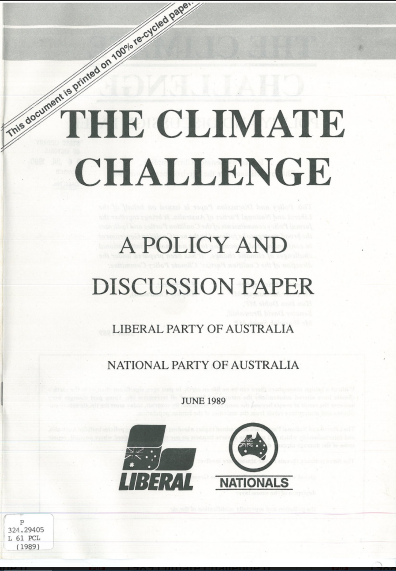
But for various reasons (including a myth that the Australian Conservation Foundation had ‘stabbed them in the back’) the Liberals and Nationals quickly decided NOT to compete for ‘green’ votes, and not to take climate seriously. Except when forced (2005 to 2009), they’ve held to that stance ever since.
The nuclear ca(na)rd never goes away, no matter how many times the objections to it are raised. There is always a new buzz phrase – fast-breeder, thorium pebbles, small modular – to roll off the tongues of those whose enthusiasm is ideological or cynical. The buzzsaw of reality hits the buzzword … and a new buzzword replaces it.
The “nuclear” option is too useful to be discarded. It serves as
as a non-answer to what many LNPers regard (secretly or openly) as a non-issue
as an invocation of Faith In Technology – it makes them feel modern/scientific/whatever, as distinct from the hysterical emotional greenies (who, dammit – and this must never ever be admitted – have a better track record of seeing what is coming)
as a wedge issue to split the environmentalists and give lazy/obedient journalists something to write about other than the sheer idiocy of the LNP’s “stance”, whatever it is this week.
Thus it is rolled out again and again. It’s Groundhog Day, only for morons.
A timeline of nuclear power advocacy and use of the climate issue in Australia (always in beta, and more interested in the pre-1988 period than is healthy.)
Over time I will add to this, if I remember. Send me stuff, I guess.
1970 Australian Atomic Energy Commission annual report
This is quoted by academics in presentations at academic conferences, e.g. ANZAAS in Brisbane, the following year
1971 Australia’s first nuclear power station – Jervis Bay– cancelled, by a Liberal Prime Minister (Billy McMahon.
1972 The Stockholm Conference on the Environment.
1975 Institute of Engineers Australia (IEAust) creates an “Energy Task Force”
1977
As part of the debates about whether Australia should be mining and exporting Uranium…
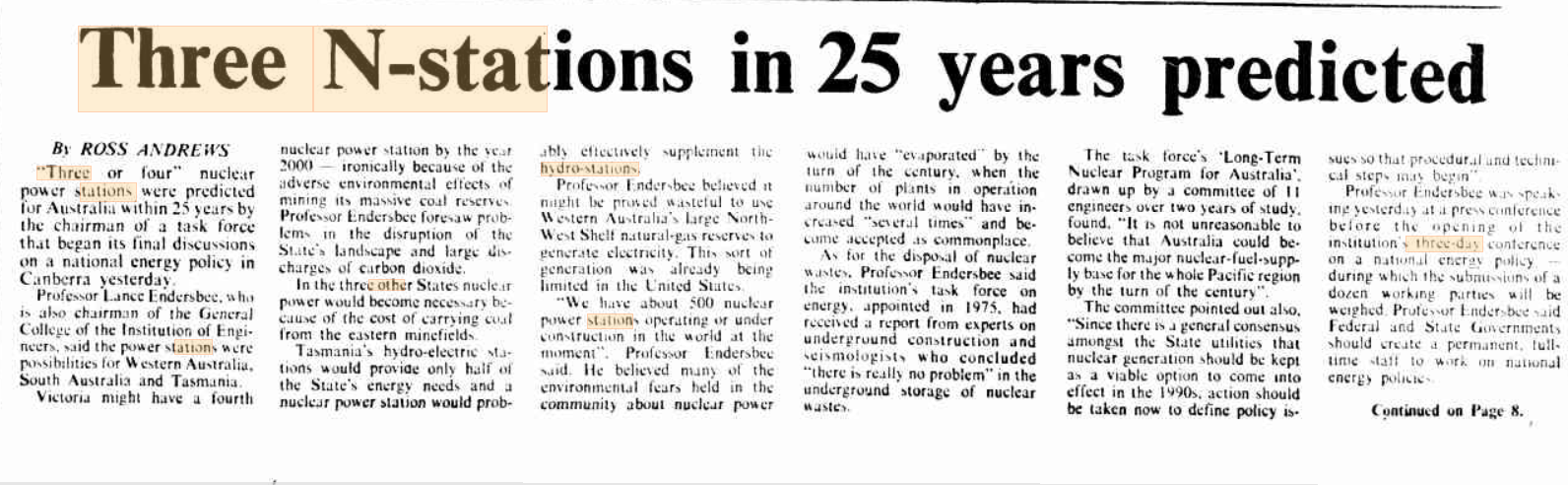
In July – The IEAust’s Lance Endersbee comments (reported on the front page of the Canberra Times thus_
“Three or four” nuclear power stations were predicted for Australia within 25 years by the chairman of a task force that began its final discussions on a national energy policy in Canberra yesterday.
Professor Lance Endersbee, who is also chairman of the General College of the Institution of Engi neers, said the power stations were possibilities for Western Australia, South Australia and Tasmania. Victoria might have a fourth nuclear power station by the year 2000 – ironically because of the adverse environmental effects of mining its massive coal reserves. Professor Endersbee foresaw problems in the disruption of the State’s landscape and large discharges of carbon dioxide.”
1978 The Australian Mining Industry Council (later rebranded as MCA) publishes a propaganda tome “Nuclear Electricity” with a glancing mention of the possible greenhouse effect
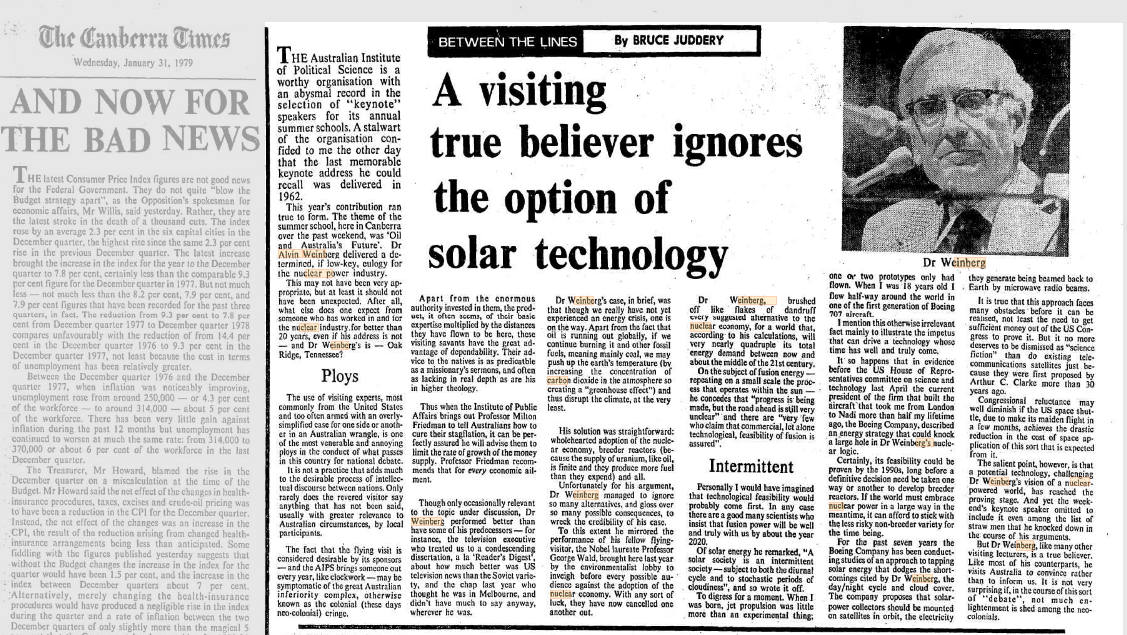
1979 Visit by American scientist and nuclear booster Alvin Weinberg (write up in Canberra Times). See here.
“Dr Weinberg’s case, in brief, was that though we really have not yet experienced an energy crisis, one is on the way. Apart from the fact that oil is running out globally, if we continue burning it and other fossil fuels, meaning mainly coal, we may push up the earth’s temperature (by increasing the concentration of carbon dioxide in the atmosphere so creating a “greenhouse effect”) and thus disrupt the climate, at the very least.”
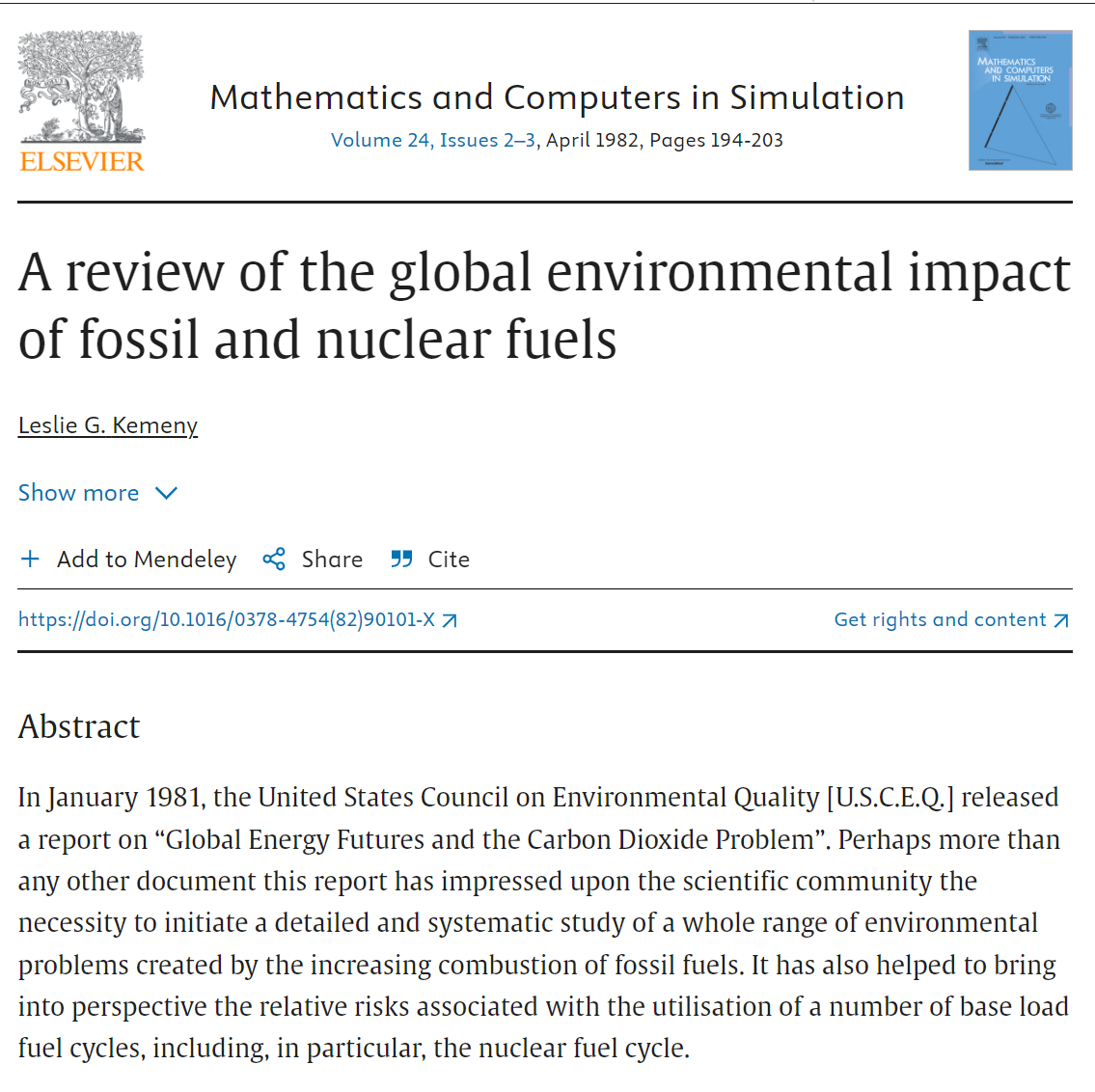
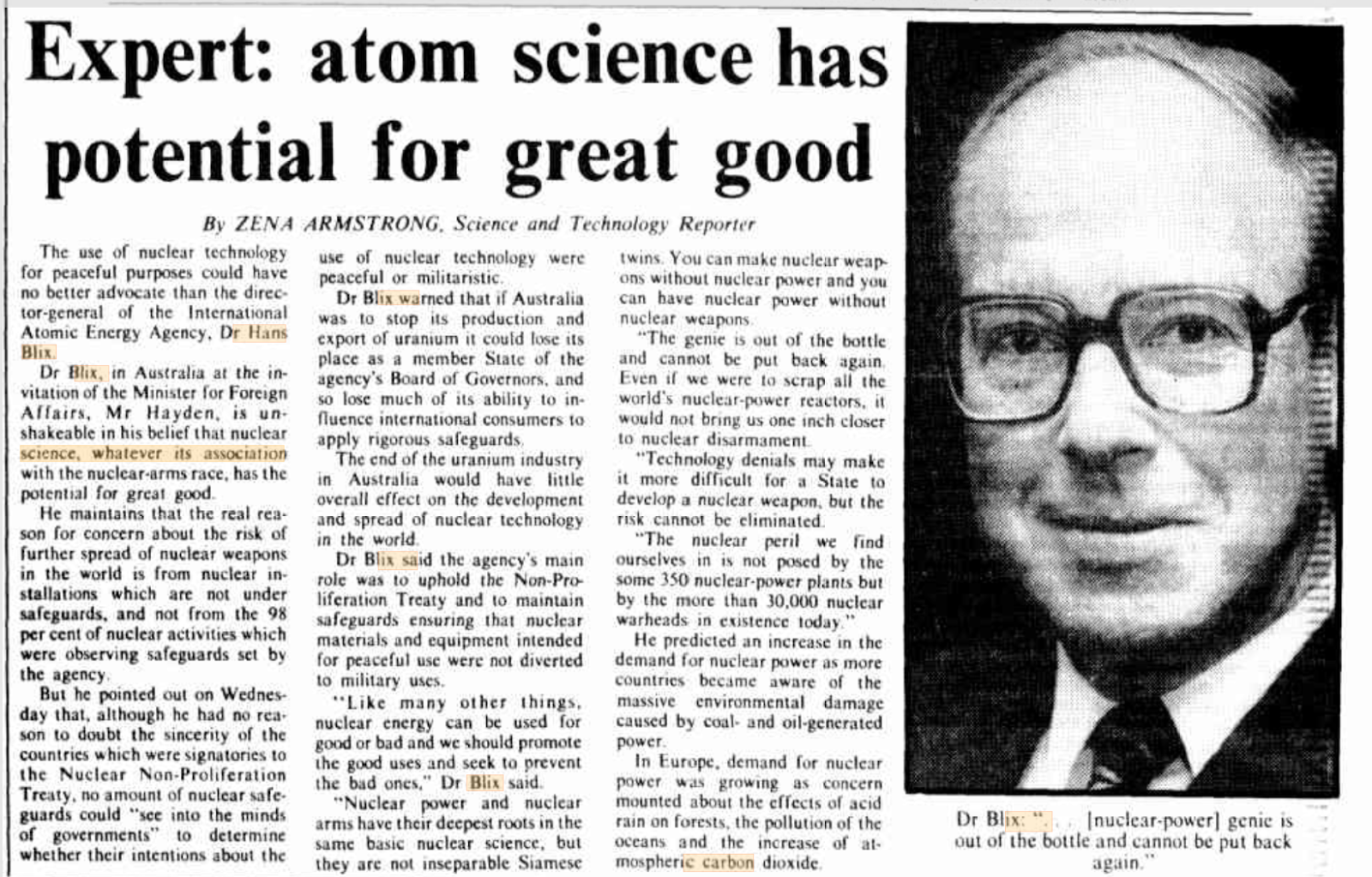
1982 Leslie Kemeny article (which he recycled in 1985 at an IEAust conference) (Kemeny a long-term enthusiastic nuclear bloviator – see Jim Green’s 2009 article in Crikey).
“In Europe, demand for nuclear power was growing as concern mounted about the effects of acid rain on forests, the pollution of the oceans and the increase of atmospheric carbon dioxide.”
In 1988 the “Greenhouse Effect” finally broke through into mass public awareness. There was plenty of denial, and also opportunistic “nuclear is the only answer” stuff.
“While the concern to make a serious attempt to do something about the problem was widespread, it was not universal. The pro-uranium lobby launched a heavy-handed campaign to portray nuclear power as the answer to the greenhouse effect, with the support of an ‘expert committee’ of the Institution of Engineers.”
(Lowe, 1989: 7)
“…. There can be no credible case on economic grounds for the nuclear option.
An understandably upset member of the Institution of Engineers, Australia, recently sent me a copy of a “position paper”, prepared for the Institution by an expert committee. I read the paper with the interest of someone who might well have been a member of the Institution had it not been for a few chance turnings along the road: I actually earned an honest crust in Sydney as a cadet engineer in bygone days when beaches were clean and books were dirty. The document stated that, ‘It is clear Australia can improve living standards internationally and contribute to an amelioration of the Greenhouse Effect by providing uranium and uranium services’. While some of the rhetoric has been changed, much of the technical detail is eerily reminiscent of a 1977 report by the same body….”
(Lowe, 1989:92)
Various enthusiasms for nuclear, in ALP and LNP. But climate issue dies by 1992 (with the coming of Keating and the UNFCCC) and over the next ten years or so, nuclear advocacy is relatively subdued….
2006 With pressure around the climate issue rising (Kyoto coming into force, the EU Emissions Trading Scheme etc), John Howard gets Ziggy Switowski to produce another report
MacLeod, R. (1994) The atom comes to Australia: Reflections on the Australian nuclear programme, 1953 and 1993, History and Technology, an International Journal, 11:2, 299-315, DOI: 10.1080/07341519408581868
Urwin, J. 2023. Better active today than radioactive tomorrow’: Environmentalism and the Australian anti-uranium movement, 1975–82. International Review of Environmental History, Volume 9, Issue 2
DISCLAIMER
I struggle (more than usually) to write in academese. Or in that kind of academese to which I once aspired. Maybe I was never good enough, maybe I never tried hard enough or long enough. Whatever.