Forty-eight years ago, on this day, June 9th, 1976, a CSIRO film gets shown on telly in Sydney (I think).
It was shown a couple of weeks later in Melbourne – see listing here.
The amount of carbon dioxide in the air was roughly 332ppm. As of 2024 it is 426ppm, but check here for daily measures.
The context was that the CSIRO had been making her educational films. And, of course, the Australian Academy of Science had just released its report on changing climate, which had said “nothing to see here”/”just a watching brief.” Even though the evidence of people like Hermann Flohn was a little bit more robust than that.
What we learn is that if you were watching the ABC, i.e. was one of 4 or 5% of the population, you would have had a chance to learn the issues.
What happened next? The documentary got shown elsewhere, elsewhen. In a few years, CSIRO would make more films around this topic, “What to do about CO2” directed by Russel Porter
What do you think? Does this pass the ‘so what?’ threshold? Have I got facts wrong? Interpretation wrong? Please do comment on this post, unless you are a denialist, obvs.
Forty eight years ago, on this day, May 20th 1976, a senior British figure worries about the weather (as the drought is just kicking off).
As early as May 1976, the chair of World Trends asked whether, given the ‘2 years of abnormally mild weather’, and a gathering ‘pressure on Ministers to make statements about climatic change’, the 1975 advice that nothing known was of concern still stood?
TNA CAB 134/4103. Minutes, WT(76)1st, 20 May 1976. Sawyer of the Met Office replied that WT(75)7 was indeed ‘still valid’
(Agar 2015: 613)
The amount of carbon dioxide in the air was roughly 332ppm. As of 2024 it is 425ppm, but check here for daily measures.
The context was that the weather had been a little weird. And people like Henry Kissinger had been talking about that at the United Nations. This was even before the long hot summer of 1976. Were we going to burn or were going to freeze? And the fact that he raised it and then had to tamp it down, “there’s nothing to worry about nothing to see here ol chap” is amusing.
What we learn is that the British state was keeping an eye on things, but had no sense of alarm. Because, well, John Mason at the Met Office told him there was nothing to be alarmed about. He wasn’t the only one.
What do you think? Does this pass the ‘so what?’ threshold? Have I got facts wrong? Interpretation wrong? Please do comment on this post, unless you are a denialist, obvs.
Forty seven years ago, on this day, November 28, 1976, another climate modelling workshop happens…
The first model of the atmosphere had been developed in 1976. However, models existing up to the mid-1970s remained rudimentary. The workshop was held at the offices of the National Oceanic and Atmospheric Administration (NOAA) from 28 November to 3 December 1976
Paterson, M (1996) p. 26
The amount of carbon dioxide in the air was roughly 332ppm. As of 2023 it is 419ppm, but check here for daily measures.
The context was that computer models at this stage were very very rudimentary and expensive. There had been work in the 60s. There’s that paper, I think by Janet Nielsen about the Met Office.
Of course computer modelling had become popular and criticised because of the Limits to Growth report. But by 1976 everyone kind of agreed that the world was going to warm as per the Norwich meeting in 75. And therefore using computers to figure out how much warming by when seemed like a good idea. So there was a workshop at NOAA.
What I think we can learn from this
The mid-1970s was scientists getting hold of the science – via computers and thinking – and saying “uh-oh”
What happened next
Those who knew their arses from their elbows did their best, but the forces of complacency and idiocy (looking at ya, BJ Mason) won the crucial battle at the First World Climate Conference in February 1979. Then came Thatcher and then came Reagan, and another decade was lost (not that we would have done anything other than piss THAT against the wall…)
What do you think? Does this pass the ‘so what?’ threshold? Have I got facts wrong? Interpretation wrong? Please do comment on this post, unless you are a denialist, obvs.
Forty seven years ago, on this day, September 13, 1976, a major US news network did a story on climate change.
“On September 13, 1976, ABC’s Jules Bergman did a two minute 10 second story on a National Academy of Sciences committee report on the damage done by fluorocarbons (from aerosol spray cans) to the ozone layer of the earth’s atmosphere. Like most fluorocarbon/ ozone stories, this one cited the medical dangers of increased skin cancers, but in this case, the committee said that the most dangerous result might be a warming of the earth’s poles.”
Sachsman, 2000 The Role of Mass Media in Shaping Perceptions and Awareness of Environmental Issues
The amount of carbon dioxide in the air was roughly 332ppm. As of 2023 it is 423ppm, but check here for daily measures.
The context was that journalists were, by 1976. very sensitised to the climate issue. There was the prolonged drought in the United Kingdom. Stephen Schneider had released “the Genesis Strategy,” and had made various appearances on the Johnny Carson Show. So getting the climate issue into a discussion of ozone was not that much of a stretch.
What I think we can learn from this is that decent journalists will give you a tolerably accurate version of the truth. You may need to reframe some of the factoids, but especially if it’s the business press, you will more or less be able to figure what’s going on. For all the good it will do you.
We have known for 50 years that there was serious trouble ahead – longer in fact, but really from the early mid 70s both the theory and the evidence were coming together… And here we are.
What happened next
In 1977 the National Academy of Science released its report. George Brown managed to Shepherd the climate protection act or whatever it was called into law Carter signed this time next year ear and there was a flurry of newspaper articles and presumably television reports about the dangers of continuing to rely on coal and here we are.
What do you think? Does this pass the ‘so what?’ threshold? Have I got facts wrong? Interpretation wrong? Please do comment on this post, unless you are a denialist, obvs.
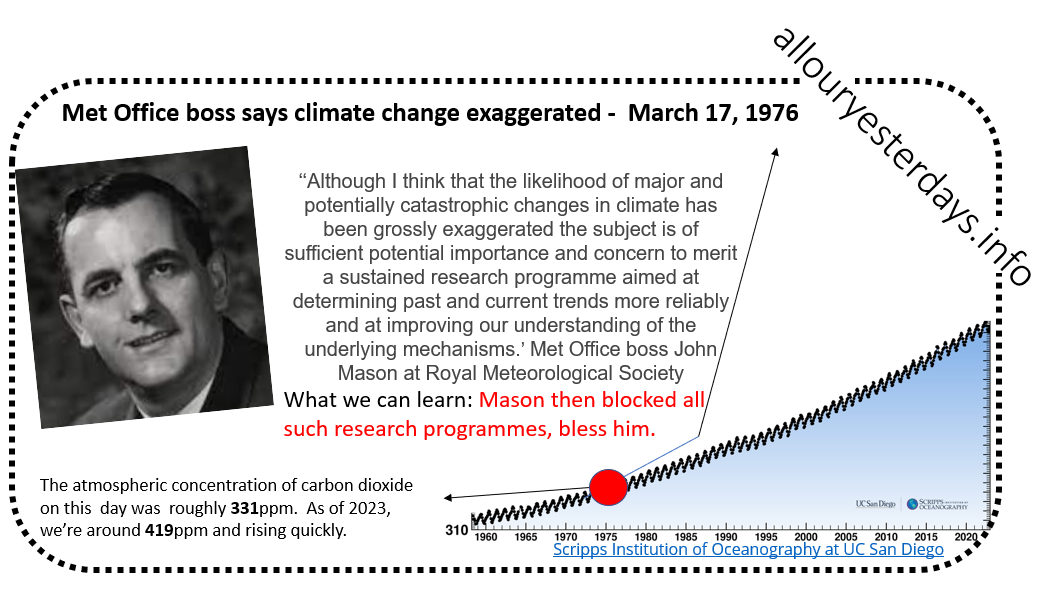
Forty seven years ago, on this day, March 17, 1976, John Mason gave a lecture at the Royal Meteorological Society…
The few mentions of climate prediction at the [Met] Office in the early to mid-1970s came from Mason—and they brought out the hesitant side of a man who was otherwise an aficionado of numerical modeling. “‘For the immediate future priority should probably be given to the use of models to test the sensitivity of the atmosphere’s response to changes in individual parameters, to elucidate the underlying physical mechanisms, and to distinguish likely changes in atmospheric behaviour from the idiosyncrasies of particular models,’’ he told the Royal Meteorological Society in 1976.
2 B. J. Mason, ‘‘Towards the Understanding and Prediction of Climatic Variations: Symons Memorial Lecture, 17 March 1976,’’ Quarterly Journal of the Royal Meteorological Society 102 (1976), 497
‘‘Although I think that the likelihood of major and potentially catastrophic changes in climate has been grossly exaggerated,’’ he said at a Royal Meteorological Society lecture in 1976, ‘‘the subject is of sufficient potential importance and concern to merit a sustained research programme aimed at determining past and current trends more reliably and at improving our understanding of the underlying mechanisms.’
Martin-Nielson – computers article –
The amount of carbon dioxide in the air was roughly 333.3ppm. As of 2023 it is 419ppm, but check here for daily measures.
The context was that American scientists were beginning to really look at carbon dioxide closely. Wally Broecker had published his “Climatic Change: Are We on the Brink of a Pronounced Global Warming?.” in Science. (see All Our Yesterdays here on that). https://www.science.org/doi/10.1126/science.189.4201.460
The National Academy of Science had a two year study underway. Mason would have been well aware of this. And there was pressure on him as the Met Office Supremo to engage. He found the whole thing distasteful and called it another hoax, basically, possibly influenced by John Maddox, editor of Nature; I’m sure the two were mates.
Oh, by this time, Stephen Schneider had published the Genesis Strategy and so forth.
Senior civil servant Crispin Tickell was back from his sabbatical year studying at Harvard, and was banging the drum too.
What I think we can learn from this is that the personal views of powerful people matter, because powerful people, by definition, are gatekeepers about what is and is not “important.” And unless you can create some sort of anarcho-syndicalist utopia, that will continue to be the case. And even if you do, they’re always going to be experts of expertise and bottlenecks. And here we are, (See Ursula Le Guin’s The Dispossessed where even in an ‘anarchist utopia’ there are all sorts of status games and so on).
What happened next Mason was forced to create or to participate in an interdepartmental committee in October 1978, and make the right noises to people of influence who were more concerned than him about climate (see AOY Feb 7 or so).
What do you think? Does this pass the ‘so what?’ threshold? Have I got facts wrong? Interpretation wrong? Please do comment on this post, unless you are a denialist, obvs..
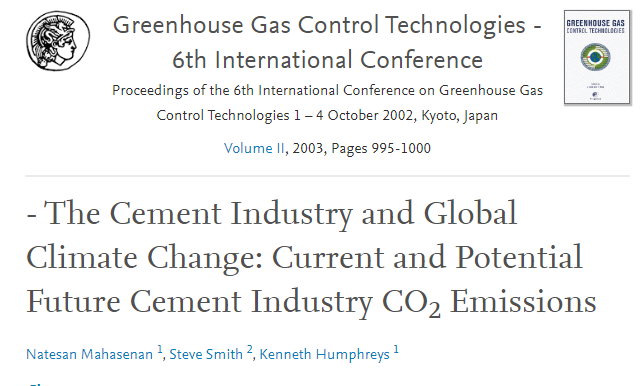
Forty seven years ago, on this day, January 19,1976, people were talking about the carbon footprint of cement.
R.M. Rotty, ‘Global Carbon Dioxide Production from Fossil Fuels and Cement, A.D. 1950-A.D. 2000’, presented at Office of Naval Research Conference on the Fate of the Fossil Fuel Carbonates, Honolulu, Hawaii, January 19-23, 1976
The amount of carbon dioxide in the air was roughly 331.5ppm. As of 2023 it is 419.
The context was that US scientists (and to a lesser extent perhaps European ones) were beginning to think about what reducing emissions – or just slowing the increase – might look like at a sectoral level.
Rotty did good work (there’s no wikipedia page for him, which someone should rectify, imo.)
What I think we can learn from this
People have been thinking about cement as a carbon problem for longer than you’d think…
What happened next
Nothing much on the cement front for a very long time…My impression it was still pretty niche even in 2003…
On this day, December 30 in1976 Congressman George Brown(of the Democrats) wrote to incoming President Jimmy Carter
“In his letter to President-Elect Jimmy Carter [on 30th] December 1976, for instance, Brown hesitated to put the blame on human factors, given serious uncertainties about the influence of other causes of climatic change. ‘‘Our knowledge,’’ he noted, ‘‘is primitive concerning the importance of not only natural factors, such as solar activity or orbital behavior, but also of man-made effects due to CO2 and particulate emissions, or fluorocarbon and NOx interaction with the ozone layer.’’
Brown’s tone was certainly not an indictment of efforts to understand the influence of human activities on the global climate system, but rather a preliminary conveyance of urgency to stimulate a much larger effort to understand the nature, causes, and potential impacts of climatic change on human affairs.”
[The amount of carbon dioxide in the atmosphere was 332ppm. At time of writing it was 419ishppm- but for what it is now,well, see here for the latest.]
The context was this –
Scientists were beginning to say they were fairly sure that additional carbon dioxide in the atmosphere was already – and would be – a problem. But not “sure sure”. Politicians were trying to get more money for them to do better research…
Why this matters.
We need to remember that these things take time – and skill – to get up the policy agenda so that ignoring comes with significant political cost..
What happened next?
Brown was “successful” and Carter, by the end of his fraught four years, had done something towards getting the US government to look at climate (if you ignore the synfuels debacle). All that would be swept aside by Reagan, of course….
On this day, December 1st, in 1976, the Director-General of the Meteorological Office, John Mason, gave a speech to the Royal Society of Arts. It was reported in Nature by John Gribbin, under the headline “Man’s influence not yet felt by climate”
“THE message conveyed by Professor B. J. Mason, Director-General of the UK Meteorological Office, in a recent lecture was- don’t panic. The theme of Mason’s lecture (given to the Royal Society of Arts on December I) was “Man’s Influence on Weather and Climate”, and his conclusion was that -the climatic system is so robust, and contains so much ·inherent stability through the presence of negative feedback mechanisms, that man has still a long way to go before his influence becomes great enough to cause serious disruption to the natural climatic system.”
[The amount of carbon dioxide in the atmosphere was xxxppm. At time of writing it was 419ishppm- but for what it is now,well, see here for the latest.]
The context was that through the mid-70s many scientists (including but not limited to those pesky young Americans with better computers than the Brits) had started saying “whoah, this build up of carbon dioxide, this might become a serious thing.” As had Europeans (including Hermann Flohn). As had the WMO, as reported in the Times earlier that year – June 22, 1976 – Times reports “World’s temperature likely to rise”
And Mason? Mason didn’t buy it, hadn’t bought it and continued not to buy it, including at the First World Climate Conference, in Geneva in February 1979…
Why this matters.
You can imagine an alternative world, where gatekeepers like Mason were able to see the nose on their faces, and the actual response to climate change began early enough to do something substantive. If you smoke some serious weed, that is…
The whole process culminated in a 1980 report and a briefing to Margaret Thatcher, who dismissed it all with an incredulous “you want me to worry about the weather?”
On this day, October 12 in 1976, an eminent US scientist was dismissive (in a personal letter) of Stephen Schneider et al.
12 Oct 1976 None of the “speculative ideas of people like … Schneider on future climate change are worth the paper (usually newspaper) they are written on. They mislead the public and they do the field harm,” Charney concluded in a separate letter.
Jule Charney to Warren Kornberg, 12 October 1976, Box 13 – NSF, 1955-81, Papers of Jule Charney, MIT Institute Archives, Cambridge, MA.
[The amount of carbon dioxide in the atmosphere was 328.72ppm. At time of writing it was 421ishppm- but for what it is now,well, see here for the latest.]
The context was this –
In the mid 1970s there was a flurry of books about climate change and its impacts. Only a very few of them focussed on the importance of carbon dioxide build-up – others saw the problem in dust, or ‘waste heat’. The grand old men of the field – Charney, Landsberg et al, feared that popularisation/tabloid style claims would damage the credibility of the field.
Why this matters.
Scientists – justifiably – worry about large claims and whether they are sound, since if the claims and predictions turn out to be wrong, all scientists suffer.
What happened next?
Charney changed his tune in 1979, agreeing that unless something very odd indeed happened, then a doubling of atmospheric CO2 would lead to serious warming…