Categories
Academia Activism Australia

August 14, 2002 – Australian economists urge Kyoto Protocol ratification

Twenty one years ago, on this day, August 14, 2002, Aussie economists tried to get the smallest, most inadequate action taken…

“In a further response to what many see as Australia’s failure on the environment, more than 270 of the country’s academic economists called on 14 August [2002] for Prime Minister John Howard to ratify the Kyoto Protocol without delay. Howard rejected the Kyoto Protocol in June this year, stating that it would not be in the country’s interest to ratify without the inclusion of the US and developing nations. This is despite the fact that a recent survey of Australian citizens revealed that 71% believe it would be in the country’s interest to ratify.

“As economists, we believe that global climate change carries with it serious environmental, economic and social risks and that preventive steps are justified,” says a statement by the economists. “Policy options are available that would slow climate change without harming employment or living standards in Australia, and these may in fact improve productivity in the long term.”

However, Environment and Heritage Minister Dr David Kemp, told journalists on 19 August that Australia intends to keep to the targets laid out in the Kyoto Protocol, despite the fact that the country will not ratify.”

http://www.edie.net/news/16/Australias-environment-is-in-reverse/5878/

Excerpt from report by Radio Australia on 14 August

The Australian government is under further pressure to ratify the Kyoto Protocol on climate change in the lead-up to the World Environment Summit in Johannesburg later this month. Samantha Hawley reports:

[Hawley] More than 250 economists have sent a message to the federal government, urging it to sign up to the protocol before the Johannesburg summit begins. Clive Hamilton, from the policy think tank, the Australia Institute, says the economists believe it will increase jobs and living standards.

[Hamilton] It really does throw the question to the prime minister on what basis is he making these claims on the economic cost ofKyoto. [End of recording]

[Passage omitted]

[Hawley] The call comes as the government moves to release its long-awaited greenhouse gas abatement figures tomorrow, which were originally due out before the election.

The amount of carbon dioxide in the air was roughly 371ppm. As of 2023 it is 423ppm, but check here for daily measures. 

The context was that Australian Prime Minister John Howard had, on Earth Day (June 5) announced he would not send the Kyoto Protocol for ratification through the Australian parliament. Clive Hamilton/Australia Institute got 270 economists together to do an open letter.

What I think we can learn from this

This is the sort of thing you have to do to raise the cost of bad behaviour, show that other people see the world differently. It didn’t work, but that’s not the fault of the people who tried it.

What happened next

Howard continued to be an asshat. Knocked down an Emissions Trading Scheme in 2003.

What do you think? Does this pass the ‘so what?’ threshold? Have I got facts wrong? Interpretation wrong? Please do comment on this post, unless you are a denialist, obvs.
Categories
Activism Australia

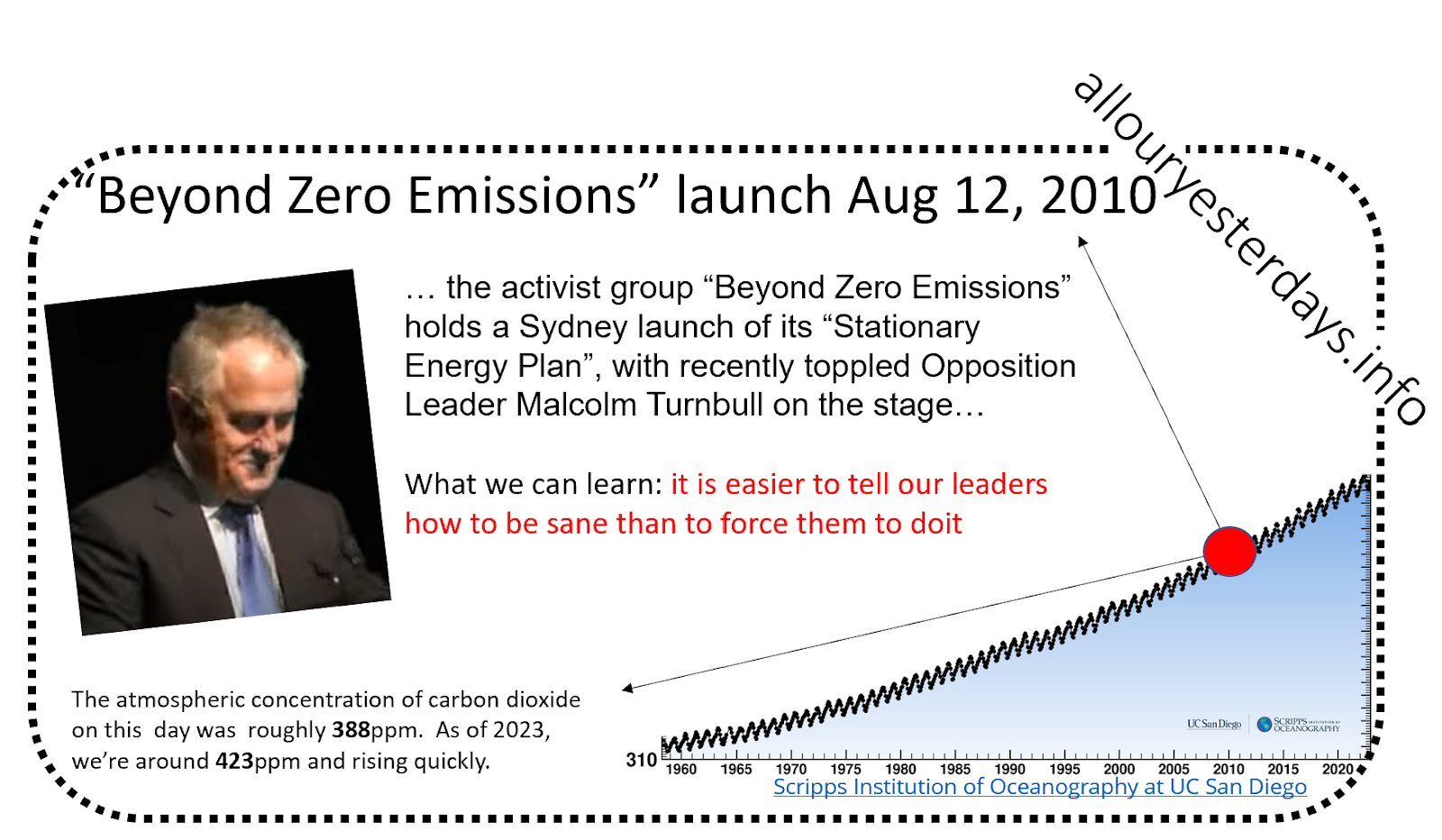
 August 12, 2010 – BZE launches energy plan for Australia

Thirteen years ago, on this day, August 12, 2010, the activist group “Beyond Zero Emissions” holds a Sydney launch of its “Stationary Energy Plan”, with recently toppled Opposition Leader Malcolm Turnbull on the stage…

Turnbull’s talk

https://www.greenleft.org.au/content/bze-plan-100-renewables-2020-clean-public-meeting-discussion

http://bze.org.au/media/newswire/zero-carbon-australia-sydney-launch-event-video-bob-carr-and-malcolm-turnbull-100912 (dead link)

Critique – https://bravenewclimate.com/2010/08/12/zca2020-critique/

The amount of carbon dioxide in the air was roughly 388ppm. As of 2023 it is 423ppm, but check here for daily measures. 

The context was that the Rudd government’s entirely unambitious climate policies the CPRS had taken up all the oxygen in 2009. The CPRS had then fallen on its face, and Rudd had been unable to summon the courage to call an election on the issue, or take up the suggestion of the Greens for a carbon tax. The activist group Beyond Zero Emissions decided to try to change the narrative with a plan for well beyond zero emissions. 

What I think we can learn from this

This sort of bold policymaking from outside the mainstream is really good at forcing the government of the day and the opposition to slightly raise their ambition – or at least ramp up their rhetoric, albeit usually within pre existing and very technocratic boundaries The kind of breakthrough transformational stuff that is proposed, rarely, if ever, gets adopted wholesale, especially if the agenda is mature (i.e. there are lots of middle-class and rich people in and funding think tanks designed to maintain their positions).

What happened next

BZE staggered on, there were personality conflicts. And then after a while it stops being quite so fresh. It became obvious to everyone that the moment has passed, and it was someone else’s 15 minutes next time…

What do you think? Does this pass the ‘so what?’ threshold? Have I got facts wrong? Interpretation wrong? Please do comment on this post, unless you are a denialist, obvs.
Categories
Activism Australia

August 11, 2005 – Greenpeace protest Hazelwood power station

Eighteen years ago, on this day, August 11, 2005, Australian activists took action.

On 11 August 2005 approximately 50 student environmentalists and Greenpeace volunteers unfurled a “Quit Coal” banner outside the plant while 12 activists occupied the brown coal pit, with two locking themselves to coal dredging equipment. This action drew worldwide attention to Hazelwood’s CO2 emissions and their harmful impacts on the global climate. (Wikipedia on Hazelwood)

See also https://www.abc.net.au/news/2005-08-11/police-remove-greenpeace-mine-activists/2078834

The amount of carbon dioxide in the air was roughly xxxppm. As of 2023 it is 423ppm, but check here for daily measures. 

The context was that the Victorian Government was continuing to talk about expanding and continuing with Hazelwood, which was burning brown coal. This, while abundant, was truly filthy. So Greenpeace were doing their best to keep the issue on the agenda, and to accelerate the demise of Hazelwood. 

What I think we can learn from this

Transitions take a long time. Involve a lot of blood sweat and tears.

What happened next

It took a long while. But finally, they won. Hazelwood is Toast and Victoria is going for wind and renewables.

What do you think? Does this pass the ‘so what?’ threshold? Have I got facts wrong? Interpretation wrong? Please do comment on this post, unless you are a denialist, obvs.

Categories
Activism Australia Coal

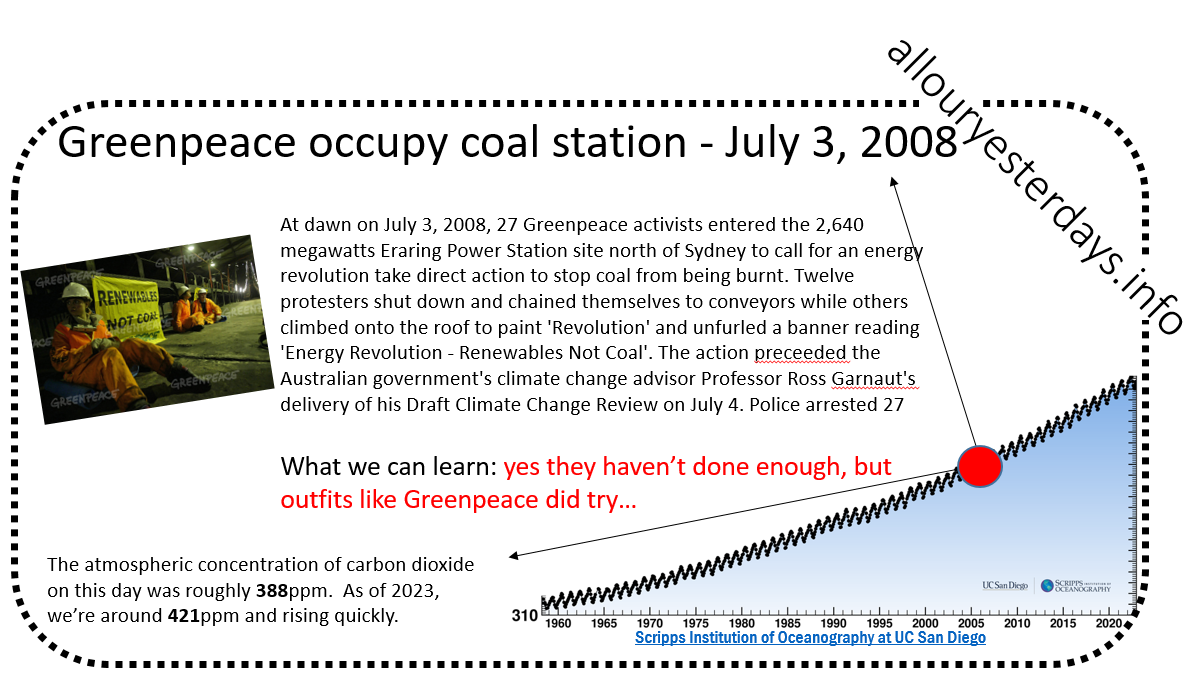
July 3, 2008 – Greenpeace occupies an Australian coal plant.

Fifteen years ago, on this day, July 3, 2008, Greenpeace occupied Australia’s most polluting coal-fired power plant

“At dawn on July 3, 2008, 27 Greenpeace activists entered the 2,640 megawatts Eraring Power Station site north of Sydney to call for an energy revolution and take direct action to stop coal from being burnt. Twelve protesters shut down and chained themselves to conveyors while others climbed onto the roof to paint ‘Revolution’ and unfurled a banner reading ‘Energy Revolution – Renewables Not Coal’. The action preceded the Australian government’s climate change advisor Professor Ross Garnaut’s delivery of his Draft Climate Change Review on July 4. Police arrested 27.”

The amount of carbon dioxide in the air was roughly 388ppm. As of 2023 it is 423ppm, but check here for daily measures. 

The context was that the new Rudd Government had appointed economist Ross Garnaut to look at climate economics, and was also appointing other panels, there was going to be a lot of green papers and white papers and speeches. What Greenpeace were, quite rightly, saying is, well, if these speeches and policy papers don’t accelerate the closure of coal-fired monstrosities – death factories in James Hansen’s term – then they’re not worth that much. 

What I think we can learn from this

It’s so difficult for an NGO, or any set of NGOs really, to be both trying to engage in the finer points of policy and simultaneously making broader societal points. Because if you go out and do the radical stuff, you’ll find yourself uninvited and disinvited to the policy roundtables, or not taken seriously when you make serious points. All the more reason why you need a very broad-based, well-funded, set of organizations within a movement and that that movement has ways of discussing what counts as “selling out,” being caught up to being a fig leaf, and what counts as constructive engagement. And there’s never going to be the final solid answer and there will always be people who disagree. 

As of 2022, Eraring is still pumping out its death, but it is scheduled for final closure shortly.

What do you think? Does this pass the ‘so what?’ threshold? Have I got facts wrong? Interpretation wrong? Please do comment on this post, unless you are a denialist, obvs.

Categories
Activism Education United Kingdom

June 14, 1973 – Education for the Future? Meh.

Fifty years ago, on this day, June 14, 1973, the UK based “Conservation Society” tried to lay out what would be needed for, you know, a future…

It begins with the prescient words – “We are in the presence of another climacteric more dramatic than any the human race has yet experienced.”

Yep.

June 14 1973 The Conservation Society launches “Education for our Future” Fairhall, J. (1973) Preparing young for crisis. The Guardian, June 14, p.6.

The amount of carbon dioxide in the air was roughly 332ppm. As of 2023 it is 423ppm, but check here for daily measures. 

The context was

Everyone was running around talking about survival and education. And what that would look like. There had been a seminar in 1972 in London, and this Conservation Society effort probably drew on that.

What I think we can learn from this

We’ve been talking about the skills that we would need to educate the young for 50 years that’s included lots of nice words like holistic and environmental and ecological and we have not done it for the most part.

What happened next

Obviously we did not educate ourselves for a new society. If we had, projects like this would not even exist.

The Conservation Society wound up in 1987, ironically just before the next big wave

What do you think? Does this pass the ‘so what?’ threshold? Have I got facts wrong? Interpretation wrong? Please do comment on this post, unless you are a denialist, obvs.

Categories
Activism United States of America

“Ecology and Politics in America” teach-in, Berkeley, May 28, 1969

On May 28, 1969, there was a ‘teach-in’ in Berkeley, California.

BERKELEY—About 2,000 persons attended—off and on—a six hour teach-in on “Ecology and Politics in America” May 28 at the U-C Berkeley campus. The idea was to relate the People’s Park issue to broader questions of planetary survival. A lot of language under a hot sun—but hopefully the thing will get made into a book to help people past the old politics and into a root politics of ecology. Sponsors were American  Federation of Teachers locals 1474 and 1795.  Their leaflet for the occasion put it succinctly where it’s at:

“The battle for a people’s park in Berkeley has raised questions that go far beyond the immediate objects of public attention. They are questions about the quality of our lives, about the deterioration of our environment and about the propriety and legitimacy of the uses to which we put our land. The questions raised by this issue reach into two worlds at once: the world of power, politics and the institutional shape of American society on the one hand, and the world of ecology, conservation and the biological shape of our environment on the other.

“The People’s Park is a mirror in which our society may see itself. A country which destroys Vietnam in order to liberate it sees no paradox in building fences around parks so that people may enjoy them. It is not at all ironic that officers of the law uproot shrubbery in order to preserve the peace. It is the way of the world! Trees are anarchic; concrete is Civilization.

“Our cities are increasingly unlivable. The ghettos are anathema to any form of human existence. Our back country is no retreat; today’s forest is tomorrow’s Disneyland. Our rivers are industrial sewers; our lakes are all future resorts; our wildlife are commercial resources.

“The history of America is a history of hostility and conquest. We have constituted ourselves socially and politically to conquer and transform nature. We measure ‘progress’ in casualties, human and environmental, in bodies of men or board-feet of lumber.

“Ecology and politics are no longer separate or separable issues…”

Keith Lampe Earth Read-Out  https://fifthestate.anarchistlibraries.net/library/81-june-12-25-1969-earth-read-out

The context was that people were realising that what was being done to the people of Vietnam – wanton murder and mayhem using ‘advanced technology’ was, (checks notes) also being done at a planetary level, with fewer explosions.  And people were (rightly, it turns out) worried about the long-term viability of such a strategy. 

What happened next

The momentum stalled as the war wound down, the first oil shock sealed the deal and although the struggle continued, we were doomed…

Categories
Activism United Kingdom

May 15, 2010 – another pointless overnight vigil.

Thirteen years ago, on this day, May 15, 2010, activists displayed their virtue.

2010 Overnight climate vigil in London

The amount of carbon dioxide in the air was roughly 393.2ppm. As of 2023 it is 423ppm, but check here for daily measures. 

The context was the UK climate “movement.” for want of a better word, had basically collapsed with the failure of Copenhagen because all the eggs had been put in the “let’s have a big march in London in December” basket; the so-called “Wave”. Climate Camp had been neutered as a Radical Space and everything was turning to shit; and this was before the revelation of all the undercover cops.

What I think we can learn from this

The collapse of morale and organisational capacity in the aftermath of some big international defeat is entirely predictable and was in fact predicted with regards to Copenhagen. These vigils remind me of the animals huddling together singing “Beasts of England” after they have witnessed the latest atrocity organised by the pigs – I’m talking about Animal Farm.

If we are to take citizen action seriously we should expect and even demand that organisers of groups warn members that everything is going is likely to turn to s*** and help them get ready for it. But as if. They’re hope-mongers, and that’s what they monger…

What happened next

The UK climate movement entered a long-term period of confusion.

Anti-fracking campaigns became the centre of attention, but the broader strategic remit was lost.

In 2018 the issue returned with the coming of the social movement organisation XR but by 2022 it was gone again…

What do you think? Does this pass the ‘so what?’ threshold? Have I got facts wrong? Interpretation wrong?  Please do comment on this post, unless you are a denialist, obvs.

Categories
Activism United States of America

May 14, 2010 – a day of action/mourning on climate

Thirteen years ago, on this day, May 14, 2010, US activists tried to do a “day of action”

2010 Rising Tide US “Day of Action/Mourning” http://climate-connections.org/2010/05/10/nationwide-day-of-action-may-14th/

The amount of carbon dioxide in the air was roughly 394.4ppm. As of 2023 it is 420ppm, but check here for daily measures. 

The context was that the prospects for action on climate change in the United States – at least at the federal level – were bleak af.  Obama had not bothered to fight for the Democratic energy package and climate package, and wasn’t going to punch that tar baby again. The Copenhagen summit had revealed the weakness of the international process and there was more rising despair and rising apathy than Rising Tide.

What I think we can learn from this was

Activist groups are obsessed with “days of action”, perhaps because these give them a sense of punctuation for the meaning of building up to something. It’s not necessarily a bad mobilising tactic but it doesn’t automatically mean that you are movement-building when you are repeatedly mobilising. See my articles about the emotacycle.

What happened next

Rising Tide US I think is dead, but I could be wrong. There are a broad range of other groups sunrise movement etc etc who are are more in the news.

It’s important though to remember that those people who protested were right even if they lost and and that cannot be taken away.

What do you think? Does this pass the ‘so what?’ threshold? Have I got facts wrong? Interpretation wrong?  Please do comment on this post, unless you are a denialist, obvs.

Categories
Activism Agnotology Business Responses Coal Industry Associations United States of America

April 27, 2007 – Coal-bashing campaign by gas company ends

Sixteen years ago, on this day, April 27, 2007, a US gas company had to stop smearing coal…

Washington – The founder of a group that ran a series of newspaper ads attacking the coal industry for selling a product that they called “filthy” says the campaign is ending.

The effort, promoted as pro-environment, was sponsored by a rival energy company, a natural-gas-production company, and sparked a round of protests from members of Congress and trade associations.

Fialka, J. 2007. Ad Campaign Bashing Coal Is Ended After Uproar. Wall Street Journal, 27 April.

This had started in early February 2007

“the ads were placed anonymously by a two-week-old group called the Texas Clean Sky Coalition. Only one of the nation’s largest gas producers, Chesapeake Energy Corp., acknowledged helping finance the advertising campaign — which easily cost several hundred thousand dollars.”

The amount of carbon dioxide in the air was roughly 386.7ppm. As of 2023 it is 420ppm, but check here for daily measures. 

The context was that a natural gas company had been trying to use climate concerns to boost its own product. And this is something that the gas industry has been looking at with more or less interest in –  throwing coal under the bus, framing coal as the dirtiest fuel. Therefore gas automatically becomes sort of some kind of “transition fuel”.

What I think we can learn from this

 It’s a seductive myth. That, yes, we need a long term transition. But while we’re getting there, gas can help. What we learn is that this fossil fuel industry is not in any sense united, though, we should note that people who do gas and oil tend to have the same bosses.

What happened next

Didn’t the guy who founded Cheseapeake Energy do suicide by Porsche? Yes, yes he did.

And threw loads of money the Sierra Club’s way to help them fund their anti-coal campaigns…

https://www.technologyreview.com/2016/03/03/108926/how-chesapeake-ceo-aubrey-mcclendon-helped-push-coal-to-the-brink/

What do you think? Does this pass the ‘so what?’ threshold? Have I got facts wrong? Interpretation wrong?  Please do comment on this post, unless you are a denialist, obvs.

Categories
Activism Sea level rise United Kingdom

April 11, 1989 – “Ark” sinks its cred

Thirty four years ago, on this day, April 11, 1989, the flash-in-the-pan UK environment group “Ark” released a report about potential sea level rise that tanked its credibility

1989 Ark Sea-level rise report, “by 2050″…

The amount of carbon dioxide in the air was roughly 355.7ppm. As of 2023 it is 420ppm, but check here for daily measures. 

The context was

Ark, launched in December 1988, was trying to outflank the existing outfits like Greenpeace and Friends of the Earth. It needed big claims to grab attention… Ooops.

What I think we can learn from this

It is hard to join a “cartel” and big big claims may grab attention, but they can also come with a big big downside.

What happened next

Ark crashed and sank, within months.

What do you think? Does this pass the ‘so what?’ threshold? Have I got facts wrong? Interpretation wrong?  Please do comment on this post, unless you are a denialist, obvs.