Categories
Australia

August 30, 1975 – The Science Show does climate change…

Forty eight years ago, on this day, August 30, 1975, the very first edition of the Australian Broadcasting Corporation’s new science program carries a segment about climate change.

http://www.abc.net.au/radionational/programs/scienceshow/the-science-show-celebrates-35-years/3023384#transcript

Peter Ritchie-Calder: In the course of the last century we’ve put 360,000 million tonnes of fossil carbon into the atmosphere. On the present trends the accumulated requirements between now and 2000 AD will come out as something like 11,000 million tonnes of coal a year, 200,000 million tonnes of crude petroleum and liquid natural gas, and 50 million million cubic metres of natural gas. Remember, this is coming out of the bowels of the Earth, and now we are taking it out and we’re throwing it back into the atmosphere, and into the climatic machine, into the weather machine, where it is beginning to affect the climate itself. Now this is a very serious matter, and to me there is no question that our climate has changed.

Robyn Williams: Do you expect the limitation to this ever-expanding use of fossil fuels to be due to either running out of them, or to this second question of climate effect?

Peter Ritchie-Calder: I think definitely that environmental factors…that you will simply be confronted with a situation which will make life virtually intolerable.

Robyn Williams: We’ve got these different possible techniques, there’s a nuclear fusion, nuclear fission, solar power, tidal power and so on. What do you think will happen to determine which of these will become the satisfactory energy source? Do think it will be questions of scientific ingenuity. Do you think it will be questions about changing social patterns and use of energy or questions of money?

Peter Ritchie-Calder: If we’re looking at what I regard as the absurd oil situation, the OPEC situation…I must say I just get a lot of sardonic pleasure out of it because here you’ve got these fellas really cocking a sniff at us and saying to the people who went for that cheap oil, ‘You’re going to pay the price that we’re going to determine for you.’ It also reminds us of the enormous stupidity of our whole scientific policies over the last 40 years. We were very emphatic in 1963, that’s 12 years ago…these are the years that the locusts have eaten, we’ve really wasted our opportunity…in 1963 we were talking at the Rome conference, the UN conference, on new sources of energy, which is rather sardonic because we weren’t talking about atomic energy at all, we were talking about the oldest sources of energy which is the sun and the wind and the water and geothermal energy.

The amount of carbon dioxide in the air was roughly 331ppm. As of 2023 it is 423ppm, but check here for daily measures. 

The context was that the Scottish public intellectual Ritchie-Calder had been aware of the potential problem of climate change since 1954 at the latest (probably earlier).  He had been speaking of it as a serious problem by 1963 at the latest. His January 1970 article about “Mortgaging the Old Homestead,” which had been serialised in the Bulletin and elsewhere, included a relatively lengthy mention of the carbon dioxide problem.

At the time this show was broadcast the Australian Academy of Science was conducting an investigation into “the carbon dioxide problem”. It was Nugget Coombs who’d set that ball rolling, using Kissinger’s speech to the General Assembly as a pretext. 

What I think we can learn from this is that intelligent Australians who listened to the Science Show knew from 1975 what was going on.

What happened next was that the Science Show kept covering the climate issue and we’ve already talked about it on this website – the  Nirenberg and O’Brien episode and others… well done Robyn Williams!

What do you think? Does this pass the ‘so what?’ threshold? Have I got facts wrong? Interpretation wrong? Please do comment on this post, unless you are a denialist, obvs.

Categories
Australia Business Responses

August 29, 2008 – business tells Labor to go softly (Labor then does, obvs).

Fifteen years ago, on this day, August 29, 2008, business supplied the Labor government with the white flag they expected the government to wave.

“Today in the national capital, close to 60 business representatives will meet Resources Minister Martin Ferguson to outline their concerns over the draft ETS outlined by Ms Wong”

Lewis, S. 2008.

“Mr Rudd can’t afford to get this one wrong. The national economy is in a precarious state. Smoke signals send carbon trade talks around in circles. The Advertiser, 29 August, p.19.  

See Lewis follow up story the following day!

Lewis, S. 2008. Government wilts as business turns up heat on emissions: Backdown on climate plan. Herald-Sun, 30 August, p.97.

The Rudd Government has given the first sign it will change its controversial emissions trading scheme amid warnings that billions of dollars in investment will be lost offshore.

In the most significant challenge to Labor since the November election, 60 business chiefs yesterday told the Government that big ticket projects would be canned.

And Kevin Rudd was warned his Government risks a repeat of the “GST food fight” as industry and policy makers battle over the shape of a carbon trading scheme.

Executives from a raft of firms — including BHP, Rio Tinto, Woodside, Chevron, OneSteel and Alcoa — warned they might be forced to halt investment during a meeting with Resources and Energy Minister, Martin Ferguson.

Other representatives from the cement, paper and pulp, coal and resources sectors also raised concerns during the Canberra summit, which is likely to lead to key changes in the design of the ETS.

In the first potential breakthrough, the head of the Climate Change Department, Martin Parkinson, signalled the Government was prepared to modify its scheme — to prevent a backlash. Mr Parkinson told the meeting in Canberra that the Government was willing to look at changing the formula for how “free” permits were issued.

The amount of carbon dioxide in the air was roughly xxxppm. As of 2023 it is 423ppm, but check here for daily measures. 

The context was that Kevin Rudd had surfed to power on climate change as “the great moral challenge of our generation,” and had started a convoluted policy process which was open to all sorts of special pleading and lobbying, especially in the context of global financial crisis. And this above is an example of business – which was already very practised at presenting a united front even if there wasn’t one – in well lobbying ministers, which in a pluralist system is totally ok, and is absolutely not a display of naked business power at all, you crazed conspiracy theorist you.

What I think we can learn from this is that any policy you try to implement is going to get watered down rather than watered up. This is the sort of thing that Ross Garnaut was talking about when he said that never has so much been given by so many to so few in his December 2008 article “oiling the squeaks.”

What happened next

Rudd’s December 2008 white paper was even more of a giveaway to business. Then in 2009 the process got even more corrupted and watered down. Rudd clearly had a mouth for it but didn’t have the spine to stand up to the vested interests who run the country. By the time he discovered that spine in April May June 2010 it was too late.

What do you think? Does this pass the ‘so what?’ threshold? Have I got facts wrong? Interpretation wrong? Please do comment on this post, unless you are a denialist, obvs.

Categories
Australia

August 27, 2013 – absurd claim of Nobel-prize winners’ support for Liberal non-policy is debunked.

Ten years ago, on this day, August 27, 2013, soon-to-be environment minister Greg Hunt was caught frolicking in fantasy land about the absurd “Direct Action” policy.

27 August 2013: Greg Hunt’s claims that Nobel laureates support direct action debunked by The Wire as they had not heard of ‘direct action’ or Greg Hunt and issue further followed up by Climate Spectator. https://www.theaustralian.com.au/business/business-spectator/news-story/b8184490c3ccc2a49c17cd9c23048357

The amount of carbon dioxide in the air was roughly xxxppm. As of 2023 it is 423ppm, but check here for daily measures. 

The context was the Liberal Party in Australia had spent the previous 3 years boosting an anti-market pro-government intervention policy which was laughingly called “Direct Action.” Direct action had been analysed and shown to be bullshit. Business was pleading with Liberal leader Tony Abbott not to do it, but he couldn’t u-turn and we now ahead of the 2013 election had a situation where the Liberal environment spokesperson Greg Hunt was just making stuff up, knowing that there would not be consequences.

What I think we can learn from this is that, in the words of journalist Nick Tomalin, “they lie they lie they lie.” And they are allowed to lie by a supine amnesiac Media and here we are.

What happened next

The Abbott government brought in so-called Direct Action and it did not reduce emissions. Of course it did not – it was never designed to do that

What do you think? Does this pass the ‘so what?’ threshold? Have I got facts wrong? Interpretation wrong? Please do comment on this post, unless you are a denialist, obvs.

Categories
Australia

August 25, 2013 – The IPA loses support, for being stupid climate deniers.

Ten years ago, on this day, August 25, 2013, the vicious stupid thugs at the Institute for Public Affairs lose some corporate funding (but of course can then turn that around to proclaim their fearless independence).

Some of the world’s largest companies have dropped financial support and membership for the free-market think tank the Institute of Public Affairs amid concern at its vociferous campaign against action on climate change.

Petroleum giants ExxonMobil and Shell and large miners are among the multinationals that have confirmed leaving the Liberal-linked IPA, led by party member John Roskam, who this year was compared to Jesus Christ with his disciples by Opposition Leader Tony Abbott.

Schneiders, B. and Millar, R. 2013. Climate hard line costs IPA support. Sydney Morning Herald, 25 August.

http://www.smh.com.au/federal-politics/federal-election-2013/climate-hard-line-costs-ipa-support-20130824-2sirk.html

The amount of carbon dioxide in the air was roughly xxxppm. As of 2023 it is 423ppm423 , but check here for daily measures. 

The context was that IPA had been a proud culture warrior in defeating Gillard’s carbon price and generally being asses. But this kind of “swinging for the fences” mentality comes with risks and costs, as we have seen already with the Global Climate Coalition and the Heartland Institute.

What I think we can learn from this is that there are are limits on what funders are willing to risk, and if you go too hard too far too fast some of your more mainstream groups which are also at the same time trying to spin a CSR (corporate social responsibility) line will clutch their pearls for fear of being exposed as hypocrites and being subject to consumer boycotts and so forth.

What’s interesting is sometimes the culture warriors just forget that there are limits and you saw this happened with Monkton with the swastika comment. They get trigger happy/high on their own supply and the Red Mist descends and they lose touch with what is going to fly and what isn’t.

What happened next

The IPA to my knowledge has continued to be asshat on climate change but I have not bothered to see whether they have dialled it down a notch, maybe someone can tell us.

What do you think? Does this pass the ‘so what?’ threshold? Have I got facts wrong? Interpretation wrong? Please do comment on this post, unless you are a denialist, obvs.

Categories
Australia

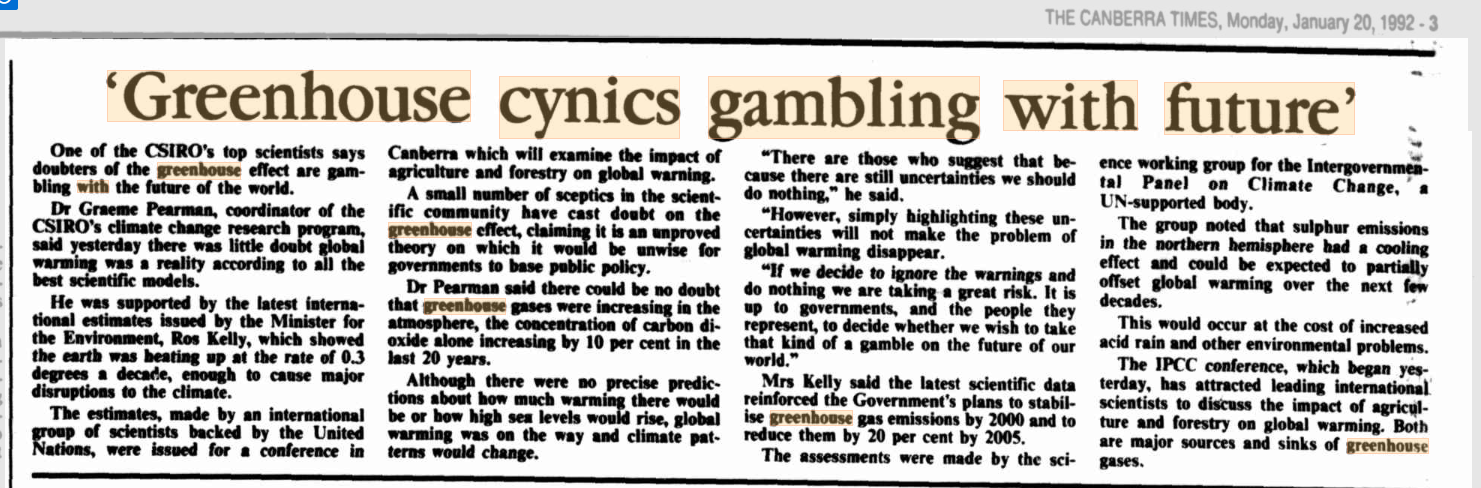
August 24, 1989 – a Sydney council takes greenhouse suggestions on-board (or says it will).

Thirty four years ago, on this day, August 24, 1989, Sydney councillors start to take note of citizen ideas for tackling “the greenhouse effect”. And use it to put the spotlight on the feds.

A concerned citizen’s letter has prompted Leichhardt Council to send three submissions to a Senate committee inquiring into ways of reducing the impact of the greenhouse effect.

The submissions, from Alderman Issy Wyner, as chairman of the council’s environment pollution control panel, Dr Ken Sullivan, president of the Clean Air Society of Australia and New Zealand, and Mr John Mara, council’s deputy chief health and building surveyor, were posted on Friday.

Mr N. G. Hyde, of Kingsgrove, had written to Leichhardt Council, expressing his concern about the greenhouse effect and depletion of the ozone layer.

“He probably wrote to every council but it stimulated a response from us,”Mr Mara said.

“We kept the matter on the agenda by writing to the Federal Environment Minister, Senator Richardson, and his NSW counterpart, Mr Moore, for advice, and picking up information from newspapers and journals.”

Bilic, J. 1989. Council officers greenhouse tips. Sydney Morning Herald, 24 August. 

The amount of carbon dioxide in the air was roughly xxxppm. As of 2023 it is 423ppm, but check here for daily measures. 

The context was that everyone was running around with urgency and ideas for dealing with what was then called the greenhouse effect. People who understood it knew that early action was not only preferable but necessary because once it has got out of hand it wouldn’t just be “too expensive to do anything about” but “impossible ti do anything about.”

This was at a federal state and local level in Australia. (Of course we had had the Brundtland Report by now, which emphasised the importance of local action).

What I think we can learn from this is that all the rhetoric about responsive government, citizen engagement citizen participation have been with us for generations. And on whole, in most places, it has not taken. And even in the places where it has taken it needs persistent consistent effort because the culture of atomization of neoliberalization of techno-salvationism is very very strong.

What happened next – they gave us the language of Local Agenda 21, but local councils went back to doing what they do best – being secretive, flogging off state assets including publicly-owned land to developers in exchange for brown envelopes and acting as a career launch pad and finishing academy for ambitious young politicians wanting to be an MP, and general “snout in the trough” opportunities for others

What do you think? Does this pass the ‘so what?’ threshold? Have I got facts wrong? Interpretation wrong? Please do comment on this post, unless you are a denialist, obvs.

Categories
Australia

August 23, 1971 – nuggets of ecological wisdom from Nugget Coombs.

Fifty two years ago, on this day, August 23, 1971, recently retired Australian civil servant Nugget Coombs delivered a lecture on “ecological and economic realities” at 12th Pacific Conference, Canberra.

The amount of carbon dioxide in the air was roughly xxxppm. As of 2023 it is 423ppm, but check here for daily measures. 

The context was that everyone was running around talking about ecological damage and – as the phrase would come out next year – “the Limits to Growth.” So you have what sounds, even today, as quite radical perspectives. 

The other context is Nugget Coombs had been a very important influential even famous civil servants in Australia. He was recently retired and was able therefore to talk more freely. This paper sets out clearly what was stake.

What I think we can learn from this

 That the language around non growth economy meeting human needs ecological limits. all of this has been around forever well 50 years.

What happened next

Coombs kept active and was still alive 20 years later when the next big wave of “Environmental Concern” came around.

What do you think? Does this pass the ‘so what?’ threshold? Have I got facts wrong? Interpretation wrong? Please do comment on this post, unless you are a denialist, obvs.

Categories
Australia Carbon Pricing

August 22, 2011 – anti-carbon pricing rally flops

Twelve years ago, on this day, August 22, 2011 , another anti-”carbon tax” rally flops

Come 22 August [2011], the event is a screaming flop. Three hundred people gather on the lawns outside Parliament House, and a ragtag of trucks circle it blowing their horns. Jones, alongside his mate Tony Abbott, addresses the crowd who all holler and howl and demand Gillard’s head over the carbon pricing scheme. Perhaps aware of what a dud he’s partly responsible for, Jones sensationally accuses the ACT Police of stopping ‘thousands’ from attending the rally and blocking ‘hundreds of trucks’ at the ACT border – as he describes it, ‘the most disgraceful thing to happen to our democracy.’

(Walsh, 2013:54-5) The Stalking of Julia Gillard      

An angry crowd of about 300 people gathered on the Australian Parliament lawns as 200 vehicles from all over the country rolled around Canberra blowing their horns, for what protesters called the convoy of no confidence.      Cummings, T. 2011. When things turned ugly. ABC News, 23 August.

There was an ugly confrontation in Canberra yesterday, one that could potentially have been very nasty indeed.

It had nothing to do with politics, nothing to do with the Convoy of No Confidence that rolled into our nation’s capital, nothing to do with the carbon tax, or live exports, or any of that.

and

I wonder whether the Convoy of No Confidence will be an unexpected pivot point in Australian politics.

Carpenter, N. 2011. Convoy Contempt could be of some consequence. The Drum, 29 August. http://www.abc.net.au/news/2011-08-29/carpenter-convoy-contempt-could-be-of-some-consequence/2860718

The amount of carbon dioxide in the air was roughly 369.8ppm. As of 2023 it is 423ppm, but check here for daily measures. 

The context was that the first half of 2011 had been totally dominated by the question of an emissions trading scheme. Tony Abbott had made all sorts of outlandish claims about the cost and risk there had been marches and protests, most notoriously on March 23rd in Canberra. This was an attempt to show enormous opposition. But I think many people were tired and bored and realised that by now they had lost, and that Gillard was going to be successful in getting the legislation through.

What I think we can learn from this is that it is not just left wing progressive protest groups who are prone to burnout and exhaustion. There is an emotacycle collapsing also for those who are trying to stand in the way of climate action, who  are also prone to burnout and exhausting themselves.

What happened next 

Julia Gillard’s legislation did indeed get through. The scheme started on the 1st of July 2012 and was then abolished by the next government headed by Tony Abbott. Emissions started climbing again. (There is some argument that the perceived success of the emissions trading scheme was down to more hydro from Tasmania in the national electricity grid at the time).

What do you think? Does this pass the ‘so what?’ threshold? Have I got facts wrong? Interpretation wrong? Please do comment on this post, unless you are a denialist, obvs.

References/further reading

 Willingham, R. 2011. Convoy of no confidence runs short on revs. Sydney Morning Herald, 23 August 2011.

Categories
Australia

August 22, 2000 – Minchin kills an Australian Emissions Trading Scheme

Twenty three years ago, on this day, August 22, 2000, the first effort at getting an emissions trading scheme for Australia died a death, killed off by climate denier Nick Minchin.

22 August 2000. Cabinet meeting at which Minchin beats Hill on a domestic emissions trading scheme. (See Crabbe, 23 Aug Advertiser etc)

The amount of carbon dioxide in the air was roughly 369ppm. As of 2023 it is 423ppm, but check here for daily measures. 

The context was that there had been lots of talk about emissions trading in the previous two or 3 years both at a national and especially New South Wales level because it seemed Australia might ratify the Kyoto Protocol. And if it did it would want to have its own emission trading scheme and perhaps make lots of money from growing trees. The best laid plans had not really come to fruition, and this was the first body blow – the rejection of a national emissions trading scheme.

What I think we can learn from this is that we have spent a veeery long time coming up with all sorts of visions and schemes rather than reducing our emissions in a safe and fair way by changing behaviours and incentives for energy efficiency etc.

What happened next

John Howard, to no-one’s surprise ruled out Kyoto ratification in 2002. In 2003 the idea of emissions trading scheme came back to cabinet and this time Cabinet was united in favour but Howard vetoed it LINK.

What do you think? Does this pass the ‘so what?’ threshold? Have I got facts wrong? Interpretation wrong? Please do comment on this post, unless you are a denialist, obvs.

Categories
Australia Carbon Pricing

August 17, 1998 – Emissions Trading considered (again)

Twenty five years ago, on this day, August 17, 1998, an Australian Parliament committee looks at Emissions Trading as the ‘way forward’.

House of Representatives Standing Committee on Environment, Recreation and the Arts into the possible introduction of trading in this new commodity. (Carbon) http://www.aph.gov.au/Parliamentary_Business/Committees/House_of_Representatives_committees?url=environ/greenhse/gasrpt/finalrpt.pdf

The amount of carbon dioxide in the air was roughly 366ppm. As of 2023 it is 423ppm, but check here for daily measures. 

The context was that the Australian government had extorted an extremely sweet deal at the Kyoto conference in December 1997. This was the starting gun for the idea of emissions trading schemes in different countries which would ultimately linked up and make bankers and traders rich while, as a sideline, “saving the world on the cheap.” 

The Australian government had signed the Kyoto protocol document in April of 1998. The leak about ratification only happening if the Americans ratified will still a month away, so at this precise moment the idea of Australia having its own emissions trading scheme that then linked up to other emissions trading schemes was not the fantasy that we would look on it as with 25 years of bruising experience.

What I think we can learn from this is that standing committees/senate inquiries house of reps stuff, it’s all nice busy work or undergrowth for policy wonks where they can can justify their money they are on, make professional connections and try to create a common sense agreement around whatever their particular pet solution is. Policy subsystems, policy constituencies etc etc.

What happened next is a proposal for an emissions trading scheme for Australia went to John Howard’s cabinet in the year 2000 killed off by Nick Minchin from South Australia the Sydney’s future exchange never got off the drawing board.

What do you think? Does this pass the ‘so what?’ threshold? Have I got facts wrong? Interpretation wrong? Please do comment on this post, unless you are a denialist, obvs.

Categories
Australia

August 16, 2010 – Polar Bears going through the motions

Thirteen years ago, on this day, August 16, 2010, protestors tried to keep issues on the agenda 

Even outside the venue, the protestors simply went through the motions. There were four anti-abortion advocates with basic placards, a huge plastic marijuana joint, two people dressed as polar bears, and another dressed as a blue elephant. But they were not so much demonstrating as loitering.

(Cassidy, 2010:202)

The amount of carbon dioxide in the air was roughly 388ppm. As of 2023 it is 423ppm, but check here for daily measures. 

The context was that this was the middle of an election campaign. And even the polar bear can’t be bothered. Everyone’s just going through the motions.

What I think we can learn from this

The polar bear costumes just don’t work. They should be hung up.

What happened next

Gillard was faced with painful electoral math and therefore had to bring carbon pricing back on to the table. 

What do you think? Does this pass the ‘so what?’ threshold? Have I got facts wrong? Interpretation wrong? Please do comment on this post, unless you are a denialist, obvs.

References