On the 29th of March 1995, in Berlin at the first “Conference of the Parties” of the UNFCCC, Kuwait, put forward a scientist, who said that if global warming was happening, it wasn’t the fault of coal and oil. Of course, they would say that; “Mandy Rice Davies applies.” You need to think about Kuwait, as a spoiler in all of this, along with Saudi in the US and Australia. And if you’re looking for the gory details, Jeremy Leggett’s book, The Carbon War is really good on this.
What happened next?
COP1 ended with the Berlin Mandate – rich countries agree to cut emissions first. Two years later, in Kyoto, the first agreement to reduce emissions was agreed for what that was worth (not much). Kyoto was not replaced, and eventually a laughable “pledge and review” system got implemented (Paris). And the emissions climb and climb.
On this day in 1979, a few weeks after the end of the First World Climate Conference, Wally Broecker, the oceanographer met with Exxon scientists who were studying climate change and fossil fuels.
Broecker, to his apparent dismay, had coined the had been the first to use the term global warming in an academic context. (According to Alice Bell’s book “Our Biggest Experiment”, he offered 200 bucks to anyone who could find an earlier example so he wouldn’t be lumbered with the unwanted title.
What’s Exxon in all this? Well, “Exxon knew”. Exxon was doing its own studies of the climate problem, the carbon dioxide problem in the late 70s, early 80s. And this involved talking to scientists who knew what they were talking about. And Broecker most certainly was one of the scientists who really knew what he was talking about
You can read more about this at the truly excellent “Inside Climate News”
We need to remember that Exxon knew, and that scientists, quite rightly will talk to different constituencies they are paid out of taxpayer funding, and they should talk to not just the grassroots groups, but the biggies. And we need to know that in 1979, there were people seriously worried about climate. And these weren’t just hippies living in communes. This was the elite and it would be another 9 or 10 years before the issue would successfully break through and the co2 concentration had gone up and more kit had been built, and more norms around production and consumption had been established. And yes, yes, the population had gone up too; we have two problems. The one that we in the West really need to do something about is overconsumption, exploitation, imperialism, hyper-extractivism, murder, you name it. And once we’ve done all of that, and paid reparations, then we can start to lecture other people about having too many babies.
On this day in 1988 the World Meteorological Organisation, (the clue is in the name) sent out invites to be part of what is now known as the IPCC
“In the absence of an official US initiative, WMO took the lead and held discussions with UNEP on this proposal. Eventually, a slightly modified version was sent out by the Secretary General of WMO on March 25, 1988 to member governments inquiring whether their country would like to be represented on a proposed ‘Intergovernmental Panel on Climate Change’ (Obasi, 1988).”
Agrawala, S. (1998a, p 615)
The context is this
The discovery of the ozone “hole” gave atmospheric scientists a high profile and trust. Atmospheric scientists had finally decided at a meeting hosted by WMO, UNEP and ICSCU,, in Villach, Austria, in October 1985, that the carbon dioxide problem they had been studying and talking about in-depth for roughly 15 years, needed proper policy responses
The right-wing administration of the US “President” Ronald Reagan was split, but mostly opposed to this. They DEFINITELY did not want independent scientists pushing them around. So, we get an intergovernmental panel rather than an international one. They key sources – but by no means the only ones – for this, are
Agrawala, S. Context and Early Origins of the Intergovernmental Panel on Climate Change. Climatic Change 39, 605–620 (1998). https://doi.org/10.1023/A:1005315532386
Agrawala, S. Structural and Process History of the Intergovernmental Panel on Climate Change. Climatic Change 39, 621–642 (1998). https://doi.org/10.1023/A:1005312331477
What happened next
The IPCC first met in November 1988, in Geneva. Within a year and a half its first assessment report was ready. It was, of course, attacked and enormous attempts were made to water it down. Things really got heated (ho ho) when the second assessment report came out. That was very very nasty indeed…
On March 23 1989, cold fusion was announced by a couple of overexcited scientists. (the gory details of why they came to be releasing this when they did can be found here).
The implication in fusion (hot or cold, but especially cold) is of limitless energy, which sounds like a good idea until you start thinking about how infantile human societies would actually use that limitless energy: we would just intensify our exploitation/exploration. [Comedy fact, the Portuguese have one word that covers both of those].
And limitless energy would accelerate our doom in all probability without some serious wisdom in our institutions. And I see no evidence of any wisdom in our institutions. (There may have been some, but we have moron-ified ourselves over the last 40 years or more.)
But anyway, this particular bout of cold fusion was quickly debunked, and there were many articles and books about what it all “meant.” Science and Technology Studies was then a relatively new thing.
On this day in 1963, the first ever policymaker meeting – in the West at least(1) – specifically around carbon dioxide bonding happened in New York under the auspices of Laurence Rockefeller’s organisation, the Conservation Foundation, (not to be confused with the Conservation Society launched in the UK three years later, and not funded by Rockefeller.)
The account of the meeting, which you can read here, had the snappy title “Implications of rising carbon dioxide content of the atmosphere; a statement of trends and implications of carbon dioxide research reviewed at a conference of scientists.”
Present at the meeting were Roger Revelle, Gilbert Plasss, Charles Keeling, and an Englishman called Frank Fraser Darling – someone we will return to…
The context was that as of 1959, it has become clear that carbon dioxide was indeed building up in the atmosphere, and that eventually, this would lead to warming of the planet. And this would lead to ice caps melting in flooded cities, changing weather patterns, etc.
But at this stage, in early 1963 the assumption was, this would be a problem in a couple of 100 years as per Svante Arrhenius
Why this matters.
The Conservation Foundation report of this symposium was not a best-seller, but it DOES pop up in the reference list of various books and articles over the rest of the decade, before it starts to be supplanted by later events with more information.
What happened next?
Revelle worked on a report for Lyndon Johnson’s science subcommittee with Margaret Mead Frank Fraser Darling would talk about the build up of co2 as a problem and his reef lectures for the BBC in November of 1969
And the CO2 would continue to accumulate
For more about the Rockefellers role in postwar environmentalism this article “The Eco-Establishment “by Katherine Barkley and Steve WeissmanRamparts Magazine, May 1970, pp. 48-50
Footnotes
(1) “Fedorov and Budyko were both key instigators of a specially convened meeting on the transformation of climate which took place in Leningrad during April 1961.40 This meeting, together with a related workshop the following June, represented the first focussed Soviet discussions concerning anthropogenic climate change” (Oldfield, 2018: 45).
Oldfield, J. (2018) Imagining climates past, present and future: Soviet contributions to the science of anthropogenic climate change, 1953e1991. Journal of Historical Geography 60 41- 51.)
On this day in March 5 1950, Jule Charney and Jonny von Neumann produced the first computer simulation of the weather. Who were these people? Jules Charney was, according to Wikipedia considered “the father of modern dynamical meteorology, Charney is credited with having “guided the postwar evolution of modern meteorology more than any other living figure.”
And in 1979, he helmed what’s now known as the Charney report, which told the politicians that yes, there was no reason to doubt that a doubling of the amount of carbon dioxide in the atmosphere would lead to a three degree temperature rise.
Jonny von Neumann was Hungarian, possibly the smartest person who’s ever lived. And in 1955 he would warn Fortune magazine of the buildup of carbon dioxide shortly before his death in early 1957.
Why this matters.
The work Neumann and Charney did was foundational for the Geophysical Fluid Dynamics Laboratory, set up in 1963 under NOAA (National Oceanic and Atmospheric Administration) to model the atmosphere.
Computer simulations, computer models of the climate have been extremely important for creating the understanding (and global awareness) of weather and climate. And there is a book by Paul Edwards called A Vast Machine which will tell you a lot more.
What happened next?
It would be another five or six years before the buildup of carbon dioxide started to impinge properly on people’s consciousness.
On this day, in 1861, Irish scientist John Tyndall read his paper about carbon dioxide at the Royal Society at the annual Bakerian lecture. Tyndall was not, we now know, the first person to point out what he called carbonic acid had greenhouse water warming potential. That honour belongs to Eunice Foote in the United States a few years earlier. There’s an interesting and useful summary of this at the beginning of Alice Bell’s excellent 2021 book “Our Biggest Experiment.” And of course the idea that there must be something, some gas, keeping the planet warmer than it otherwise would be dates back to Fourier in 1824.
Tyndall did the research, reported it. It wasn’t for another 35 years that someone, Svante Arrhenius. said, “this is in fact going to be a thing (but not for centuries, and it will be a good thing.”. He was trying to distract himself from a messy divorce by doing laborious calculations, which your mobile phone could probably do in about three seconds now.
Why this matters,
We’ve understood the science – this is 19th century physics – for a very long time. Unfortunately, we have not acted. And as I’ve said before, I will say again, that “we” first person plural pronoun is doing a lot of work in that sentence.
On this day, the New York Times released a report, written by Andy Revkin, about how famed climate scientist James Hansen was being subjected to attempts at gagging him by some of George W Bush’s appointed goons. You can read all about it here. There’s a whole (very good) book about the campaign, called Censoring Science.
Hansen had already been up against this sort of stuff in 1981, when the incoming Reagan administration had cut his funding in retaliation to a previous front page story on the New York Times.
Why this matters?
Because if scientists, charities, think tanks, civil trade unions, etc, are gagged and silenced, then the public don’t get a real sense of “what’s up” (though by now, it amounts to wilful ignorance, and anyway, information on its own counts for nothing). This is all part of the long war against impact science, usually by no means exclusively, on the part of the “ right “. You have to remember that when the “left” is in charge, it also doesn’t go particularly well for independently minded scientists.
What happened next
Hansen is still publishing. You can see his Google Scholar page here because Hansen is in the old Yiddish term, a mensch.
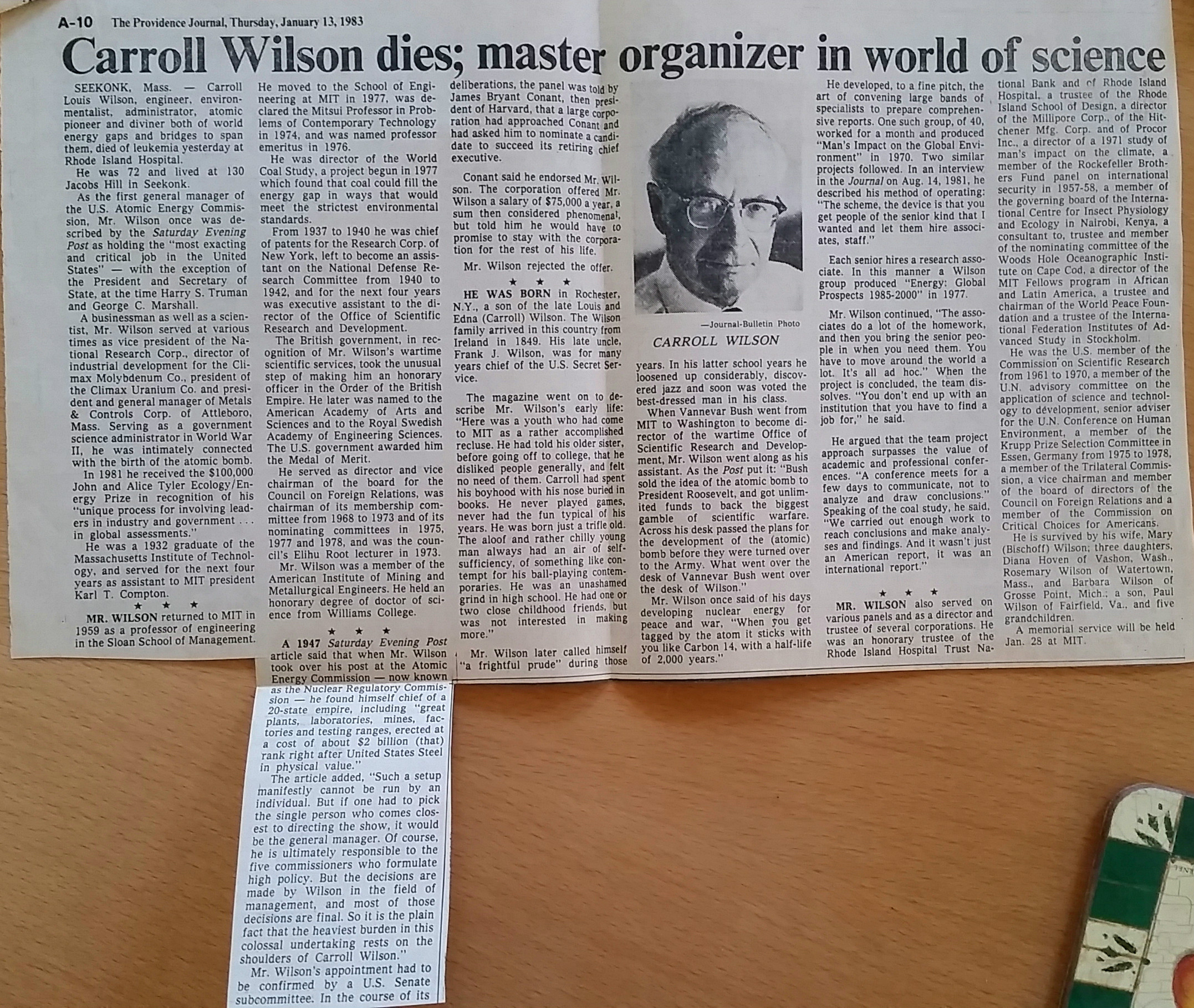
Jan 12, 1983 – RIP Carroll Wilson, “master organizer in world of science” (and early climate connector)
On this day, in 1983, a man died who you’ve almost certainly never heard of, but is one of the many who tried – ultimately unsuccessfully – to raise the alarm over 50 years ago.
“Wilson then turned to larger issues, pioneering a new format for studying and publicizing major scientific problems in world development. In 1970, for the first study, he assembled a multi-disciplinary group that produced, in one month, Man’s Impact on the Global Environment. The study was an important catalyst of debate within the U.S. on the greenhouse effect and other major environmental consequences of technology, including the SST. The following year Wilson brought together 35 atmospheric scientists from 15 countries in Stockholm to produce Inadvertent Climate Modification: Report of the Study of Man’s Impact on Climate.”
Here’s a four page article on him, which has him as crucial midwife to the Limits to Growth report –
“The chain of events which led to the book began when Carroll Wilson introduced Jay Forrester, S.M. ’45, head of the System Dynamics Group at M.I.T., to the Club of Rome – an independent, international forum for the “great issues.” Forrester saw that the problems of growing complexity considered by the Club of Rome lent themselves to computer modeling. He produced two models and one of his collaborators produced a third on which some of Forrester’s colleagues based The Limits to Growth.”
And here is a jpg of an obituary which calls him “a master organizer in the world of science”.
Why it matters – we should pause to remember the efforts of the Revelles, the Bolins, the Wilsons and others. It wasn’t for lack of warning from scientists that we stuffed this one up. And hoping that another scientist will turn up, with just the right graph, and just the right tone of voice, is at best stupid. At worst it is a wilful refusal to be a citizen.