Categories
Carbon Capture and Storage Carbon Dioxide Removal Swtizerland Uncategorized

August 30, 1998 – Fourth International Conference on Greenhouse Gas Control Technologies

Twenty-seven years ago, on this day, August 30th, 1998,

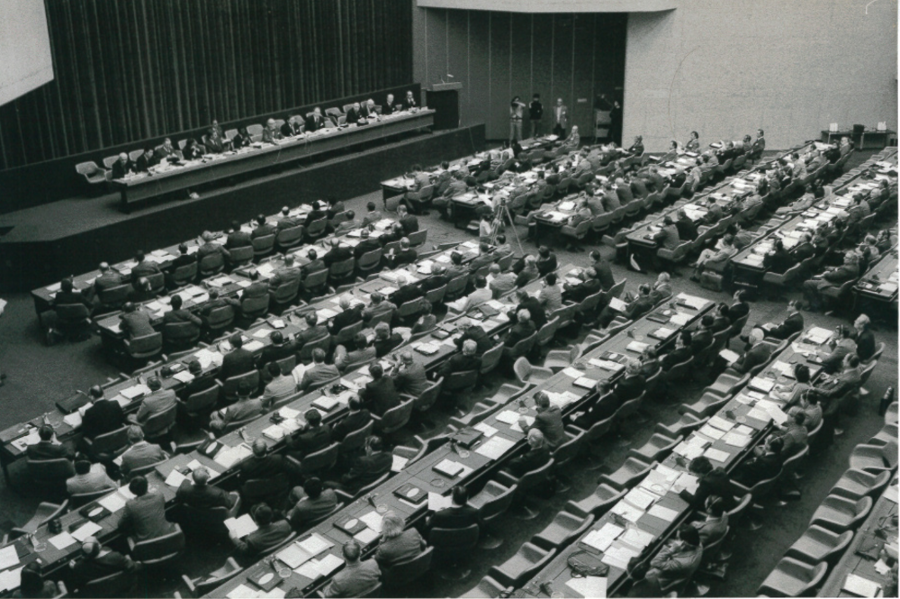
4th International Conference on Greenhouse Gas Control Technologies, 30 Aug. – 2 Sept. 1998, Interlaken, Switzerland

There’s a book here

The amount of carbon dioxide in the air was 367ppm. As of 2025, when this post was published, it is 430ppm. This matters because the more carbon dioxide in the air, the more heat gets trapped. The more heat, the more extreme weather events. You can make it more complicated than that if you want, but really, it’s not. Fwiw, I have a tattoo of the Keeling Curve on my left forearm.

The broader context was that conferences about “greenhouse gas control technologies” had been happening since the early 1990s.

The specific context was that this was the first one after the Kyoto Protocol was “agreed” the previous December. It now looked like rich countries were going to have to something to reduce their emissions. Therefore, a bit more attention was being paid to various 

What I think we can learn from this is that the promises of capture/reducing greenhouse gas emissions have been spilling from engineers’ mouths for decades. Proven at scale technologies that capture meaningful amounts of carbon dioxide? Not so much…

What happened next – the conferences kept happening. CCS has gone through periodic periods of rise and fall since then. The only really steady trend is in the Keeling Curve, which measures the amount of carbon dioxide in the atmosphere. And guess what, that’s starting to point up more. Happy days.

What do you think? Does this pass the ‘so what?’ threshold? Have I got facts wrong? Interpretation wrong? Please do comment on this post, unless you are a denialist, obvs.

Also on this day: 

August 30, 1971 – Bob Carr (ex- NSW premier) ‘gets’ climate change

August 30, 1975 – The Science Show does climate change…

August 30, 1986 – Adelaide warned about climate change by Environment Minister Don Hopgood

August 30, 1989 – A global tax on emissions?!

August 30, 1990 -Australian diplomats (probably) tried to water down IPCC recommendations
Categories
Swtizerland UNFCCC

July 18, 1996 – Geneva Ministerial Declaration noted but not adopted

Twenty nine years ago, on this day, July 18th, 1996,

COP 2, Geneva, Ministerial Declaration was noted (but not adopted) July 18, 1996, COP 2 took place in July 1996 in Geneva, Switzerland. Its Ministerial Declaration was noted (but not adopted) July 18, 1996, and reflected a U.S. position statement presented by Timothy Wirth, former Under Secretary for Global Affairs for the U.S. State Department at that meeting, which:

1. Accepted the scientific findings on climate change proffered by the Intergovernmental Panel on Climate Change (IPCC) in its second assessment (1995);

2. Rejected uniform “harmonized policies” in favor of flexibility;

3. Called for “legally binding mid-term targets”.

The amount of carbon dioxide in the air was 363ppm. As of 2025, when this post was published, it is 430ppm. This matters because the more carbon dioxide in the air, the more heat gets trapped. The more heat, the more extreme weather events. You can make it more complicated than that if you want, but really, it’s not. Fwiw, I have a tattoo of the Keeling Curve on my left forearm.

The broader context was that the negotiations for a climate treaty, which got underway officially in early 1991, were hampered from the start by US intransigence on any strong action (yes, the Republicans were ideological about this, but there was also the industrial interests, for example the Global Climate Coalition).

The specific context was that at the COP1 meeting in Berlin, the rich nations had agreed to turn up at the third meeting (some point in 1997) with plans for actual cuts. This was causing all sorts of mayhem….

What I think we can learn from this is that it’s easy-ish to make promises. But the closer you get to having to deliver on them, the more awkward and angry everyone gets….

What happened next – the Kyoto meeting led to an utterly inadequate set of promises, which didn’t even get enacted because the US and then Australia pulled out. The Kyoto Protocol finally became law in 2005 when Russia joined, as part of a quid pro quo for World Trade Organisation membership….

What do you think? Does this pass the ‘so what?’ threshold? Have I got facts wrong? Interpretation wrong? Please do comment on this post, unless you are a denialist, obvs.

Also on this day: 

July 18, 1979 – US Senators ask for synthetic fuel implications for greenhouse warming. Told.

July 18, 2005 – inconvenient energy targets scrapped

July 18, 2012: Climate Justice poem – “Tell Them” by Kathy Jetnil-Kijiner – hits the internet

Categories
Swtizerland

June 5, 1967 –  Working Group on Atmospheric Pollution and Atmospheric Chemistry

Fifty eight years ago, on this day, June 5th, 1967, some scientists met in Geneva. I know, fascinating eh…

REPORT OF MEETING – METEOROLOGICAL ASPECTS OF ATMOSPHERIC POLLUTION AND ATMOSPHERIC CHEMISTRY

(Received 23 January 1968)

IN THE week of 5 June 1967 the Working Group on Atmospheric Pollution and Atmospheric Chemistry, established by the Commission for Atmospheric Sciences (formerly Commission for Aerology) of the World Meteorological Organization met for the first time in Geneva.

The following persons act as members of the W.G.:

F. H. Schmidt (Chairman), Netherlands

E. Eriksson, Sweden

A. G. Forsdyke, England

R. E. Munn, Canada

Mrs. E. S. Selezneva, U.S.S.R.

Atmospheric Environment, Pergamon Press 1968. Vol. 2, pp. 423-426.

The amount of carbon dioxide in the air was roughly 322ppm. As of 2025 it is 430ppm, but check here for daily measures. 

The broader context was that from the early 1950s questions around atmospheric pollution – first sulphur dioxide, but then latterly carbon dioxide and others – worked their way through the science-policy system.

The specific context was that the President’s Scientific Advisory Council had released a report in late 1965 that did more than name-check carbon dioxide.  Shell and others were beginning to pay attention… 

What I think we can learn from this is that the wheels of the WMO and WHO and so on grind slow, but grind they do. (Given time, I’d like to trace this process more.)

What happened next – by the late 1960s, word was getting through, thanks not so much to these sorts of meetings (that was not their purpose!) but thanks to various popularisers, e.g. Peter Ritchie-Calder.

What do you think? Does this pass the ‘so what?’ threshold? Have I got facts wrong? Interpretation wrong? Please do comment on this post, unless you are a denialist, obvs.

Also on this day: 

June 5, 1993 and 2011- let’s have a march for #climate… It will make us feel good. – All Our Yesterdays

Categories
Swtizerland

April 30, 1993 – HTML

Thirty two years ago, on this day, April 30th, 1993, British scientist Tim Berners-Lee, then at CERN, publishes the protocols for what would become the “World Wide Web.”

The amount of carbon dioxide in the air was roughly 357ppm. As of 2025 it is 427ppm, but check here for daily measures. 

The context was that ARPANET and Darpanet were already “a thing”, but getting computer to speak to computer was not necessarily that easy. Berners-Lee’s genius was in the codification but also in refusing to patent it.

What I think we can learn from this is that there is such a thing as an intellectual commons, but that commons requires rules and governance. This is possible, despite what actual racist scumbags like Garrett Hardin may have though. Having said that, the AI slop and the broligarchs are making Hardin’s view plausible.

What happened next

1995-96 the internet for public consumption begins to kick in. You have email, then you have Hotmail, web based email. You have websites, internet cafes, Hollywood making websites for things like the movie Independence Day and so on, and I was relatively young back then. I’m very glad that I hit my adulthood, if you can call it that, before the internet and certainly before social media, and certainly, certainly before smartphones. Because those things are like the blood in Alien they are acid, and they will burn through any container you care to mention.

What do you think? Does this pass the ‘so what?’ threshold? Have I got facts wrong? Interpretation wrong? Please do comment on this post, unless you are a denialist, obvs.

Also on this day: 

April 30, 2007 – Rudd hires Garnaut – All Our Yesterdays

April 30, 1985 – New York Times reports C02 not the only greenhouse problem

April 30, 2001 – Dick Cheney predicts 1000 new power plants

Categories
Australia International processes Swtizerland

July 12, 1996 – medics slam energy companies for outright denial and obstruction

Twenty eight years ago, on this day, July 12th, 1996, COP2 

GENEVA, July 12 (Reuter) – Top specialists on the effects of global warming on human health on Friday accused energy corporations of working to undermine international efforts to halt climate change.

The attack came amid growing controversy at a two-week United Nations conference on how far to limit “greenhouse gas” emissions, mainly from burning of oil and coal, blamed by key scientists for rising world temperatures.

“The fossil fuel lobby is beginning to behave like the tobacco industry did 30 years ago, as adverse health effects of smoking first emerged,” Anthony McMichael of the London School of Hygiene and Tropical Medicine said.

“It is using a typical rearguard action, through attempts at distortion, delaying tactics and making enough noise to drown out the arguments for strong moves by the world’s political leaders to cut emissions,” he told a news conference.

1996 – Evans, R. 1996 Doctors hit energy groups over global warming. Reuters News 12th July

The amount of carbon dioxide in the air was roughly 363ppm. As of 2024 it is 426ppm, but check here for daily measures. 

The context was that COP1 had finished with the so-called Berlin Mandate, which meant rich nations were going to have to come to Kyoto with an agreement to reduce their emissions. The new federal government in Australia was distinctly unimpressed. And so was industry, which had seen off a domestic carbon tax and had it replaced with a meaningless Greenhouse Challenge probably saw no reason why that same victory couldn’t be repeated on the international stage. Yes, you’d have to ignore brown people living in low lying countries and islands. But that was hardly difficult. 

What we learn is that fossil fuel interests had had successes domestically, and had every confidence that they could repeat that internationally. And it turns out, sadly, for our species, and all the other species on this beautiful planet, that their confidence was well-founded. They managed to gut the ambition and the Kyoto Protocol. And they’ve managed to keep winning. Now, they were joined in this by inertia, complacency, neoliberalism, whatever set of explanations, nouns you want to use. But they were a key factor in making sure nothing significant got done. And they were very, very good at doing that.

What happened next? Australia carved out an incredibly generous deal at Kyoto in 1997. And then, still refused to ratify. When they finally did in 2007 it was a meaningless gesture. The sort of thing that Kevin Rudd excelled at. Actually doing policy and implementation, he found somewhat more challenging.

What do you think? Does this pass the ‘so what?’ threshold? Have I got facts wrong? Interpretation wrong? Please do comment on this post, unless you are a denialist, obvs.

Also on this day: 

July 12, 1953 – “The Weather is Really Changing” says New York Times

July 12, 1978 – US Climate Research Board meeting

July 12, 2007 – #Australia gets swindled on #climate change…

Categories
Science Swtizerland

February 12, 1979 – First World Climate Conference opens

Forty four years ago, on this day, February 12th, 1979,the First World Climate Conference began in Geneva.

The amount of carbon dioxide in the air was roughly 337ppm. As of 2024 it is 422ppm, but check here for daily measures. 

The context was that all through the 1970s, climatologists have become more and more convinced that climate change was happening, and that carbon dioxide was the principal culprit. And so a proposal had been accepted for the first world climate conference. And it opened at some big hall in Geneva where the World Meteorological Organisation is based.

What we learn is that if you want to have an impact, you need these sorts of conferences. Unfortunately, John Mason, the British head of the Meteorological Office was not helpful. 

What happened next? There was ongoing momentum around the climate issue ‘79-80. And then as Al Gore said, in 1988, it all ended once Reagan became president. Or rather, US political support did – the science kept going, best it could.

What do you think? Does this pass the ‘so what?’ threshold? Have I got facts wrong? Interpretation wrong? Please do comment on this post, unless you are a denialist, obvs.

Also on this day: 

Feb 12, 1958- the Unchained Goddess is unchained…

February 12 1968 – The Motherfuckers do their motherfucking thing, with garbage in New York.

Categories
IPCC Swtizerland

November 9, 1988 – Tolba gives “Warming Warning” speech at first IPCC meeting

Thirty five years ago, on this day, November 9, 1988, the director of the United Nations Environment Program, the Egyptian scientist Mostafa Tolba, gave a stark opening address at the first meeting of the Intergovernmental Panel on Climate Change.

Tolba, M.: 1988, ‘Warming: Warning’, Opening Speech at the First Session of the Intergovernmental Panel on Climate Change, Geneva, November 9.

Oreskes and Conway 2010, page 184

The amount of carbon dioxide in the air was roughly 351.7ppm. As of 2023 it is 419ppm, but check here for daily measures. 

The context was the IPCC had been set up after negotiations, especially with the Americans. They wanted an intergovernmental panel that was frankly dependent, because they didn’t want to get “bounced” in the way they perceived they had been over the question of Ozone, by Bob Watson and his ilk (including Tolba).

What I think we can learn from this is that the institutional settings the terms of reference, who’s going to fund what, who’s going to deliver what and how matter.

What happened next

The IPCC delivered its first assessment report in 1990. Was attacked (see Ted Benton in the Greening of Machiavelli anecdote about Sundsvall).

What do you think? Does this pass the ‘so what?’ threshold? Have I got facts wrong? Interpretation wrong? Please do comment on this post, unless you are a denialist, obvs.

Categories
International processes Swtizerland

November 6, 1990 – Second World Climate Conference underway

Thirty three years ago, on this day, November 6, 1990, the consequential bits of the “Second World Climate Conference” began in Geneva. That is to say, the politicians turned up (the scientists had been hard at work for some days already).

[see here for a Conversation article about protests etc]

The amount of carbon dioxide in the air was roughly 354.4ppm. As of 2023 it is 419ppm, but check here for daily measures. 

The context was that the first world climate conference in Geneva, in February of 1979 had been pretty much scientists and a few policy makers. You can read various accounts of it. But the short version is that those who were wanting a bold statement that said “carbon dioxide is a real problem and we need to start taking action now” were unable to overcome the veto of people like John Mason, head of the UK Meteorological Office who was a long term climate skeptic. 

The following ten years of science and advocacy had pushed climate onto the agenda. The second world climate conference had been pushed back six months so that it could suit political needs because this was no longer purely a scientific endeavour. Since 1985, new climate scientists had been trying to engage policymakers directly and urgently or beginning in late 1985.

The existence of the conference had forced the question of emissions reductions targets onto the table, because no politician wanted to get booed and heckled by their colleagues and the media. So, for example, while Australia had come up with a provisional or Interim Planning Target, as it was called, very few other nations had. There were protests, organised by Greenpeace, very polite, as the Swiss had it, (see my Conversation article). 

What I think we can learn from this

Want to shake loose the bureaucracy? Engineer events as action-forcers I guess? Or rather decision-forcers The action will depend on implementation, which may or may not happen….

What happened next

At the beginning of 1991, pretty much simultaneous with the push to remove Saddam Hussein from Kuwait the climate negotiations finally started. 

There was a third world climate conference, but it was a denialist event in Moscow, and no one speaks of it… 

What do you think? Does this pass the ‘so what?’ threshold? Have I got facts wrong? Interpretation wrong? Please do comment on this post, unless you are a denialist, obvs.

Categories
Swtizerland

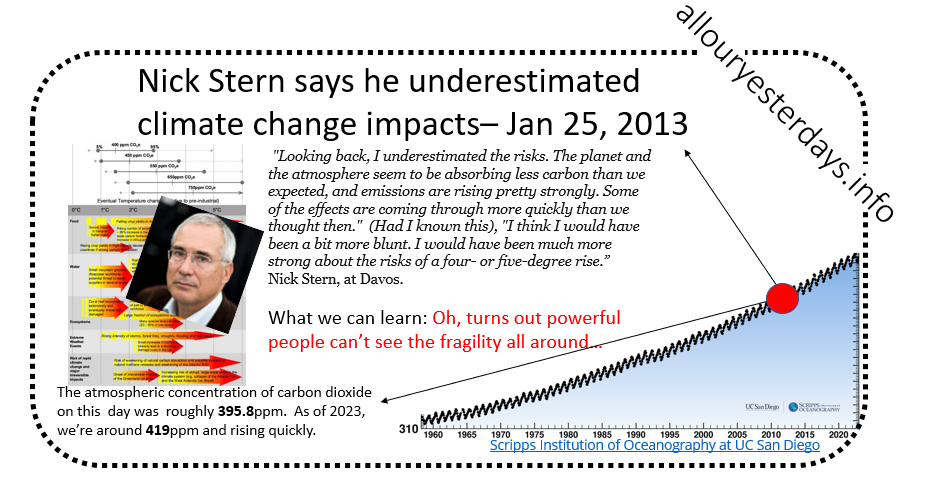
January 25, 2013 – Lord Stern admits #climate “worse than I thought”

Ten years ago, on this day, January 25, 2013, one of the white men who has been born with a “safe pair of hands” had the good grace to admit that he’d misunderestimated the speed and breadth of climate impacts. Nick Stern, former World Bank economist, had been tapped on the shoulder by then-Treasurer Gordon Brown in 2005, and had produced a report (“the Stern Review” on the Economics of Climate Change). Interviewed by two Guardian journos at Davos 6 years after its release, he said 

 “Looking back, I underestimated the risks. The planet and the atmosphere seem to be absorbing less carbon than we expected, and emissions are rising pretty strongly. Some of the effects are coming through more quickly than we thought then.”  (Had I known this), “I think I would have been a bit more blunt. I would have been much more strong about the risks of a four- or five-degree rise.”

http://www.theguardian.com/environment/2013/jan/27/nicholas-stern-climate-change-davos

The amount of carbon dioxide in the air was roughly 395.8ppm. As of 2023 it is 419.

The context was that the international climate negotiations were beginning to crank up for the next “big” meeting (Paris 2015) and folks at Davos (where the rulers of the world and their consiglieres, lackeys and hangers-on go to be seen) were making the right noises.

What I think we can learn from this

The people with the safe pairs of hands? Always ask yourself – safe for WHO? Safe for WHAT?

What happened next

Davos kept going (everyone should read Thomas Mann’s The Magic Mountain, imo. It’s set in Davos, but with a different cast of characters, different sensibility.). The Paris Agreement happened.  And everyone was saved.

What do you think? Does this pass the ‘so what?’ threshold? Have I got facts wrong? Interpretation wrong?  Do comment on this post.

References

Stewart, H. and Elliott, L. (2013) Nicholas Stern: ‘I got it wrong on climate change – it’s far, far worse’. The Guardian, 27 January.