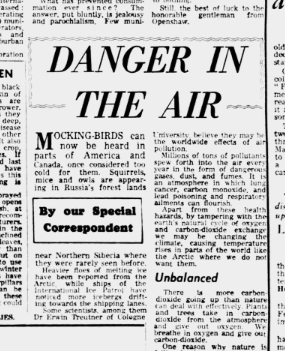
Fifty seven years ago, on this day, May 18th, 1967, NA Leslie, giving the Presidential Address at Institute of Petroleum, quotes from Barry Commoner’s Science and Survival, and mentions CO2 build- up as a possible problem
The amount of carbon dioxide in the air was roughly 322ppm. As of 2024 it is 425ppm, but check here for daily measures.
The context was that Barry Commoner’s book had come out the previous September. The BBC had shown Challenge in January of 1967 and the oil and gas industries’ own environmental body Concawe had been going since ‘63. And Torrey Canyon had just happened too…
[It would be fascinating to know if Concawe had written anything I don’t know where their records might be but I need to talk about them as a body as well.]
What we learn is that the oil and gas industries were aware of the issue at the time, not at the stage of necessarily wanting to do anything about it.
What happened next is that over the next couple of years the possible problem of carbon dioxide build up became much more broadly known in the UK and US (and to a lesser extent in Australia).
What do you think? Does this pass the ‘so what?’ threshold? Have I got facts wrong? Interpretation wrong? Please do comment on this post, unless you are a denialist, obvs.
Forty-five years ago, on this day, May 17, 1979 an important book on Environmental Pollution, written by Martin Holdgate, came out (with a section on carbon dioxide build-up),
The amount of carbon dioxide in the air was roughly 336.8ppm. As of 2024 it is 425ppm, but check here for daily measures.
The context was that Martin Holdgate had been working on pollution issues for 10 years by this stage and had a lot of useful data. This book had been finalised a couple of years before. The broader context of course, is that Margaret Thatcher had just taken office. And this unfortunately meant that the work on climate change that had been building under the Callaghan government was largely frozen out and ignored. So it goes.
What we can learn is what you have already learned from the site, which is that smart people knew. We knew. People who read newspapers knew. We knew we knew we knew.
The problem was not lack of information. The problem was plausible pathways to power and influence.
What happened next. Holdgate and others kept writing, kept working. And the emissions kept climbing.
What do you think? Does this pass the ‘so what?’ threshold? Have I got facts wrong? Interpretation wrong? Please do comment on this post, unless you are a denialist, obvs.
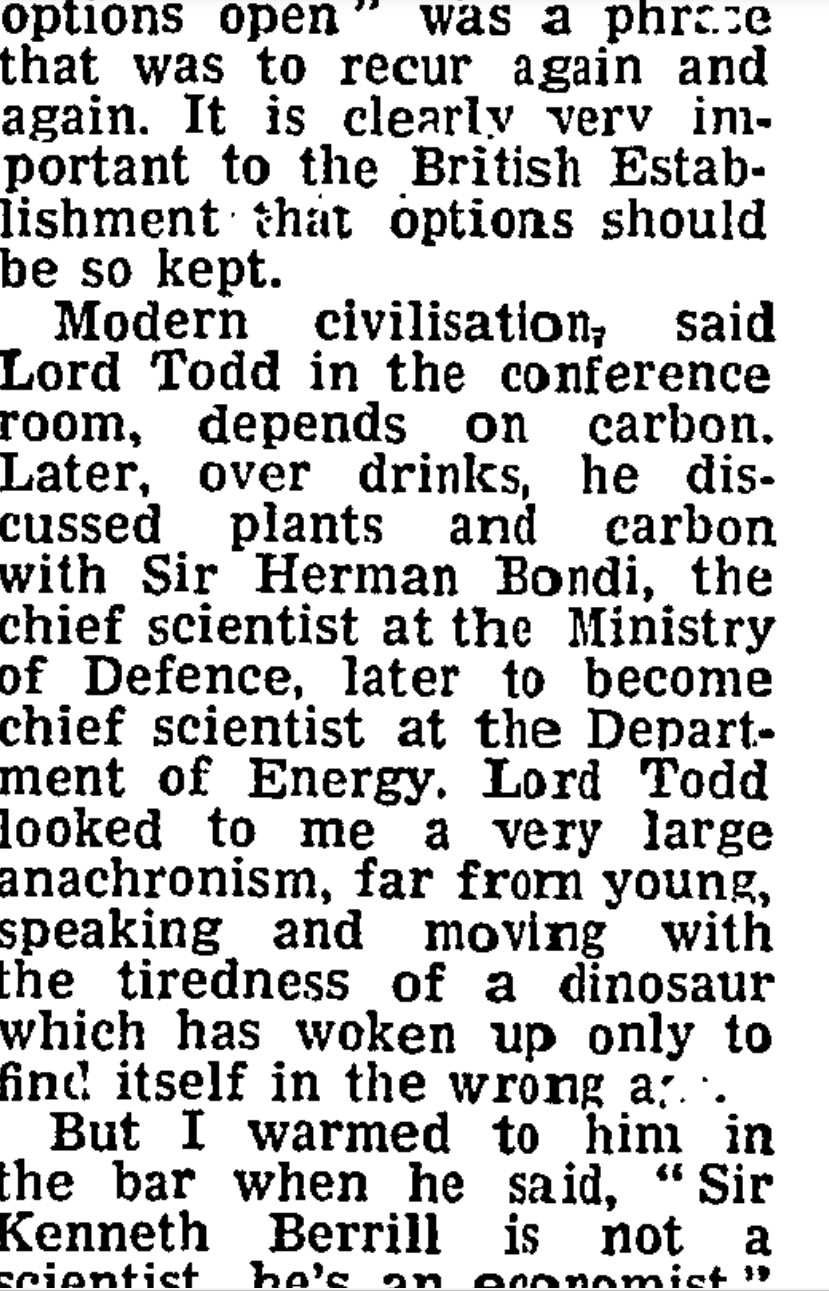
Forty-seven years ago, on this day, May 13th, 1977, Tony Benn, then Energy Minister, met assorted experts at Sunningdale to grapple with nuclear versus solar etc.
NB Wasn’t it Sunningale where the Police ‘processed the Libyans after the Yvonne Fletcher shooting??
The amount of carbon dioxide in the air was roughly 333ppm. As of 2024 it is 425ppm, but check here for daily measures.
The context was that the British state was in a financial hole. Energy was a big part of the problem,
What we learn is that, well, the civil servants in the nuclear lobby were very powerful and were capable of outwitting the politicians who were not necessarily the sharpest tools in the box.
What happened next, the climate issue was bubbling along. And in 1978, an interdepartmental group was set up to study the issue, producing a pipsqueak report that almost got suppressed or not released, before coming out in February 1980.
What do you think? Does this pass the ‘so what?’ threshold? Have I got facts wrong? Interpretation wrong? Please do comment on this post, unless you are a denialist, obvs.
References
Sedgemore, B. 1980. Civilisation: keeping the options open . The Guardian, March 10, p.7
Sixty seven years ago, on this day, May 13th, 1957, English steam engineer Guy Callendar, who had been pointing to carbon dioxide build-up as an explanation for increased global temperatures since the late 1930s, wrote to Gilbert Plass, who in 1953 had brought the problem to global attention (see my Conversation piece here).
How easy it is to criticise and how difficult to produce constructive theories of climate change! and ““A point of special interest is the large discrepancies between the apparent increase of atmospheric CO2 given by the air-CO2 observations . . . and the predicted increase derived from the size of the exchange reservoirs as now revealed by radio carbon measurements.”
Letter from Callendar to Plass 13 May 1957 (Fleming, 2007: chapter 5)
Guy Callendar
The amount of carbon dioxide in the air was roughly 315ppm. As of 2024 it is 425ppm, but check here for daily measures.
The context was that Guy Callendar had been banging on about climate change and carbon dioxide buildup since 1938. And Plass had been doing the same since 1953. The two were corresponding and Callendar made a very good point about how the more conventional/mainstream/whatever people were resentful of an outsider committing that terrible crime of being right and proving the experts to be wrong.
What we learn is that sometimes the experts are wrong. Other times they’re right but sometimes they are wrong. Don’t expect them to applaud you.
What happened next Callendar had another great piece in 1960 – see here. He died in 1964. Plass kept writing about climate for a few more years but eventually moved on to other things. And the emissions kept climbing.
What do you think? Does this pass the ‘so what?’ threshold? Have I got facts wrong? Interpretation wrong? Please do comment on this post, unless you are a denialist, obvs.
References
Fleming, J. 2009 The Callendar Effect – The Life and Times of Guy Stewart Callendar (1898–1964), The Scientist Who Established the Carbon Dioxide Theory of: The Life … of Climate Change
Thirty four years ago, on this day, May 11th, 1990, the pink’un pointed out that the problem would be difficult to solve.
If the world’s environmental problems could be solved by high-powered conferences, then the planet would have nothing to worry about. Officials from the world’s environment ministries, activists from green pressure groups and scientists specialising in environmental problems have spent the year jetting from one international gathering to another.
Thomas, D and Hunt, J. 1990. Wave on wave of good intentions: The issues facing the world’s environmental diplomats. Financial Times, 11 May.
The amount of carbon dioxide in the air was roughly 354.5ppm. As of 2024 it is 425ppm, but check here for daily measures.
The context was that there were, as the FT article says, endless meetings for diplomats and negotiators to attend, on either “sustainable development” or climate or both. The Earth Summit was due in June of 1992.
And the FT had been running some good pieces, some good reportage and the usual bullshit denial because that’s what a portion of its audience wanted.
What we learn is what the FT is, quite rightly pointing out is that good intentions will get you so far, fine words butter, no parsnips, etc.
What happened next, the FT kept running the occasional denial bullshit, but on the whole, reasonably good reportage and reasonably good opinion within its worldview, obviously. Pretty much everyone acts within their worldview all the time, especially if they’re a big organisation that needs its gatekeepers.
What do you think? Does this pass the ‘so what?’ threshold? Have I got facts wrong? Interpretation wrong? Please do comment on this post, unless you are a denialist, obvs.
Professor Jason Scott-Warren (Twitter account here) is the organiser of an open letter signed by 2500 academics to the Royal Society about its climate stance. He has kindly answered a few questions about the campaign. (You can read an August 2023 article in TheGuardianhere. There’s a piece in the Financial Times[paywalled] today, about the RS saying ,in effect, “yeah, nah.”
BTW, the Royal Society has – understandably – a long history in the UK around climate change, which will have to wait for another day. For now, there’s this from 2006, when it chided Exxon for funding denialist groups.
1. What is the campaign trying to achieve?
The campaign is asking the Royal Society to speak out about the fossil fuel industry and how dangerous it is, both in its determination to carry on exploring for new reserves and in its lobbying activities. Both aspects of its behaviour should be red lights for scientists, at a time when the Paris Agreement goals are hanging by a thread. If the Royal Society were to make a statement about this, it would help to galvanise action in the UK academic community, and to sway public discourse.
2. How did it get going?
I’ve been involved in campaigns at the University of Cambridge, initially to persuade the University to divest from fossil fuel companies and more recently to ask it to cut all research and philanthropic ties with them. It became clear to me that some scientists at the University were willing to give the likes of BP and Shell the benefit of the doubt because the Royal Society had not given a clear steer in this area. So I decided to start an open letter calling for an unambiguous statement. The letter now has more than 2500 signatures from UK academics.
3. What has the Royal Society’s response been – was it in anyway surprising?
The Royal Society has engaged with us, albeit at a pace that has not always inspired confidence. They agreed to hold a meeting with a small group of signatories, and discussed our demands in detail. But we were not surprised when they eventually turned our request down, pointing to all the other worthy things that they were doing on climate, and saying it would be inappropriate to condemn one sector ‘within a complex system where multiple actors need to engage urgently with these challenges’.
Decoded, this means they have swallowed the fiction that fossil fuel companies are ‘part of the solution’. At some point in the future, the story goes, these companies are going to suck all the carbon out of the atmosphere and bury it under the ocean, just so long as they can carry on generating obscene profits in the here-and-now. The susceptibility of the Royal Society to this narrative is not entirely surprising. The idea of a technological solution to the climate problem flatters their rather narrow sense of their mission. More broadly, the entanglement of some parts of the scientific establishment with the petrochemical industry is so deep that they cannot register what is happening before their eyes. They cannot admit that they have created a machine that has run out of control, and which is rapidly destroying the biosphere.
4. What are the next stages, and what help are you looking for?
In a way, this is all just more evidence (as if we needed it) that petitions and polite debates don’t work. Money trumps everything, and institutions would rather watch the world burn than bite the hand that feeds them. We need more direct action to demand changes that will never come by asking nicely. But I do think we need to keep putting pressure on the timid institutions that we inhabit, and to alert them to the fact that they have urgent moral responsibilities that they are failing to address. Their behaviour is going to look as shameful in retrospect as propping up the slave trade or apartheid. They still have an opportunity to rectify this.
5. Anything else you’d like to say.
We should celebrate the institutions that are taking a stand in this area—the UN, the International Energy Agency, the BMA and others.
Twenty-years ago, on this day, April 24th, 2004, the business outfit the “Climate Group” was launched, with a speech by Tony Blair.
24 April 2004 Launch of the Climate Group. Blair speaks at it.
http://news.bbc.co.uk/1/hi/uk/3662303.stm
The amount of carbon dioxide in the air was roughly 377.7ppm. As of 2024 it is 425ppm, but check here for daily measures.
The context was that the UNFCCC process was potentially coming back on board with Kyoto moving towards ratification. Businesses were worrying. The Global Climate Coalition was dead. There was a space for new business activity. And along comes the Climate Group launched today but probably conceived a couple of years before.
What we learn is that the early 2000s mark a kind of shift, there is that split in business between what the headbangers have wanted and succeeded in destroying, i.e. destroying high ambition. And then there’s all the other companies, which might make money from the green transition, or can just read a bloody Keeling curve, and see that there’s trouble ahead.
What happened next, the Climate Group had its peak years probably in the run up to Copenhagen. It’s still going. I’m not quite sure why. There is now a coalition called “we mean business” as well. But there’s always a proliferation of these groups, I guess, representing slightly different interests and making work for well-meaning but fundamentally dim technocrats.
What do you think? Does this pass the ‘so what?’ threshold? Have I got facts wrong? Interpretation wrong? Please do comment on this post, unless you are a denialist, obvs.
Fifty nine years ago, on this day, April 22nd, 1965, the Manchester Evening News ran another article warning about carbon dioxide build up,
22 April 1965 Article about C02 and global warming in Manchester Evening News
The amount of carbon dioxide in the air was roughly 320ppm. As of 2024 it is 425ppm, but check here for daily measures.
The context was that a couple of months earlier, Lyndon Johnson, as President of the United States, had made a special address to Congress, which mentioned CO2 buildup, and other scientists were sniffing around the issue. The Evening News has talked about carbon dioxide buildup before but this was a pretty clear case.
What we learn is that if you were a tolerably intelligent person with a tolerably decent memory, and I don’t know, O-level chemistry and physics, you’d have understood the climate issue from them a lot earlier than I thought even a couple of years ago.
What happened next Manchester Evening News very periodically covered the issue. So did everyone. But it wasn’t really until ‘69 – 70 that it got any traction, and then it went away again until 1988.
What do you think? Does this pass the ‘so what?’ threshold? Have I got facts wrong? Interpretation wrong? Please do comment on this post, unless you are a denialist, obvs.
Fifty four years ago, on this day, April 18th, 1970, UK Prime Minister Harold Wilson was trying to get some kudos for wrapping himself in the issue of the day…,
In April 1970, Wilson gave a speech to the United Nations Association in York, in which he espoused the virtues of international cooperation on the environment:
We need a new charter of international rights – and obligations. This is how it might read. All States have a common interest in the beneficial management of the natural resources of the Earth. All States should cooperate in the prevention or control of physical changes in the environment which may jeopardise the quality of human life, and which may endanger the health or the survival of animals or plants.102
102 TNA: FCO 55/429, Prime Minister’s Address to Annual General Meeting of the United Nations Association in York, 18 April 1970
(Sims, 2016: 212)
The amount of carbon dioxide in the air was roughly 325ppm. As of 2024 it is 425ppm, but check here for daily measures.
The context was that Harold Wilson had been talking about environmental issues since September of the previous year, at the Labour Party Conference, in a period of competitive consensus. In January he gave a speech up in New York about a new special relationship on pollution. The Conservatives were yapping at his heels. Wilson in his head was probably thinking about the next election. And the green issue was an important one for voters. This is long before the Ecology party, which later became the Green Party.
What we learn is that there was a period of alarm and competitive consensus in the late 60s early 70s. And compare and contrast that with what happened in the periods of 2006 to 2008. And the coupled lack of ambition in 2023-4. We’re so doomed.
What happened next? Well, a month later, the first ever Environment White Paper was released. It mentioned carbon dioxide buildup as a potential issue. Wilson then went on to lose the June 1970 election. He returned to office in 74 and stepped down in 76.
What do you think? Does this pass the ‘so what?’ threshold? Have I got facts wrong? Interpretation wrong? Please do comment on this post, unless you are a denialist, obvs.
Fifty five years ago, on this day, April 15th, 1969, a well-known British Scientist was sounding the alarm.
Anon, 1969. Air Pollution Could Cause Flood- Expert. Coventry Evening Telegraph, April 16, p.10
The amount of carbon dioxide in the air was roughly 326.4ppm. As of 2024 it is 425ppm, but check here for daily measures.
The context was that more and more senior British scientists were switching on to the danger of carbon dioxide. And Mellanby was one of the first, maybe first, to make a public song and dance about it.
What we learn is that well, whoever went to that event in Coventry in 1969, will have been sensitised to the issue.
What happened next? Mellanby kept talking about it. Mellanby was okay with the Blueprint for Survival of January 1972.
What do you think? Does this pass the ‘so what?’ threshold? Have I got facts wrong? Interpretation wrong? Please do comment on this post, unless you are a denialist, obvs.