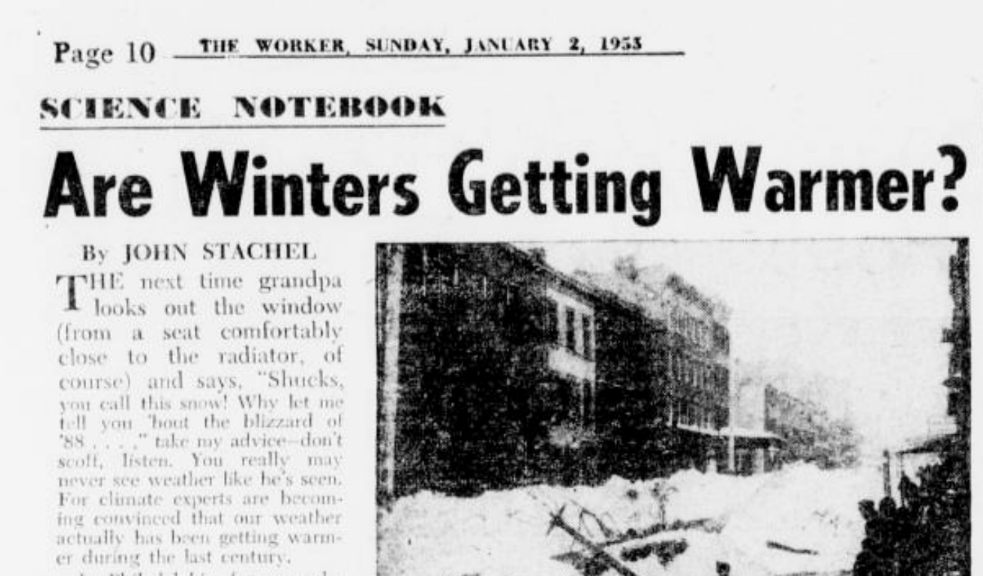
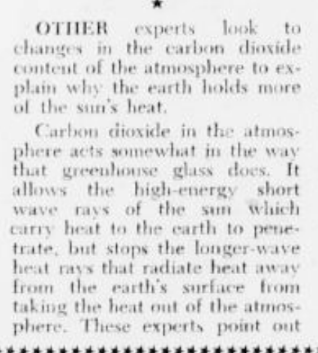
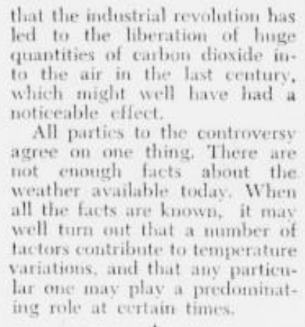
Seventy years ago, on this day, December 9th, 1955,
The amount of carbon dioxide in the air was 313ppm. As of 2025, when this post was published, it is 430ppm. This matters because the more carbon dioxide in the air, the more heat gets trapped. The more heat, the more extreme weather events. You can make it more complicated than that if you want, but really, it’s not. Fwiw, I have a tattoo of the Keeling Curve on my left forearm.
The broader context was that from the late 1940s the possibilities of what we would not call geo-engineering – melting the Arctic on purpose etc – were popping up in the popular press and the left-wing press.
The specific context was that the International Geophysical Year was coming up, and questions of changes in the weather/climate and the possibilities of man-made weather were becoming a commonplace.
What I think we can learn from this – the knowledge was there, for a very long time, but mostly “lost in the noise.”
What happened next – these sorts of articles kept getting published. The emissions kept climbing.
What do you think? Does this pass the ‘so what?’ threshold? Have I got facts wrong? Interpretation wrong? Please do comment on this post, unless you are a denialist, obvs.
A discussion is given of a simple mathematical model of the carbon dioxide cycle in atmosphere-biosphere-sea, with special attention to the possibility of self-sustained oscillations and to the behaviour of the cycle when additional carbon dioxide is injected from an outer source. The discussion is confined to phenomena with characteristic times of the order of 10–103 years leaving out the long geologic periods as well as the purely annual periods. Some numerical computations are also carried out on the electronic computer BESK. The discussion and the computations show that self-sustained oscillations possibly appear due to the presence of the sea, and that they generally are favoured when there exist time-lags in the biosphere of the order of a few decades. The computations also indicate that additional carbon dioxide injected at a rate corresponding to the present combustion of fossil carbon does not change significantly the carbon dioxide concentration in the atmosphere, since most part of it will be stored in the biosphere. Thus, the present theory suggests that the increase of carbon dioxide indicated by recent measurements may represent part of a natural self-sustained oscillation and not necessarily be a response to an increased combustion of fossils.
The amount of carbon dioxide in the air was 313ppm. As of 2025, when this post was published, it is 430ppm. This matters because the more carbon dioxide in the air, the more heat gets trapped. The more heat, the more extreme weather events. You can make it more complicated than that if you want, but really, it’s not. Fwiw, I have a tattoo of the Keeling Curve on my left forearm.
The broader context was that all sorts of new possibilities for understanding the universe were being opened up in the 1940s and 1950s – the technical advances of the second war offered new ways of gathering and analysing data, finding patterns.
The specific context was that those meetings in 1954-1955 were a neglected (especially by this site!) push for understanding of the carbon dioxide influence…
What I think we can learn from this – the knowledge of potential problems ahead was solid by the mid-1950s, and it wasn’t all down to Gilbert Plass…
What happened next – then-young Swedish scientist Bert Bolin went to the US in 1959 and tried to get everyone alarmed about carbon dioxide build-up. Oh well…
What do you think? Does this pass the ‘so what?’ threshold? Have I got facts wrong? Interpretation wrong? Please do comment on this post, unless you are a denialist, obvs.
Seventy years ago today, on Thursday September 22nd 1955, a scientist employed by General Electric stood in front of an audience of engineers and told them that the build up of carbon dioxide in the atmosphere “may be having a greenhouse effect on our climate” because mankind was “contaminating the earth’s atmosphere faster than nature can clean it.”
The audience was a meeting of the American Institute of Electrical Engineers, hosted by the Cleveland Engineering Society. The scientist giving the after-dinner speech, titled “Fact and Fantasy” was John G. Hutton, originally English, who had gained a PhD in electrical engineering at Yale.
The following day the newspaper the Plain-Dealer carried the story under the headline “Clears H-Bomb as Weather Climate.” From there the story got picked up by UP (United Press) which quoted Hutton – having explained that trees and plant life absorb carbon dioxide and release oxygen – as saying
“However… when people chop down trees, bulldoze once-rural land for suburbs, and build factories on former open fields, they lessen the amount of carbon dioxide nature is cleaning from our air.”
Hutton also referred to the Los Angeles smog problem (see Rebecca John’s investigation for DeSmog on how fossil fuel companies warped the scientific research effort around this, burying the carbon dioxide aspect).
Hutton had been born in 1916, Sunderland, England. Having failed his exam to enter secondary school, he worked in manual labour and went to night school in order to be accepted to Durham University. From there he was awarded a fellowship to attend Yale, where he got his Masters and Doctorate. After brief stints in Canada and teaching at Cornell, he started working for General Electric in 1943 as an electrical engineer.
Hutton’s inspirations
Hutton already was an experienced after-dinner speaker by this time, and it is not clear why he chose to talk about climate change.
Two years previously Gilbert Plass, drawing on the work of Swedish Nobel Prize winner Svante Arrhenius, and the more recent work of English Steam Engineer Guy Callendar, had pointed to the build-up of carbon dioxide in the atmosphere as a long-term threat. Also in 1953 economist Willam J. Baxter, author of the very popular “Today’s Revolution in Weather” had touched on the theory. When Hutton spoke, Plass’s first academic paper on CO2 build-up had been submitted but not published, and Roger Revelle, the famous scientist and administrator, had not yet begun to use carbon dioxide build-up as one part of his (successful) campaign to convince US federal politicians to fund expensive science.
It may simply have been that the International Geophysical Year – a world-wide collaboration of data gathering – was coming soon (1957-1958) and he thought it worth talking about; he told his Cleveland audience that carbon dioxide build-up would be investigated during the IGY.
Two other possible sources of inspiration deserve a mention. In June 1955, Fortune magazine had published an article by the extremely well-known and respected Jonny von Neumann. In “Can we survive technology?” the Hungarian genius noted that
“[t]he carbon dioxide released into the atmosphere by industry’s burning of coal and oil-—more than half of it during the last generation—may have changed the atmosphere’s composition sufficiently to account for a general warming of the world by about one degree Fahrenheit.”
The second source is internal to GE. Another – far more prominent – General Electric scientist was already making waves on the question of carbon dioxide and the atmosphere, albeit from another perspective.
From the late 1940s, pursuing work he and others had conducted during the second world war, Irving Langmuir advocated using frozen carbon dioxide (“dry ice”) to see clouds.
On the afternoon of October 13, 1947, an Air Force B-17 aircraft penetrated a hurricane 415 miles (667 km) east of Jacksonville and dumped several pounds of crushed dry ice into the storm, just to see what would happen. This was the first attempt to modify a tropical cyclone by seeding it with freezing nuclei.
Regardless of Hutton’s specific impetus, the idea that man might modify the weather and climate – either deliberately (as a weapon of war, or to improve crop growth) or accidentally was “in the air.” In June 1953 tornados had occurred in places that had rarely had them before, and there was a great deal of speculation and anxiety around the possibility that H-bomb tests had caused them (for a great summary of this see McBrien, 2019).
What happened next
There was immediate newspaper coverage around the United States in local papers. Usually this was buried in later pages, but on several occasions it was front page news. (e.g. “Engineer lays hotter weather on growing industrialization” The Buffalo News, September 23, page 1) and “Auto Exhaust May Change Climate More Than A-Bomb” Omaha World-Herald, November 18, page 1)
Over the following months, the story was syndicated elsewhere, often with the “no, it’s not H-bombs” angle emphasised.
In February 1956 the science correspondent for the Washington Evening Star (then a far more important paper than the Washington Post) covered Hutton’s speech.
Other publications, including Journal of the Franklin Institute, “Management” and “Power Plant Engineering” also ran articles covering his speech.
Most intriguingly, in 1956 the long-running radio program sponsored by GE, “Excursions in Science,” covered the question of carbon dioxide build-up. Hutton’s speech was not mentioned – the episode was based on Gilbert Plass’s paper which had just come out. You can listen to it here: Climate Change and Industrial Activity – Excursions in Science Radio Program from 1950s
What we learn and what happened next
The value of this is that it builds a picture of carbon dioxide build-up as a persistent (albeit minor) factor in US print media coverage of what would later be called “pollution” narratives. The carbon dioxide theory had received a boost thanks to Gilbert Plass’s May 1953 presentation to the American Geophysical Union. Hutton’s speech, the first I have found, came before Revelle, Teller and others, before we even had “the Keeling Curve”
Hutton seems not to have repeated his warning. He spent 39 years working for GE, retiring in 1981. He died in 1995 after an extended illness, just after the first “COP” meeting of the United Nations Framework Convention on Climate Change, and a few months before the IPCC’s Second Assessment Report stated that human activities were already having a “discernible” impact on the world’s climate.
When Hutton made his speech in Cleveland, the atmospheric concentration of C02 was 313ppm and annual human emissions were 7.4bn tonnes.
When he died they were at 360ppm, with emissions at 23.27bn tonnes.
Today they stand at 424ppm, with emissions at 37bn tonnes.
There is a very great deal of trouble ahead. Some of it has arrived, but much much more is on its way. We can’t say we were not warned.
McBrien, Justin. 2019. “‘The Tornado Was Not the A-Bomb’s Child’: The Politics of Extreme Weather in the Age of Atmospheric Nuclear Weapons Testing.” Environment & Society Portal, Arcadia (Autumn 2019), no. 40. Rachel Carson Center for Environment and Society. doi.org/10.5282/rcc/8814.
Sixty nine years ago, on this day, August 9th, 1955, Gilbert Plass submits a paper… You can read it here.
(Manuscript received August 9 1955
The amount of carbon dioxide in the air was roughly 314ppm. As of 2024 it is 424ppm, but check here for daily measures.
The context was that Plass had been talking, researching, writing about CO2 buildup for a while. He made public statements in May of 1953 [see my Conversation article], at the American Geophysical Union that went viral. And here he was submitting an article to Tellus, a Swedish academic journal. (Tellus was the watering hole for atmospheric physics those people at that time.)
What we learn is that smart people could see what was happening.
What happened next. Plass wrote that paper. He wrote another paper, I think, in 1959. And he also had an article in Scientific American in 1959. That, btw, was advertised in the Observer.
What do you think? Does this pass the ‘so what?’ threshold? Have I got facts wrong? Interpretation wrong? Please do comment on this post, unless you are a denialist, obvs.
NB Hutchinson was aware of C02 build-up at the latest in 1948
The amount of carbon dioxide in the air was roughly 314ppm. As of 2024 it is 426ppm, but check here for daily measures.
The context was that the Conservation Foundation had been set up seven years previously. And they were hosting this big meeting of all sorts of prestigious environmental thinkers, scientists, etc. And there was just one glancing mention of carbon dioxide build up, despite the facts that
Gilbert Plass had flagged it two years earlier
One of the big names – G. Evelyn Hutchinson had been aware of C02 build-up, and writing/talking about it from 1948…
What we learn from this is that smart people think that they can spot future problems. But actually, the real problem might be something they’ve overlooked as trivial. And that although it’s important to listen to experts, expecting them to be able to gaze into the crystal ball with anything approaching usefulness is maybe unwise…
What happened next? Well, the Conservation Foundation did indeed get cracking with work on CO2 in 1963. But then, at the follow-up meeting of the Conservation Foundation in I think 1964, or 1965, also had only one fleeting mention. And that was when Frank Fraser Darling raised it in q&a, only for it to be dismissed, essentially.
It’d be interesting to see if there’s archives of that started it. And if there were people in the States that I could ask to do the research or where the files might be.
What do you think? Does this pass the ‘so what?’ threshold? Have I got facts wrong? Interpretation wrong? Please do comment on this post, unless you are a denialist, obvs.
Sixty nine years ago, on this day, April 12th, 1955, a regional newspaper in England explained what was coming.
Anon, 1955. Melting Ice Could Menace the World. Coventry Evening Telegraph April 12 p.7
The amount of carbon dioxide in the air was roughly 314ppm. As of 2024 it is 425ppm, but check here for daily measures.
The context was that there was, for many years, a consensus that the world was warming up. It wasn’t quite so clear what was causing it. This article explicitly mentions carbon dioxide as one possible culprit.
What we learn is that the idea of the world warming was not particularly controversial. But the mechanism was, and what Gilbert Plass, drawing on Guy Callendar, did was give a plausible explanation. That’s a really important distinction, something I hadn’t quite figured out.
What we learn is that the British regional press back at this time was still worthy of the name more or less (though I’m sure it didn’t feel to campaigners at the time that it was!). One mustn’t look at the past with rose-tinted glasses.
What happened next The Coventry Evening Telegraph did keep reporting on the issue. There was just a general awareness that things were warming up, and that there might be trouble ahead.
What do you think? Does this pass the ‘so what?’ threshold? Have I got facts wrong? Interpretation wrong? Please do comment on this post, unless you are a denialist, obvs.
What we can learn from this is that awareness of potential peril and long-term big changes was out and about in mainstream and far left circles. And of course, mainstream ideas draw on observations and insights from the margins, the extreme left and extreme right. Blah, blah, Overton Window, blah, blah.
What do you think? Does this pass the ‘so what?’ threshold? Have I got facts wrong? Interpretation wrong? Please do comment on this post, unless you are a denialist, obvs.
Sixty eight years ago, on this day, June 9, 1955, the finest brains (sic) in the UK met to chew on atmospheric research. Didn’t spot the elephant in the room (it was small, to be fair!)
It is appropriate, in view of the forthcoming intensification of atmospheric research during the International Geophysical Year of 1957-58, to examine the present state of research in such a subject as radiative balance in the atmosphere, and a one-day discussion meeting on this subject was held in London at the Royal Society on June 9. In such a short period it was clearly out of the question to attempt any comprehensive survey, and attention was concentrated instead on subjects in which research is being actively pursued.
Nature 1 October 1955
Meteorological Magazine
The amount of carbon dioxide in the air was roughly 313ppm. As of 2023 it is 423ppm, but check here for daily measures.
The context was that the International Geophysical Year was coming. There had already been a bunch of articles in the media speculating on carbon dioxide buildup. And having three years after the London smog, and the year before the Clean Air Act was passed, the quality of air was still very high on the agenda as it should be, as it still really needs to be.
What I think we can learn from this
Carbon Dioxide build up was NOT on the agenda. Not because these people were stupid, complacent, careless or anything else. Just wasn’t on their radar yet. Not enough evidence etc built up. Only Callendar, some newspaper articles and comments by Plass.
What happened next
The International Geophysical Year happened next…
What do you think? Does this pass the ‘so what?’ threshold? Have I got facts wrong? Interpretation wrong? Please do comment on this post, unless you are a denialist, obvs.