Categories
Brazil NotClimate

January 21, 1971 – Disappearance of Rubens Paiva #NotClimate

On this day, January 21, in 1971

Rubens Beyrodt Paiva (Brazilian Portuguese: [ˈʁubẽs ˈpajvɐ]; 26 December 1929 – 21 January 1971)[2][3] was a Brazilian civil engineer and politician who, as a Congressman at the Brazilian Chamber of Deputies, opposed the implementation of the military dictatorship in Brazil in 1964. Due to his involvement with activities deemed subversive by the dictatorial regime, he was arrested by the military forces, tortured, and murdered.[4] As of 2026, his body has not been recovered.

https://en.wikipedia.org/wiki/Rubens_Paiva

Atmospheric carbon dioxide levels were at 326 parts per million.

As of 2026 they are 428ppm at and rising rapidly. Enjoy yourself, it’s later than you think. 

Btw, the point(s) of this project is …. the how, the who the hell am I and the what do I currently believe?

The context was that the Americans were supporting military takeovers all over the joint, though I don’t know their grubby fingerprints were as closely on the 1964 one in Brazil as – say – Guatemala 1954 or Chile 1973.

The U.S. Government and the 1964 Coup | We Cannot Remain Silent

Why care?

Because this is one of the more extreme, or rather “unsubtle” ways of control.  No body equals more fear, more uncertainty, even more anguish. Charming, isn’t it?

(How) does it connect to climate change?

What, you think they’re not already disappearing inconvenient activists?

What happened next

Brazil emerged from that coup in the 1980s, iirc.

How does it help us understand the world?

This is how power works, innit?  Not everywhere all the time, but enough of the time to send the desired message.

How does it help us act in the world?

OpSec is a good thing, I guess.

The source that it comes from, if necessary, 

Xxx

The other things that you could read about this or watch 

That film Cental Station (which I’ve not seen).

John Sayles film Men With Guns.

What do you think?

If you have opinions or info about this, or other things that happened on this day that are worth knowing, let me know!

Also on this day

Wikipedia

Working Class History

Etc

Categories
NotClimate

January 1, 1971 – Last cigarette advert on US TV #NotClimate

On this day, January 1,  in 1971 – TV adverts for cigarettes stop in the USA.

Veronica Hamel was the model in the last[5] cigarette commercial televised in the U.S. (for Virginia Slims, aired at 11:59 pm on January 1, 1971, on The Tonight Show).[6] Hamel had been a model in print advertisements, not just for Slims, but also for Pall Mall Gold cigarettes.[7]  

So there was presumably a prolonged battle to get cigarette advertising on television banned, presumably the Surgeon General and Republicans and Democrats together. This was back in the days when you could make the public health argument without being screamed down on grounds of free market capitalism, etc. Presumably, the tobacco companies argued freedom of speech/First Amendment rights. 

On Veronica Hamel– fun fact, she had an uncredited cameo at the beginning of Klute – a film worth watching! Also played Joyce Davenport, public defender on Hill Street Blues.

Atmospheric carbon dioxide levels were at 325 parts per million.

As of 2026 they are 428ppm at and rising rapidly.  Enjoy yourself, it’s later than you think. 

Btw, the point(s) of this project is ….  the how, the who the hell am I and the what do I currently believe?

The context was that by the late 1960s the evidence that smoking was bad for your health was absolutely overwhelming.  And states were still expected to protect their populations, even in the face of concerted efforts by vested interests.  Ah, such innocent times…

Why care?

If you read old magazines (or fossick in digital archives as I do), you come across all these adverts for cigarettes, and they are quite arresting. If we were a sane species, then by now, adverts for fossil fuel intensive activities (flying, driving tanks etc) would have been similarly banished.

(How) does it connect to climate change?

The analogy about knowing things are bad for you, the ways the denialist campaigns worked – well, read Oreskes and Conway for the gory details.

What happened next

Advertisers kept finding new ways to push cancer sticks (“cool” characters in Hollywood movies, etc etc etc) 

Nicotine use is frequently shown in movies, historically often in return for six-figure (US$) sponsorship deals. More money is paid for a star actor to be shown using nicotine. Smokers in movies are generally healthier, more successful, and younger than actual smokers. Health effects, including coughing and addiction, are shown or mentioned in only a few percent of cases, and are less likely to be mentioned in films targeted at younger viewers.[3]: 372–374 

Regulation of nicotine marketing – Wikipedia

How does it help us understand the world?

Knowing that there was  a time when public health arguments were bipartisan and could be successful. Now we have RFK and pro-plagues – sorry “anti-vaxxer” nutjobs.

How does it help us act in the world?

Well there are various campaigns trying to ban SUV advertising and so forth. Badvertising and so on.

The source that it comes from, if necessary, 

Xxx

The other things that you could read about this or watch 

Agnotology (the creation of doubt/ignorance.

Stuff I will download and probably never read.

McAuliffe, R. (1988). The FTC and the effectiveness of cigarette advertising regulations. Journal of Public Policy & Marketing, 7(1), 49-64.

doi.org/10.1177/074391568800700105

What do you think?

If you have opinions or info about this, or other things that happened on this day that are worth knowing, let me know!

Also on this day

Wikipedia

Working Class History

What Happened on January 1 | HISTORY

Categories
United States of America

December 20, 1971 – Nixon’s climate plans

Fifty four years ago, on this day, December 20th, 1971,

But the newly revealed Dec. 20, 1971, research proposal by the White House Office of Science and Technology shows for the first time that Nixon’s science advisors embarked on an extensive analysis of the potential risks of climate change and an assessment of the data needs. https://insideclimatenews.org/news/26042024/nixon-administration-climate-research-plan/

The amount of carbon dioxide in the air was 326ppm. As of 2025, when this post was published, it is 430ppm. This matters because the more carbon dioxide in the air, the more heat gets trapped. The more heat, the more extreme weather events. You can make it more complicated than that if you want, but really, it’s not. Fwiw, I have a tattoo of the Keeling Curve on my left forearm.

The broader context was the first global ecological awakening (aka “The Malthusian Moment”) had begun in late 1968/early 1969, with Earthrise and then the Santa Barbara Oil Spill. April 1970 had seen “Earth Day”…. That same year had seen the passage of NEPA and the creation of the Environmental Protection Agency. 

The specific context was that Nixon’s people (e.g. Daniel Moynihan) had been talking about carbon dioxide build-up since 1969.

What I think we can learn from this – there were people doing the research and thinking all the way back then.

What happened next – extensive federal support for climate research only got going late in the 1970s, with the 1978 National Climate Programme Act. 

What do you think? Does this pass the ‘so what?’ threshold? Have I got facts wrong? Interpretation wrong? Please do comment on this post, unless you are a denialist, obvs.

Also on this day: 

December 20, 1961 – UNGA resolution on outer space and weather modification 

December 20, 1969 – AGU on climate change… –

December 20, 1983 – Documentary on “the Climate Crisis” shown

December 20, 2007 – UK opposition leader David Cameron gives clean coal speech in Beijing…

Categories
Denial United Kingdom United States of America

September 9, 1971 – Stephen Schneider’s letter, and a World Model

Fifty four years ago, on this day, September 9th, 1971 climate scientist Stephen Schneider wrote a letter to the New York Times about some industry bullshit that the Times had run as a n op-ed.

AND on the same day, things were a foot in the United Kingdom

“Whereas Bray had been highly sceptical of the World model, Cottrell had been enthused by its demonstration. Returning to Britain, he proposed that the British government develop a similar model, stating his belief that ‘Forrester’s approach is the most important development of its kind since Keynes’ general theory’.117

Given the centrality of Keynesianism in post-war economic policy, this was a significant claim. Heath, as his early enthusiasm for management science had revealed, had some interest in forecasting and simulation, and gave his permission for a scoping study on the feasibility of a British world model. Cottrell held a meeting on the subject at the Cabinet Office in September 1971, in which he had told the assembled civil servants that developing a global model for British purposes would require £50,000 and four staff. In response, an unnamed civil servant argued that the Treasury had a more sophisticated econometric model that it used for forecasting. Despite this criticism, the general idea of a global environmental model was well received, and further work was proposed.118 “

Histories of Technology, the Environment and Modern Britain

The amount of carbon dioxide in the air was 326ppm. As of 2025, when this post was published, it is 430ppm. This matters because the more carbon dioxide in the air, the more heat gets trapped. The more heat, the more extreme weather events. You can make it more complicated than that if you want, but really, it’s not. Fwiw, I have a tattoo of the Keeling Curve on my left forearm.

The broader context was that in the late 1960s people started worrying about the global impact of industrialisation and population growth (as distinct from concerns about localised pollution).

The specific context was that a) Schneider was already making a name for himself as combative and b) the British state was beginning to think about systems modelling (aware that the Club of Rome report was coming)…

What I think we can learn from this is that there was mention of carbon dioxide and limits to growth way back when. It had pushed out from the undergrowth in the late 1960s…

What happened next: By 1973, we were back to sleep, for the most part. A few new NGOs, a couple of magazines (Your Environment, The Ecologist).  It is very very hard to combat a world view.

What do you think? Does this pass the ‘so what?’ threshold? Have I got facts wrong? Interpretation wrong? Please do comment on this post, unless you are a denialist, obvs.

Also on this day: 

September 9, 1947 – The Daily Worker talks about melting the ice-caps

September 9, 1971 – of Australian Prime Ministers and American scientists…

September 9, 1990 – classic (?) film Mindwalk released

Categories
Sweden

August 16, 1971 – “The changing chemistry of the oceans.”

Fifty four years ago, on this day, August 16th, 1971,

The changing chemistry of the oceans : proceedings of the twentieth Nobel symposium held 16-20th August, 1971 at Aspendäsgården, Lerum and Chalmers University of Technology, Götenborg, Sweden Nobel Symposium, (20th: Sweden: 1971); Dyrssen, David, editor; Jagner, D. joint editor 1972

See also

The amount of carbon dioxide in the air was 326ppm. As of 2025, when this post was published, it is 430ppm. This matters because the more carbon dioxide in the air, the more heat gets trapped. The more heat, the more extreme weather events. You can make it more complicated than that if you want, but really, it’s not. Fwiw, I have a tattoo of the Keeling Curve on my left forearm.

The broader context was that from about 1968 (earlier in Sweden, by a couple of months), there had been an “environmental turn” – meaning people were beginning to realise that all this “Vorsprung durch Teknik” (progress through technology) came with a price tag – that air pollution, water pollution, the loss of habitats etc were not local events only, but symptoms of a wider set of problems. Heck, there was even going to be a conference in Stockholm the following year.

The specific context was that oceanographers had been very well aware of the pollution of the oceans – and that included the impact that raised atmospheric carbon dioxide levels might have. After all, some of the very earliest papers about carbon dioxide were by oceanographers (Revelle and Seuss etc).

What I think we can learn from this – well, as with so many of these 60s and 70s posts, smart people knew. People reading newspapers knew. But getting action, beyond the creation of a few ministries and bureaucracies

What happened next Some Nobellers kept warning (e.g. 1974). The emissions? Kept going up, didn’t they?

What do you think? Does this pass the ‘so what?’ threshold? Have I got facts wrong? Interpretation wrong? Please do comment on this post, unless you are a denialist, obvs.

Also on this day: 

August 16 1984 – “Why are they lying to our children?” – what a 40 year old propaganda campaign can tell us about today (and tomorrow’s) cultural battles. #Climate #CorporatePropaganda – All Our Yesterdays

August 16, 2002 – “Oil Lobby Urges Bush to Keep Climate Change Off the Table at Earth Summit”

August 16, 2010 – Polar Bears going through the motions 

August 16, 2012  – Tony Windsor calls Tony Abbott an “absolute disgrace” on carbon tax/climate 

Categories
Norway

March 27, 1971 – Norwegian Tabloid talks about the climate threat

Fifty four years ago, on this day, March 27th, 1971,

In 1971, in Norway’s largest tabloid newspaper, a journalist reported [on March 27] that global warming “may cause the polar ice to melt, that the ocean will rise above its shores, that cities and large territories of land will be under water, [and] that humans will be displaced to mountain regions” (Anonymous 1971). This alarming news story, possibly the first reference to the issue of global warming in Norwegian press, was buried in a host of similar stories of doom and gloom. Since Earth Day a year before, readers had become used to hearing about a fast approaching environmental Ragnarök. This was alarming news to Norwegians who would typically spend their vacations enjoying the country’s beautiful fjords and mountains. 

Anonymous (1971) Og havet vil stige, VG March 27 

Source: Anker, 2018

The amount of carbon dioxide in the air was roughly 326ppm. As of 2025 it is 427ppm, but check here for daily measures. 

The context was that the previous year, in February, Prince Bernhard of the Netherlands had mentioned CO2 build up. There were probably other mentions in the press, but crucially, this is apparently the first one in the Norwegian press, alongside a general sense of ecological problems, there was also a very specific climatological issue. 

What I think we can learn from this

Climate change was among the other late 1960s-early 197s eco-concerns…

What happened next

Well, nine years later, the Minister for Statoil said it was a long way off.  [see March 21, 1980]

What do you think? Does this pass the ‘so what?’ threshold? Have I got facts wrong? Interpretation wrong? Please do comment on this post, unless you are a denialist, obvs.

Also on this day: 

March 27, 1966 – The “Conservation Society” to be launched

March 27th, 1977- what we can learn from Dutch arrogance and aviation disasters

Categories
United Kingdom

March 8, 1971 – The Future cancelled for lack of interest…

Fifty four years ago, on this day, March 8th, 1971,

“Due to Lack of Interest… ” Paul Ehrlich documentary” –

https://genome.ch.bbc.co.uk/6254d3d38f674b6288acb485fcffdeda

The amount of carbon dioxide in the air was roughly 326ppm. As of 2025 it is 427ppm, but check here for daily measures. 

The context was the BBC was making all of these documentaries about environmental issues and whether we were taking them seriously enough or too seriously. And this is another one of those.

March 1971 is possibly “peak Ehrlich” and peak environment. Everyone knew the Stockholm conference was coming. There was a new Department of the Environment. Super departments have been created, Royal Commission on Environmental Pollution, etc. 

And here we are. 

What I think we can learn from this

The TV shows that we think will “wake up the masses” have been made again and again and again and again. And again.

What happened next

Ehrlich’s predictions of the inescapable famine did not come to pass, and this has definitely hurt the green cause, if you want to call it that. 

What do you think? Does this pass the ‘so what?’ threshold? Have I got facts wrong? Interpretation wrong? Please do comment on this post, unless you are a denialist, obvs.

Also on this day: 

March 8 – International Women’s Day – what is feminist archival practice? 

March 8, 1999 – Direct Air Capture of C02 mooted for the first time

Categories
South Paciific

August 5, 1971 – First “South Pacific Forum” happens

Fifty three years ago, on this day, August 5th,1971, leaders of small island states get together…

 The first Pacific Islands Forum (then known as the “South Pacific Forum”) is held in Wellington, New Zealand, with the aim of enhancing cooperation between the independent countries of the Pacific Ocean.

The amount of carbon dioxide in the air was roughly 324ppm. As of 2024 it is 424ppm, but check here for daily measures. 

The context was that the Vietnam War was still going on (the Americans were losing.) There were pacts of different nations, SEATO to ASEAN, all the rest of it. Eisenhower’s Secretary of State John Foster Dulles had been doing “pactomania.” BUT not everything should be seen as the machinations of the metropole. Sometimes – gasp – the “colonials” have plans of their own…

The ‘no politics’ restriction on discussion in the [south Pacific Conference] was the source of great dissatisfaction for the nascent leadership from the islands. The most pressing issues for the islands were clearly political ones involving larger questions of decolonization, but the greatest concern was nuclear testing by France.7
Matters came to a head at the 1965 meeting in Lae, Papua New Guinea, when Ratu Sir Kamisese Mara of Fiji led a major push from the island representatives to give the Conference more relevance in the actions of the SPC beyond its existing ‘advisory’ capacity. The ‘Lae Rebellion’ was ‘the first concerted effort by Pacific Islanders to protest against the structures in the SPC which ensured dominance by the colonial powers’.8
Mara was also the driving force behind the creation in 1965 of the first indigenously motivated ‘islands-only’ regional organization, the Pacific Islands Producers Association (PIPA). Formed by Fiji, Tonga, and Western Samoa outside of the domain of the SPC, PIPA provided a unified front for negotiating the prices of common agricultural products for export.
Faced with increasing irrelevance, the SPC did evolve in an attempt to meet these new challenges and demands from the island states. From 1967 onward, meetings of the Conference and Commission were held together, and the difference between the two bodies essentially disappeared by 1974.9
Despite these reforms, it was clear the SPC’s charter made the organization too limited to deal with all of the issues confronting the region, and the South Pacific Forum was founded in 1971 as an attempt to address these rising challenges.

THE PROBLEMS AND POTENTIAL OF THE PACIFIC ISLANDS FORUM by ERIC SHIBUYA

What we learn is that if you don’t know something these days, you can just Google it. Pretty much go to Google Scholar. Truth – or at least the facts – will out. 

What happened next? Well, by 1987, the Commonwealth was getting interested in global warming, there was the 1987 meeting at which Margaret Thatcher got schooled. And of course, in 1988, it burst on the public agenda. And then there was the Male Declaration in 1989. And since then, AOSIS, and since then the Pacific island nations have been begging and pleading with Australia to be less of a douche. And Australia’s been like, “yeah, nah” on it. We do have the fun of Albo’s 2006 Labor Party position paper on “Our Drowning Neighbours.” And then in 2023 there’s a deal where people from Tuvalu can swap their snorkels for visas.

What do you think? Does this pass the ‘so what?’ threshold? Have I got facts wrong? Interpretation wrong? Please do comment on this post, unless you are a denialist, obvs.

References

Xxx

Also on this day: 

August 5, 1997 – Australian politician calls for “official figures” on #climate to be suspended because they are rubbery af

August 5, 2010 – academics call for insurance industry to get involved in climate fight

Categories
United States of America

June 29, 1971 – American Coal Association prez says greenies might pose national security threat

Fifty three years ago, on this day, June 29th, 1971, the “national security” argument gets an early run,

The president of the American Coal Association warned that the environmental movement could be radicalised to the point that it could weaken the United States by denying it necessary minerals and other resources.

Carl E. Bagge “Radicalism Perils Supply of Minerals.” Speech quoted in Salt Lake City Tribune, 29 June 1971, p6.

(McCormick, 1991:86)

The amount of carbon dioxide in the air was roughly 326ppm. As of 2024 it is 426ppm, but check here for daily measures. 

The context was that the American Coal Association was beset by on one hand a nuclear lobby trying to eat into electricity generation and on the other side, the environmentalists. And obviously, if you want to win the argument, you slipped back into a resonant frame, and in this case, the idea of national security. They started to paint environmentalists as unwitting or witting dupes of the Kremlin. 

What we learn is that frame wars, frame walls, frame wars. Add that as a page actually. 

As per that wonderful scene in Stanley Kubrick’s Dr Strangelove the concern around “draining our vital fluids”

What happened next? On the American Coal Association the next I know of them in relation to climate change is the rather excellent August 1 1980 article in the Wall Street Journal where they dismiss it. 

What do you think? Does this pass the ‘so what?’ threshold? Have I got facts wrong? Interpretation wrong? Please do comment on this post, unless you are a denialist, obvs.

Also on this day: 

June 29, 1956 – Just DRIVE, she said…

June 29, 1979 – G7 says climate change matters. Yes, 1979.

June 29, 1979 – Thatcher uses carbon dioxide build-up to shill for nuclear power

Categories
United States of America

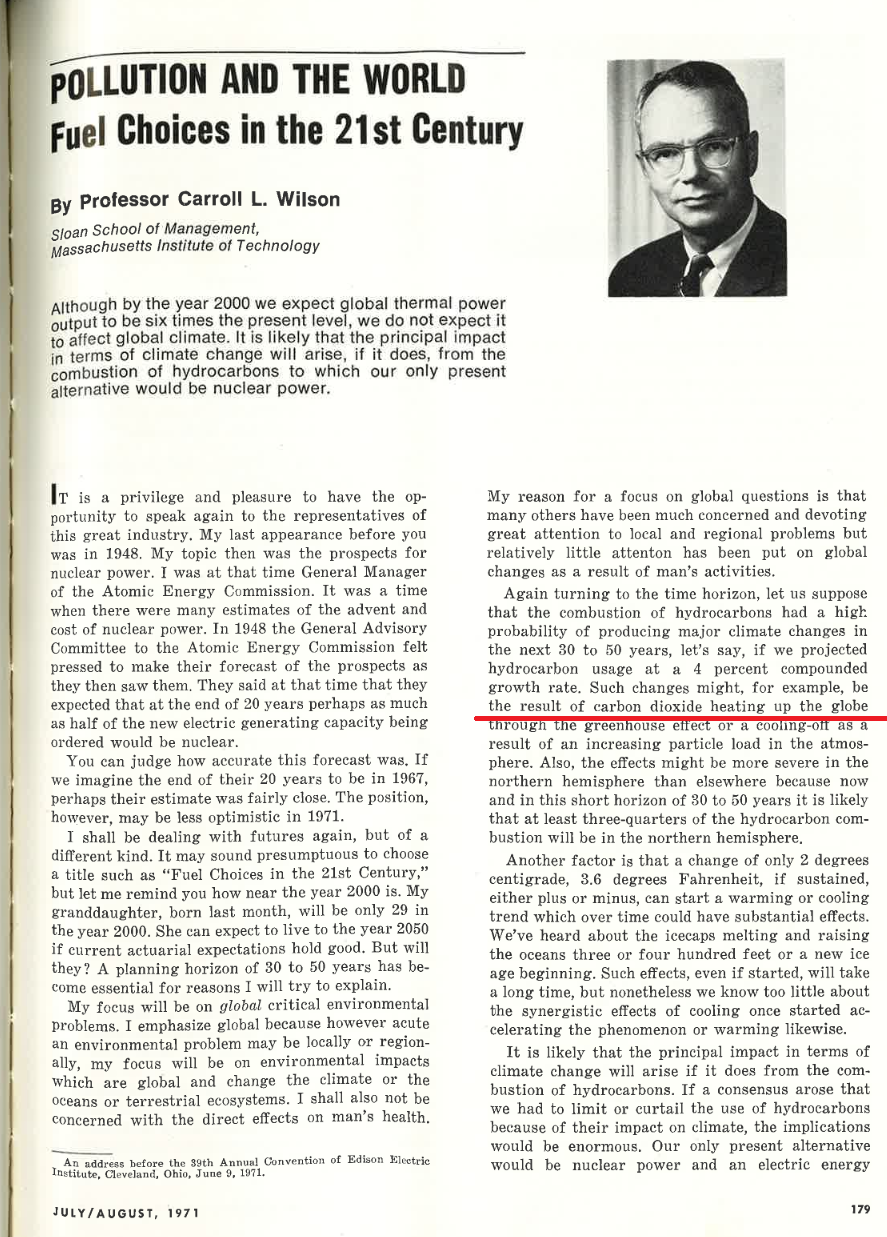
June 9, 1971 – Carroll Wilson talks C02 build up at at Electricity Industry conference

Fifty-three years ago, on this day, June 9th, 1971, Carroll Wilson (who died in 1983) mentioned carbon dioxide build-up at an Electricity Industry conference.

For more, see this article in the Atlantic (paywalled).

The amount of carbon dioxide in the air was roughly 326ppm. As of 2024 it is 426ppm, but check here for daily measures. 

The context was Caroll Wilson was one of those  within-institution cross-organisation movers, shakers fixers well-connected, well-respected. He had already helped put together the conferences that led to the Limits to Growth report. So he would have received a fair hearing. And would have been well aware of the work that was about to get underway about the Study of Man’s Impact on Climate in Sweden.

These guys knew. Yes, there were more pressing short term concerns around air quality in cities and smog and so forth. But Caroll Wilson will have not said anything particularly surprising to the audience, they would have been aware of the CO2 issue, most of them. 

What we learn from this is that while stuff seems shocking and new, when you’re looking without the background, once you understand any given event is part of a pattern, a flow and accretion. It kind of changes perspective a little bit. 

What happened next, Wilson died in I think, 1980. The environmental push, at least the public portion of it died by 1973. And the emissions kept climbing. 

What do you think? Does this pass the ‘so what?’ threshold? Have I got facts wrong? Interpretation wrong? Please do comment on this post, unless you are a denialist, obvs.

Also on this day: 

June 9, 1955 – Royal Society misses the point (tbf, easily done)

June 9, 1989 – the Australian Labor Party versus the unions versus the planet #climate

CATEGORIES- 

TAGS-