The amount of carbon dioxide in the air was roughly 334ppm. As of 2024 it is 422ppm, but check here for daily measures.
The context was that the 2 year study “Energy and Climate” had been released a couple of months before.
What I think we can learn from this – we knew, we knew we knew. Also, the idea of “carbon budgets” is an older one than most would understand.
What happened next In 1979, their ad hoc panel Charney panel met and did the numbers again and said “yeah, this is a thing.” Climate change then popped up in the Global 2000 report, as well as the Council on Environmental Quality Report that made Carter’s Chief Scientific Adviser Frank Press somewhat unhappy. And then came Reagan; thus it was another eight years before the issue finally finally broke through.
What do you think? Does this pass the ‘so what?’ threshold? Have I
What do you think? Does this pass the ‘so what?’ threshold? Have I got facts wrong? Interpretation wrong? Please do comment on this post, unless you are a denialist, obvs.
Forty seven years ago, on this day, August 28th, 1977, the first under-a-Greenpeace-banner action took place. It was against the last whaling in the English speaking world, Albany Western Australia
On 28th August 1977, activists in inflatable zodiacs took on a whaling ship in Albany, Western Australia. And they won. Known back then as the ‘The Whale and Dolphin Coalition,’ they blockaded the Cheynes Beach whaling station for three weeks, drawing global media attention to the issue of commercial whaling.
In November 1978, Australia harpooned its last whale. This long blockade was the first-ever Greenpeace action in Australia – and it was the beginning of the end of our country’s whaling industry.
The amount of carbon dioxide in the air was roughly 334ppm. As of 2024 it is 424ppm, but check here for daily measures.
The context was that Australia was still permitting whaling, having perpetrated awful crimes for a couple of hundred years so that we could have lighting and so forth. You all should read Moby Dick. And this was the first Greenpeace Australia action. Greenpeace was then a very new beast, having been set up to protest nuclear testing.
What we learn is Greenpeace got a foothold and then more in the Australian political scene. And then in 1985, I think the Rainbow Warrior got scuttled by French secret agents. Because France, because states and terrorism.
What happened next. Greenpeace has kept going, with various peaks and troughs…
Whaling still happens – carried out by Iceland and Japan for “research”. We humans are a relentlessly barbaric species. And no, I’m not vegan. I’m a hypocrite like everyone else.
What do you think? Does this pass the ‘so what?’ threshold? Have I got facts wrong? Interpretation wrong? Please do comment on this post, unless you are a denialist, obvs.
Forty seven years ago, on this day, July 21st, 1977, days before the “Energy and Climate” report was released, the Washington Post ran a story…
July 21, 1977, staff writer Paul Valentine wrote a page-one story for the Washington Post headlined “100-Year Trend: Warmer; Confirming What You Feel: Our Summers are Getting Warmer.”
(Sachsman, 2000: 3)
The amount of carbon dioxide in the air was roughly 334ppm. As of 2024 it is 426ppm, but check here for daily measures.
The context was that the National Academy of Sciences was about to release its Energy and Climate report. Two years in the making, it meant that all things climate-related were newsworthy. The weather had been playing silly buggers for the last few years, crop failures, heat waves in the UK.
What we learn is that if you’re reading a serious newspaper in 1977 you were aware of the climate issue. Yes, there were still people telling you it was wrong. If you understood 19th century physics though…
What happened next The Energy and Climate report was released a couple of days later. “Warning traffic lights at yellow” said scientist Thomas Malone. And then there was the push for the First World Climate Conference, which happened in Geneva in February of ‘79. We knew enough by then to start shitting ourselves. But we didn’t take action. And so now all we can do is shut ourselves because the emissions keep rising.
What do you think? Does this pass the ‘so what?’ threshold? Have I got facts wrong? Interpretation wrong? Please do comment on this post, unless you are a denialist, obvs.
Forty-seven years ago, on this day, May 13th, 1977, Tony Benn, then Energy Minister, met assorted experts at Sunningdale to grapple with nuclear versus solar etc.
NB Wasn’t it Sunningale where the Police ‘processed the Libyans after the Yvonne Fletcher shooting??
The amount of carbon dioxide in the air was roughly 333ppm. As of 2024 it is 425ppm, but check here for daily measures.
The context was that the British state was in a financial hole. Energy was a big part of the problem,
What we learn is that, well, the civil servants in the nuclear lobby were very powerful and were capable of outwitting the politicians who were not necessarily the sharpest tools in the box.
What happened next, the climate issue was bubbling along. And in 1978, an interdepartmental group was set up to study the issue, producing a pipsqueak report that almost got suppressed or not released, before coming out in February 1980.
What do you think? Does this pass the ‘so what?’ threshold? Have I got facts wrong? Interpretation wrong? Please do comment on this post, unless you are a denialist, obvs.
References
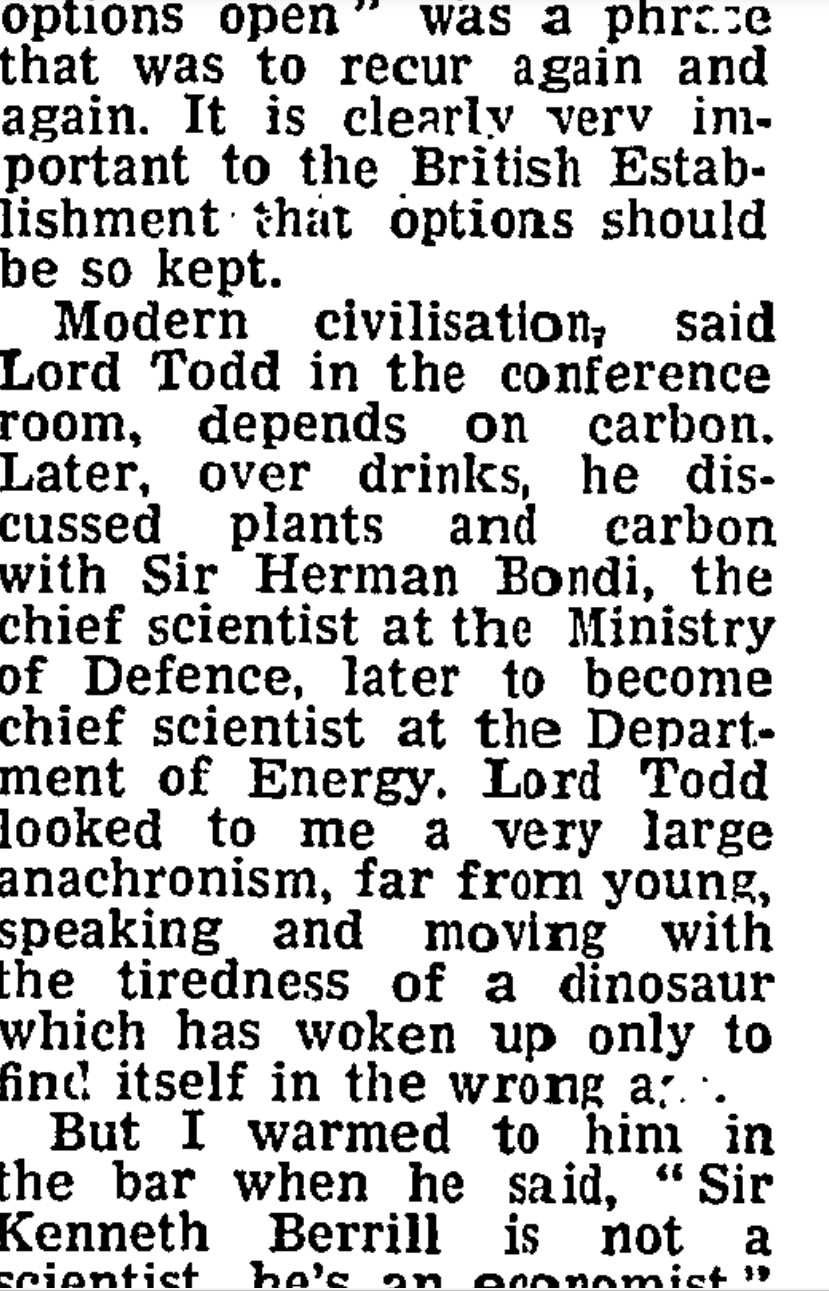
Sedgemore, B. 1980. Civilisation: keeping the options open . The Guardian, March 10, p.7
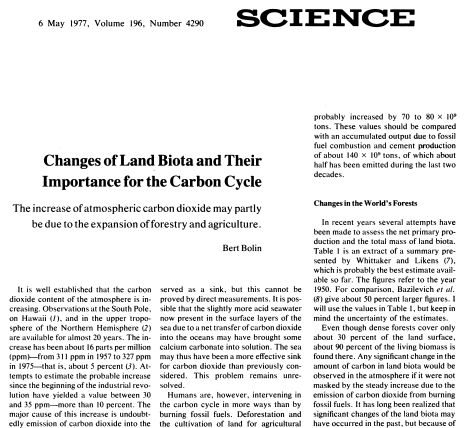
Forty seven years ago, on this day, May 6th, 1977, Swedish scientist Bert Bolin sounded a warning about other sources (besides burning oil, coal and gas) leading to more CO2 in the atmosphere.
The amount of carbon dioxide in the air was roughly 334ppm. As of 2024 it is 425ppm, but check here for daily measures.
The context was that Bolin had been looking at carbon dioxide buildup and its consequences since the late 50s. There were concerns about food production; these had been voiced publicly by Henry Kissinger in 1974. And other work was ongoing about that. What Bolin was doing here was pointing out how deforestation and agriculture might be contributing to CO2 build up alongside the vast increases in fossil fuel burning for energy production.
What we learn is Bolin was a mensch and that people reading science knew what was going on.
What happened next? Bolin ended up as the first chair of the IPCC and lived long enough to see the Nobel Prize and died shortly after that in 2007.
What do you think? Does this pass the ‘so what?’ threshold? Have I got facts wrong? Interpretation wrong? Please do comment on this post, unless you are a denialist, obvs.
They are forced to this situation by the desperate shortage of fossil fuels throughout the world and the immense dangers which are inherent in burning fossil fuels, particularly coal. Almost daily people are dying from the pollution effects of coal fired power stations. Yet no one is getting emotional over mining and burning of coal. It’s a bit like the terrible carnage on our roads. Because it happens every day no one seems to care any more. Nonetheless the hazards of coal fired power stations have not diminished. In fact there is every reason to believe that the CO2 catastrophe is possibly the most portentious aspect of our entire long range energy policy. It is my belief that once the CO2 problem becomes widely understood, even given all the uncertainties, it will become the single strongest argument for turning to the nuclear alternative. Most scientists viewing the accelerated burning of fossil fuels now agree that CO2 will warm the earth’s surface temperature significantly.
Peter Baume (also a Liberal MP), later in the same debate, said this –
I then proceed to outline some of the major problems with which I believe conservationists have not adequately coped. I stress the points made by the honourable member for Kalgoorlie about carbon dioxide. He certainly stated the position very clearly; there is a real risk to our existence on this planet from carbon dioxide from the burning of fossil fuels. I would like to hear the same kind of analysis of the risks applied to our existing fuel usage as has been applied with extraordinary enthusiasm to the projected fuel usage of a material which is available in Australia and whose development would be to our national advantage. When I hear a comparable analysis from the conservationists group, I will believe that they have a far sounder basis on which to approach the people of Australia with a rational argument.
As has been pointed out by Dr Weinberg in the paper to which the honourable member for Kalgoorlie referred, the CO2 catastrophe-the carbon dioxide catastrophe- is possibly the most portentious aspect in our entire long range energy policy. If the carbon dioxide concentrations increase, more radiation from the sun is directed back towards earth and the earth’s temperature increases. It is, of course, the green house effect. Since the mid-nineteenth century there has been an estimated 10 per cent rise in carbon dioxide levels in the atmosphere. About 50 per cent of the carbon dioxide from burning fossil fuels goes into the atmosphere and stays there. If the world continues to increase its usage of fossil fuels at a rate of 4 per cent, atmospheric concentration of carbon dioxide will double by the middle of the twenty-first century, according to Dr Weinberg.
The amount of carbon dioxide in the air was roughly 333.8ppm. As of 2024 it is 425ppm, but check here for daily measures.
The context was Australia was wanting to export uranium to nuclear powers around the world. And not everyone was on board with that, for reasons of proliferation and just being against nuclear energy. And so therefore there was a debate in Parliament. What’s interesting is that carbon dioxide buildup was already being spoken of. In such fora. This is perhaps unsurprising given that CSIRO had made some movies and that the Australian Academy of Science had released a report – it came out in 76. So it’s not altogether surprising.
What we learn is that carbon dioxide build-up was a topic of conversation by the mid-1970s.
What happened next? We exported uranium. Nuclear power did not make a dent in the upward trajectory of our emissions, and of atmospheric concentrations.
What do you think? Does this pass the ‘so what?’ threshold? Have I got facts wrong? Interpretation wrong? Please do comment on this post, unless you are a denialist, obvs.
Forty six years ago, on this day, October 14, 1977, the head of the United Nations Environment Program mentions climate at an UNESCO conference on environmental education.
The amount of carbon dioxide in the air was roughly 333.7ppm. As of 2023 it is 423ppm, but check here for daily measures.
The context was that the United Nations Environment Program, although small and weak compared to other UN bodies, still had some weight. One of its sticks was environmental education. Mostafa Tolba here was well aware of the climate problem and was helping Bert Bolin stitch together the kind of international cooperation and collaboration that you need for an international problem.
What I think we can learn from this is that in the 1970s people were banging on about climate change in the context of Environmental education.
[insert screen grab of 1983 thesis abstract that you sent Jenna Ashton]
What happened next
Here we are 40 years later and environmental education is still not on the agenda. I think part of this is if you did teach children about the fragility of the planet and and how to do systems thinking then it would be harder to keep them in line as obedient production and consumption units
see also Noam Chomsky quote on the Kyoto Protocol and what they teach you at university highly educated people is to conform and consume.
What do you think? Does this pass the ‘so what?’ threshold? Have I got facts wrong? Interpretation wrong? Please do comment on this post, unless you are a denialist, obvs.
Forty six years ago, on this day, Wednesday July 27, 1977, a professor visited the country town of Adelaide to talk about his book…
Canberra Times, Thursday 28 July, page 7
The amount of carbon dioxide in the air was roughly 334.9ppm. As of 2023 it is 423ppm, but check here for daily measures.
The context was
11 years before yesterday’s blog post, a pro-nuclear Professor was in Adelaide giving a speech – basically part of his book tour for “Uranium On Trial.” And yes, climate change was high on his list of reasons why we should have nuclear.
The broader context is that the Ranger inquiry was ongoing in Australia around uranium mining. And as the Professor noted, the National Academy of Sciences in the US was putting the finishing touches on its two year study of climate change.
What I think we can learn from this is that even people in sleepy country towns like Adelaide had had news of climate by 1977.
What happened next
“if nothing was done”… We’re all going to die. And if you are under 40 or even under 50, you’re going to see that unfold properly in your lifetime. If you are 20 or under, my advice is to start carpe the diems right now.
What do you think? Does this pass the ‘so what?’ threshold? Have I got facts wrong? Interpretation wrong? Please do comment on this post, unless you are a denialist, obvs
Forty six years ago, on this day, July 15, 1977, the New York Times ran a front page story that makes you just groan. Oh, and by the way, coal use is up in the last year..
The amount of carbon dioxide in the air was roughly 334.9ppm. As of 2023 it is 423ppm, but check here for daily measures.
The context was that the National Academy of Science had been doing a two year investigation into weather and carbon dioxide and was about to release its report. And clearly a journalist at the Times had been given a tip off and was getting a kind of exclusive in first.
From the 50s some scientists had been saying “hey, carbon dioxide is going to be an issue,” and had slowly been able to build an epistemic community as Hart and Victor would have you call it.
What I think we can learn from this
We knew. It was, literally, front page news.
What happened next
In the mid-late 70s it all started to come together. It was then scuppered/slowed successfully between 1981 and 1985. And then with the scientific meeting in September 1985 at Villach, the push begins again.
What do you think? Does this pass the ‘so what?’ threshold? Have I got facts wrong? Interpretation wrong? Please do comment on this post, unless you are a denialist, obvs.
Forty six years ago, on this day, February 23, 1977, as per the wonderful article by Jon Agar, the UK’s Chief Scientific Advisor wrote a prescient memo about carbon dioxide build up…
However, ‘one complicating factor, which will have to be taken seriously’ was carbon dioxide: …” as a result of the increasing use of fossil fuels the atmospheric carbondioxide [sic] content has increased by 10 per cent over the last century. Increased atmospheric carbondioxide leads, via the ‘greenhouse’ effect to an increase in temperature. However, carbondioxide production is usually associated with the production of dust (especially from coal) and particulate material in the atmosphere scatters light and thus leads to a decrease in temperature. It is possible that these two effects cancel, to a first approximation, but it is something that gives rise to a lot of debate; especially among those who wish to build nuclear power stations. Carbondioxide is, of course, soluble but it will take about 1,000 years for equilibrium to be reached between the atmosphere and the ocean; if the dust settles out faster than the carbondioxide dissolves there might be some interesting short-term effects”.
Rounding off a review of climate change, Ashworth gave a prediction:
‘Future forecast—changeable and probably getting worse’. The note is significant because it is the first, recorded instance of the UK’s senior government adviser passing up the chain of command a firm view about climate change, in this case that natural climatic change was an understood fact and anthropogenic climate change a distinct possibility’ TNA CAB 184/567. ‘The weather’, Ashworth to Berrill, 23 February 1977
The amount of carbon dioxide in the air was roughly 333.1ppm. As of 2023 it is 419ppm, but check here for daily measures.
The context was
The Germans, Swedes and most of all Americans were looking at carbon dioxide build-up and saying “we may have a serious problem”. So was the World Meteorological Organisation. The idea of an ice age had been put to one side after a Norwich meeting in 1975. Ashworth was trying to get Berrill and Mason to take it seriously.
What I think we can learn from this
Getting dinosaurs to tap dance, to spot problems on the horizon, is hard going.
What happened next
Ashworth’s efforts were ‘rewarded’, at last, with an interdepartmental committee in late 1978, which produced a “nothing to see here” report. Members of Thatcher’s government tried to keep it from seeing the light of day, but it finally limped out in February 1980. When Ashworth briefed Thatcher, her response was incredulity and “you want me to worry about the weather?”
Meanwhile, the opportunity to start doing something was, of course, lost.
What do you think? Does this pass the ‘so what?’ threshold? Have I got facts wrong? Interpretation wrong? Do comment on this post.
References
Agar, J. (2015). “Future forecast – changeable and probably getting worse”: the UK Government’s Early Response to Anthropogenic Climate Change” Twentieth Century British History, Volume 26, Issue 4, Pages 602–628, https://doi.org/10.1093/tcbh/hwv008 See here.