Categories
United Kingdom

October 27, 1988 – the Guardian’s advertising dept is revolting

Thirty seven years ago, on this day, October 27th, 1988, the limits are pushed…

This recalls an infamous case from 1988 involving the Guardian, considered Britain’s most liberal newspaper. An article by Guardian journalist James Erlichman covered a Greenpeace campaign to name and shame Ford motor company – then by far the country’s biggest advertiser – because it lagged behind other car manufacturers in adapting engines to take unleaded petrol. A Greenpeace poster showed exhaust fumes in the shape of a skull and crossbones with the slogan: ‘Ford Gives You More.’

Greenpeace tried to publish the poster as an advertisement in The Times, the Guardian and the Independent – all refused. The conclusion to Erlichman’s piece contained one of the great bombshells in the history of British journalism:

“Greenpeace booked 20 hoardings for its poster campaign. But then the advertising agency was informed that most of the sites – those owned by Mills & Allen – had been withdrawn.

Carl Johnson, who is handling the account, said: ‘We were told that the posters were offensive, but I am sure someone was afraid of losing a lot of Ford advertising.’

Mr Johnson attempted to book the ‘skull and crossbones’ advertisement with The Times, the Guardian and the Independent. ‘I have no doubt that they all feared losing Ford’s advertising if they accepted ours,’ he said.” (Erlichman, ‘Threat of boycotts “turns firms green”,’ The Guardian, October 27, 1988) https://www.medialens.org/2009/the-guardian-climate-and-advertising-an-open-email-to-george-monbiot/

The amount of carbon dioxide in the air was 351ppm. As of 2025, when this post was published, it is 425ppm. This matters because the more carbon dioxide in the air, the more heat gets trapped. The more heat, the more extreme weather events. You can make it more complicated than that if you want, but really, it’s not. Fwiw, I have a tattoo of the Keeling Curve on my left forearm.

The broader context was that newspapers have been reliant on advertising for a very long time. Efforts to break free of that have on the whole not worked so well, at a mass level.

The specific context was that everyone was het up about global warming. It was a good story. There was nothing wrong with it journalistically. Economically though….

What I think we can learn from this – that advertising is one of the five filters in the Herman and Chomsky Propaganda Model. Which should be taught in schools, but won’t ever be.

What happened next – the Guardian mostly learned its lesson, eh?

What do you think? Does this pass the ‘so what?’ threshold? Have I got facts wrong? Interpretation wrong? Please do comment on this post, unless you are a denialist, obvs.

Also on this day: 

October 27, 1990 – The Economist admits nobody is gonna seriously cut C02 emissions –

Categories
United Kingdom

May 9, 1989- Tony Blair says market forces can’t fix the greenhouse effect…

Thirty six years ago, on this day, May 9th, 1989 that nice young Tony Blair has an opinion piece in the Guardian. It includes the immortal lines

“From the moment Mrs Thatcher took up the greenhouse effect she has been at risk. Market forces cannot solve it. Indeed, they may have caused it.”

And later

“It is wholly impractical to solve the greenhouse effect through increased reliance on nuclear power.” 

The amount of carbon dioxide in the air was roughly 353ppm. As of 2025 it is 430ppm, but check here for daily measures. 

The context was that Margarat Thatcher had performed an astonishing reverse-ferret in September 1988, and brought “the greenhouse effect” onto the political agenda. Then,her bluff was called by various NGOs, who threw down a thirty point “green gauntlet” in November. It was obvious she was all mouth and no trousers. Labour had to have a response, and this was it…

What I think we can learn from this is political parties are always seeking out – or responding to – “issues” thrown up by social movements, the media.

What happened next. A few weeks later Blair would be rubbishing the idea of any carbon taxes.

What do you think? Does this pass the ‘so what?’ threshold? Have I got facts wrong? Interpretation wrong? Please do comment on this post, unless you are a denialist, obvs.

References

Blair, T. 1989. People switch on to the age of the green light-bulb. The Guardian, May 9, p.9

Also on this day: 

May 9, 1959 – “Science News” predicts 25% increase of C02 by end of century (Bert Bolin’s guesstimate) – All Our Yesterdays

May 9, 2009 – Another white flag goes up on the “Carbon Pollution Reduction Scheme”

May 9, 2016 – South Australia’s last coal-plant shuts down 

Categories
Activism

May 3, 2024 – Friends of the Earth and Client Earth win a court case

One year ago, on this day, May 3rd, 2024,

Britain’s climate action plan unlawful, high court rules

Environmental campaign groups took joint action against decision to approve carbon budget delivery plan

Helena Horton

Fri 3 May 2024 11.44 BST

The UK government’s climate action plan is unlawful, the high court has ruled, as there is not enough evidence that there are sufficient policies in place to reduce greenhouse gas emissions.

The energy secretary, Claire Coutinho, will now be expected to draw up a revised plan within 12 months. This must ensure that the UK achieves its legally binding carbon budgets and its pledge to cut emissions by more than two-thirds by 2030, both of which the government is off track to meet.

The amount of carbon dioxide in the air was roughly 425ppm. As of 2025 it is 430ppm, but check here for daily measures. 

The context was the UK government has been making ever-bolder pledges around targets for emissions reduction (60 percent reduction by 2050, no – 80! – no, “net zero” for a couple of decades. Promises are easy, actual policies harder and implementing those policies harder still

What I think we can learn from this. You can (and should try, obvs) to win in the courts. But the megamachine rolls on.

See also Kayfabe.

What happened next

Oh, presumably some new plan will be released at some point, and challenged in its turn.

Meanwhile, the environmental protection rules that we have are about to be fed into the woodchipper.

Labour’s great nature sellout is the worst attack on England’s ecosystems I’ve seen in my lifetime | George Monbiot | The Guardian

What do you think? Does this pass the ‘so what?’ threshold? Have I got facts wrong? Interpretation wrong? Please do comment on this post, unless you are a denialist, obvs.

References

Xxx

Also on this day: 

May 3, 1978 – First and last “Sun Day”

May 3, 1989 “Exploration Access and Political Power” speech by Hugh Morgan – All Our Yesterdays

May 3, 1990 – From Washington to Canberra, the “greenhouse effect” has elites promising…

Categories
Denial

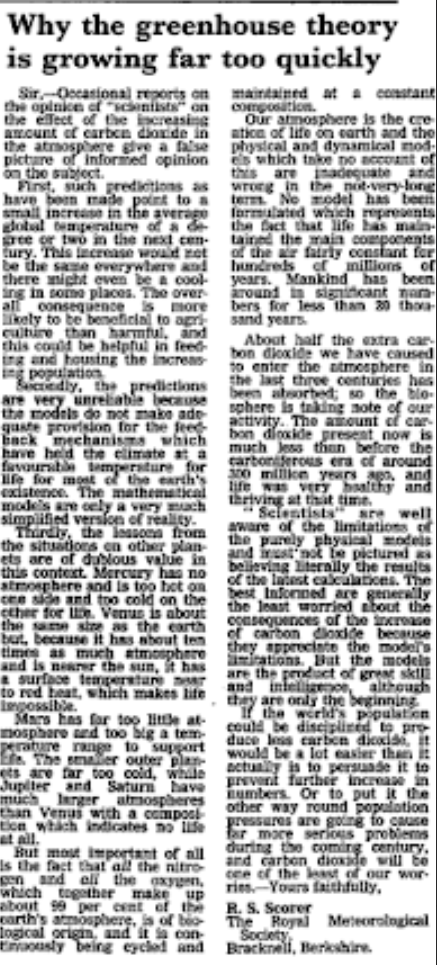
January 9, 1987 – another stupid letter in the Guardian

Thirty eight years ago, on this day, January 9th, 1987 a grumpy scientist who had already been wrong about ozone was being wrong about carbon dioxide build-up.

The amount of carbon dioxide in the air was roughly 349ppm. As of 2025 it is 425ppm, but check here for daily measures. 

The context was was that more concern was being paid to the greenhouse effect, especially since the Villach meeting in October 1985 and people were talking about it, clearly. The other context will be that Richard S. Scorer was well as ozone problems, from the 70s and his actions on the latter score a mention (p.114) in a Oreskes and Conway’s book The Merchants of Doubt.

What’s fascinating here is that latter the same year Scorer, in his capacity as President of the Royal Meteorological Society, was engaged in “high level” discussions” about climatic change (as per National Archives binge, Jan 2025 – watch this space!)

What I think we can learn from this

Relevance Deprivation Syndrome, and having been flat wrong is a real thing – see also John Maddox (twice Nature editor) And John Mason (ex-Met boss) for that matter.

What happened next

1988 was the banner year for climate change. It broke through into the public policy agenda. Scorer died in 2011. and the Guardian keep kept publishing asinine letters from asinine people

What do you think? Does this pass the ‘so what?’ threshold? Have I got facts wrong? Interpretation wrong? Please do comment on this post, unless you are a denialist, obvs.

Also on this day:

January 7, 2004 – geoengineering our way outa trouble?

January 7, 2013 – Australian climate activist pretends to be ANZ bank, with spectacular results 

2013, Jan 7: Paper (briefly) wraps rock. But coal wins in the end… #auspol

Categories
Activism United Kingdom

August 4, 2008 – Police pepper spray #climate campers

On this day, August 4, 2008, the forces of law and order provided law. And order. Forcefully.

At the Third Climate Camp

“Police used pepper spray on the crowd at the Climate Camp 2008. It was around 6am Monday 4th August and campers had been woken to the alarm of ‘cops on site’. They were trying to seize vehicles that campers had parked at a top gate of the camp. It was denied later the same day by Sir Ian Blair that any pepper spray would have been used, but this footage clearly shows its unnecessary use.

This was the same Climate Camp where the Met put it about that police had suffered injuries and been hospitalised. A Labour Minister said 70 police had been injured.

The right wing media picked this up (of course) and ran stories about crazed violent eco-anarchists.  

But guess what, it turned out that NONE OF THIS WAS TRUE.

The Liberal Democrats put in a Freedom of Information Act request. The answer 

“showed that no officers in the £5.9m police operation at Kingsnorth power station in Kent during August had been injured by protesters. Instead, police records showed that their medical unit had dealt mostly with toothache, diarrhoea, cut fingers and “possible bee stings”.

https://www.theguardian.com/environment/2008/dec/16/kingsnorth-environment-police-inquiry-injuries

And, of course

Vernon Coaker, the Home Office minister, told MPs at Commons question time yesterday [December 15]: “I was informed that 70 police officers were hurt and naturally assumed that they had been hurt in direct contact as a result of the protest. That clearly wasn’t the case and I apologise if that caused anybody to be misled.”

“If”. Yeah, sweet non-apology apology. Stay classy, Vern.

On this day the PPM was 384.32 ppm. As of August 2021  it is 421ish- but see here for the latest.

Why this matters. 

The media love a good beat-up. And most are in a symbiotic relationship with our lords and masters.

What happened next?

Climate Camp imploded (it wasn’t just down to the undercover cops, btw). Various groups kept the NVDA flame alive. Extinction Rebellion came along in 2018 and learnt absolutely nothing from the history. Nothing. Nada. Nowt.  

Oh well.

Categories
Carbon Capture and Storage Technophilia

June 25, 2002, 2003 and 2008 – CCS’s first hype cycle builds

On this day, June 25, across 6 years, we can watch a technology emerge from obscurity (see June 4 for how an issue goes through an arc).

Carbon capture and storage is the proposal to stop carbon dioxide molecules, released when you burn a hydrocarbon (oil, coal or gas), from getting into the atmosphere. I could go on, but I won’t…

On this day in 2002 the UK Department of Trade and Industry (DTI) held an “ Improved Oil Recovery” Research Seminar.

Then, a  year later the US, EU, 12 countries agreed to develop carbon capture technologies” – the grandly named “Carbon Sequestration Leadership Forum” became a thing.

Then, five years after that, with CCS very high up the agenda in the UK,  a Shell-sponsored CCS supplement turned up in the Guardian  containing 14-articles, all focusing on CCS. Page 234 of Mander et al (2013)

Why this matters. 

Technologies build up a head of, erm, steam. Or they don’t. It takes time for things to emerge. Then they work, or they don’t, or they do something else.

What happened next?

CCS? It went away. Then it came back, as fantasies do.