Categories
Arctic

February 20, 1969 – The Arctic will melt

Fifty seven years ago, on this day, February 20, 1969,

“Col. Bernt Balchen, polar explorer and flier, is circulating a paper among polar specialists proposing that the Arctic pack ice is thinning and that the ocean at the North Pole may become an open sea within a decade or two.”

Expert Says Arctic Ocean Will Soon Be an Open Sea Catastrophic Shifts in Climate Feared if Change Occurs; Other Specialists See No Thinning of Polar Ice Cap

By WALTER SULLIVAN February 20, 1969. New York Times.

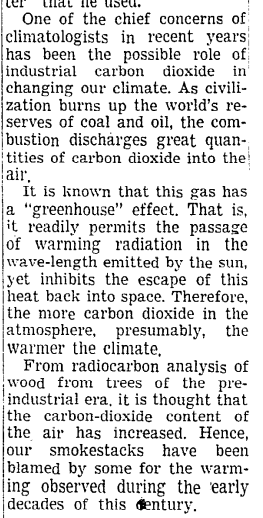
The amount of carbon dioxide in the air was roughly 324ppm. As of 2026 it is 428ppm, but check here for daily measures. 

The broader context was that the Arctic had been perceptibly warming since the end of the 19th century. And this had been spotted onwards and onwards from 1916 onwards. It was not a particularly controversial finding, though, the mechanism was in dispute, and the speed with which the changes would hit were within dispute.

The specific context was that all things environmental were a hot topic, because in January of 1969 the Santa Barbara oil spill had happened. You’d also had the Earth Rise photo from NASA, and everyone was beginning to worry about the impacts of man’s activities.

What I think we can learn from this is that we’ve known that we were causing havoc and mayhem for a long time. We haven’t always been accurate on how that havoc and mayhem would unfold, because, well, after all, prediction is very difficult, especially about the future. It’s worth noting that Walter Sullivan, their science correspondent, had been neck deep in the International Geographical Year, publicity or reporting, so he knew what he was talking about.

It was also Sullivan who, in 1981 reported on James Hansen’s findings, I think, in August, and that ended up costing Hanson some funding, which had already been granted because the Reagan administration was, well, the Reagan administration. 

What happened next: More and more attention paid to the melting of ice caps and the freeing up of polar sea lanes, etc. And now as of 2026, well, the fights are on.

What do you think? Does this pass the ‘so what?’ threshold? Have I got facts wrong? Interpretation wrong? Please do comment on this post, unless you are a denialist, obvs.

Also on this day: 

February 20, 1966 – US Senators told about carbon build-up by physicist

February 20, 1970 – South Australian premier sets up an Environment Committee

February 20, 2017 “Clean Coal” money being spent on PR

Categories
United States of America

August 29, 1981 – New York Times editorial “Heating up the Atmosphere”

Forty four years ago, on this day, August 29th, 1981, a week after a front page story “Study finds warming trend that could raise sea levels,” the New York Times editorialised

For years there have been doomsday predictions that burning of fossil fuels might bring about a climatic catastrophe. According to the most alarming theories, fossil fuels release carbon dioxide into the atmosphere where it acts as a greenhouse, blocking the escape of heat into space and thus warming the Earth’s surface. The ice caps could melt, sea levels could rise, agriculture could be disrupted and vast coastal areas might be inundated.

The chief weakness in such theories has been lack of evidence that the greenhouse effect is actually occurring. Though carbon dioxide in the atmosphere has been increasing, temperatures in the Northern Hemisphere have been falling over the last 30 years. But now seven scientists from the National Aeronautics and Space Administration claim to have found evidence that, on a global basis, carbon dioxide has already been warming the Earth for a century. They predict it will produce ”unprecedented” warming in the next century.

Their study finds that the warming predicted by various computer models of the greenhouse effect is consistent with worldwide temperature readings since 1880 – and with observations from Venus and Mars. That gave them confidence that the effect is real and that the models can predict it. Other scientists will challenge their assumptions, methods and conclusions. Some actually believe that the greenhouse effect would be beneficial to world agriculture. Conclusive observations may not be available for decades. But it is significant that a respected team of scientists has now joined the group warning of possible catastrophe.

What, if anything, should be done? The nation seems to be turning to the worst possible fuels in terms of carbon dioxide. It is depending less on solar and nuclear power, which emit no carbon dioxide at all. And among the fossil fuels, it is shifting from natural gas and oil, which emit little carbon dioxide, to coal and synthetic fuels, which emit much more.

The greenhouse effect is still too uncertain to warrant total alteration of energy policy. But this latest study offers fair warning; that such a change may yet be required is no longer unimaginable.

Opinion | Heating Up the Atmosphere – The New York Times

The amount of carbon dioxide in the air was 340ppm. As of 2025, when this post was published, it is 430ppm. This matters because the more carbon dioxide in the air, the more heat gets trapped. The more heat, the more extreme weather events. You can make it more complicated than that if you want, but really, it’s not. Fwiw, I have a tattoo of the Keeling Curve on my left forearm.

The broader context was that the New York Times, and other papers, had been reporting on carbon dioxide build-up, quite intermittently, since the 1950s.

The specific context was that the Reagan administration was busy attacking science. The New York Times’ science correspondent, Walter Sullivan, had talked to James Hansen, which ended up costing some funding. See this 2007 interview with Hansenhttps://www.pbs.org/wgbh/pages/frontline/hotpolitics/interviews/hansen.html.

Why do you think that your testimony in particular was sensitive in the [Reagan] administration, so much so that OMB would want to shade what you were saying?

Well, I think the reason it was sensitive was the fact that it got attention. In 1981 the paper that we wrote in Science — that predicted that the world would be getting warmer over the 1980s and that by the year 2000 you begin to see loss of sea ice and eventually you have opening of the fabled Northwest Passage — that article was reported on the front page of The New York Times by Walter Sullivan. As a result, we lost our funding from the Department of Energy, because, in that administration, they simply did not want that sort of attention to this problem, because it has big implications for fossil fuel industry.

What I think we can learn from this is that we knew enough and we didn’t act. We can stick that on our tombstone.

What happened next – it would be 1988 before politicians would have to start to pretend to give a damn.

What do you think? Does this pass the ‘so what?’ threshold? Have I got facts wrong? Interpretation wrong? Please do comment on this post, unless you are a denialist, obvs.

Also on this day: 

August 29, 1990 – The Australian mining and forestry industries threaten to spit the dummy

August 29, 2005 – Hurricane Katrina

August 29, 2008 – business tells Labor to go softly (Labor then does, obvs).

Categories
United States of America

January 30, 1961 – New York Times reports world is cooling

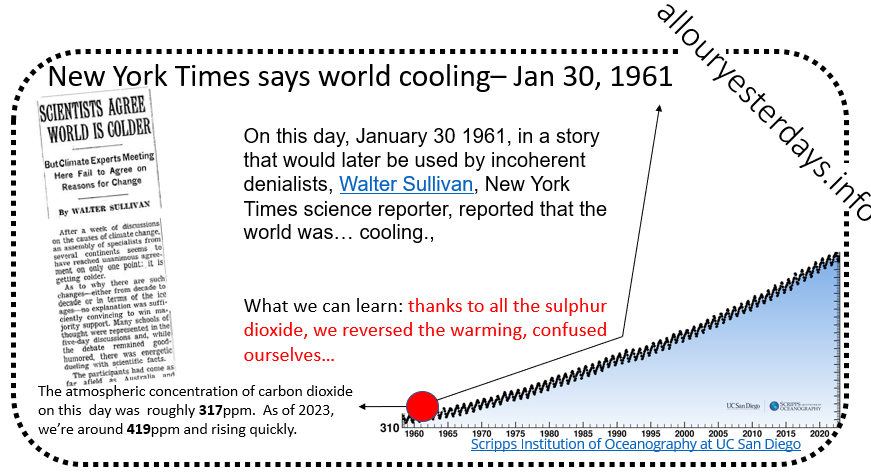
Sixty two years ago, on this day, January 30 1961, in a story that would later be used by incoherent denialists, Walter Sullivan, New York Times science reporter, reported that the world was… cooling.,

You see this clip on various denialist websites.  You don’t see this below, from the same article.

This was in the context of a symposium in New York, attended by Hermann Flohn and Gilbert Plass, among others…

The amount of carbon dioxide in the air was roughly 317ppm. As of 2023 it is 419. .

The context was that global temperatures had been rising over the last 50 plus years (Guy Callendar had been one of many to spot this – his contribution had been to say it was down to carbon dioxide build-up). However, from about 1940, the amount of dust/smog/sulphur had increased the reflectiveness of the atmosphere, meaning some of the sun’s heat didn’t hit the Earth.  So temperatures started falling…

What I think we can learn from this

The signal did not properly emerge from the noise until the 1970s (though the reason – smog/suplhur was well understood)

Denialists cherry-pick like mad, then project that onto people who… advocate for 19th century physics.

What happened next

The carbon dioxide kept accumulating. Sullivan kept covering it, forming good relationships with working scientists like Stephen Schneider (they met late 1972) and James Hansen.

What do you think? Does this pass the ‘so what?’ threshold? Have I got facts wrong? Interpretation wrong?  Do comment on this post.

Categories
Energy United States of America

January 3, 1984 – US report on energy transition to combat climate released

Thirty-nine years ago, on this day, January 3, 1984, the New York Times science journalist Walter Sullivan had a story that began with words that could have been written yesterday, more or less…

“A GLOBAL strategy to reduce a potentially dangerous increase in atmospheric carbon dioxide has been outlined by engineers and economists at the Massachusetts Institute of Technology and Stanford University.

“In a report to the National Science Foundation, the specialists propose that the use of fossil fuel, largely responsible for the carbon dioxide increase, can be substantially reduced by greater efficiency in energy production.”

Sullivan, W. (1984)  “Report Urges Steps to Slow Down Climate Warming,” The New York Times, January 3.

Sullivan had been writing about carbon dioxide build-up in the atmosphere for the NYT since the early 1960s (having become aware of the issue during his coverage of the 1957-8 International Geophysical Year).

The report’s lead author, David Rose had been quoted in an August 1980 Wall Street Journal article (which we will come to later) as saying that if the CO2 theory were right “that means big trouble.”

The amount of carbon dioxide in the air was roughly 344ppm. As of January 2023 it is 417. .

The context was that by the mid-late 1970s, US scientists were able to get funding for decent studies of carbon dioxide build-up, and were even getting some sympathetic hearings from the Jimmy Carter White House. That all ended when Reagan and his goons turned up… In October 1983 two “conflicting” reports about CO build-up had been released. (something AOY will cover later this year).

What I think we can learn from this

We knew. As I have argued here, and elsewhere, ad infitum  and nauseam, there is not an information deficit,,but there is a sustained radical social movements deficit.

What happened next

The issue finally was forced onto the agenda in 1988.  Reports like the MIT/Stanford one have been written pretty much every year since then.  Human emissions of carbon dioxide and other greenhouse gses have climbed almost every year. Atmospheric concentrations of carbon dioxide have gone up and up and up.

What do you think? Does this pass the ‘so what?’ threshold? Have I got facts wrong? Interpretation wrong?  Do comment on this post.

References

Rose, David J.; Miller, Marvin M.; Agnew and  Carson E. (1983) “Global energy futures and CO\2082-induced climate change: report prepared for Division of Policy Research and Analysis, National Science Foundation https://dspace.mit.edu/handle/1721.1/60493

Sullivan, W. (1984)  “Report Urges Steps to Slow Down Climate Warming,” The New York Times, January 3. https://www.nytimes.com/1984/01/03/science/report-urges-steps-to-slow-down-climate-warming.html

Categories
United States of America

September 11, 1961 – New York Times reports “Air Found Gaining in Carbon Dioxide”

On this day, 11 September, 61 years ago, the New York Times carried a story – on page 29 – from their science correspondent Walter Sullivan.

The title was  “Air Found Gaining in Carbon Dioxide”  

Sullivan had already written a book – “Assault on the Unknown” about the International Geophysical Year, so this finding was hardly a shock.

On this day the PPM was 314.99. Now it is 421ish- but see here for the latest.

Why this matters. 

Again, early days, but the issue was being watched…

What happened next?

Scientists kept sciencing. Sullivan kept writing about this stuff. Other NYT journos picked up the story too, over the following decades.

Categories
Ignored Warnings United States of America

July 25, 1977 – New York Times front page story “scientists foresee serious climate changes”

On this day, 25 July, 1977 the New York Times ran a front page story, by its science reporter, Walter Sullivan. Its title – “Scientists Fear Heavy Use of Coal May Bring Adverse Shift in Climate

“Highly adverse consequences” may follow if the world, as now seems likely, depends increasingly on coal for energy over the next two centuries, according to a blue‐ribbon panel of scientists.

“In a report to the National Academy of Sciences on their two‐and‐a‐half‐year study, the scientists foresee serious climate changes beginning in the next century. By the latter part of the 22nd century a global warming of 10 degrees Fahrenheit is indicated, with triple that rise in high latitudes.”

Sullivan, W. (1977) Scientists Fear Heavy Use of Coal May Bring Adverse Shift in Climate New York Times, July 25, p.1
Here’s the report.

Two days later, it made its way into The Times

Why this matters. 

We knew enough by the late 1970s to move from watching brief to “action!”. 

“We” didn’t do that.

What happened next?

Briefed in 1980 by her Chief Scientific Advisor, Margaret Thatcher was incredulous “You want me to worry about the weather.”