Forty seven years ago, on this day, January 19,1976, people were talking about the carbon footprint of cement.
R.M. Rotty, ‘Global Carbon Dioxide Production from Fossil Fuels and Cement, A.D. 1950-A.D. 2000’, presented at Office of Naval Research Conference on the Fate of the Fossil Fuel Carbonates, Honolulu, Hawaii, January 19-23, 1976
The amount of carbon dioxide in the air was roughly 331.5ppm. As of 2023 it is 419.
The context was that US scientists (and to a lesser extent perhaps European ones) were beginning to think about what reducing emissions – or just slowing the increase – might look like at a sectoral level.
Rotty did good work (there’s no wikipedia page for him, which someone should rectify, imo.)
What I think we can learn from this
People have been thinking about cement as a carbon problem for longer than you’d think…
What happened next
Nothing much on the cement front for a very long time…My impression it was still pretty niche even in 2003…
Sabine Clarke is Senior Lecturer in Modern History. She works on the history of science, technology and medicine in Britain and its colonial empire between WWI and 1965, with a particular focus on the Caribbean and East Africa. She kindly agreed to be the latest person interviewed as part of the All Our Yesterdays project.
Who are you and how did you come to be studying insecticides?
I am Senior Lecturer in Modern History at the University of York. I have been at York since 2010 and before that I was a Research Fellow at the University of Oxford. I did my PhD at Imperial College in the Centre for the History of Science, Technology and Medicine.
From University of York website
My work focusses on two things – the history of science in Britain from WWI to the 1970s and the history of British imperialism in the twentieth century. I am particularly interested in relationship between science, scientists and the state, including big issues such as the increasing attention paid to experts by government in the early 20th century and the ‘rise of research’, in which an activity labelled as ‘research’ became as the key activity that needed to be funded by business and government.
I first became interested in insecticides when I discovered that the British government had set up a major centre for insecticides research in the colony of Tanganyika after WWII. A group of scientists based there carried out extensive trials of DDT and other chemicals in East Africa during the 1950s. I tracked down the scientist who had been the head of the centre before independence, Dr Kay Hocking, and interviewed him about his work.
It struck me that the history of DDT use in the tropics had come to be completely dominated by the story of the World Health Organisation’s Global Eradication of Malaria project and that other bodies who sponsored extensive research into insecticides, and promoted their use, such as the Colonial Office in Britain, had been completely ignored. This prompted me to put together a funding application to the Wellcome Trust for a project to recover the history of insecticides in Britain and places that were part of the colonial empire. This project, called The Chemical Empire, is now in its fourth year and I am writing two books at present – one on DDT in Britain and the other mapping insecticide use across the British Empire.
2. What has surprised you in the course of researching insecticides?
I think one of the really surprising things about researching the history of insecticides in Britain and the British empire is that previous historians have not asked some fairly fundamental questions. There has been no attempt to really investigate where and when the deployment of different insecticides was greatest, in public health, homes, or farming. A lot of unexamined assumptions have become embedded in our existing histories. For example, a tendency to assume that malaria control was the most significant area of insecticide use in the tropics after 1945 has meant that other areas of insecticide deployment have been overlooked. In many places in the British empire, far greater volumes of chemicals were disseminated fighting agricultural pests, such as locusts in East Africa, than eliminating mosquitoes. What this means is that we have often been looking in the wrong places to understand insecticides and their impact on the environment and people in the mid-twentieth century. The insecticide experiences of whole communities have been ignored.
3. What lessons are there in how campaigners worked on this issue for climate campaigners?
The history of insecticides shows us the power of public outrage. The British case illustrates that concerns amongst scientists and some campaigning groups could only go so far in persuading policy makers to take action. Civil servants and politicians were forced to do something when a growing number of everyday people expressed their concern to newspapers, their MPs and directly to Ministers (there is a large file containing letters from the public in the National Archives) The turning point appears to have been the publication of Silent Spring in Britain in 1963. I would agree with the point that many people have made beforehand – that Rachel Carson’s intervention was incredibly important. Specifically, it is really striking in the British case that Carson’s book did not necessarily provide revelations of harm that nobody had previously known about (the harms had already gained a certain amount of publicity), but rather she provided a powerful set of metaphors and imagery that changed the way that people spoke about insecticides. The idea of a sea of poison washing over the countryside, the idea of invisible toxins seeping into our land and water, the invocation of similarities with atomic radiation and thalidomide and so on. I think what Carson did was capture the imagination of people in a way that scientific reports had failed to do, and perhaps most importantly of all, provide some incredibly affecting metaphors and images that provided a common language for the way that people expressed their concerns.
4. How and where can people find your work?
Two articles have been published recently on our work on The Chemical Empire project – both are Open Access.
Sabine Clarke and Thomas Lean, “Turning DDT into ‘Didimac’: making insecticide products and consumers in British farming after 1945”, History and Technology, 2022, Vol. 38, 1, 31–61
Sabine Clarke and Richard J.E. Brown, “Pyrethrum and the Second World War: Recontextualising DDT in the Narrative of Wartime Insect Control”, Journal of History of Science and Technology, Vol. 16, no. 2, December 2022, pp. 89-112.
And this video shows me talking about the history of insecticides and locust control in East Africa.
5. What next?
Tom Lean and I hope to finish our book on the history of insecticides in Britain by the end of the year. I plan to travel to Ghana to find out more about the history of insecticides and stored products in the summer.
6. Anything else you’d like to say
I am organising a workshop next year to discuss the global history of pesticides so please get in touch if this is something that you work on!
“A major new effort to develop jobs which protect the environment”, was how the January 18 joint statement by the Australian Council of Trade Unions and the Australian Conservation Foundation described their joint Green Jobs in Industry Plan. The scheme was launched at the Visyboard Paper and Cardboard Recycling Plant in Melbourne by Peter Baldwin, minister for higher education and employment services.
Noakes, F. (1993) ACTU and ACF launch green jobs program. Green Left Weekly January 27th
The amount of carbon dioxide in the air was roughly 357.1ppm. As of 2023 it is 419.
.
The context was this. The ACF had been at the forefront of “greenhouse effect” efforts, trying to shape policy in the period 1989 to 1992. By mid-1992 it was clear they’d been defeated in their intense and praiseworthy efforts to get anything meaningful. ‘Green Jobs’ was a kind of consolation prize, and a way of continuing dialogue with the union movement (relations were intermittently fraught, for the usual reasons).
What I think we can learn from this
“Green jobs” are a kind of boundary object, or a Rorschach Test, or a floating signifier, or whatever cool academic term is being used to mean “something various groups can emphatically agree on as a principle, and so defer awkward conversations about winners and losers.”
What happened next
It went nowhere – the Keating Government was not interested. The Howard government even less so. The ACF and ACTU released another report (yes, there may have been others in between) in 2008, spruiking a Green Jobs Bonanza.
What do you think? Does this pass the ‘so what?’ threshold? Have I got facts wrong? Interpretation wrong? Do comment on this post.
David Annandale,Angus Morrison‐saunders &Louise Duxbury (2004) Regional sustainability initiatives: the growth of green jobs in Australia. Local Environment, Pages 81-87 https://doi.org/10.1080/1354983042000176610
Goods, C. 2020 Labour Unions, the Environment and Green Jobs.
Twenty two years ago, on this day, January 17, 2001, Energy gouger “Enron” engineered some blackouts in California to… gouge. It’s what they did. It was their “corporate DNA”…
As the FERC report concluded, market manipulation was only possible as a result of the complex market design produced by the process of partial deregulation. Manipulation strategies were known to energy traders under names such as “Fat Boy”, “Death Star“, “Forney Perpetual Loop”, “Wheel Out”, “Ricochet”, “Ping Pong”, “Black Widow”, “Big Foot”, “Red Congo”, “Cong Catcher” and “Get Shorty”.[10]
In a letter sent from David Fabian to Senator Boxer in 2002, it was alleged that:
“There is a single connection between northern and southern California’s power grids. I heard that Enron traders purposely overbooked that line, then caused others to need it. Next, by California’s free-market rules, Enron was allowed to price-gouge at will.”[11]
But we are not supposed to remember this sort of behaviour. It doesn’t get institutionally remembered (included in textbooks, mentioned by mainstream commentators and columnists). That would be ‘impolite, or ‘political’ or even ‘unAmerican’ or ‘conspiracy theorising’.
The amount of carbon dioxide in the air was roughly 375ppm. As of 2023 it is 419.
The context was that the free market was providing opportunities. As per Adam Smith, author of the Wealth of Nations –‘People of the same trade seldom meet together, even for merriment and diversion, but the conversation ends in a conspiracy against the publick, or in some contrivance to raise prices’.
What I think we can learn from this
That the “normal” workings of infrastructure are intensely political. They are literally games of power.
That if we don’t remember the history, it will be repeated.
What happened next
Enron went under. And the shenanigans were forgotten,or dismissed as an aberration.
The trust between consumers/citizens and providers that would be needed for some kind of ‘energy transition’? Not helped.
What do you think? Does this pass the ‘so what?’ threshold? Have I got facts wrong? Interpretation wrong? Do comment on this post.
Twenty years ago, on this day, January 16 2003, a “milestone” was reached. Oh yes.
CHICAGO, IL – Efforts to develop market-based solutions to global warming reach a milestone today as leading U.S. and international companies and the City of Chicago announce they will be the Founding Members of Chicago Climate Exchange (CCX®), a voluntary cap-and-trade program for reducing and trading greenhouse gas emissions. In an unprecedented voluntary action, these entities have made a legally binding commitment to reduce their emissions of greenhouse gases by four percent below the average of their 1998-2001 baseline by 2006, the last year of the pilot program.
The amount of carbon dioxide in the air was roughly 375.5ppm. As of 2023 it is 419.
The context was that a bunch of people thought – or chose to pretend they thought – that we could trade our way out of trouble, and that those who were early and/or quick could make a killing, and be doing well by doing good.
Carbon trading as a substitute for actual action… Because, you know, it would be cheaper that way…
What I think we can learn from this
That trading schemes are going to cause a feeding frenzy for banks and legal consultancies, and keen-to-burnish-image customer-facing businesses. Smart people take a breath and try to separate the hype and froth from what is actually being proposed.
What happened next
Turns out it didn’t work.
“CCX ceased trading carbon credits at the end of 2010 due to inactivity in the U.S. carbon markets,” (wikipedia)
What do you think? Does this pass the ‘so what?’ threshold? Have I got facts wrong? Interpretation wrong? Do comment on this post.
Here’s the weekly update about what is coming up/has happened, both on this site, but also in what is left of the world.
Coming Up
Coming up this week on All Our Yesterdays: there’ll be posts from 1961 through to 2011, from South African mining disasters to carbon trading and everything in between.
Coming up in the real world
In the UK –
Online “National Climate Conference” on 18th January
And I made a video about “The Macmillan Manoeuvre”
"The Macmillan Manoeuvre" – a new short video. Not great, not terrible. Tell me what you think… Tips for improving general technique very welcome. pic.twitter.com/XXs9umj2D2
As ever, I want to hear from you, what use you are finding the posts, what else you’d like to see. And I would love to appear on your website, podcast, whatever… Do get in touch….
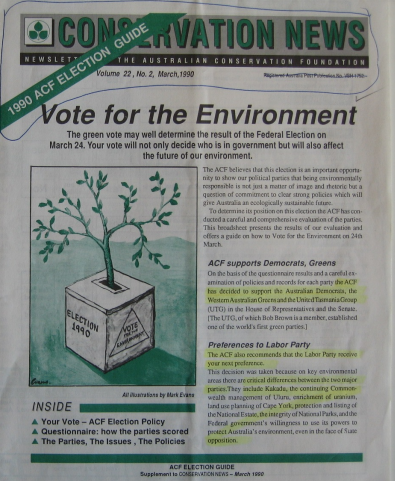
On this day, January 15, 1990, with a Federal Election looming, the Opposition leader and would-be Prime Minister Andrew Peacock and his shadow Environment Minister Chris Puplick, met with the boss of the Australian Conservation Foundation (ACF)… The political journalist Paul Kelly (not the same guy who sings the songs!) tells it thus.
Peacock and Puplick met the ACF’s Philip Toyne for lunch at an Italian restaurant in Melbourne. This discussion has passed into Liberal folklore as a great deception. Peacock and Puplick say that Toyne told them that the ACF would not be actively advocating a vote for either of the major parties in the House. It would be supporting the Democrats and minor parties in the Senate. Peacock and Publick left with a misplaced optimism. The political truth is that there was no way that Labor’s investment in the greens would be denied. The entire ALP was confident that it would have the green’s backing. It is idle to think that Toyne was unaware of these realities.
Kelly, P. (1992) The End of Certainty. p.543
The amount of carbon dioxide in the air was roughly 353.8ppm. As of 2023 it is 419.
The context was that the Liberals were hoping to form the next government, and had some relatively bold proposals (or rather, targets!). They wanted the environment movement ‘bosses’ to “play dead” during the impending Federal Election campaign.
What I think we can learn from this
Personalities matter. Narratives of betrayal stick, and become ‘folklore’. (But also, this can be overplayed. The Libs and Nats were never going to become Chipko women. The idea that there is a path dependency from January 15 1990 is… heroic).
Ultimately, if you want to have a better future, then you need a broad-based and “uncontrollable” set of social movements that force politicians and businesses to face environmental and social realities. And I do not know how those movements would grow and sustain themselves and each other, in the context of super-wicked problems and the seductions of stale repertoires and the abyss… But maybe that’s just me.
What happened next
The Libs went anti-green, and have basically stayed there ever since. It is finally, in 2023, costing them electorally.
What do you think? Does this pass the ‘so what?’ threshold? Have I got facts wrong? Interpretation wrong? Do comment on this post.
Thirteen years ago, on this day, January 14, 2010 various investors met for the fourth meeting sponsored by the usual suspects, at the United Nations HQ in New York.
The Summit brought together more than 520 financial, corporate, and investor leaders with more than $22 trillion in combined assets. Speakers from the investment community, business, labor, and government highlighted the fact that private investment in climate change solutions is crucial for addressing the climate crisis and will not happen at the necessary scale without strong climate and energy policies that limit emissions and put a price on carbon.”
The amount of carbon dioxide in the air was roughly 388.9ppm. As of 2023 it is 419. .
The context was – a “Bali Roadmap” had been agreed for negotiations to culminate in a post-Kyoto Protocol deal at the December 2009 climate conference in Copenhagen. This meeting of investors will have been put in everyone’s diary months earlier, in anticipation of sunny uplands and money-making opportunities. In the event, Copenhagen ended in farce, and so the mood was probably quite downbeat. So it goes.
What I think we can learn from this
The investors won’t save us. They will talk among themselves and cling on to the trappings of power, influence, intelligence, but none of it amounts to a bucket of warm spit. They have to delude themselves, but we don’t have to fall for the same delusions…
What happened next
They kept holding conferences. New buzzwords are invented, tossed around, age out, and are replaced by new buzzwords… Meanwhile, the carbon dioxide accumulates.
What do you think? Does this pass the ‘so what?’ threshold? Have I got facts wrong? Interpretation wrong? Do comment on this post.
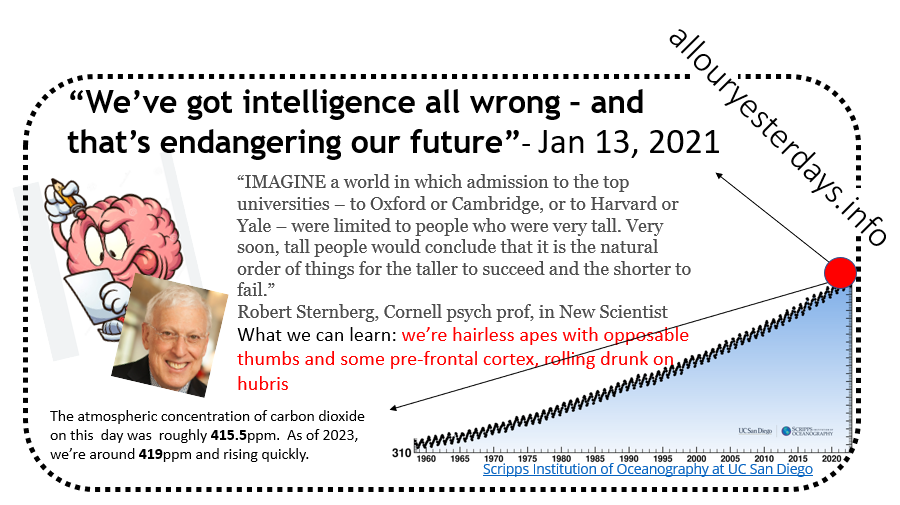
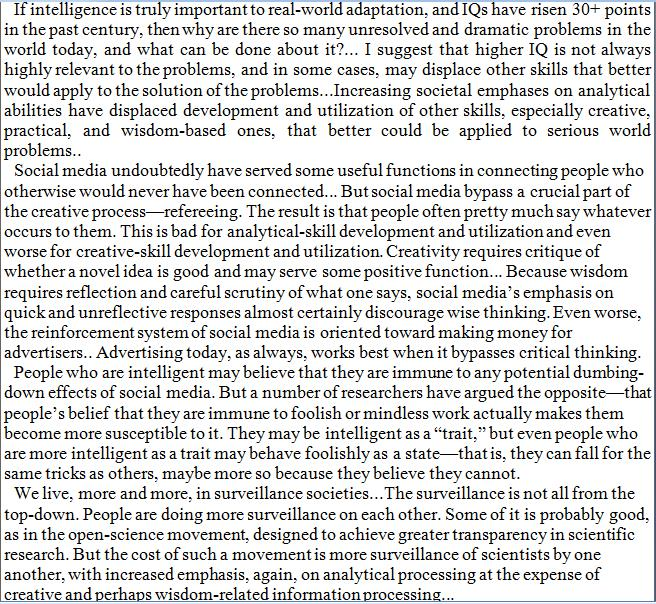
Two years ago, on this day, January 13, 2021, Robert J Sternberg, an American academic who has been studying intelligence for decades, argues in a New Scientist article that, well
“We’ve got intelligence all wrong – and that’s endangering our future”
IMAGINE a world in which admission to the top universities – to Oxford or Cambridge, or to Harvard or Yale – were limited to people who were very tall. Very soon, tall people would conclude that it is the natural order of things for the taller to succeed and the shorter to fail.
This is the world we live in. Not with taller and smaller people (although taller people often are at an advantage). But there is one measure by which, in many places, we tend to decide who has access to the best opportunities and a seat at the top decision-making tables: what we call intelligence. After all, someone blessed with intelligence has, by definition, what it takes – don’t they?
We have things exactly the wrong way round. The lesson of research by myself and many others over decades is that, through historical accident, we have developed a conception of intelligence that is narrow, questionably scientific, self-serving and ultimately self-defeating.
The amount of carbon dioxide in the air was roughly 415.5ppm. As of 2023 it is 418. .
What I think we can learn from this
Robert Sternberg has produced so much useful work (on love, on creativity/intelligence).
The game is rigged, and those rigging it want to keep the game as it is. Basically, a bunch of extractivist violent arrogant planet-killers think they are God’s gift, because they made God in their image. And here we are.
What happened next
We keep relying on our “intelligence” to get us out of this.
What do you think? Does this pass the ‘so what?’ threshold? Have I got facts wrong? Interpretation wrong? Do comment on this post.
References
Sternberg. R. (2018) “Why Real-World Problems Go Unresolved and What We Can Do about It: Inferences from a Limited-Resource Model of Successful Intelligence”
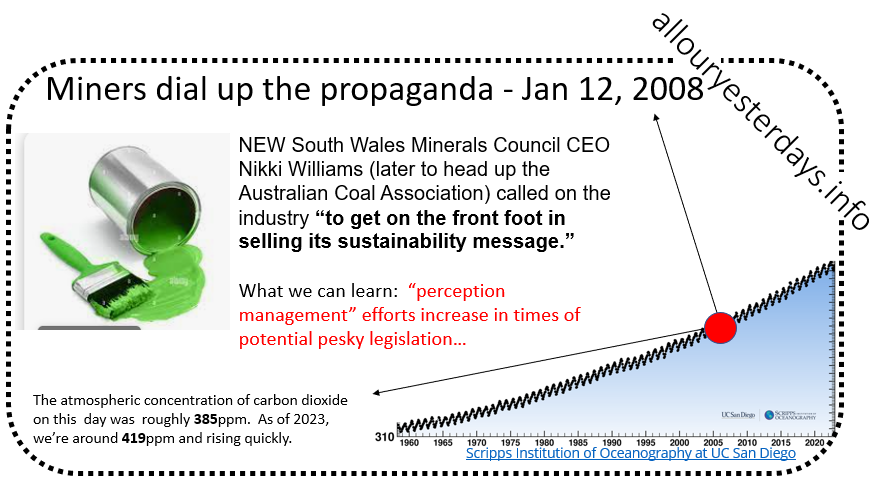
NEW South Wales Minerals Council CEO Nikki Williams (later to head up the Australian Coal Association) called on the industry “to get on the front foot in selling its sustainability message.” (see here)
The amount of carbon dioxide in the air was roughly 385.7ppm. As of 2023 it is 419.
The context was that Australia was in the grip of another awareness of its fragility and of serious trouble ahead. Mining companies were understandably looking to burnish their images with the usual bag of tricks – sponsorships of sports teams, tree planting and the like. Doing it as individual companies is expensive and open to easy sneering. Getting your trade association to do it helps you a) spread costs and b) gain more “respectability,” at least in the eyes who choose not to see what their eyes can see.
What I think we can learn from this
We live in a propaganda-ised society. A major function of trade associations is to pump out propaganda when it is needed, to deflect, slow or soften the actions of the state. See that Chomsky fella, or Alex Carey.
What happened next
Lots of propaganda. Lots of lobbying. The Rudd government spent two years faffing and selling its arse. Its “Carbon Pollution Reduction Scheme” was a farce. Then the Gillard government had to try to pick up the pieces. Meanwhile, the emissions climbed and people got (rightly) cynical about how much politicians would prance and preen while doing nowt.
What do you think? Does this pass the ‘so what?’ threshold? Have I got facts wrong? Interpretation wrong? Do comment on this post.


 .
.