Categories
Uncategorized

May 23, 2012 – wicked problems and super-wicked problems all around…

Eleven years ago, on this day, May 23, 2012, there was an interesting paper published about “wicked problems” and super wicked problems.

2012 Overcoming the tragedy of super wicked problems: constraining our future selves to ameliorate global climate change published on 23 May 2012 

Most policy-relevant work on climate change in the social sciences either analyzes costs and benefits of particular policy options against important but often narrow sets of objectives or attempts to explain past successes or failures. We argue that an ‘‘applied forward reasoning’’ approach is better suited for social scientists seeking to address climate change, which we characterize as a ‘‘super wicked’’ problem comprising four key features: time is running out; those who cause the problem also seek to provide a solution; the central authority needed to address it is weak or non-existent; and, partly as a result, policy responses discount the future irrationally. These four features combine to create a policy-making ‘‘tragedy’’ where traditional analytical techniques are ill equipped to identify solutions, even when it is well recognized that actions must take place soon to avoid catastrophic future impacts.

https://link.springer.com/content/pdf/10.1007/s11077-012-9151-0.pdf?pdf=button

The amount of carbon dioxide in the air was roughly 396.9ppm. As of 2023 it is 420ppm, but check here for daily measures. 

The context was that we have known about so-called wicked problems for 50 years. And the idea of super wicked problems has been around for thirty.

Climate change is a super wicked problem par excellence, and this was especially obvious in the aftermath of the Copenhagen fiasco, which had occurred in December 2009. And it was not at this point at all clear that the UNFCCC caravan could have its wheels put back on in any meaningful sense.

What I think we can learn from this

It’s super-wicked problems all the way down… We kept punching the tar baby, and now it’s all over but the dying.

What happened next

We didn’t even acknowledge that these are super-wicked problems, let alone take actions to roll with the punches…

What do you think? Does this pass the ‘so what?’ threshold? Have I got facts wrong? Interpretation wrong?  Please do comment on this post, unless you are a denialist, obvs.

Categories
Uncategorized

Build Back Biodiversity:  International Biodiversity Day

A guest post by John Patmore

Today, 22 May 2023, is International Biodiversity Day or ‘International Day of Biological Diversity’ to use UN’s phrasing. This year’s theme is ‘From Agreement to Action: Build Back Biodiversity

If you look on Social Media search for: #BuildBackBiodiversity

And also: #AgreementToAction #KMGBF,

Along with: #HarmonyWithNature #30by30 #ForNature #ActionDecade #post2020

What Happened?

The original Convention on Biological Diversity (CBD) was prepared and signed following the 1992 ‘Rio Earth Summit’*. Thirty years later it is worth reminding ourselves why the term ‘Biodiversity’ arose, and what it was meant to capture.

Angry Monkey

“The earth is black in front of the cliff, and no orchids grow.

 Creepers crawl in the brown mud by the path.

 Where did the birds of yesterday fly?

 To what other mountain did the animals go?

 Leopards and pythons dislike this ruined spot;

 Cranes and snakes avoid the desolation.

 My criminal thoughts of those days past

 Brought on the disaster of today.”

‘Monkey’  Wu Ch’ên-Ên  Penguin Classics 

Humanity likes to see itself as all-knowing. Technology will provide solutions. ‘We’ are clever enough to control our destiny through applied engineering backed up with enough money.

Over recent decades we have seen there are many examples of our desires for more, faster and easier results failing. Recent floods across England, Pakistan and Bangladesh to name a few have left people homeless. The hottest summer ever recorded last year in England along with forests burning in Europe and USA over this century indicate massive environmental change we need to prepare for if we can’t ‘solve’ Climate Change.

Biodiversity was never seen as an end in itself. With publication of the ‘UK Biodiversity Action Plan’ (HMSO 1994) I asked the naive question “What is the point of it?”; my question was deliberate as ‘Conservation’ had been going on in Britain for over a Century. 

Biodiversity and the ‘Action Plans’ which emerged fulfilled several functions; a key one being to monitor change in the natural world. Sustainable Development as the foundation of the ‘Rio Earth Summit’* had three interconnected lynch pins. ‘Environment’ being the one that biodiversity plans aimed to monitor. Put simply: ‘You only go extinct once’ and we are seeing that increasingly across the World. In Britain the Scottish Wildcat has vanished, common dormouse is no longer common, water voles are extinct across many former counties.  The various ‘Biodiversity Action Plans’ (BAP) specified a range of habitat actions and species targets to enhance UK biodiversity.  added 

While we started to catalogue changes in biodiversity in the 1990s and list the objectives needed to enhance it there was a lack of meaningful action or senior level commitment. Even the Government’s National  UKBAP website, the index to biodiversity objectives, now advertises a private company!

However, COP15 provides continuity with the original UN CBD. There is genuine love for nature and commitment to biodiversity at the more local community levels.  

Some may say “We cannot control nature”; this phrase is often used by climate-change sceptics too. Yet we have successfully increased global air and sea temperatures over the past fifty years at rates never measured previously! We have destroyed habitats around the globe, whether it is rainforests or coral reefs. We have built on, ploughed and polluted heathlands, meadows and freshwater rivers in this country. So yes, “We can control nature”.

Breaking your own toys

When a complex and functioning system stops working normally a frequent immature reaction is to over-react. An intellectually and emotionally simple primate will literally ‘break its own toys’ rather than appreciate and understand how they should work. It can also be termed ODD (Oppositional Defiant Disorder). Having ‘broken’ the planet Earth it is clear that repair will require a focused action, agreed at a global scale. Most truly natural habitats have been destroyed and there has been over a century of damage to the area and connections between ‘Semi Natural Habitats’.

We have seen recent examples of emotionally simple ‘ODD’ reactions. Car fuel queues and anger over heating following Russian gas supply anxieties. We sheepishly recall fisticuff over toilet rolls –  Loo Roll Riots, of all things! This illustrates how we live in an interconnected world; or ‘Ecosystem’, as ecologists normally refer to this planet of natural, semi-natural habitats and species. 

Perhaps think of the global ecosystem as though it was your own body. You can lose teeth. You can lose a finger, or a toe. As each component of the ecosystem is lost the quality of life diminishes. Failing organs and hormone imbalance have a much larger impact than their physical size indicates; best to not overlook and ignore the diversity of creatures in our collective ecosystems! 

We are given indicators of ecosystem change, if we choose to see them. The zoonoses transfer of viruses from birds, bats and eventually larger mammals to humans led to the global pandemics of Covid19 and H5N1 (‘Bird Flu’ in Asia starting 2003).

Where next – Mars?

Following many centuries of species extinctions (Dodos were hunted to death!) and natural habitat loss it is time to reflect. Destruction of the Brazilian rainforest has been well documented, and still continues as cattle are farmed for a few short years to supply the ‘beefburger’ fast food trade. Borneo is one of the richest ecosystems in the world (= most biodiverse) and we see accelerating decline of its forests to be replaced by urban areas or palm oil plantations. In 1973 (fifty years ago) the large island of Borneo was almost completely dominated by tropical and sub-tropical rainforest. Now within two generations only a much reduced strip of rainforest now remains in the centre of Indonesian Kalimantan. 

We destroy the very health of planet Earth. At an egocentric level this will result in damage to our own human health. At an ecocentric level the very planet which has sustained life for over three billion years is being destroyed. Humanity is smart enough now to see this destruction. Mars is a long distance into the future. It makes far more sense to look after the only planet we know can support life.

Where next then?

Within Brighton and Hove’s Wildlife Forum (BHWF) we look to work with partner bodies to promote biodiversity and geodiversity. Everyone has a connection with nature. If you are keen to help improve nature conservation there are some basic first steps which will make a big big difference.

1. Set up a connection with others. This is the crucial ‘Agreement’ step which provides the foundation for action.

2. Confirm the current places with biodiversity and geodiversity features in your area. Google Maps is a super resource for this as you can plot polygons and single points on an internet map that everyone can see and share in improving.

3. Arrange to visit the Local Wildlife Sites (LWS = biodiversity and geodiversity) you have selected. They do not have formal protection so you can simply start by photographing and describing them.

4. As other people with a shared interest become focused on each particular LWS you can build up a list of habitats and species which depend on that site. Ideally you can monitor the size and health of your LWS areas.

5. Keep an eye on council forward plans, and also planning applications. You can identify threats to the LWS network. Given support from conservation groups you can actively prevent the loss and destruction of local biodiversity. 

And finally,

6. It’s not all trouble and strife! Once you have a LWS network on the live map, which people close by can see and know about, it’s time to expand. Look for opportunities to connect up the separate LWS areas, with ‘Wildlife Corridors’. This can be as small and personal as planting native species in a part of your garden adjacent to a neighbour also doing this. Allowing ‘Hedgehog Corridors’ to be created (see ‘Hedgehog Street Campaign’) 

7. Habitat Connectivity is often the most positive improvement that can be made by local groups and people. Finding the LWS network, protecting the areas and then enhancing their natural qualities to connect with nearby areas are the practical steps From Agreement to Action: …. to Build Back Biodiversity

John Patmore is an ecologist based in Brighton, England (Eco21st.com) He established BHWF ( BHWF.org.uk) with Martin Robinson over a decade ago. The Forum looks to promote biodiversity and geodiversity actions and policy across Brighton and Hove. 

* The United Nations Conference on Environment and Development 

Categories
Uncategorized

May 11, 2001 –  Bush Signs Oil Lobbying Organization’s Executive Order

Twenty two years ago, on this day, May 11, 2001, George “Supreme Court got me this gig” Bush did his masters’ bidding.

President Bush signs Executive Order 13211. It is a verbatim copy of a “suggested” order sent in March by American Petroleum Institute official James Ford (see March 20, 2001). The executive order, enigmatically titled “Actions Concerning Regulations That Significantly Affect Energy Supply, Distribution, or Use,” exempts certain industry actions from federal review. [White House, 5/22/2001; Dubose and Bernstein, 2006, pp. 17] AND in a letter of 11 May 2001 The White House asked the US NAS for assistance in identifying the areas in the science on climate change where there are greatest certainties and uncertainties. The NAS was also asked for its views on whether there are any substantive differences between the IPCC reports and the IPCC summaries. An answer to the request was expected in early June, i.e., within less than a month. The NAS quickly appointed a special committee under the chairmanship of Dr Ralph Cicerone, chancellor of the University of California, Irving, CA, and a well-known researcher in atmospheric chemistry (and president of the NAS since 2005). Its report was ready in June…

(Bolin, 2007) Page 179

The amount of carbon dioxide in the air was roughly 374ppm. As of 2023 it is 423ppm, but check here for daily measures. 

The context was that George Bush who had become president thanks to the decision of Supreme Court judges appointed by his dad was not losing any time in a bolstering the oil and gas industries and began trying to delay any action on climate change by asking for yet another appraisal because while an appraisal is being done you can defer any questions about what you are going to do. Once the appraisal has been done you can say that you’re studying and considering it and that buys you more time.  And maybe something else will come along and distract everyone and in any case you are demoralising and exhausting your opponents.

What I think we can learn from this

This is a standard technique that incumbents use to delay things to talk out the clock to make it at the same time seem as if they care about the issue because why else would they be calling for scientists to investigate, so it’s a win-win. It’s a deeply deeply cynical manoeuvre; it should be noted that the US government had been asking for these appraisals since 1979 and they always come back the same way. So this was not a disinterested search for knowledge – this was a delaying tactic by a deeply irresponsible man-child.

What happened next

The NAS delivered its appraisal and to precisely nobody’s surprise it said that climate change was real and things urgently needed to be done about it. Bush of course did nothing except make the problem worse.

What do you think? Does this pass the ‘so what?’ threshold? Have I got facts wrong? Interpretation wrong?  Please do comment on this post, unless you are a denialist, obvs.

Categories
Uncategorized

May 6, 2004 – Australian Prime Minister John Howard meets business, to kill renewables

Nineteen years ago, on this day, May 6, 2004, Australian Prime Minister John Howard convened a meeting of the Low Emissions Technology Advisory Group in order to …  get them to help him kill off renewables. This is really quite extraordinary. 

The Federal Government and fossil-fuel industry executives discussed ways to stifle growing investment in renewable energy projects at a secret meeting earlier this year.

Prime Minister John Howard called the meeting on May 6, five weeks before releasing the energy white paper on June 14.

The white paper favours massive investment in research to make fossil fuels cleaner, at the expense of schemes boosting growth in renewable energy.

Mr Howard called together the fossil-fuel-based Lower Emissions Technology Advisory Group to seek advice on ways to avoid extending the mandatory renewable energy targets scheme.

Anon, 2004. PM called talks to derail renewable energy The Age, October 3, 

The amount of carbon dioxide in the air was roughly 380.8ppm. As of 2023 it is 420ppm, but check here for daily measures. 

The context was that there was a federal election coming. Opposition Leader Mark Latham was having some success, talking about renewables. The existing renewable scheme that had grudgingly started in 2002, was proving more successful than Howard wanted. Vestas had opened up a factory in Tasmania. And it was all looking as if Howard wasn’t going to be able to continue to easily rubbish renewables and therefore he tried to call in favours. We only know about this because it was leaked later that year.

What I think we can learn from this 

The slowness of the arrival of renewables is not simply a question about whether the technology is not ready or “Oh, the business models aren’t ready.” There is also often explicit effective resistance from business and from government. It’s rare for them to be caught as red-handed as this. It didn’t seem to have much short term damage for Howard who won the 2004 Election.

What happened next

The Vestas factory in Tasmania shut down. Australian progress on renewables was slowed. John Howard deserves to rot in a fiery hell for what he did to Australia but personally, I don’t believe in hell so I’d just be happy to see him rot in a prison cell in The Hague on trial for crimes against humanity.

What do you think? Does this pass the ‘so what?’ threshold? Have I got facts wrong? Interpretation wrong?  Please do comment on this post, unless you are a denialist, obvs.

Categories
Uncategorized

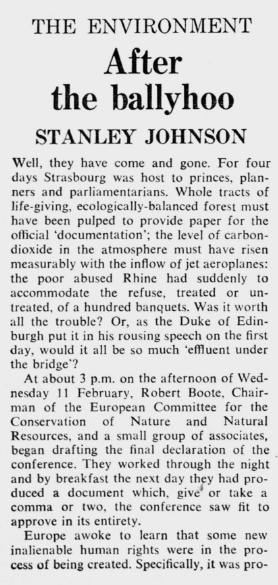
 March 16, 1973 –  North Sea Oil for the people?! (Nope)

Fifty years ago, on this day, March 16, 1973, The  Conservation Society released  report about North Sea Oil and how the gains could and should be spread around

The Guardian 16 March 1973, page 8

The amount of carbon dioxide in the air was roughly 330.3ppm. As of 2023 it is 419ppm, but check here for daily measures. 

The context was

There was lots of North Sea oil coming at us. (See also Doctor Who and the Terror of the Zygons.) And the question of how these riches would be invested and distributed and spent was very real. 

Reading about that Conservation Society report with the benefit of 50 years of hindsight, and in the context of the Industrial Decarbonisation Research and Innovation Centre effort is freaking hilarious.

And of course, the workers doing the hard graft on off-shore wind are… getting screwed. See this recent report in The Ecologist.

What I think we can learn from this

That there were smart people talking about a “just transition”, and lobbying MPs etc, fifty years ago.

What happened next

North Sea oil revenues were used by Thatcher to cover up the economic catastrophe that she was causing, paying unemployment benefits and sick benefits, rather than creating a sovereign wealth fund, as the Norwegians have done; I’m not saying Norway is perfect by the way.  And some people got very very rich indeed.

Thank goodness we’re no longer trying to get the last dregs of hydrocarbons out, during a climate emergency, because that would reveal us to be pathetic hairless apes with opposable thumbs and a two millimetre sheet of neurons that didn’t make us quite as smart as we thought…

What do you think? Does this pass the ‘so what?’ threshold? Have I got facts wrong? Interpretation wrong?  Please do comment on this post, unless you are a denialist, obvs..

Categories
Uncategorized

Of Cliff Richard, a 60 year old #climate meeting and the grim meathook future…

On March 10 1963, “Summer Holiday” sung by Cliff Richard and the Shadows, reached the top of United Kingdom’s pop charts. The accompanying film, which had been released three weeks earlier, follows a group of friends retrofitting an iconic double-decker bus and driving it to Athens, so they can enjoy a holiday “where the sun shines brightly.”  

Two days after the song’s chart triumph, what was probably the first ever meeting given over to the build-up of carbon dioxide in the atmosphere took place across the Atlantic, in New York.  Although the science was far more than rudimentary than today, the basic message is unchanged – releasing carbon dioxide into the atmosphere (which happens when you burn oil, coal and gas) would trap more heat on the earth’s surface, melt ice caps and change weather patterns. The intervening sixty years have not changed that.

While some want you to believe climate science is a figment of the imagination of George Soros, “the Chinese, Greta Thunberg or Al Gore, the origins of the carbon dioxide theory stretch back almost two hundred years. In 1824 the French scientist Joseph Fourier pointed out that, given the Earth’s distance from the sun, and the temperature being higher than you would otherwise expect, then something was trapping a certain amount of the sun’s heat. He even used the term “glasshouse.”  Thirty years later, an American feminist and scientist Eunice Foote proposed that carbonic acid (carbon dioxide in solution) might be one cause (her work was only rediscovered in 2010, but may have been read by John Tyndall, the Irish scientist whose 1861 paper made the carbon dioxide idea better known (Tyndall lives on in the naming of the Tyndall Centre). As many conversation readers will know, in 1895 Svante Arrhenius, a Swedish scientist and later Nobel-prize winner suggested that, given the amount of carbon dioxide being released by the burning of oil coal and gas, over time (centuries, he thought) there could be an appreciable warming. This, thought Arrhenius, would be a good thing, opening up new areas for growing food.  Although some scientists (erroneously) said carbon dioxide could not cause such a build-up, there was a certain amount of popular acceptance.  

In 1938 a British steam engineer, Guy Callendar, ascribed the uncontroversial increase in the Earth’s temperature over the previous 50 years to a build up of carbon dioxide. His ideas were more ignored than rebutted.  After World War Two (in which he had helped devise fog-dispersal devices for returning RAF bombers), he continued to push his theory.  Crucially he caught the attention of an American physicist Gilbert Plass.  In May 1953 Plass’s warming warning went around  the world

C02 or not co2, that is the question

While it is easy to draw direct lines and argue “they should have known back then, straight away”, we must remember that carbon dioxide build-up was seen as only one of many possible influences on weather, alongside wobbles in the Earth’s orbit, changing intensity of the Sun and much else. It was not even, according to some, that carbon dioxide levels were climbing. A 1955 US Weather bureau paper pointed to the “noisiness” of the data, and the unreliability of some measurements.  Swedish scientists interested in carbon dioxide had gotten wildly differing measurements.

However, already by the mid-1950s important scientists were saying carbon dioxide build-up might be an influence. 

The Hungarian polymath Jonny Von Neumann told Fortune readers in December 1955

“The carbon dioxide released into the atmosphere by industry’s burning of coal and oil-—more than half of it during the last generation—may have changed the atmosphere’s composition sufficiently to account for a general warming of the world by about one degree Fahrenheit”

Speaking to lawmakers (about getting more funding for science) Roger Revelle said in 1956…

“We may actually, for example, find that the Arctic Ocean will become navigable and the coasts become a place where people can live, then the Russian Arctic coastline will be really quite free for shipping, as will our Alaskan coastline, if this possible increase in temperature really happens. . . .”  (source)

To solve the empirical questions, Revelle hired Charles “Dave” Keeling, with Pentagon funding made available for the International Geophysical Year (a global stock-taking effort) to investigate. In March 1958 Keeling started taking careful measurements at an extinct volcano in Hawaii, Mauna Loa, (the site was chosen to be far from sources of error such as forests and factories). By May 1960 Keeling was able to confirm that not only could reliable carbon dioxide measures be compared (he was also collecting in Antarctica) but aht carbon dioxide levels were reports co2 is indeed climbing. A 1961 New York Academy of Sciences meeting responded to this and other work,, and presumably was part of the impetus for the March 1963 conservation foundation meeting.

Conservation foundation meeting

It was in this context that the Conservation Foundation meeting, snappily titled “Implications of Rising Carbon Dioxide Content of the Atmosphere” took place. It was attended by a small number of scientists, including the aforementioned Plass and Keeling, and an Englishman, Frank Fraser Darling. The meeting resulted in a short report.

On page 6: “many life forms would be annihilated” [in the tropics] if emissions continued unchecked in the upcoming centuries.”  It also  also projected that carbon dioxide emissions could raise the average surface temperature of the earth by as much as 4°C during the next century (1963-2063)”

We should not imagine this led to immediate acceptance. Revelle worked on various panels, including the President’s Science Advisory Committee. In February 1965 president Lyndon Johnson gave an address to Congress about environmental issues, mentioning that 

“Air pollution is no longer confined to isolated places. This generation has altered the composition of the atmosphere on a global scale through radioactive materials and a steady increase in carbon dioxide from the burning of fossil fuels”

However a big Conservation Foundation meeting two months later, on “Future Environments of North America” saw only one brief mention (by Fraser Darling) which was met with bland dismissal –    “So far the increase in carbon dioxide with time in the open country is still so small that there are people who don’t believe there has been one.  This is reassuring.”

However, the carbon dioxide issue did not go away, appearing in a reports about weather modification (then a military dream) and the books about environmental crisis that began to crop up in the second half of the 1960s.

Carbon dioxide accumulation in the atmosphere began to mentioned in US congress (see 1966 and 1969) and when Frank Fraser Darling gave the Reith lectures in November 1969 he mentioned carbon dioxide

“There’s a carbon dioxide cycle which naturally keeps levels right. It’s a system of great age and stability which we are now taxing with the immense amounts of carbon dioxide which we’re adding from the fuel we burn.”

Dave Keeling, who measured carbon dioxide till he died, was similarly speaking out.

What’s happened since (“how our understanding has changed since then?”)

By the late 1960s conferences on climate change (ice age or hothouse?!) were being held, especially in the United States and UK. The upcoming Stockholm Conference on the Human Environment, to be held in June 1972, provided added impetus, and in June 1971 scientists met for three weeks in Sweden for a workshop on “Man’’s Impact on Climate”. One outcome of the Stockholm conference was the creation of the United Nations Environment Program, which together with the pre-existing World Meteorological Organisation began collecting data and holding conferences.

By late 1970s, scientists were  pretty sure there was serious trouble ahead because of carbon dioxide build-up.. UK chief scientific advisory tried to use an interdepartmental committee’s findings to brief Margaret Thatcher, who had referenced carbon dioxide build-up in mid-1979 in a pro-nuclear comment at the G7 meeting in Tokyo. She responded with incredulity – “you want me to worry about the weather?”

[Source – John Campbell, Margaret Thatcher. Vol. 2: The Iron Lady (London, 2003), 642-643.]

In 1981 Warming Warning, the first documentary solely focused on Carbon Dioxide as a climate changer appeared, directed by Richard Broad, who  had made other crucial  films.

Only in 1988, after another decade of dotting the is and crossing the tees did it become an unavoidable issue. Thatcher famously changed her mind (and changed it back  later).

As of 2023, we now developed sophisticated “integrated assessment models” and all manner of ways of charting the collapse of the Antarctic sea ice, sea level rise etc.  But there’s a simple test for all our fine words about (future) fine actions. – are we bringing emissions down rapidly (no)?

The atmospheric concentration of carbon dioxide that day in New York,  60 years ago, was about 319 parts per million (ppm). Today, it’s 420ppm, and its terrible cousin methane is also booming.

In 1963 if Cliff Richard and pals wanted warm weather they had to retrofit a double-decker bus and drive all the way to Greece. Last summer the UK hit 40 degrees for the first time ever. Summer has come here. What else is coming may be no holiday…

Categories
Uncategorized

Of cops and gardens

“Put out that joint right now!”, yells the cop.

“Of course”, I reply, almost without thinking. I rub the joint against the grass and show it to him.

“Smoking weed in front of the police station! Unbelievable!”, he mutters begrudgingly, and goes back in.

I’m still processing what just happened. I had just arrived at the urban garden, and as a welcome gesture somebody had handed me that joint. Right beside the fence of the garden lies the police station. Two different worlds very close to each other.

It’s the first time I’m working on this garden. While uprooting grass near the spinach, I’m having a conversation with two women about feminism. One of them criticizes how indigenous men from her hometown make their wives carry all their heavy stuff, including their babies, while they themselves don’t carry a thing besides a machete.

In their culture, I tell her, the men need to protect the women from the many dangers of the jungle. She then tells me her mother is indigenous and she was bullied and shamed growing up because of it.

Later on, as we’re starting to light a fire, another cop arrives. He’s asking what we’re gonna cook. We’re just gonna make some aguapanela, we explain. “Only aguapanela?”, he asks. “Y’all should add some alcohol to it”. Which is a really weird thing for a cop to say.

He also gives advice on how to light a fire in such a way that’s suitable for cooking. He is very knowledgeable. He probably comes from the countryside. But he keeps giving us orders, which feels weird. Before he leaves I shake his hand, ask him his name (he gives me his surname), and promise to bring him some aguapanela later.

The water is boiling. We add panela to it, as well as lemongrass, mint, rhubarb and a few other herbs from the garden. A fellow gardener tells us she, as a victim, was feeling very uncomfortable with that cop. This is supposed to be a safe space, she says, free from guns and uniforms. She doesn’t say what she’s a victim of, but it was probably cops. Or soldiers.

Two cops arrive on a motorbike. “Put that fire out”, one of them shouts. We approach the fence to talk to them and explain we have a permit from the city’s Botanical Garden. “We’ll see about that”, he replies. These cops clearly don’t belong to the police station because they arrived from the other side of the park.

We realize we don’t have any cups, so I go to a nearby tienda to buy some. When I come back, a middle-aged woman and her son are talking to some gardeners. Apparently they’re upset that there is a community garden here.

“Where do you live?”, she asks me, defiantly, when I join the conversation. I tell her my address. As it turns out, I live nearby, as do most of the other gardeners. But I know she was assuming I lived in a faraway, poorer part of town, and she was getting ready to tell me to go back there and make a fire there. Now she’s feeling uneasy but still tells me to go make a fire in my home.

I still try to explain to her this is an initiative to create a more sustainable way of living in the city, and to strengthen community bonds in the neighborhood. But her son replies that this is not a good park to have a garden because it attracts junkies.

They seem unable to truly say why they dislike the garden, but I assume they’re frightened conservatives. When the mother leaves, however, the son changes his tone and seems eager to learn about the garden. Even though he doesn’t stay for the aguapanela, he still asks for our numbers.

We’re drinking the aguapanela and doing some planning. We want this year’s garden activities to follow the Muisca calendar. But we don’t get very far because all of a sudden twenty cops arrive.

They stand defiantly at the fence and tell us it is forbidden to light fires in Bogotá, unless we have a permit from the Mayor’s ffice. This is a tense moment. We tell the policemen about a decree from the Botanical Garden, but they don’t seem to buy it. We don’t have that decree handy. We need to look it up on our phones.

An authoritarian woman arrives. She’s a city official. She’s accompanied by other city officials and some cops. “Put that fire down immediately”, she screams. We don’t comply. Somebody scrambles to find the decree and shows it to her on a phone, but she wants none of it. She’s asking for a permit, not a decree. Some of the gardeners get angry. One of them is recording the scene with her phone.

The police chief, however, is trying to de-escalate. He takes the phone we’re handing them, reads the relevant paragraph, and explains the situation to us. Apparently some neighbor called them because they didn’t like the fire. “These are fake environmentalists. They say they wanna protect the Earth, yet they burn wood” is what the neighbor had said. To be fair, that’s not a bad argument.

We end up putting out the fire as an act of goodwill. After all, this is a community thing, and if a neighbor is bothered by the smoke, we respect that. But why do they have to call the cops on us? And why do cops behave like butlers of rich people?

We still end up bringing some aguapanela to the police station later on.

Learn more about our urban garden at https://www.facebook.com/profile.php?id=100080354461241

Categories
Uncategorized

January 7, 2013 – Australian climate activist pretends to be ANZ bank, with spectacular results  

Ten years ago, on this day, January 7, 2013, an Australian climate activist sent out a press release pretending to be a bank…

Jonathan Moylan of Front Line Action on Coal … purported to be ANZ’s Group Head of Corporate Sustainability, Toby Kent. Mr Moylan falsely claimed that ANZ was cancelling its $1.2 billion loan facility for Whitehaven Coal’s open-cut mine project in Maules Creek, NSW.

http://www.sbs.com.au/news/thefeed/story/jonathan-moylan-and-300-million-dollar-hoax 

The amount of carbon dioxide in the air was roughly 395.6ppm. As of 2023 it is 419. .

The context was that, as ever, state governments were bending over forwards, backwards, sideways to make it easier for companies to dig up and sell coal to people who would burn it.  And activists had tried all the legal means to try to stop it, getting tied up in consultations, petitions etc etc. And then they branched out, into other non-violent (but certainly illegal) tactics…

As ABC journo Sarah McVeigh wrote in 2017

Moylan had been living in the forest for months. He’d started the Maules Creek blockade in the hopes of stopping the mine. The protest made headlines when Wallabies star David Pocock was arrested for chaining himself to a bulldozer. But when the New South Wales government gave it its final tick of approval, Moylan’s hopes were dashed.

“The only two legitimate options were to try and get the (then) federal environment minister Tony Burke to protect the critically endangered woodland in the Leard State forest or to get the ANZ Bank to try and change its decision about financing the project.”

What I think we can learn from this

Making fun of money gets you in trouble.  See that early Michael Haneke film “The Seventh Continent”, where well, spoilers, cash is destroyed

What happened next

On Friday 25 July 2014 Jonathan Moylan was sentenced by the Supreme Court: 1 year 8 months, suspended with the condition of good behaviour for 2 years.

Non-violent protest continues in Australia, despite the best efforts of State and Federal governments to chill it with ever more draconian policing and sentencing

See also

Tim DeChristopher.

What do you think? Does this pass the ‘so what?’ threshold? Have I got facts wrong? Interpretation wrong?  Do comment on this post.

References

McVeigh, S. (2017)  “I wanted to stop the mine”: Jonathan Moylan and the $300 million hoax. ABC 3 October https://www.abc.net.au/triplej/programs/hack/jono-moylan/9010874

Categories
Uncategorized

December 15, 2009 – Daily Express expresses its irresponsibly idiocy…

On this day, December15  in 2009 those galaxy brains at the Daily Express ran a front cover “100 reasons why global warming is natural.”

Pricks.

[The amount of carbon dioxide in the atmosphere was 387ppm. At time of writing it was 419ishppm- but for what it is now,well, see here for the latest.]

The context was this – 

The newspapers at this point were full of stories about climate change because the Copenhagen COP15 conference was underway and since 2006, a wave of climate activism and legislation had been happening. The Daily Express readers wanted to be able to dismiss it all as just another green hoax-  god forbid it turned out that the hippies and the eco nuts were actually right.  That would cause mental anguish in the tiny brains of Express readers.

Why this matters. 

We need to remember just how how stupid and irresponsible the popular press has been on the question of climate change (for well understood reasons – grok the Propaganda Model of Herman and Chomsky).

What happened next?

The Daily Express has continued to be a newspaper by and for idiots.

Categories
Uncategorized

October 25, 1982 – Exxon and “Climate Processes & Climate Sensitivity” symposium

On this day, October 25 in 1982, the “Climate Processes and Climate Sensitivity” symposium opened in New York.

And Exxon knew about this. How do we know Exxon knew?

Because, um, they sponsored it, and one of their guys gave a speech.

http://www.columbia.edu/~jeh1/mailings/2017/David.E.E.1982.EXXON.EwingSymposium.pdf

First day of Climate Processes and Climate Sensitivity . … Biennial Maurice Ewing Symposium held at Palisades, New York, October 25-27, 1982  

[The amount of carbon dioxide in the atmosphere was 338.41ppm. At time of writing it was 421ishppm- but for what it is now,well, see here for the latest.]

The context was this –  The late 70s effort to get politicians onboard had failed. The work, however, continued.

Why this matters. 

The “we didn’t know” defense is no good…

What happened next?

In 1984 a book of the same name was published https://ui.adsabs.harvard.edu/abs/1984GMS….29…..H/abstract

Exxon? Exxon went on to help launch the Global Climate Coalition and to delay action on climate change. Of course it did.