Thirty-four years ago, on this day, May 26th, 1990, the Times ran a big story about Thatcher settling for a “stabilise UK emissions by 2000 at 1990 levels” target, but calling it “tough.”
The amount of carbon dioxide in the air was roughly 354ppm. As of 2024 it is 425ppm, but check here for daily measures.
The context was that there had been fights over emissions reductions for rich nations. In 1989, an energy minister, Lady whoever or Baroness whatever had nixed that {LINK}. But the negotiations were coming and the UK would need some sort of position. SDtabilisation target looks like a winner, even if it wasn’t adequate scientifically(that’s never stopped people before and it didn’t on this occasion).
What we learn is that there were intense tussles and battles in that period of the 80s, ‘88 to ‘92. And this was one of them.
What happened next Thatcher was gone in six months. And the stabilisation target made its way into the UNFCCC treaty.
What do you think? Does this pass the ‘so what?’ threshold? Have I got facts wrong? Interpretation wrong? Please do comment on this post, unless you are a denialist, obvs.
Thirty-two years ago, on this day, May 25th, 1992, the Cabinet of new Australian Prime Minister Paul Keating discussed the upcoming Earth Summit in Rio. Cabinet was (mostly) not in favour of making any big splash, and Keating himself would not attend the event (the only leader of an OECD country not to go…)
The amount of carbon dioxide in the air was roughly 356ppm. As of 2024 it is 425ppm, but check here for daily measures.
The context was that as early as 1987, there had been an agreement that there would be an Earth Summit in 1992 in Rio. The following year, climate change had exploded onto the public consciousness and the Earth Summit had become the place where the climate treaty would be agreed. Australia had been initially seen as a leader on this, one of its diplomats had helped the IPCC processes as a co-chair on working group one (WM Tegart), and there had been an extremely hedged promise in October of 1990 for a so-called interim planning target.
However, since then, the champion of action Bob Hawke had been toppled. His replacement, Paul Keating was actively hostile to greenies. And Australia was in/emerging from a recession, “the recession we had to have.” And Keating wasn’t gonna go to Rio, (he was the only head of an OECD member who didn’t).
There had also been a successful campaign against introducing a carbon tax. This had been a suggestion as part of the Ecologically Sustainable Development process. So all in all, the Cabinet meeting was just signing off on allowing the environment minister to go. But pretty much saying to her that she wasn’t allowed to be exuberant or make any promises. And so it came to pass.
What we learn is that Australia had an opportunity to behave differently, but the leadership of the time had other plans and other priorities. And we are living with the consequences of that. And future generations will live and die with the consequences of that. And here we are.
What happened next, RosKelly went to Rio, was the ninth person to sign up to some misogynist flak from the denialists, of course. And Australia had another bite at the carbon tax for domestic purposes. This also failed, and then Australia carved out an insanely generous steal at Kyoto, which it then didn’t ratify. Poisonous, horrible, horrible political, economic elite. But what do you expect of an extractive settler state, a quarry with a state attached to it.
What do you think? Does this pass the ‘so what?’ threshold? Have I got facts wrong? Interpretation wrong? Please do comment on this post, unless you are a denialist, obvs.
Twenty seven years ago, on this day, April 28th, 1997, Prime Minister John Howard says Australia should not have signed the UNFCCC. Classy guy.
On 28 April 1997 on ABC Radio National, the Australian Prime Minister, John Howard, stated publicly that he believed that Australia should never have signed the United Nations Framework Convention on Climate Change. This was the culmination of over a year of backpedaling by the Australian Liberal-National Party Government on the issue of climate change due to purported negative economic impacts.”
Yu and Taplin, 2000 The Australian Position at the Kyoto Conference in Gillespie and Burns (eds) Climate Change in the South Pacific: Impacts and Responses in Australia, New Zealand, and Small Island States, Kluwer
The amount of carbon dioxide in the air was roughly 364ppm. As of 2024 it is 425ppm, but check here for daily measures.
The context was that there was the COP3 (Kyoto) conference coming at the end of year, and the Berlin Mandate of 1995 meant that rich nations (including Australia) were supposed to turn up and agree to a CUT in emissions.
What I think we can learn from this
Howard has never been a “conservative”. He’s a radical statist directing taxpayers’ money and assets towards his mates. Like Thatcher squandering North Sea Oil, he squandered the commodity supercycle. Prick.
What happened next
Howard had ten years to destroy everything decent about Australia. Job’s largely done, though there are mopping up operations ongoing. And resistance, of course.
What do you think? Does this pass the ‘so what?’ threshold? Have I got facts wrong? Interpretation wrong? Please do comment on this post, unless you are a denialist, obvs.
Twenty-nine years ago, on this day, April 8th, 1995, Fred Pearce of the New Scientist points out that there is a gamble going on (as did Australian climate scientist Graeme Pearman three years earlier).
The amount of carbon dioxide in the air was roughly 361ppm. As of 2024 it is 425ppm, but check here for daily measures.
The context was that the first COP had just finished. Rich nations had been resisting emissions cuts using scientific uncertainty as their final excuse. But Swedish scientist Bert Bolin, who had been banging on about climate change, and carbon dioxide build up since 1958, at the latest, was telling them that the IPCC Second Assessment Report would be out later this year and that they shouldn’t expect to be able to use the uncertainty card for very much longer, more or less.
What I think we can learn from this is that the really sharp battles at the end of 1995, were all about that. I hadn’t quite grokked that before.
What happened next
Well, there were really sharp battles at the end of ‘95. From the middle of ‘95 efforts by denialists to smear individual scientists (the “Serengeti Strategy”) and the process in order to slow progress towards a serious protocol.
What do you think? Does this pass the ‘so what?’ threshold? Have I got facts wrong? Interpretation wrong? Please do comment on this post, unless you are a denialist, obvs.
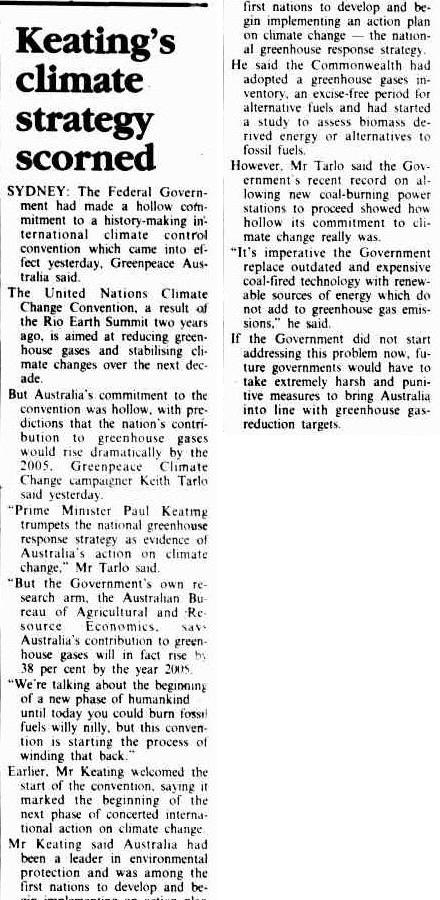
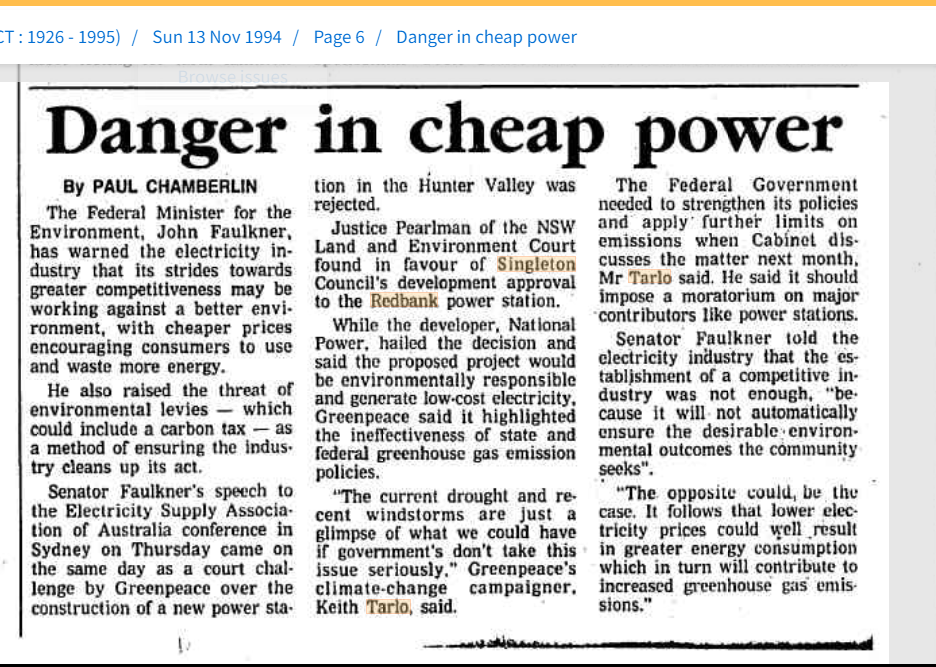
Thirty years ago, on this day, March 21st, 1994, a local council in New South Wales, Australia says yes to another coal fired power station, on the day that the UNFCCC comes into farce. Sorry, force.
The amount of carbon dioxide in the air was roughly 359ppm. As of 2024 it is 425ppm, but check here for daily measures.
The context was that Australia had a growing economy, and needed more electricity. The easiest way to do that was to dig up and burn coal. So we do the easiest thing. Councils are going to wave through the sorts of things because jobs, donations to parties, perks, a sense of normalcy.
And the UNFCCC being ratified and becoming law the same day? It’s just one of life’s historical ironies. The Greenpeace campaign against Redbank is also just not even historical footnote really is it? There you are.
What happened next. Redbank pumped out seriously amounts of planet-cooking CO2.
What do you think? Does this pass the ‘so what?’ threshold? Have I got facts wrong? Interpretation wrong? Please do comment on this post, unless you are a denialist, obvs.
The amount of carbon dioxide in the air was roughly 387ppm. As of 2023 it is 421ppm, but check here for daily measures.
The context was that everyone was bummed out, because all the delusional lies that they had been telling themselves about Copenhagen had been exposed. Nobody was saved and art certainly was not going to save the damned planet.
What I think we can learn from this is that there will always be groupies and hangers on and opportunist hacks wanting to say that they’re making some sort of contribution. I don’t want to be more of a philistine than I already am but seriously, fudge that noise.
Am I too cynical?
What happened next
Artsy people have kept artsy-ing. It’s helped a lot.
What do you think? Does this pass the ‘so what?’ threshold? Have I got facts wrong? Interpretation wrong? Please do comment on this post, unless you are a denialist, obvs.
“the European Union agreed to ratify the FCCC without any commitment to an energy/carbon tax. The debate continues, with all governments increasingly interested in raising revenue from energy consumption in the home and on roads.”
Boehmer‐Christiansen (1995; 185)
The amount of carbon dioxide in the air was roughly 356.5ppm. As of 2023 it is 421ppm, but check here for daily measures.
The context was that the UNFCCC climate treaty had had far fewer teeth than the Europeans wanted, thanks to the successful resistance of US President George Bush, his Chief of Staff John Sununu and others. There were no targets and timetables for emissions reductions but at least they’d seen the back of George Bush having been defeated in the 1992 presidential election by Bill Clinton of the Democratic party, for what that was worth (not much when it came to climate.)
What I think we can learn from this
This is just one of those moments of history. Thirty years. And what has been achieved since then? Half of fuck all – though the Europeans will tell you that massively reduced their emissions so maybe that’s something I don’t know- if the cause of that has been the same as in in the UK – deindustrialisation and some uptake of different forms of energy besides coal – that’s a question I could look into.
What happened next
We have kept tipping carbon dioxide into the atmosphere like there’s no tomorrow…
What do you think? Does this pass the ‘so what?’ threshold? Have I got facts wrong? Interpretation wrong? Please do comment on this post, unless you are a denialist, obvs..
Twenty two years ago, on this day, November 22, 2000, climate protesters stormed the stage at the COP6 negotiations in The Hague.
http://news.bbc.co.uk/1/hi/sci/tech/1036211.stm
The amount of carbon dioxide in the air was roughly 369.7ppm. As of 2023 it is 419ppm, but check here for daily measures.
The context was that three years after the Kyoto negotiations ITwas obvious that the UNFCCC process was again going nowhere. Bands of climate protesters descended upon the Hague, which had been the scene of a 1989 meeting on climate in order to say “get moving.”
The Hague process ended in disarray andwas the first and only time there was no formal end to the meeting. So they had to continue in Bonn the following June or July.
What do you think? Does this pass the ‘so what?’ threshold? Have I got facts wrong? Interpretation wrong? Please do comment on this post, unless you are a denialist, obvs.
Twenty nine years ago, on this day, September 2, 1994, was the 10th meeting of the outfit that had planned the climate bit of the 1992 Earth Summit and had kept on going afterwards, in the run up to the first “conference of the parties” (to be held in Berlin, in March-April 1995).
Slooooow progress between Rio and Berlin….
Despite the introduction of a formal text into the proceedings which proposed C02 reductions, the session remained deadlocked on the introduction of a protocol such as that proposed by the Germans (Eco, 2 September, 1994: 1). Despite the fact that it was Germany which had proposed it, the EU rapidly said it was not prepared to consider a protocol for COP1, and many developing countries were also opposed, believing it might be a pretext for commitments to be imposed on them, or in some cases even that OECD action itself would hurt their interests. Oil-producing countries often presented their own interests in this way, suggesting OECD action would harm developing countries as a whole e.g. see Al-Sabban, 1991).
Paterson 1996 page 68
The amount of carbon dioxide in the air was roughly 358ppm. As of 2023 it is 423ppm, but check here for daily measures.
The context was that by this time everyone knew that COP1 was coming (to be held in Berlin) and therefore there would be more and more pressure for something serious to be agreed. But here we were still in the shadow-boxing phase, even though it was obvious that the initial stabilisation targets were not going to be met, and that the science was getting stronger. The IPCC people were working towards their second assessment and the denialists were in their pomp, having defeated Clinton’s BTU.
What I think we can learn from this is that we have been grinding away for over 30 years. And given, the absence of strong social movements (among other significant factors) in the countries that matter – for energy justice, climate justice, intergenerational justice – then you’re going to get these sort of technocratic “lost in the detail” shitshows. And so it has come to pass.
What happened next
At cop1 finally there was the Berlin Mandate forcing rich nations to agree that by the end of 1997 they would agree to cuts. That meeting ended up happening in Kyoto, Japan.
What do you think? Does this pass the ‘so what?’ threshold? Have I got facts wrong? Interpretation wrong? Please do comment on this post, unless you are a denialist, obvs..
Thirty years ago, on this day, August 27, 1993, the post-Rio Earth Summit process was edging forward.
1993 End of INC negotiations at which – first tentative but informal discussions of the adequacy of the commitments contained in articles 4.2(a) and (b) of the convention (Paterson 1996, page 67)
The amount of carbon dioxide in the air was roughly xxxppm. As of 2023 it is 423ppm, but check here for daily measures.
The context was that in May 1992, following a prolonged fight, the Americans won an infamous victory by removing target and timetables from the text of the climate treaty. This victory was short-lived however because it was obvious that emissions reductions were going to be needed. And the international negotiating committee saw this by August of 1993 at which point various nations had already ratified the UNFCCC and it was well on the way to meeting the threshold for ratification, and therefore the first “Conference of the Parties” – an international meeting which in the end took place in Berlin in March-April 1995.
What I think we can learn from this is that blocking victories doesn’t necessarily last terribly long – you can take something off the agenda but it will crawl and slither its way back onto the agenda whether it’s good or bad. And therefore the work of containing and corralling and controlling is never-ending. The kind of people who wrote The Powell memorandum, they understand that. And they have to the deep pockets to fund a culture war. Progressive groups, because they tell themselves the myth of the neutral State and of the information deficit, are constantly surprised that they have to keep fighting. Also, they’re also, almost by definition, worse off for funding.
What happened next
At the Berlin meeting in 1995 the Berlin Mandate was agreed, meaning that rich countries were going to have to cut their emissions. Or rather, they were going to have to turn up to the third COP with a number in their heads for emissions reductions. They did this. It was inadequate, and then the USA and Australia walked away.
What do you think? Does this pass the ‘so what?’ threshold? Have I got facts wrong? Interpretation wrong? Please do comment on this post, unless you are a denialist, obvs.