Categories
Australia Kyoto Protocol UNFCCC

April 29, 1998 – Australia signs the Kyoto Protocol

Twenty five years ago, on this day, April 29, 1998, Australian Environment Minister Robert HIll signed the Kyoto Protocol while in New York.

 As distinct from ratifying it… Robert Hill in New York…

R Hill (Minister for the Environment),Hill signs historic agreement to fight global warming, media release, 29 April, 1998.

The amount of carbon dioxide in the air was roughly 368.8ppm. As of 2023 it is 420ppm, but check here for daily measures. 

The context was that Australia had secured an absurdly sweet deal at Kyoto. The so-called reduction target meant it could increase its emissions to 112%, and 130%  once a land clearing clause loophole was taken into account. 

It wasn’t clear at this stage whether Australia would try to ratify the Kyoto Protocol –  a federal election was due relatively soon. And so it was mostly harmless signing. So they did it. And not signing would have caused more trouble than it was worth.

What I think we can learn from this

You have to know the details of a process, so you don’t get over-excited about what (you want it to) mean.

What happened next

In September of 1998 it was leaked that the Cabinet had agreed that Australia would not ratify unless the US did. And the US was very unlikely to do that. In the end, in 2002, on Earth Day, because he has a sense of humour. Prime Minister John Howard, to no one’s great surprise, but many people’s shock and dismay, announced Australia would not, in fact, ratify Kyoto.

What do you think? Does this pass the ‘so what?’ threshold? Have I got facts wrong? Interpretation wrong?  Please do comment on this post, unless you are a denialist, obvs.

Categories
Business Responses Denial Kyoto Protocol UNFCCC United States of America

April 26, 1998 – “Industrial Group Plans to Battle Climate Treaty”

Twenty five years ago, on this day, April 26, 1998, The New York Times runs a story, probably not that different from the one on the 26th of December 1997 in the Washington Post. That, lo and behold, industrial interests, coal miners, auto makers, etc. are going to continue to try to – to use the academic terminology – shit all over climate action. And I think this is front page news but certainly not a surprise. 

Anyone who’s paying any attention knows that we live in a plutocracy, not a democracy, and that the ability of powerful cashed up vested interests, to shape policy to prevent policies they don’t like, is enormous. Just because the power is enormous doesn’t mean that they always win all the time. But it means the game is rigged, y’all.

1998 Cushman of NYT breaks story – Cushman, J. 1998. Industrial Group Plans to Battle Climate Treaty. New York Times, 26 April, p.1

The amount of carbon dioxide in the air was roughly pp368.8m. As of 2023 it is 420ppm, but check here for daily measures. 

The context was  that the US had been at COP-3 Kyoto meeting. I think Al Gore even signed, but it was never going to come to the Senate for ratification. But the danger was that in two years time, if there was a Democrat in the White House, things could somehow change…

What I think we can learn from this

Opponents of action take nothing for granted and are always trying to keep their muscles, their attack muscles fresh, in case they’re needed.

What happened next

Cashed up denialist kept doing their denying.

What do you think? Does this pass the ‘so what?’ threshold? Have I got facts wrong? Interpretation wrong?  Please do comment on this post, unless you are a denialist, obvs.

Categories
Germany UNFCCC

April 7, 1995 – First “COP” meeting ends with industrialised nations making promises…

April 7, 1995 – First “COP” meeting ends with industrialised nations making promises…

Twenty eight years ago, on this day, April 7, 1995, the first (of many!) “COP” events ended in Germany. The main outcome, the so-called Berlin Mandate, which meant rich industrialised countries had to come up with an agreement to cut their own emissions….

1995 The first UNFCCC Conference of Parties took place on 28 March – 7 April 1995 in Berlin, Germany. It voiced concerns about the adequacy of countries’ abilities to meet commitments under the Body for Scientific and Technological Advice (SBSTA) and the Subsidiary Body for Implementation (SBI  (See Flavin, 1995 account).

The amount of carbon dioxide in the air was roughly 363.4ppm. As of 2023 it is 420ppm, but check here for daily measures. 

The context was

The UNFCCC text agreed for the Rio Earth Summit had been weak, thanks to the best efforts of the United States and a selection of (hydrocarbon) allies.  There was nothing in there about targets and timetables for rich nations to make reductions. Three years later, that question was back on the table…

What I think we can learn from this

The “original sin” – the attitude of rich nations (and esp. Uncle Sam) during the period 1988-1992 – has cast the longest shadow, and one that people who grew up since then don’t even understand, let alone have the vocabulary to name.

What happened next

The Berlin Mandate culminated (if that is the word?) in the 1997 Kyoto Protocol.  Australia gouged out an incredibly generous “reduction” target (de jure 12% increase in emissions, de facto 130% – and STILL did not ratify!).

What do you think? Does this pass the ‘so what?’ threshold? Have I got facts wrong? Interpretation wrong?  Please do comment on this post, unless you are a denialist, obvs.

Categories
UNFCCC United Kingdom United Nations

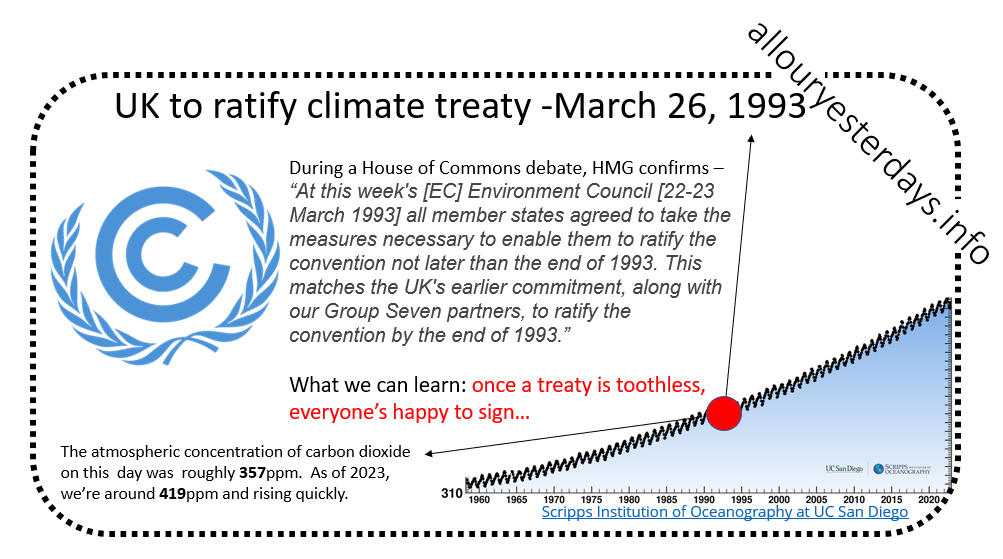
March 26, 1993 – UK government to ratify climate treaty

Thirty years ago, on this day, March 26, 1993, there was a  House of Commons debate  In reply to a question on the subject, the Government confirmed that they would be ratifying the UNFCCC.- 

“At this week’s [EC] Environment Council [22-23 March 1993] all member states agreed to take the measures necessary to enable them to ratify the convention not later than the end of 1993. This matches the UK’s earlier commitment, along with our Group Seven partners, to ratify the convention by the end of 1993.” 

The amount of carbon dioxide in the air was roughly 358.6ppm. As of 2023 it is 419ppm, but check here for daily measures. 

The context was that in 1992, nations had come together and held hands in Rio, and signed a massively watered down treaty. John Major had offered to host the follow up to Rio because at this point, it wasn’t clear that the treaty would receive enough ratifications quickly enough to start holding its official meetings. So the UK still wanted to be seen as a leader on international climate policy. 

What I think we can learn from this

Sometimes things happen quicker than people think (like UNFCCC ratification)

What happened next

The Global Forum in Manchester, which was a serious egg-on-face for the Labour Council…

What do you think? Does this pass the ‘so what?’ threshold? Have I got facts wrong? Interpretation wrong?  Please do comment on this post, unless you are a denialist, obvs

Categories
Denial Industry Associations International processes UNFCCC United Nations United States of America

February 27, 1992 – climate denialists continue their effective and, ah, well EVIL, work

Thirty one years ago, on this day, February 27, 1992, denialists released a denial statement during what were supposed to be the last negotiations before the “Earth Summit”, the one where a text was supposed to be agreed that could then lock-in the attendance of Prime Ministers and Leaders…

In February 1992 the Science and Environmental Policy Project (SEPP) published the “Statement by Atmospheric Scientists on Greenhouse Warming” objecting to the United Nations Conference on Environment and Development Earth Summit planned for Rio de Janiero in June 1992.[1]

The signatories to the letter complained that the Earth Summit “aims to impose a system of global environmental regulations, including onerous taxes on energy fuels, on the population of the United States and other industrialized nations. Such policy initiatives derive from highly uncertain scientific theories. They are based on the unsupported assumption that catastrophic global warming follows from the burning of fossil fuels and requires immediate action. We do not agree.” 

https://www.sourcewatch.org/index.php/SEPP_and_the_Statement_by_Atmospheric_Scientists_on_Greenhouse_Warming

The amount of carbon dioxide in the air was roughly 357.2ppm. As of 2023 it is 419ppm, but check here for daily measures. 

The context was

The climate negotiations were coming to a crunch. The whole thing might fall over. The US administration, with George Bush senior as the boss, was blocking blocking blocking, but there was always the fear they might – with a US Presidential election pending – make concessions. The denialists wanted to make that more unlikely by making it more costly….

What I think we can learn from this

Those fearful of change will keep pushing even if “their guy” (and it usually is a guy) is ‘rock solid’.  They take little/nothing for granted. That attitude, and all their money, and their structural position within the economy, explains why they win so often…

What happened next

Bush held firm. The French blinked on the question of targets and timetables for emissions reductions in the climate treaty. There were extra “negotiations” in May in New York, but they were just really a white flag being run up. Everyone went to Rio for a grip and grin.

The following 30 years have been about trying to claw back a mechanism by which rich countries would actually cut emissions.
It was never going to be easy, but the Bush Whitehouse rendered it actually impossible.

Am so very very glad I did not breed, because I’d have had to try to teach my kid a whole bunch of survival skills for a shituation whose particular needs are pretty impossible to specify.

What do you think? Does this pass the ‘so what?’ threshold? Have I got facts wrong? Interpretation wrong?  Do comment on this post.

Categories
UNFCCC United States of America

December 19, 1991- Will UN negotiations go as usual and “commit us to global catastrophe”?

On this day, December 19 in 1991 a close observer of the negotiations for a global climate treaty warned that it might end up being useless.

 Michael Oppenheimer of the Environmental Defense Fund lamented that ‘We remain confident that the texts of a Convention will emerge. However, we are not at all confident it will be an effective Convention. Those square brackets exist for the purpose of defending the supposed interests of countries. But in so doing they may yet commit us to global catastrophe (quoted in ECO, 19 December 1991).

Paterson, M (1996) page 58

[The amount of carbon dioxide in the atmosphere was 351ppm. At time of writing it was 419ishppm- but for what it is now,well, see here for the latest.]

The context was this – 

The negotiations for a global climate treaty had finally begun – despite the best efforts of the US to stop them from happening at all – in 1991.  And it instantly became obvious that Uncle Sam was just gonna delay and block, block and delay…

Why this matters. 

If you know your history, you will know that … you’re history

What happened next?

This. What you are living.  The catastrophes.

Categories
UNFCCC United Nations

November 25, 2000 – CoP meeting ends in official disarray…

On this day, November 25, 2000, the global climate negotiations in the Hague collapsed without a formal end of the conference, which had to be “continued” in Bonn the following year. You can read all about it here 

COP6 had seen various protests (see here)  by direct action types, who, in those far-off innocent pre-September 11 days even managed to storm the main stage,  and also some of the first discussions of “climate justice”

The Australian business lobby was there in force, of course – 

“Business is scared the Europeans will get their way at The Hague, and that Australia won’t get the sinks or other concessions that would allow it to go on polluting as long as it planted trees or took other measures. Australian industry has a big team at The Hague: on the government delegation will be John Eyles from the Australian Greenhouse Industry Network, and Maria Robertson from Comalco will be on the New Zealand delegation. And there are observers from the BCA, Rio Tinto, ICF Kaiser, Origin Energy, ACL, Woodside Energy, the Australian Gas Association, the Aluminium Council, BHP, Hancock NRG, the ACCI and others.”

Clennell, A. 2000. Taking Care Of Business. Sydney Morning Herald, 14 November, p.15.

[The amount of carbon dioxide in the atmosphere was 369ppm. At time of writing it was 416ppm- but for what it is now,well, see here for the latest.]

The context was this. Three years previously rich nations had grudgingly agreed a piss-weak “Kyoto Protocol”, but that still hadn’t been ratified by the USA (was never gonna get through the Senate) or Australia.  Earlier that month George Bush had been selected by the supreme court, after losing the popular vote (who remembers ‘hanging chads’?)

Why this matters. 

It was all clear, and protesters were doing their best, 22 years ago.

What happened next?

The COP circus has kept going (you may have noticed). The Kyoto Protocol finally became live  in 2005, after a Russian quid pro quo for WTO membership.  The follow-up (Copenhagen) went down in flames. Then the French came up with a “pledge and review” compromise. Guess what, nobody is really pledging, and nobody is reviewing…This was all predictable, and indeed predicted.

Categories
UNFCCC United Kingdom

October 27, 1990 – The Economist admits nobody is gonna seriously cut C02 emissions

On this day, October 27, 1990, the British Magazine the Economist had a cover story about “global warming” and international agreements.

In a cover story, The Economist (“Warm world, cool heads,” 27 Oct. 1990, p. 13) observes that “No country seriously contemplates Toronto levels of self-restraint.” Thus pressures for emission standards come from several European nations that want to hold CO2 emissions steady by the year 2000.

(Ungar, 1992.)

In late June 1988 a conference – of scientists and NGO types had come up with a call for a 20% cut in emissions by 2005 for rich countries. Various nations – including Australia – had by the time of the Economist story – come up with some versions of a pledge, usually with all sorts of get out clauses.

The Economist’s story came out just before the Second World Climate Conference, which was attended by political leaders (including Margaret Thatcher), and was the starting gun for the international process that led to the UNFCCC. Which had various (aspirational) targets – none of which went beyond stabilising emissions at 1990 levels by 2000 (which nations did not do, obvs).

What happened next?

Thirty years of pledges and promises, as emissions soared.

Categories
Australia International processes Kyoto Protocol UNFCCC United States of America

October 22, 1997 – US and Australian enemies of #climate action plot and gloat

On this day, October 22 in 1997, the Competitive Enterprise Institute (nasty neoliberal ‘think’tank) hosted a pre-Kyoto spine stiffening meeting.

“On October 22, 1997, the CEI hosted ABARE’s Brian Fisher at a luncheon with the aim of winning over “economic attaches to embassies of developing countries which might prefer differentiation to uniform reduction targets”. The CEI had “recognized the strategic importance of Australia in the climate change gambit” according to CEI research fellow (and Australian national) Hugh Morley. “If Australia sticks to its guns”, Morley said, “there might not be a Kyoto treaty after all.” (Hugh Morley, 1/11/97, “Australia Cool To Warming”, <www.cei.org/gencon/005,01305.cfm>.)”

From Jim Green “WMC Ltd: corporate greenhouse gangster”

[The amount of carbon dioxide in the atmosphere was 360.98ppm. At time of writing it was 421ishppm – but for what it is now, well, see here for the latest.]

The context was this – 

American corporate interests were solidifying pre-existing links with Australian denialists (politicians, corporates, bureaucrats) – these had begun in earnest in 1990 (Tasman Institute hosting various folks) and then gradually strengthened. The “Countdown to Kyoto” conference had already been staged in Canberra, by this time…

Why this matters. 

Think internationally. Those preventing climate action do.

What happened next?

Kyoto was a joke. Not a funny one. And here we are.

Categories
International processes UNFCCC

October 21, 1989 – Langkawi Declaration on environmental sustainability…

On this day, October 21 in 1989, the Commonwealth Heads of Government issued a warm-words statement.

“The Langkawi Declaration on the Environment was a declaration issued by the assembled Heads of Government of the Commonwealth of Nations on the issue of environmental sustainability. It was issued on October 21, 1989 at Langkawi, Malaysia, during the tenth Commonwealth Heads of Government Meeting(CHOGM).

http://en.wikipedia.org/wiki/Langkawi_Declaration

[The amount of carbon dioxide in the atmosphere was 350.33ppm. At time of writing it was 421ishppm- but for what it is now,well, see here for the latest.]

The context was this – 

Everyone was making bold statements that Something Must Be Done. It made them feel good. It responded to recent surges in green votes. It amounted to nothing.

Why this matters. 

Let’s be skeptical about the power of a pledge, okay?

What happened next?

The whole UNFCCC process. Oh joy.