Eleven years ago, on this day, April 23rd, 2013, power companies tried to influence the “mind” of Tony Abbott, who was a dead-cert to become Prime Minister at the forthcoming Federal Election.
Power companies have urged the Coalition to rethink its ‘direct action’ carbon plan, saying that it may cause them more difficulty than the Government’s emissions trading scheme.
The Australian Financial Review reports that the Energy Supply Association of Australia (ESAA) has urged the Coalition to change its plan to immediately scrap the carbon tax if it wins the federal election on September 14.
ESSA represents big power companies such as Origin, TRUenergy and International Power. It has supported an emissions trading scheme for a long time and the recent….
The amount of carbon dioxide in the air was roughly 396.7ppm. As of 2024 it is 425ppm, but check here for daily measures.
The context was that Abbott was clearly going to become prime minister, Labor’s opinion poll ratings were in the toilet. His idiotic “direct action” policy was going to become law of the land. And the power companies would be adversely affected because it was opaque and stupid. And so you know, “be careful what you wish for you might get it.” They had either resisted Gillard’s carbon tax or played dead. And now there were going to be consequences for those actions.
What we learn is that businesses are fantastically short-sighted despite their claim to do long term planning or being responsible, farsighted, on behalf of investors, etc. And here we are.
What happened next? Abbott became prime minister. He abolished Gillard’s Emissions Trading Scheme, instituted his moronic direct action. Emissions didn’t go down the way they needed to. And here we are.
What do you think? Does this pass the ‘so what?’ threshold? Have I got facts wrong? Interpretation wrong? Please do comment on this post, unless you are a denialist, obvs.
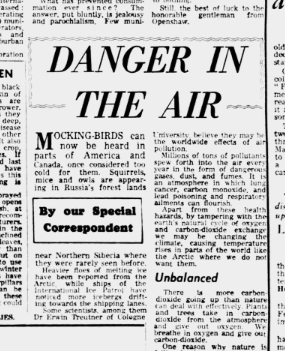
Fifty nine years ago, on this day, April 22nd, 1965, the Manchester Evening News ran another article warning about carbon dioxide build up,
22 April 1965 Article about C02 and global warming in Manchester Evening News
The amount of carbon dioxide in the air was roughly 320ppm. As of 2024 it is 425ppm, but check here for daily measures.
The context was that a couple of months earlier, Lyndon Johnson, as President of the United States, had made a special address to Congress, which mentioned CO2 buildup, and other scientists were sniffing around the issue. The Evening News has talked about carbon dioxide buildup before but this was a pretty clear case.
What we learn is that if you were a tolerably intelligent person with a tolerably decent memory, and I don’t know, O-level chemistry and physics, you’d have understood the climate issue from them a lot earlier than I thought even a couple of years ago.
What happened next Manchester Evening News very periodically covered the issue. So did everyone. But it wasn’t really until ‘69 – 70 that it got any traction, and then it went away again until 1988.
What do you think? Does this pass the ‘so what?’ threshold? Have I got facts wrong? Interpretation wrong? Please do comment on this post, unless you are a denialist, obvs.
They are forced to this situation by the desperate shortage of fossil fuels throughout the world and the immense dangers which are inherent in burning fossil fuels, particularly coal. Almost daily people are dying from the pollution effects of coal fired power stations. Yet no one is getting emotional over mining and burning of coal. It’s a bit like the terrible carnage on our roads. Because it happens every day no one seems to care any more. Nonetheless the hazards of coal fired power stations have not diminished. In fact there is every reason to believe that the CO2 catastrophe is possibly the most portentious aspect of our entire long range energy policy. It is my belief that once the CO2 problem becomes widely understood, even given all the uncertainties, it will become the single strongest argument for turning to the nuclear alternative. Most scientists viewing the accelerated burning of fossil fuels now agree that CO2 will warm the earth’s surface temperature significantly.
Peter Baume (also a Liberal MP), later in the same debate, said this –
I then proceed to outline some of the major problems with which I believe conservationists have not adequately coped. I stress the points made by the honourable member for Kalgoorlie about carbon dioxide. He certainly stated the position very clearly; there is a real risk to our existence on this planet from carbon dioxide from the burning of fossil fuels. I would like to hear the same kind of analysis of the risks applied to our existing fuel usage as has been applied with extraordinary enthusiasm to the projected fuel usage of a material which is available in Australia and whose development would be to our national advantage. When I hear a comparable analysis from the conservationists group, I will believe that they have a far sounder basis on which to approach the people of Australia with a rational argument.
As has been pointed out by Dr Weinberg in the paper to which the honourable member for Kalgoorlie referred, the CO2 catastrophe-the carbon dioxide catastrophe- is possibly the most portentious aspect in our entire long range energy policy. If the carbon dioxide concentrations increase, more radiation from the sun is directed back towards earth and the earth’s temperature increases. It is, of course, the green house effect. Since the mid-nineteenth century there has been an estimated 10 per cent rise in carbon dioxide levels in the atmosphere. About 50 per cent of the carbon dioxide from burning fossil fuels goes into the atmosphere and stays there. If the world continues to increase its usage of fossil fuels at a rate of 4 per cent, atmospheric concentration of carbon dioxide will double by the middle of the twenty-first century, according to Dr Weinberg.
The amount of carbon dioxide in the air was roughly 333.8ppm. As of 2024 it is 425ppm, but check here for daily measures.
The context was Australia was wanting to export uranium to nuclear powers around the world. And not everyone was on board with that, for reasons of proliferation and just being against nuclear energy. And so therefore there was a debate in Parliament. What’s interesting is that carbon dioxide buildup was already being spoken of. In such fora. This is perhaps unsurprising given that CSIRO had made some movies and that the Australian Academy of Science had released a report – it came out in 76. So it’s not altogether surprising.
What we learn is that carbon dioxide build-up was a topic of conversation by the mid-1970s.
What happened next? We exported uranium. Nuclear power did not make a dent in the upward trajectory of our emissions, and of atmospheric concentrations.
What do you think? Does this pass the ‘so what?’ threshold? Have I got facts wrong? Interpretation wrong? Please do comment on this post, unless you are a denialist, obvs.
Fifteen years ago, on this day, April 20th, 2009, the Australian Chief Scientist tried to inject some urgency into the policy debate…,
The Government’s chief scientist wants the country to set the toughest possible targets for reducing greenhouse gas emissions, warning that action must begin now against climate change.
The Government has committed to cutting Australia’s emissions by 5 to 15 percent of 2000 levels by 2020 and wants to start an emissions trading scheme next year.
However, the target has been slammed by the Greens and environmental groups as being too low and the Opposition has also recently signalled it would support a stronger cut in emissions.
Professor Penny Sackett would not put an exact figure on what she thought the target should be but she said she has advised the Government to set the steepest target possible.
The amount of carbon dioxide in the air was roughly 387.6ppm. As of 2024 it is 425ppm, but check here for daily measures.
The context was that the Rudd Government had been selling out the future by allowing lobbyists for the oil and gas and coal industries to chip away and chip away at the already initially piss-weak ambition of the Carbon Pollution Reduction Scheme. It was about to be introduced to Parliament, and presumably Penny Sackett, Chief Scientific Adviser was trying to stiffen everyone’s resolve so that further compromises would be minimal. Well, ideally, ambition will be ramped up, but no, it’s a ratchet.
What we learn is that scientists are largely powerless in these matters and all they can do is speak truth to power and power will ignore them and so it came to pass.
What happened next? Rudd’s Piss-weak and ever pisser weaker legislation was defeated because of Tony Abbott. And because the Greens decided something bad would come along, Rudd was toppled the following year. And Sackett resigned in April 2011 without giving a reason, but this has shed some light on why she might have done that.
What do you think? Does this pass the ‘so what?’ threshold? Have I got facts wrong? Interpretation wrong? Please do comment on this post, unless you are a denialist, obvs.
The amount of carbon dioxide in the air was roughly 390ppm. As of 2024 it is 425ppm, but check here for daily measures.
The context was the clue is in the name, Deepwater and Horizon, both implying that we’re having to go further and further to find oil, that the energy return on investment is lowering and it’s getting riskier. And so it did. The context was that we’ve been extracting oil. If you don’t count Burma for 170 years, we’re very good at it. If by good you want to overlook the inevitable leaks, and the inevitable tanker disasters, these normal accidents.
What we learn Is that accidents happen. Normal accidents happen…
What happened next, BP tried to dodge the blame with a certain amount of success. The marine environments were devastated. people’s livelihoods were devastated. But we’ve moved on… other disasters we can expect. And there’s the Onion story, clearly inspired by Deepwater Horizon…
What do you think? Does this pass the ‘so what?’ threshold? Have I got facts wrong? Interpretation wrong? Please do comment on this post, unless you are a denialist, obvs.
The amount of carbon dioxide in the air was roughly 390ppm. As of 2024 it is 425ppm, but check here for daily measures.
The context was there were the meetings of outfits like the World Economic Forum at Davos. There were the IPCC meetings and the UNFCCC meetings. There had been the World Social Forum meetings, largely run by elite NGOs. And so “let’s all meet in Bolivia and [redacted on advice of myself]… and achieve fuck all but we’ll feel good about ourselves in the meantime.”
What we learn is you can have a Rumble in the Jungle. You can feel good but ultimately if you don’t have strong movements in your home countries, the energy, excitement, enthusiasm, attention, whatever will just dissipate. And so it came to pass.
What happened next in the UK Climate Camp staggered on for another year before releasing laughable metamorphoses statement [link to February 2011 post]. And the emissions kept climbing.
What do you think? Does this pass the ‘so what?’ threshold? Have I got facts wrong? Interpretation wrong? Please do comment on this post, unless you are a denialist, obvs.
Twenty eight years ago, on this day, April 19th, 1996, climate campaigners took to the web…,
Australian environmental education has been launched onto an international stage, with local group ARK Australia yesterday going live on the Internet with a World Wide Web site called Planet Ark.
The product of a significant cooperative effort involving the Seven Network , Austereo, Reuters and Sanitarium, the site will provide on-demand 24-hour environmental radio news on the Net, along with environmental software and celebrity campaigns that can be downloaded free of charge, including the “Save the Planet” videos featuring stars such as Pierce Brosnan, Dustin Hoffman, Tom Cruise and Nicole Kidman.
Helen Meredith. 1996. Planet Ark’s world-first on the Net. The Australian Financial Review, 19 April 1996 p48
The amount of carbon dioxide in the air was roughly 362ppm. As of 2024 it is 425ppm, but check here for daily measures.
The context was that the World Wide Web and cyberspace were just arriving. And therefore it was newsworthy when someone set up a website. The deeper context is that the Australian outpost of Ark seemed to have taken some sort of hold, though it had sunk in the UK.
What we learn is that celebrities have always been yammering about environmental issues, but are also often celebrities that are spectacularly badly placed. Because pretty much by definition, their lifestyles are high carbon, and they can be accused of being hypocrites, so out of touch, e.g. “Carbon Cate” in 2011…
What happened next? The World Wide Web gave us a highly intelligent fact based public sphere. Now I’m just playing with you: look around you for a minute…
What do you think? Does this pass the ‘so what?’ threshold? Have I got facts wrong? Interpretation wrong? Please do comment on this post, unless you are a denialist, obvs.
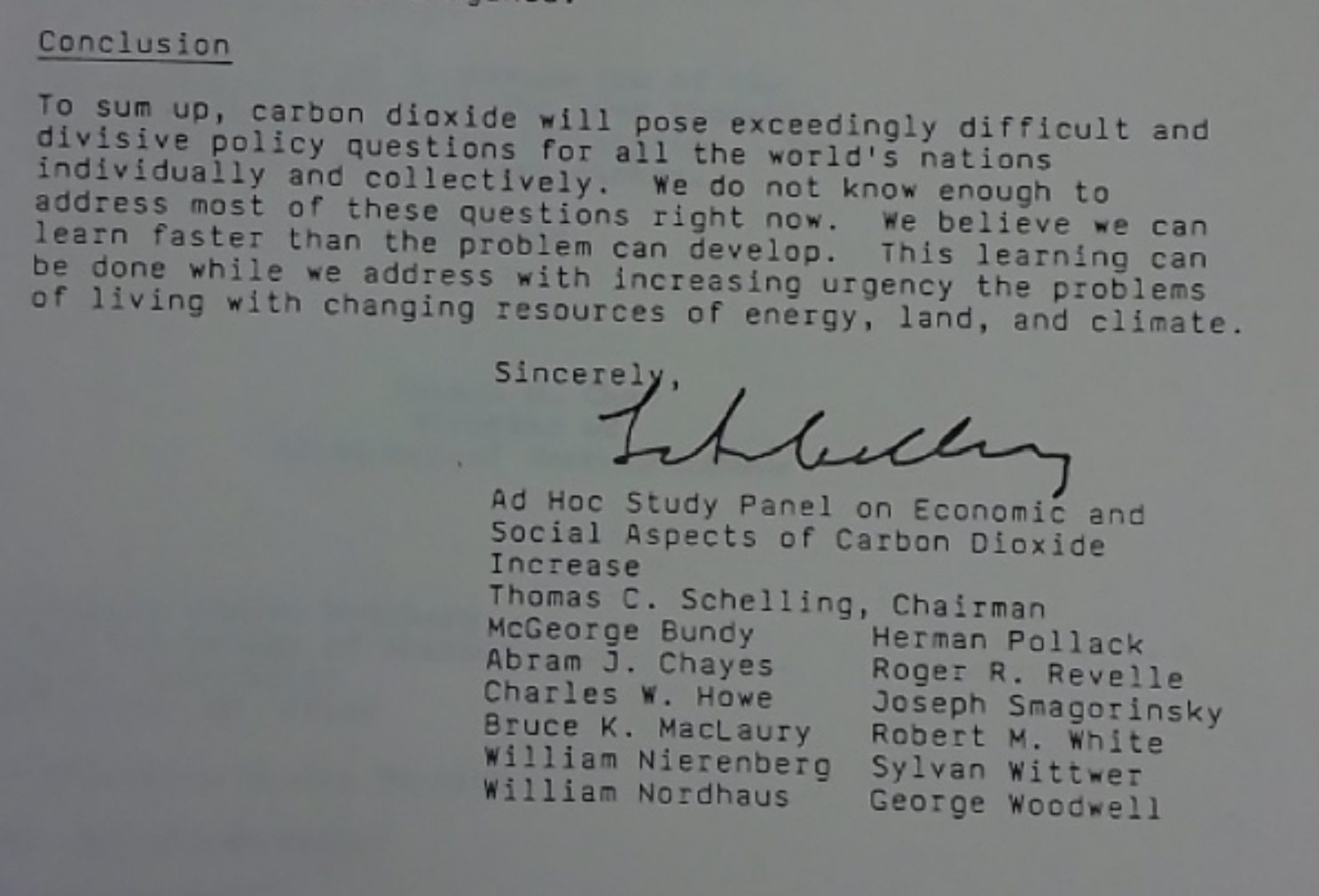
Forty four years ago, on this day, April 18th, 1980, an Ad Hoc Panel of heavy hitters warned that there were not going to be ANY easy fixes for the carbon dioxide build-up issue. How right they were.
“We must recognize now that increases in energy consumption using fossil fuels will have increasingly undesirable climatic effects” NAS panel on “Economic and Social Aspects of Carbon Dioxide Increase” in letter to Dr Philip Handler, its president Cited by Speth in Global Energy Futures and Carbon Dioxide Problem ..
The amount of carbon dioxide in the air was roughly 338.7ppm. As of 2024 it is 425ppm, but check here for daily measures.
The context was the various ad hoc panels and groupings of Department of Energy, the American Association for the Advancement of Science, IIASA etc were all pondering “well, what happens if the carbon dioxide emissions do keep climbing and the world does get warmer, what impact will that have geo politically and socially, economically?”
What we always learn From the period of the late 70s we knew enough to be worried. And some people were worried. But idiots don’t worry(looking at you Ronald Reagan).
What happened next? Growing concern largely came to a grinding halt when Reagan took office (It will be interesting to try to figure out who organised that 1982 conference on “carbon dioxide, science and consensus” and why).
What do you think? Does this pass the ‘so what?’ threshold? Have I got facts wrong? Interpretation wrong? Please do comment on this post, unless you are a denialist, obvs.
Fifty four years ago, on this day, April 18th, 1970, UK Prime Minister Harold Wilson was trying to get some kudos for wrapping himself in the issue of the day…,
In April 1970, Wilson gave a speech to the United Nations Association in York, in which he espoused the virtues of international cooperation on the environment:
We need a new charter of international rights – and obligations. This is how it might read. All States have a common interest in the beneficial management of the natural resources of the Earth. All States should cooperate in the prevention or control of physical changes in the environment which may jeopardise the quality of human life, and which may endanger the health or the survival of animals or plants.102
102 TNA: FCO 55/429, Prime Minister’s Address to Annual General Meeting of the United Nations Association in York, 18 April 1970
(Sims, 2016: 212)
The amount of carbon dioxide in the air was roughly 325ppm. As of 2024 it is 425ppm, but check here for daily measures.
The context was that Harold Wilson had been talking about environmental issues since September of the previous year, at the Labour Party Conference, in a period of competitive consensus. In January he gave a speech up in New York about a new special relationship on pollution. The Conservatives were yapping at his heels. Wilson in his head was probably thinking about the next election. And the green issue was an important one for voters. This is long before the Ecology party, which later became the Green Party.
What we learn is that there was a period of alarm and competitive consensus in the late 60s early 70s. And compare and contrast that with what happened in the periods of 2006 to 2008. And the coupled lack of ambition in 2023-4. We’re so doomed.
What happened next? Well, a month later, the first ever Environment White Paper was released. It mentioned carbon dioxide buildup as a potential issue. Wilson then went on to lose the June 1970 election. He returned to office in 74 and stepped down in 76.
What do you think? Does this pass the ‘so what?’ threshold? Have I got facts wrong? Interpretation wrong? Please do comment on this post, unless you are a denialist, obvs.
Below is an email interview with Bill Hare, CEO & Senior Scientist at Climate Analytics
You can follow Bill on Twitter – @BillHareClimate
1. When did you first hear about climate change, and how? What was the Australian Conservation Foundation’s early position on it?
I heard about rising CO2 concentrations and climate change in high school from a geography teacher in the early 1970s.
What woke me up to it as a significant problem was an academic at University of Western Australia gave me a paper in nature in 1978 to look at. At first, I was sceptical, but the more I looked into it the more I became convinced it – fossil fuel CO2 induced climate warming – was a serious problem.
When I first joined the Australian Conservation Foundation climate change was not a theme. Stratospheric ozone depletion was an emerging problem, and I was pretty heavily briefed by CSIRO scientist at the time, notably Barrie Pittock. He also brought to my attention, a number of international publications on rising concern about global warming.
By the late 1980s, there were calls for a 20% reduction in C02 emissions by 2005 (the Toronto target). If I recall correctly the ACF lined up behind those calls in various submissions and press commentary.
At the same time, we were also calling for a phase out of chlorofluorocarbons and other ozone-depleting substances to combat stratospheric ozone depletion.
2. Australian policy elites first started to have their attention properly drawn to the issue almost 30 years ago, in 1986, with the public following in 1988.
Yes, there was the 1987 CSIRO conference, and that I think marks the beginning of formal attention to this issue
I had a paper at this conference with my colleague at the time Helen Quilligan
Since then, there have been fierce battles over even the most elementary of policy instruments (carbon pricing and support for renewables).
Yes, and at the level of macroeconomic policy, the view by the late 1980s in Australia was that the country had a lot to benefit from exporting coal and other resources to North East Asia, including China.
This became quite a dominant view and provided a justification of much of what happened in the 1990s and beyond.
Hawke in responding to this report, recognised the environmental challenges that would come from a massive expansion of and made the claim that
“And let me make this point. My Government does not accept the simplistic dichotomy – development or the protection of the environment. We must have both. And our record shows that we can have both.”
The ecologically sustainable development process that he set up however, failed to substantially impact the direction and scale of environmental protection in Australia. Paul Keating had a little interest in this when he assumed the role of prime minister and there’s process became completely moribund, under pressure from the resource development lobby and relevant agencies of government.
Climate policy was essentially non-existent, and opposition to action inside government federally was widespread and intensive.
One fairly standard academic view is that this is what you’d expect of a country with enormous fossil fuel reserves and a powerful mining industry.
That is very fatalistic view. Is that what had to be? I’m not so sure – ecological modernisation, under the umbrella of the Ecologic development process was aimed at industrial power. I don’t think it had to end up the way it did.
Looking back at this period, I don’t think the extent of capture of the political parties by the fossil fuel industry was anywhere near as advanced as it is now.
Is that too fatalistic? Does that let the politicians, other business and civil society off the hook?
I think it lets politicians off the hook and does not properly contextualise the rapacious behaviour of Australia is mining, resources industry and fossil fuel industry. I think the Murdoch press played a very significant and destructive roll in all this over the last 20 or 30 years.
It’s hard to comment on the role of civil society.
(And if this academic view is not a good explanation, what is a better one?)
I don’t know how ground breaking it is to describe the blinding obvious in retrospect.
It might have helped if a lot more academics has spoken up about the adverse direction of Australia on climate action over the years.
3. Without getting bogged down, what could and should have been done differently,
Well, it depends on ones view of history. Is it historically determined that in 2013 Australia elected a government that would repeal groundbreaking climate legislation and policies and start a decade of denial?
If this legislation has not been repealed, then I think we would be in a substantially different place. Then we are now, probably one somewhat behind the European Union, but with a range of different policy instruments in place that could be improved.
and – crucially – what could and should ‘campaigners’ (broadly defined so as to include renewables companies etc) do differently in the short-to-medium term to try to accelerate policy and technology change towards something that might be considered adequate.
Well, there are a number of things that need to be focused on, and these include working to establish the right long-term policy frameworks, fearlessly hold government to account on their policies and actions, continue the campaign to convince people of the wisdom and benefits of climate policy action, make sure people understand the risks coming from global warming and to upgrade communication efforts in this area.
It is very important that NGOs and academics are fully independent of government and special or pecuniary interests, particularly in the Australian context interest in offsets. Unfortunately, there seems to be quite a pattern of interest that may conflict.
It is also very important that NGOs are brave and fearless, and do not concern themselves overly with the health of the Labour Party internally, nor prioritise, access to ministers over, maintaining a strong and consistent position on the right things to do. In the end, and my experience, mature government will listen even if I don’t like the message they are at first.
4. Personal question – where do you get your hope/tenacity from? (If it’s a special Amazon delivery, what’s the URL for that!!)
One has to have hope, and as soon as one becomes cynical it’s time to leave the field. Surprising as it might seem, I get a lot of energy from the science of this issue. Yes, the news is very depressing, but if one focuses on what can be done and how fast then one can see a way forward. In addition, the massive role out of renewables, electric vehicles and batteries has to give rise to hope that we can bend the curve fast enough. At the end of the day, the problem is too serious to give up and to serious to surrender hope