The amount of carbon dioxide in the air was roughly 398ppm. As of 2023 it is 423ppm, but check here for daily measures.
The context was
The carbon tax battle had been lost. And now the anti-climate anti-Gillard sorts were doing their best to keep the flame alive with an anti wind power rally. But you can’t reheat a souffle. And this one was an embarrassment because people on the whole, like wind power, (especially if they don’t have to have their house immediately underneath a turbine).
What I think we can learn from this
Some technologies catch the public mind and are considered nice and good, and others are not. It’s not entirely fair. And neither is life.
What happened next
The anti-wind turbine people kind of more or less, folded up their tent and switched to other sorts of stuff, but then they could afford to do that because by September of 2013, their guy was in power and he hated the damn things. (See my 2017 paper ‘wind beneath their contempt’)
What do you think? Does this pass the ‘so what?’ threshold? Have I got facts wrong? Interpretation wrong? Please do comment on this post, unless you are a denialist, obvs..
The amount of carbon dioxide in the air was roughly 388ppm. As of 2023 it is 423ppm, but check here for daily measures.
The context was
Everyone, especially the Europeans, was running around talking about the wonders of CCS, we were in a hype cycle. And some of the people intimately involved, know the dangers. And what will happen if there is an over promising and under-delivering.
What I think we can learn from this
And so the more sane members of a community will try and tamp down exuberance and excessive expectations. And that’s what appears to be happening in this case.
What happened next
CCS got European Union support. But none of the projects got constructed. And here we are in 2023. And it’s still not clear that much CCS is going to happen – watch this space!
What do you think? Does this pass the ‘so what?’ threshold? Have I got facts wrong? Interpretation wrong? Please do comment on this post, unless you are a denialist, obvs.
Thirty years ago, on this day, June 16, 1993, an OECD/IEA conference “International Conference on the Economics Of Climate Change” ended in Paris.
What a doomed species we are.
The amount of carbon dioxide in the air was roughly 359.6ppm. As of 2023 it is 423ppm, but check here for daily measures.
The context was
The Earth Summit happened. And now everyone was gonna have to figure out the economics of climate change. The IEA and the OECD were good venues for this, both of them with one foot in the technology. So see for examplethe carbon disposal symposium in Oxford earlier in the year. And IEA had been playing around with the science since well, February of 1981, at the latest. IEA had been looking ideas about what would you do about the economics of climate change? This stuff had been discussed as far back as the mid 1970s by Nordhaus for IASSA
What I think we can learn from this
And the same sets of ideas get moved around the chessboard. And then a new game starts and they set the chess pieces up. And round and round and round it goes. Questions of political and social cultural power, are, of course, bracketed or sidestepped altogether, because that would be normative and not easily quantified. And might take you towards things like new international economic orders, an old unpopular (with the rich) idea from the 1970s…
What happened next
The carbon dioxide kept accumulating. And the economists and so forth, kept flying from conference to conference.
What do you think? Does this pass the ‘so what?’ threshold? Have I got facts wrong? Interpretation wrong? Please do comment on this post, unless you are a denialist, obvs.
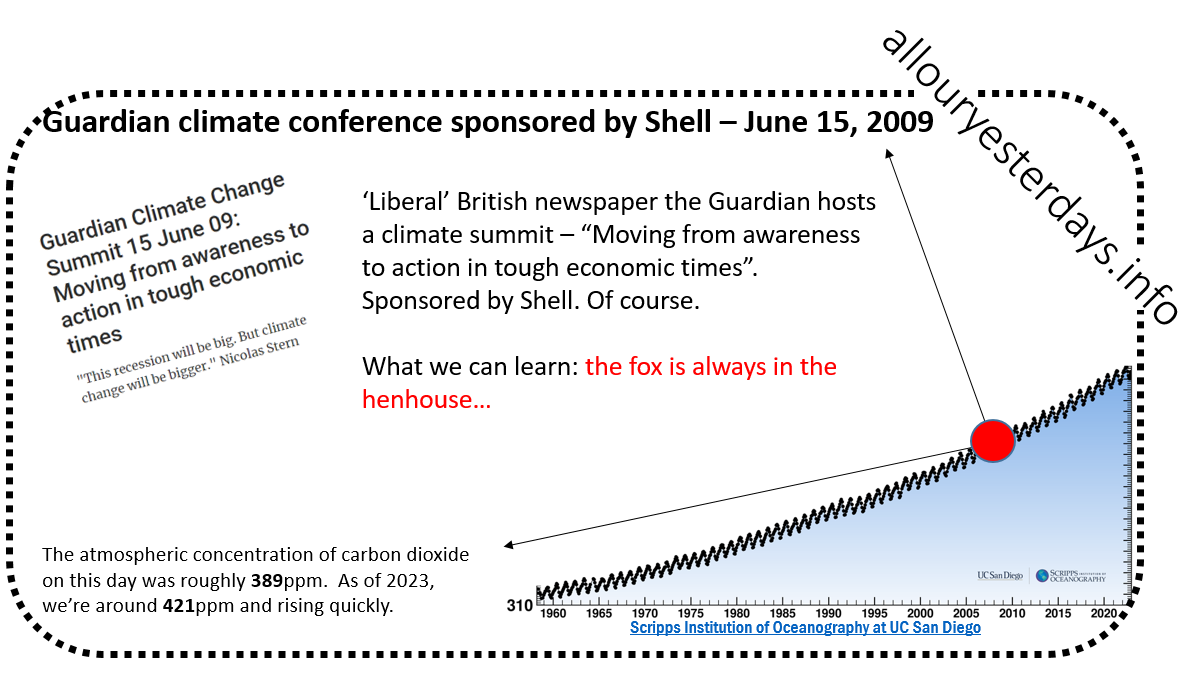
The amount of carbon dioxide in the air was roughly 389.7ppm. As of 2023 it is 423ppm, but check here for daily measures.
The context was that every man and their dog were talking about climate change – had been since the second half of 2006. And now the Copenhagen Climate Summit was going to be the icing on the cake. So of course, a quote left of centre, but actually centrist newspaper has to bring together the bien-peasants (sic) and business to show that it is a responsible corporate citizen. And there is lots of talk about technology and social change and expectations. Because there are reputations to be burnished and logs to be rolled and mutual back-scratching of various intensity. And how else do you know if you’re alive, unless you’re on one of these platforms being obediently listened to?
What I think we can learn from this
What we learn is that the cycle goes on, and that everyone has their stable place in the emotacycle and the corporate emotacycle. But no one asks question “Gee, what have we been doing wrong?”
What happened next
Copenhagen was predictable and predicted catastrophe. But everyone keeps on same day.
What do you think? Does this pass the ‘so what?’ threshold? Have I got facts wrong? Interpretation wrong? Please do comment on this post, unless you are a denialist, obvs.
Fifty years ago, on this day, June 14, 1973, the UK based “Conservation Society” tried to lay out what would be needed for, you know, a future…
It begins with the prescient words – “We are in the presence of another climacteric more dramatic than any the human race has yet experienced.”
Yep.
June 14 1973 The Conservation Society launches “Education for our Future” Fairhall, J. (1973) Preparing young for crisis. The Guardian, June 14, p.6.
The amount of carbon dioxide in the air was roughly 332ppm. As of 2023 it is 423ppm, but check here for daily measures.
The context was
Everyone was running around talking about survival and education. And what that would look like. There had been a seminar in 1972 in London, and this Conservation Society effort probably drew on that.
What I think we can learn from this
We’ve been talking about the skills that we would need to educate the young for 50 years that’s included lots of nice words like holistic and environmental and ecological and we have not done it for the most part.
What happened next
Obviously we did not educate ourselves for a new society. If we had, projects like this would not even exist.
The Conservation Society wound up in 1987, ironically just before the next big wave
What do you think? Does this pass the ‘so what?’ threshold? Have I got facts wrong? Interpretation wrong? Please do comment on this post, unless you are a denialist, obvs.
Seventy years ago, on this day, June 13, 1963, high-powered scientists Werner Von Braun and Roger Revelle spitball the future, but don’t seem to talk about climate change…
13-14 June 1963 Teller Von Braun and Revelle at UCSD The Future of Science conference
The amount of carbon dioxide in the air was roughly 321.4ppm. As of 2023 it is 423ppm, but check here for daily measures.
The context was Revelle had been at the Conservation Foundation’s meeting in March of 1963. Teller had written and publicly proclaimed about climate change, but neither of them particularly mentioned it on this occasion, as far as I can tell.
What I think we can learn from this is that carbon dioxide buildup was only one issue among many at the time, and didn’t warrant a lot of attention.
What happened next
Revelle kept publishing, kept working, died in 1991, and was used as a pawn in the culture war. Teller went on with his Dr. Strangelove obsessions and the Space-Based Defence initiative (Star Wars). And the carbon dioxide kept accumulating.
What do you think? Does this pass the ‘so what?’ threshold? Have I got facts wrong? Interpretation wrong? Please do comment on this post, unless you are a denialist, obvs.
The amount of carbon dioxide in the air was roughly 394ppm. As of 2023 it is 423ppm, but check here for daily measures.
The context was that Monckton was on one of his periodic tours of Australia, lapping up the attention that he was getting for his swivel eyed lunacy contesting the science of climate change with half baked nonsense. And unfortunately for him, he got high on his own supply, and went too far. With an allegation that Schellnhuber was a Nazi, or that Ross Garnaut was a Nazi. This then created a reputational issue for his sponsors and the Liberal Party, then led by Tony Abbott, and pressure was clearly applied, and Monckton apologised. For what that was worth, not that anyone particularly believed it.
What I think we can learn from this
What we can learn is that culture warriors often get triggered, have peaks and go below you and go too fast, and then have to try to claw back their position. See, another example of this would be the Heartland Institute and its Unabomber billboards.
At a climate conference in Melbourne, in July, the Lyndon LaRouche lunatics held up a noose and called Schellnhuber a Nazi. It was so classy.
What do you think? Does this pass the ‘so what?’ threshold? Have I got facts wrong? Interpretation wrong? Please do comment on this post, unless you are a denialist, obvs.
Twenty years ago, on this day, June 11, 2003, AEI + IPA vs, well, life on earth.
On June 11, 2003, AEI and an Australian think tank, Institute for Public Affairs (IPA), cosponsored a conference titled “Non-governmental Organizations: The Growing Power of an Unelected Few,” held at the AEI offices in Washington, D.C. The conference laid the ground for the launch of “NGO Watch” – a website and political campaign cosponsored by AEI and The Federalist Society.
(Hardistry and Furdon 2004)
The amount of carbon dioxide in the air was roughly 378.4ppm. As of 2023 it is 423ppm, but check here for daily measures.
The context was that the American Enterprise Institute and the Institute for Public Affairs were both long-lived think tanks which had been captured by the neoliberals in the 70s and 80s. And were now launching a full frontal assault on civil society and NGOs. In order to get the ignorant rabble in line.
What I think we can learn from this is that there is a never-ending war for public perception and the power struggle to make sure that the state is insulated from popular pressure and can be a trough for favoured industries and research and development, and also function to continue to batter the proles until they submit.
And the “DDT is good for you” myth never goes away.
What happened next
As you’d have predicted, the IPA then set about trying to attack and smother civil society organisations in the United in Australia. It set up a fake environmental group in 2005 in order to try to confuse people, because that’s who these scum buckets are.
What do you think? Does this pass the ‘so what?’ threshold? Have I got facts wrong? Interpretation wrong? Please do comment on this post, unless you are a denialist, obvs.
Fifty four years ago, on this day, June 10, 1969, the chair of the Atomic Energy Commission gave carbon dioxide build-up as an anti-coal/pro-nuke argument.
“Speaking today before the opening session of the 37th annual convention of the Edison Electric Institute, Glenn T. Seaborg, chairman of the AEC said that
“While tremendous efforts were under way to cut the sulphur content of coal, oil and gas – fossil fuels – there were “no methods known of eliminating carbon dioxide that results from combustion.” ”
The Times goes on to report “Nuclear power adds no pollutants to the atmosphere.”
(Smith 1969)
The amount of carbon dioxide in the air was roughly 326.7ppm. As of 2023 it is 423ppm, but check here for daily measures.
The context was that the nuclear lobby was starting to realise that it could use the alleged low carbon nature of its power stations versus coal. You’d seen Teller to do this in 1957-59. You’d seen an article in the 1964 “Population Resources” book that did the same thing. And I think the editor of the journal Science Philip Abelson had also mentioned climate change as an argument for nuclear in the late 1960s…
Seaborg had already warned about this in 1966 at a commencement address at UC San Diego.
“At the rate we are currently adding carbon dioxide to our atmosphere (six billion tons a year), within the next few decades the heat balance of the atmosphere could be altered enough to produce marked changes in the climate–changes which we might have no means of controlling even if by that time we have made great advances in our programs of weather modification.” [wikipedia]
The “nukes will save us from climate” thing goes back longer than a lot of people would think.
What happened next
Nukes didn’t save us from climate.
What do you think? Does this pass the ‘so what?’ threshold? Have I got facts wrong? Interpretation wrong? Please do comment on this post, unless you are a denialist, obvs..
References
Smith, G. 1969. UTILITIES URGED TO BACK A-POWER. The New York Times; Jun 10, pg. 63
Sixty eight years ago, on this day, June 9, 1955, the finest brains (sic) in the UK met to chew on atmospheric research. Didn’t spot the elephant in the room (it was small, to be fair!)
It is appropriate, in view of the forthcoming intensification of atmospheric research during the International Geophysical Year of 1957-58, to examine the present state of research in such a subject as radiative balance in the atmosphere, and a one-day discussion meeting on this subject was held in London at the Royal Society on June 9. In such a short period it was clearly out of the question to attempt any comprehensive survey, and attention was concentrated instead on subjects in which research is being actively pursued.
Nature 1 October 1955
Meteorological Magazine
The amount of carbon dioxide in the air was roughly 313ppm. As of 2023 it is 423ppm, but check here for daily measures.
The context was that the International Geophysical Year was coming. There had already been a bunch of articles in the media speculating on carbon dioxide buildup. And having three years after the London smog, and the year before the Clean Air Act was passed, the quality of air was still very high on the agenda as it should be, as it still really needs to be.
What I think we can learn from this
Carbon Dioxide build up was NOT on the agenda. Not because these people were stupid, complacent, careless or anything else. Just wasn’t on their radar yet. Not enough evidence etc built up. Only Callendar, some newspaper articles and comments by Plass.
What happened next
The International Geophysical Year happened next…
What do you think? Does this pass the ‘so what?’ threshold? Have I got facts wrong? Interpretation wrong? Please do comment on this post, unless you are a denialist, obvs.