Sixty eight years ago, on this day, November 6th, 1958,
By the year 2000 it may be possible to forecast good or bad summers many years ahead, an expert in climatology, Professor Gordon Manley, said in Coventry last night.
…
“There was no doubt that the ice in the polar regions was melting, resulting in an increase in sea level, he said… “If the sea level is rising to a much greater level than we think it would make quite a mess of most of our sea ports..”
Anon. 1958. Climate key explained in Coventry. Coventry Evening Telegraph, November 7, p.22
The amount of carbon dioxide in the air was 313ppm. As of 2026, when this post was published, it is 430ppm. This matters because the more carbon dioxide in the air, the more heat gets trapped. The more heat, the more extreme weather events. You can make it more complicated than that if you want, but really, it’s not. Fwiw, I have a tattoo of the Keeling Curve on my left forearm.
The broader context was that in 1938 Guy Callender had given a presentation at the Royal Meteorological Society about carbon dioxide build up and the heating of the planet. He received a lukewarm reception. However, one person who was on board was Gordon Manley, and Manley had been quoted in 1954 or ‘55 , as saying that in 30 years time we’d be growing grapes and have orange trees in the south of England.
Thespecificcontext was that it has basically been agreed by scientists studying within the International Geophysical Year, they’ve released an interim report in June that has said the world is one big greenhouse. And so here Manley is saying that seaports may be wiped out by rising sea level rise.
And it’s important to remember that whether you believed in carbon dioxide build up or not, there was enough evidence to convince everyone that the earth was warming up for whatever reason, and that ice would melt. . .
What I think we can learn from this is that the warnings were there.
What happened next – we kept emitting carbon dioxide in enormous quantities. The Fafocene is here.
On this topic, you might like these other posts on All Our Yesterdays
Xx
References
xx
You can see the chronological list of All Our Yesterdays “on this day” posts here.
What do you think? Does this pass the ‘so what?’ threshold? Have I got facts wrong? Interpretation wrong? Please do comment on this post, unless you are a denialist, obvs.
If you want to get involved, let me know.
If you want to invite me on your podcast, that would boost my ego and probably improve the currently pitiful hit-rate on this site (the two are not-unrelated).
Sixty eight years ago, on this day, February 19 1958,
A meeting at Linneas Society London, from which Council for Nature group forms.
The amount of carbon dioxide in the air was roughly 315ppm. As of 2026 it is 428ppm, but check here for daily measures.
The broader context was that in the 1950s it was becoming clear that industrialization wasn’t just an issue for cities air quality, but also large chunks of the beautiful English countryside and diverse species were being wiped out. This had been going on for ages. Of course, I don’t want to say that it was just in the 50s.
The specific context was -well, I don’t know about the Council for Nature, presumably the Tory government wanting to look like it gave a shit. And there will have been people within the Tory government who did give a shit.
What I think we can learn from this is that there are always these fine sounding names slapped on state bodies that are there ostensibly to regulate and protect. These bodies always run out of steam, get captured, get corrupted, and occasionally renewed, but during their capture and corruption, they waste a lot of people’s time and hope and then cause cynicism, despair, apathy, which you could argue is ultimately a feature, not a bug.
What happened next:
Oh, these groups come and go, get rebranded and waste a lot of everyone’s time and hope.
The Council for Nature. Nature 181, 867–868 (1958). https://doi.org/10.1038/181867a0
What do you think? Does this pass the ‘so what?’ threshold? Have I got facts wrong? Interpretation wrong? Please do comment on this post, unless you are a denialist, obvs.
Sixty-six years ago today (October 8th, 1958) British meteorologist Gordon Manley wrote to his friend, steam engineer Guy Callendar, who had – for the past twenty-plus years had been banging on about carbon dioxide building up in the atmosphere as a (or even the) factor affecting the climate.
The amount of carbon dioxide in the air was roughly 315ppm. As of 2024 it is 422ppm, but check here for daily measures.
The context was that the International Geophysical Year was happening. More people were coming on board with the carbon dioxide theory, Gilbert Plass, GER Deakin, Appleton, etc. And Manley was congratulating Guy Callendar, bless.
What we learn is that Guy Callendar was getting a little bit of recognition and was getting published still in journals like Tellus and so forth. But he wasn’t being carried through the streets on people’s shoulders, as perhaps he should have been. Such is the nature of humanity when the wrong person making the announcement, if you’re Miss Triggs.
What we learn is that you can be right and not get the credit you deserve. That’s one of the oldest stories in the book.
What do you think? Does this pass the ‘so what?’ threshold? Have I got facts wrong? Interpretation wrong? Please do comment on this post, unless you are a denialist, obvs.
References
CP 1, Gordon Manley to Callendar, 8 October 1958, cited in Fleming, 2007
Sixty six years ago, on this day, September 21st, 1958, the Los Angeles Times ran a truncated version of the full Spilhaus cartoon on the greenhouse effect.
The amount of carbon dioxide in the air was roughly 314ppm. As of 2024 it is 422ppm, but check here for daily measures.
The context was that the International Geophysical Year was still underway. Sputnik had gone up, so the Soviets were winning! Charles David Keeling had started his measurements at Mauna Loa. And even before they were complete, people kind of knew, as per Washington Post front page in July 1957, that there was a greenhouse effect that was going to bake us. Spilhaus had done a PhD before the war. He was well aware of Roger Revelle, I think they’d work together. And he’d started doing educational cartoons about science. And here we are.
What we learn is that mass publics were being educated by cartoons and documentaries like the Unchained Goddess about what was going on.
What happened next Spilhaus mentioned the greenhouse effect in the 1960 science documentary that appeared, I think, on CBS.
What do you think? Does this pass the ‘so what?’ threshold? Have I got facts wrong? Interpretation wrong? Please do comment on this post, unless you are a denialist, obvs.
Sixty six years ago, on this day, August 3rd, 1958, we boldly go…
On August 3, 1958, the USS Nautilus (SSN-571) made history by becoming the first ship to pass underneath the North Pole. The 1,830-mile journey was launched from Pearl Harbor, Hawaii, on July 23, 1958, under the name “Operation Sunshine” and brought the sub and her crew to the shores of England in 19 days.
The amount of carbon dioxide in the air was roughly 314ppm. As of 2024 it is 424ppm, but check here for daily measures.
The context was that the bloody Ruskies had put a little ironmonger’s ball in orbit. And so therefore, the Americans needed to boldly go somewhere. In this case, it was under the North Pole in the Nautilus commanded by Captain Nemo or someone.
What we learn is that phallic objects get everywhere if they give you a sense of power.
What happened next. Residues of nuclear weapons are all around us. Operation Sunshine, etc. And the polar ice cap is… melting and melting and melting.
What do you think? Does this pass the ‘so what?’ threshold? Have I got facts wrong? Interpretation wrong? Please do comment on this post, unless you are a denialist, obvs.
The amount of carbon dioxide in the air was roughly 314ppm. As of 2024 it is 426ppm, but check here for daily measures.
The context was that Australian newspapers were fond of articles about the changing climate and droughts because Australia is a land of scorching droughts, or whatever the Dorothea Mackellar poem goes. And of course, the International Geophysical Year was just behind us, so everyone was able to have an opinion about the weather. It fills column inches.
What happened next? Various little mentions of carbon dioxide build up. In Australia press, possibly notably the cartoon in 1965 in the Sydney Morning Herald, and two years later, Canberra Times. It’s fairly niche, though, it’s got to be said.
What do you think? Does this pass the ‘so what?’ threshold? Have I got facts wrong? Interpretation wrong? Please do comment on this post, unless you are a denialist, obvs.
Sixty six years ago, on this day, January 26th, 1958,
At the same time NAS was channelling Revelle, Edward Teller, father of the hydrogen bomb and an avid advocate for building hundreds of nuclear power plants, warned at the December 1957 meeting of the American Chemical Society that increasing CO2 might someday melt the polar icecaps and flood the world’s coastal regions.
Teller’s remarks and Revelle’s testimony to a congressional committee sparked a Washington Sunday Star article by Phil Yeager and John Stark in January 1958: “Mystery of the Warming World.” It was published on page 26 and included the prediction that CO2 warming of the climate might generate” a type of control regulation, law, interstate compact, and international agreement which could scarcely help clashing with some of our cherished notions of free enterprise. Industry, which might blossom in some directions … would be hamstrung in others. … Further, in view of the global nature of the problem, ordinary international agreements might prove inadequate for effective regulation.” International controls backed up by penalties, the prescient pair wrote, would be “sure to foster great heat and controversy.”
The amount of carbon dioxide in the air was roughly 315ppm. As of 2024 it is 422ppm, but check here for daily measures.
The context is that people had been talking about the greenhouse issue. And including Edward Teller. And two journalists had used it as the opening topic in a series of science articles.
What we learn – we knew. We really knew.
What happened next The issue kind of went away in 1959-60, and only started to seriously come back in the late 1960s. And I think it’s just too big for people to understand. And it’s still too big for them to understand the idea that we could have a global impact. I mean, it’s just bizarre.
What do you think? Does this pass the ‘so what?’ threshold? Have I got facts wrong? Interpretation wrong? Please do comment on this post, unless you are a denialist, obvs.
Sixty five years ago, on this day, November 19, 1958, at a meeting of the American Association for the Advancement of Science meeting Dr C Leake warns of carbon dioxide build up. This is reported the following day in the Times.
Anon. 1958. Air Pollution Menace to Health. The Times, November, 20, p.16
The amount of carbon dioxide in the air was roughly 315.3ppm. As of 2023 it is 419ppm, but check here for daily measures.
The context was that by the late 1950s scientists (especially American ones) were switching on to the threat of carbon dioxide build-up, and talking about it.
What I think we can learn from this
Nobody pushed back, really. In a “liberal democracy” the active resistance only starts when you threaten established economic and political interests.
What happened next? It’s unclear if Leake continued warning. The carbon dioxide issue goes a bit quieter in the 60, for various reasons (no news hook, not enough confirmed science/data to justify etc).
What do you think? Does this pass the ‘so what?’ threshold? Have I got facts wrong? Interpretation wrong? Please do comment on this post, unless you are a denialist, obvs.
Sixty five years ago, on this day, June 21, 1958, the Washington Post (not then the paper it is now) reported on carbon dioxide build-up.
21 June 1958 – IGY findings – Price, B. (1958) World Seen Turning Into a ‘Greenhouse’. Washington Post and Times Herald ; Jun 21, pg. A1
The amount of carbon dioxide in the air was roughly 317.2ppm. As of 2023 it is 423ppm, but check here for daily measures.
The context was
That, even without Charles David Keeling measurements, it was clear that atmospheric CO2 was building up and would eventually cause the planet to overheat. This was thanks to the International Geophysical Year which was by this stage almost 12 months old. The previous December the Washington Post and run a front page story based on Edward Teller’s warning of a long-term climate apocalypse.
What I think we can learn from this
We can learn that there really wasn’t any secret about this in Washington or presumably London, it was just in the too hard and too far away basket
What happened next
The measurements started. The scientists continued to point out that there would be trouble ahead, especially people like Herman Flohn and David Keeling. But it would be 1988 before politicians were forced to take note.
What do you think? Does this pass the ‘so what?’ threshold? Have I got facts wrong? Interpretation wrong? Please do comment on this post, unless you are a denialist, obvs.
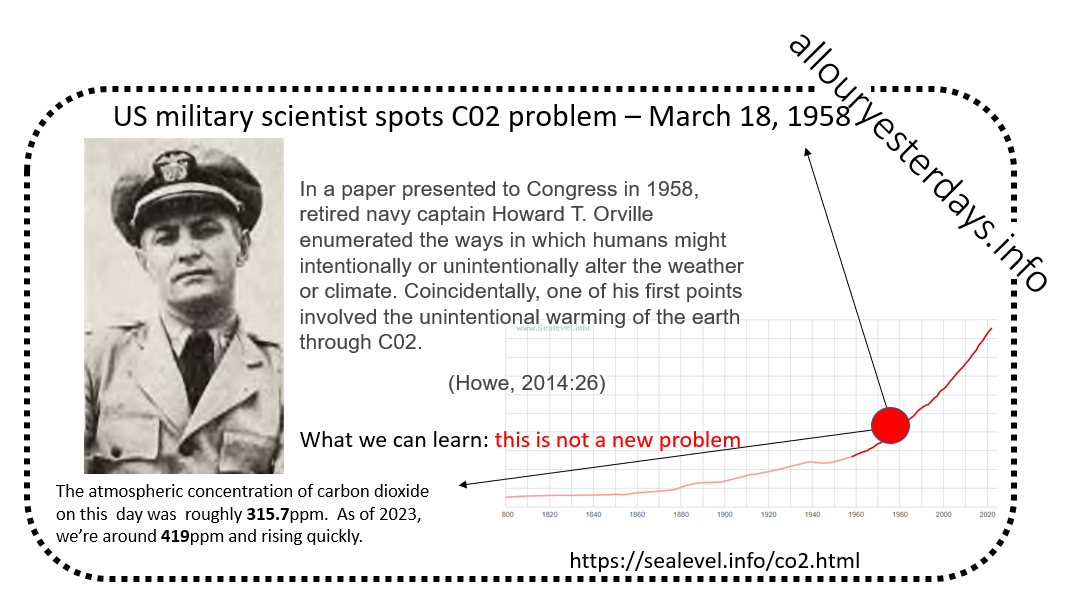
Sixty five years ago, on this day, March 18, 1958, a US military man explains that carbon dioxide build-up is a possible, accidental, form of weather modification.
In a paper presented to Congress in 1958, retired navy captain Howard T. Orville enumerated the ways in which humans might intentionally or unintentionally alter the weather or climate. Coincidentally, one of his first points involved the unintentional warming of the earth through C02.
(Howe, 2014:26)
Orville quoted; Weather Modification Research hearings of House Committee on Interstate and Foreign Commerce, 85th Congress, March 18-19 1958
The amount of carbon dioxide in the air was roughly 315.7ppm (this was the first month we have C02 measurements from Mauna Loa!). As of 2023 it is 419ppm, but check here for daily measures.
The context was that at this point, the idea of intentional weather modification, think using hurricanes to smash your opponents, crops and fleets, was still a thing (This was the late 1950s when we were properly drunk on hubris). And so Captain Orville’s testimony came, it was not the first time he had spoken on this. And came three months after the New York Times had done a detailed report about this, that included concern about carbon dioxide buildup, and Orville himself talked about co2 buildup as inadvertent weather modification (link Jan 1 1958 article).
What I think we can learn from this
Sometimes or in fact, all the time, you don’t hit what you aim for, that the knowledge that is later useful comes almost by accident. And again, in the 1950s American politicians were indeed being warned about carbon dioxide, and had been for several years by then.
What happened next
The weather modification, beyond some very local effects in Vietnam (Operation Popeye), was a washout, despite what the chemtrailers would have you believe.
What do you think? Does this pass the ‘so what?’ threshold? Have I got facts wrong? Interpretation wrong? Please do comment on this post, unless you are a denialist, obvs..