DeFries, Ruth S .; Malone, Thomas F. National Research Council (U.S.), Committee on Global Change Forum on Global Change and Our Common Future 1989 Washington, D.C. Washington, D.C.: National Academy Press; 1989. xiii, 227 p. : ill., maps ; 28 cm. Committee on Global Change, National Research Council.
Proceedings of the Forum on Global Change and Our Common Future, held on May 2-3, 1989, at the National Theatre in Washington, D.C., and organized by the National Research Council’s Committee on Global Change. Includes bibliographical references.
The amount of carbon dioxide in the air was roughly 353ppm. As of 2025 it is 430ppm, but check here for daily measures.
The context was that the “Our Common Future” report had been released in 1987. It was a sequel/rehash of sorts of the Brandt report of 1980, and sat alongside the Global 2000 report. All these – whisper it – were dancing around the fact that the Limits to Growth people of 1972 were basically right but nobody wanted to admit it so everyone went along with the bright shining lies about Technology or Development or Human Rights or whatever protective incantations were popular and career-enhancing at that moment.
What I think we can learn from this. We were smart enough to spot the problems. Mostly too scared (with good reason) to point out that the maniac sociopaths in charge would never allow the actions required, because it would interfere with their power, prestige, appetites, ideology. Duck and cover? Kinda.
What happened next
In 1989 the Global Climate Coalition was formed – oil companies and auto companies and so on – to fight any meaningful policy response to climate change. They won.
What do you think? Does this pass the ‘so what?’ threshold? Have I got facts wrong? Interpretation wrong? Please do comment on this post, unless you are a denialist, obvs.
Thirty six years ago, on this day, April 29th, 1989, the ABC radio programme the “Science Show” had this as its running line up.
The Science Show [Episode 658] – Reply to David Suzuki from Barry Jones; Greenhouse Effect Consequences; New Scientist Editor; Research Used for Biological Weapons; Lichens; Bopplenuts
The amount of carbon dioxide in the air was roughly 353ppm. As of 2025 it is 427ppm, but check here for daily measures.
The context was that the Science Show had, from its first August 1975 broadcast, been alerting listeners to the threat of climate change. Science Minister Barry Jones had been on the case too, and his “Commission for the Future” had worked with the CSIRO on a highly effective “Greenhouse Project.” The Australian Federal Government was grappling with ‘what to do’… David Suzuki, the Canadian science communicator, was making frequent trips to Australia and had recently lectured on the Amazon.
What I think we can learn from this was that the late 1980s really was a burst of awareness/fear around climate change, but that people can only cope with so much fear and then they turn away, happy to be told that every little thing’s gonna be alright, even (especially) when they know that really, it won’t be…
What happened next
We turned away – the green groups were unable to maintain the momentum, sustain their capacity. It was always going to end like this. It’s how every story ends…Or has ended so far. Who knows, maybe next time will be different. Sure.
What do you think? Does this pass the ‘so what?’ threshold? Have I got facts wrong? Interpretation wrong? Please do comment on this post, unless you are a denialist, obvs.
The amount of carbon dioxide in the air was roughly 353ppm. As of 2025 it is 425ppm, but check here for daily measures.
The context was
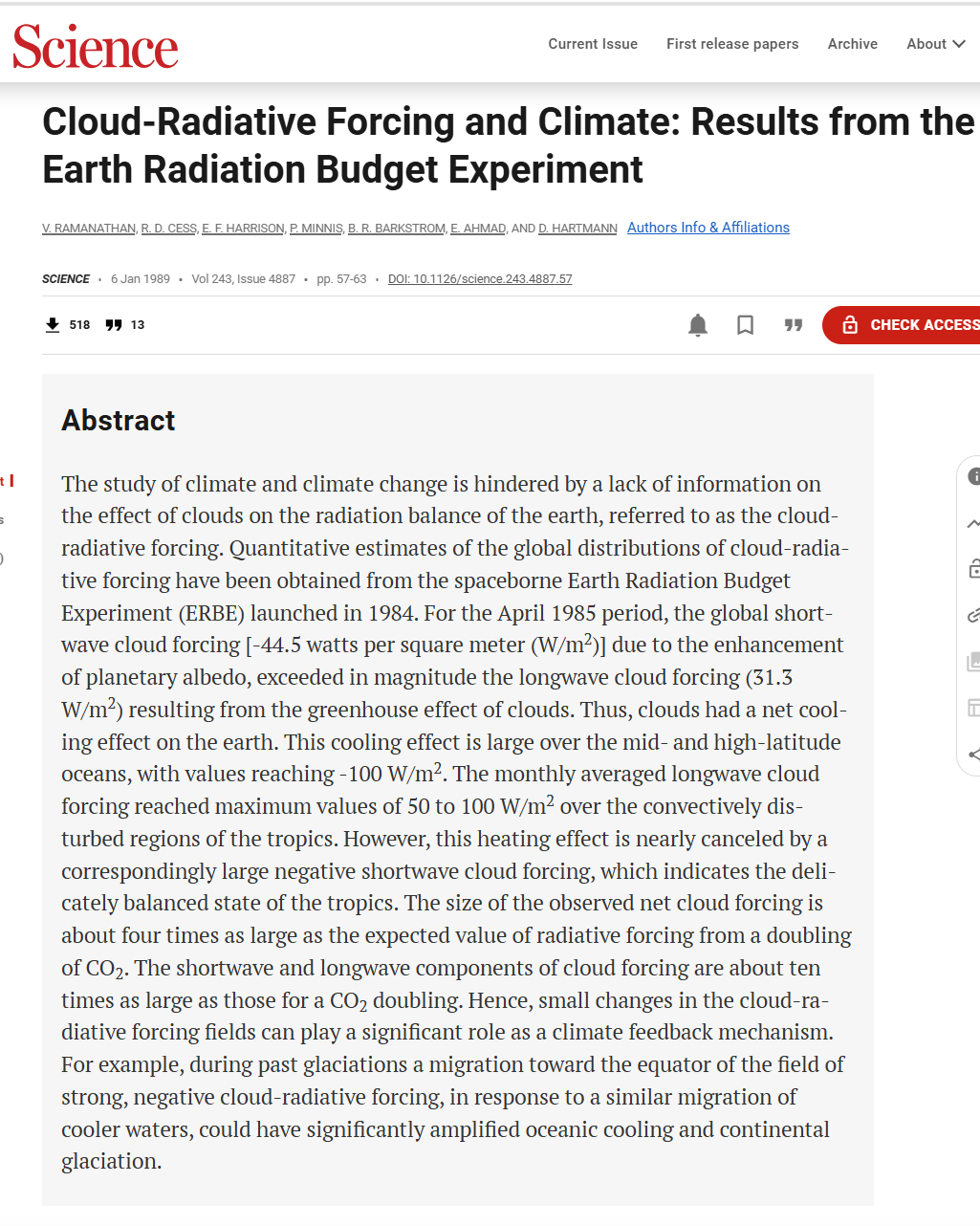
The starting gun for *public* concern about climate change had been fired a few months before (June 1988), thanks to both James Hansen’s testimony to a Senate committee in Washington DC, a very hot summer, and other events (including statements by senior politicians such as George HW Bush and Margaret Thatcher). Ramanthan’s work on the effect of all the other trace gases on estimated temperature rise had been one factor in making the Villach meeting of 1985 what it was.
What I think we can learn from this
That smart people have been scratching their heads/worrying about the earth’s radiation budget and imbalance for a long long time.
What happened next
Scientists kept sciencing, and the emissions kept climbing.
What do you think? Does this pass the ‘so what?’ threshold? Have I got facts wrong? Interpretation wrong? Please do comment on this post, unless you are a denialist, obvs.
References
V. Ramanathan R. D. Cess, E. F. Harrison, P. Minnis, B. R. Barkstrom, E. Ahmad and D. Hartmann 1989. Cloud-Radiative Forcing and Climate: Results from the Earth Radiation Budget Experiment Science Vol. 243, No. 4887 (Jan. 6, 1989), pp. 57-63
Thirty-four years ago, on this day, November 11th, 1988,
At that [Nov 11, 1988] conference [organised by Time] French environmental official Brice Lalonde remarked, “Through the late 1970s, lots of things we learned about the environment came from the United States. And [in the] late seventies, it stops, and the lead [switched to] Scandinavia, Germany, and the Netherlands.” To this, Tennessee Democrat Senator Albert Gore quickly responded “January of 1981, to be precise.”
(Schneider, 1989: 225)
The amount of carbon dioxide in the air was roughly 351ppm. As of 2024 it is 423ppm, but check here for daily measures.
The context was that Time magazine was holding a conference about the environment and climate change and so forth. Because that sold newspapers and they wanted to get another story out of it.
So convene a big bunch of big names. You can put it on your cover, get reflected/halo glory, future connections. It’s then easier for journalists to phone up and get quotes. Bish bosh.
And what Gore was doing was telling the truth about how the Reagan administration had been, at best indifferent, at worst, actively hostile to all environmental concerns.There had been in effect, a lost decade, longer by the time you took the incoming President Bush into account.
What we learn is that there was a lost decade,
What happened next, Gore went toe-to-toe with Bush Snr over the subject of global warming. revealing that NASA scientist James Hansen had been gagged, etc, etc. Gore was then Clinton’s running mate in 1992, at the same time “Earth in the Balance” came out.
And here we are, with the emissions still climbing.
What do you think? Does this pass the ‘so what?’ threshold? Have I got facts wrong? Interpretation wrong? Please do comment on this post, unless you are a denialist, obvs.
Thirty-five years ago, on this day, November 8th, 1989, UK Prime Minister Thatcher speech to UN General Assembly
The amount of carbon dioxide in the air was roughly 354ppm. As of 2024 it is 423ppm, but check here for daily measures.
The context was that 14 months previously, Margaret Thatcher had stunned everyone by making a speech about global warming to a gathering of the Royal Society in Oxford. And this had really moved the conversation on “the greenhouse effec”t and what to be about it onto a much higher level. But she’d actually committed the UK to very little despite her special one day Cabinet meeting about the greenhouse effect April 1989. And here, we have her making nice flowery speeches at the UNGA.
What we learn is that she was a consummate politician.
What happened next, a couple of days later, environmental analyst Tom Burke pointed out that there was “a hole in the policy layer”(which is quite a fun title, but you have to put it in the context of the ozone). And he pointed out that the UNGA speech had half an hour of flowery rhetoric, but nothing concrete, nothing specific. And so it came to pass that nothing specific or concrete was done.
What do you think? Does this pass the ‘so what?’ threshold? Have I got facts wrong? Interpretation wrong? Please do comment on this post, unless you are a denialist, obvs.
Thirty five years ago, on this day, October 23rd 1989 Republican Governor of New Jersey Thomas Kean issues an executive order. Yep. it was a broadly bi-partisan issue, until 1990-1991, and the beginning of the organised fight back by the fossil fuel interests…
The amount of carbon dioxide in the air was roughly 353ppm. As of 2024 it is 422ppm, but check here for daily measures.
The context was that at this stage you could be a Republican and still give a shit about climate change and be seen to be doing something or wanting to do something about it. The culture wars hadn’t really hardened the arteries of the body politic. That’s not to say that what the Republicans were proposing as solutions were going to work. But at least they acknowledged that there was a problem. The fact that that seems like a small mercy or something noteworthy tells you how decayed we are.
What I think we can learn from this is that we knew and that it wasn’t always a culture war.
What happened next remained governor of New Jersey until 1990 and the culture war hardened
What do you think? Does this pass the ‘so what?’ threshold? Have I got facts wrong? Interpretation wrong? Please do comment on this post, unless you are a denialist, obvs.
Thirty five years ago, on this day, October 5th, 1989, Australian Federal Environment Minister Graham Richardson warns Prime Minister Bob Hawke that he will have to save Kakadu (i.e. ban mining) to win the election, because green-minded voters will accept nothing less. (See Paul Kelly’s The End of Certainty for details)
The amount of carbon dioxide in the air was roughly 353ppm. As of 2024 it is 422ppm, but check here for daily measures.
The context was that Australia had been digging up and exporting minerals for good 25 years in large quantities. And the whole concept of Aboriginal land rights and sacred sites was nothing important back then. Not to the white people anyway. But by the mid-late 80s, that was changing. And the idea for an expansion of the uranium mine at Kakadu that would damage the National Park was a vote loser in the marginal inner city constituencies where Labor hoped it would be able to cling on to power at the next federal election. This had to happen early in 1990 and therefore Graeme Richardson, who was Prime Minister Bob Hawke’s very effective environment minister, was telling Hawke that he was going to have to save Kakadu even though this was going to seriously piss off the mining lobby. The mining lobby feared that it was the beginning of serious restrictions on their ability to plunder, sorry to “develop”, Australia’s resources for their own benefit. And Hawke took that on board; he delayed the decision and took the credit for that.
What we learn is that these seemingly tangential issues are important to understand if you want to understand how climate policy works
What happened next Labor did in fact squeak home in the March 1990 election, and then had a quid pro quo debt to keep the Ecologically Sustainable Development process.
What do you think? Does this pass the ‘so what?’ threshold? Have I got facts wrong? Interpretation wrong? Please do comment on this post, unless you are a denialist, obvs.
Thirty-five years ago, on this day, September 11th, 1989, The New Yorker Magazine publishes ‘The End of Nature’ , an essay by William McKibben.
In an interview with the same magazine in 2014 McKibben recognised he had initially miscalculated what we are up against.
“It took me a long time to realize that the scientists had won the argument but were going to lose the fight, because it isn’t about data and science, it’s about power. The most powerful industry is fossil fuel, because it is the richest. At a certain point, it became clear that our only hope of matching that money was with the currencies of movement: passion, spirit, creativity—and warm bodies”
The amount of carbon dioxide in the air was roughly 354ppm. As of 2024 it is 420ishppm, but check here for daily measures.
The context was that for the past 13 months, everyone had been banging on about the “greenhouse effect” since James Hansen’s testimony. This had been neatly secured by Grant Swinger. And here was the first one of the first big philosophical pieces written by then young Bill McKibben. Talking about the End of Nature/
The New Yorker, of course, had been the venue for Rachel Carson’s 1962 effort Silent Spring. So this was in keeping with their general long form, big picture jeremiads (see also Elizabeth Kolbert’s Field Notes from a Catastrophe).
What we learn is that there are specific publications where if you really want to have an influence, that’s where you need to be. Because everyone will be reading it and the mere fact that it got published there will mean that people take it seriously. Even if more interesting, important work is appearing somewhere else. Because we do mental shortcuts – we have to, because we’re surrounded by so many potential sources of information.
What happened next McKibben’s essay got published as a book. Good Book. McKibben went on to found 350.org involved in divestment and so forth. Probably still thinks that the situation is salvageable. I don’t know. Maybe I should interview him. Anyway, that’s 35 years ago.
What do you think? Does this pass the ‘so what?’ threshold? Have I got facts wrong? Interpretation wrong? Please do comment on this post, unless you are a denialist, obvs.
Thirty five years ago, on this day, August 23rd, 1989,
WASHINGTON — Gigantic orbiting mirrors may offer a solution – albeit a very costly one — to Earth’s anticipated woes with global warming if pollution control efforts fail, a Swiss scientist said Wednesday.
In a letter published in the British journal Nature, Walter Seifritz said he thinks it is unlikely humans will do much in the near future to reduce pollution that threatens to boost the planet’s temperature.
Carbon dioxide and other gases generated by fuel consumption and burning of tropical forests warm Earth’s atmosphere by trapping solar heat like a greenhouse.
Many scientists predict if current pollution trends continue, Earth’s temperature could rise 4 to 9 degrees over the next 70 years. Such an increase would cause a marked rise in sea levels and dramatic climate changes.
If efforts to cut emission of so-called greenhouse gases fail and serious global warming occurs, Seifritz contends ‘a remote but feasible possiblity’ would be to lower temperatures by artificially blocking the amount of sunlight reaching Earth.
‘To compensate for a temperature increase of 2.5 degrees Kelvin (4.5 degrees Farenheit), the solar radiation must be reduced by about 3.5 percent. The task could be done by satellites bearing large, lightweight mirrors,’ wrote the professor from Switzerland’s Schurrer Institute.
Kolberg, R. 1989. Mammoth mirrors could offset global warming. UPI, 23 August.
The amount of carbon dioxide in the air was roughly 354ppm. As of 2024 it is 424ppm, but check here for daily measures.
The context was that everyone had been banging on about climate change for a year. And now, the techno-fetishists were getting in on the act, with the idea of space mirrors as part of the whole solar radiation management gimmick.
What we learn is that rather than look inside and examine our actual problems, we are far keener on looking outside and listening to people who point to “this thing of darkness we acknowledge is someone else’s” (That’s a riff on Prospero in The Tempest, btw). And technofixes are a really good example of that. Press bro would not be surprised.
What happened next, we still don’t have any space mirrors. We didn’t do anything to reduce the trajectory of emissions. And we are beginning to boil, metaphorically speaking.
What do you think? Does this pass the ‘so what?’ threshold? Have I got facts wrong? Interpretation wrong? Please do comment on this post, unless you are a denialist, obvs.
Thirty five years ago, on this day, July 20th, 1989, a nice new job is announced…
Major conservation groups believe that the new post of Ambassador for the Environment will be only as effective as Federal Government policy allows.
The new position – to be filled by the former Governor-General and High Court judge Sir Ninian Stephen – was announced by the Prime Minister this week as part of his major environmental statement.
Mr Hawke said that “no-one could better discharge that role for Australia”.
Speaking from Melbourne, Sir Ninian said he was not sure why he had been chosen but was delighted to accept when it was offered by Mr Hawke by telephone last weekend.
Bailey, P. 1989. All praise for our green envoy. Sydney Morning Herald, July 22, p.7.
The amount of carbon dioxide in the air was roughly 353ppm. As of 2024 it is 426ppm, but check here for daily measures.
Australia gets its first ambassador for the environment. A nice job for a superannuated civil servant in this case, Ninian Steven.
The context was that Prime Minister Bob Hawke had an eye on the next federal election, and needed to keep small-g green tinged voters onside, and needed to therefore do some harmless appointing of meaningless jobs to fly the flag and to keep the greenies happy.
What we learn is that the sorts of gestures get made, you always have to ask for “What responsibilities does the person have?” “What rights do they have?” “How will they be funded?” “Will they be able to take names and embarrass anyone?” And if there aren’t good answers to those questions, then what you’re looking at is just more bullshit.
What happened next. He had the job for a while, I forget who was next. Think it was a woman. The post degenerated to its natural state when the head of the Australian Coal Association, Ralph Hilman, was appointed by John Howard.
What do you think? Does this pass the ‘so what?’ threshold? Have I got facts wrong? Interpretation wrong? Please do comment on this post, unless you are a denialist, obvs.