Categories
United Kingdom

May 13, 1991 – UK Energy minister fanboys nuclear as climate solution. Obvs.

Twenty seven years ago, on this day, May 13, 1991, a UK 

“Britain’s last Secretary of State for Energy wrote in May 1991 that ‘the environment has to be a priority in shaping global resources plans’ and expressed official support for nuclear power as an insurance policy against global warming, also pleading for higher prices for fossil fuels”

Boehmer‐Christiansen (1995; 184)- citing Wakeham, J. 1991. Nurturing a greener policy for world energy. The  Times, 13 May. 

The amount of carbon dioxide in the air was roughly 358.7ppm. As of 2023 it is 420ppm, but check here for daily measures. 

The context was  the United Kingdom was trying to paint itself as environmentally responsible both domestically and internationally, and also being a big fan of nuclear. So, nothing has changed.

What I think we can learn from this

The political games keep getting played. The players change often. The rules change slowly. Ultimately the game Remains the Same the losers future generations, other species.

What happened next

UK policy making on climate and energy remained pretty disconnected until the 2003 Energy White Paper and even then things have been seriously contested and a classic mess since then. The opportunities to invest in energy efficiency and renewable energy have been mostly missed, thanks to an ongoing obsession with nuclear power and generalised animosity towards the measures you would need to take to tackle climate change. This is hardly a surprise.

What do you think? Does this pass the ‘so what?’ threshold? Have I got facts wrong? Interpretation wrong?  Please do comment on this post, unless you are a denialist, obvs.
Categories
Science United States of America

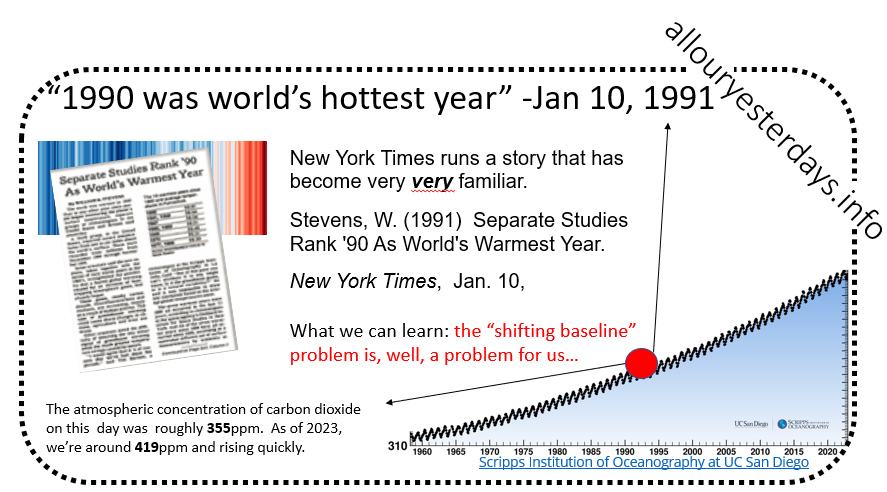
January 10, 1991 – “Separate studies rank 1990 as world’s warmest year”  #ShiftingBaseline

Thirty two years ago, on this day, January 10, 1991, the New York Times ran a story that has become very very familiar.

The earth was warmer in 1990 than in any other year since people began measuring the planet’s surface temperature, separate groups of climatologists in the United States and Britain said yesterday.

A third group, in the United States, reported record temperatures from one to six miles above the earth’s surface. These were recorded from balloons from December 1989 through November 1990.

Stevens, W. (1991)  Separate Studies Rank ’90 As World’s Warmest Year  New York Times,  Jan. 10.

The amount of carbon dioxide in the air was roughly 355ppm. As of 2023 it is 419. .

The context was that the US had finally been forced to agree to take part in negotiations for a world climate treaty (what became, in June 1992, the United Nations Framework Convention on Climate Change).  The denial and delay campaigns were kicking into gear (the so-called ‘Global Climate Coalition’ doing its predatory delay thing).  Part of the context for the whole climate awakening was how warm the 1980s had been (mild by today’s standards, of course).

What I think we can learn from this

The “warmest year ever” meme does not, on its own, ‘wake up the sheeple’.  If you want to have effective long-term action, you need effective long-term social movement organisations.

Also – shifting baselines are a thing.

By @cameron_jms

See – https://twitter.com/cameron_jms/status/1120259348788338689

And

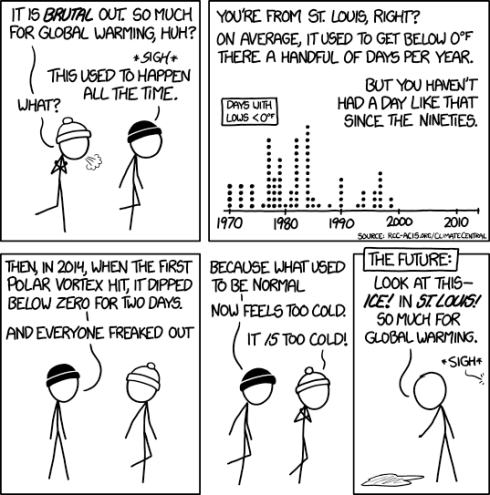
https://xkcd.com/1321/

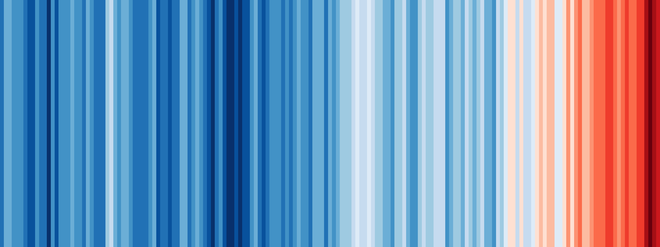
And the warming stripes

https://en.wikipedia.org/wiki/Warming_stripes

What happened next

It kept getting warmer, as you may have noticed.

What do you think? Does this pass the ‘so what?’ threshold? Have I got facts wrong? Interpretation wrong?  Do comment on this post.

Categories
UNFCCC United States of America

December 19, 1991- Will UN negotiations go as usual and “commit us to global catastrophe”?

On this day, December 19 in 1991 a close observer of the negotiations for a global climate treaty warned that it might end up being useless.

 Michael Oppenheimer of the Environmental Defense Fund lamented that ‘We remain confident that the texts of a Convention will emerge. However, we are not at all confident it will be an effective Convention. Those square brackets exist for the purpose of defending the supposed interests of countries. But in so doing they may yet commit us to global catastrophe (quoted in ECO, 19 December 1991).

Paterson, M (1996) page 58

[The amount of carbon dioxide in the atmosphere was 351ppm. At time of writing it was 419ishppm- but for what it is now,well, see here for the latest.]

The context was this – 

The negotiations for a global climate treaty had finally begun – despite the best efforts of the US to stop them from happening at all – in 1991.  And it instantly became obvious that Uncle Sam was just gonna delay and block, block and delay…

Why this matters. 

If you know your history, you will know that … you’re history

What happened next?

This. What you are living.  The catastrophes.

Categories
Australia

December 2, 1991 – “Ecologically Sustainable Development” bites the dust…

On December 2 1991, the Australian policy experiment of “Ecologically Sustainable Development” basically ended, just over a year after it began. It had been set up because the ALP’s Bob Hawke needed small-g green (the Greens didn’t exist yet) votes to win the 1990 election.  The ESD process had rattled along,and there’s lots of interesting stories (see AOY posts here and here).


Well, with Hawke mortally wounded (politically), and the Fight Back! by fossil interests (including right-wing Labour and Federal bureaucrats – this isn’t just Those Evil Capitalists Over There), the ESD’s days were numbered.

“The Ecologically Sustainable Development Working Groups final report received a “cautious welcome” yesterday, although there were fears the Government might not act to implement the report’s recommendations.

Union, conservation, business and political groups were generally pleased with the 272-page report which contains more than 300 recommendations for measures to achieve development which is consistent with preservation of the environment. The report was issued yesterday by the heads of the working group, Professor Stuart Harris and Professor David Throsby. However, some groups believed the report had “not gone far enough.”

The president of the Australian Council of Trade Unions, Martin Ferguson, said the working group process had been “very useful” for setting an agenda but not for “developing solutions to Australia’s economic and environmental problems.”  [THAT? Martin Ferguson??? Yes, that one… ]”

Iffland, K. 1991. Ecology report finds approval. Canberra Times, 3 December, p.3.

and

“When the chairmen released their work on Monday [2nd December], they took the opportunity to say the Opposition’s plan to cut the price of petrol would make it harder for the Government to meet its targets on reduction of greenhouse gases. Reducing the price of petrol by up to 19 cents a litre, as proposed by Dr John Hewson, could lead to greater use of petrol, in contrast to the theme of the Ecologically Sustainable Development taskforce of reducing energy use.”

Peake, R. 1991. A Tapestry That Weaves The Green With The Gold. The Age, 4 December, p.13.

[The amount of carbon dioxide in the atmosphere was 355ppm. At time of writing it was 419ishppm- but for what it is now,well, see here for the latest.]

The context was this – 

Why this matters. 

There was a time ‘rational’ (or at least sane and understanding of limits) policymaking could be cosplayed. Now, not so much. We should remember where we failed for the last consequential time. It will soothe us so much as everything falls apart.

What happened next?

The next Prime Minister, Paul Keating, buried the ESD. The next Prime Minister after him, Honest John Howard, buried Australia’s chance of responding to climate change in ways that could have saved something from the wreckage. And here we are.

Categories
United Kingdom

November 4, 1991 – UK Government launches first of many blame-shifting publicity campaigns on #climate

On this day, November 4 in 1991,  the UK Government launched a £10m campaign  “Helping the earth begins at home”.

The usual guilt-tripping about energy efficiency (with no support for renters or people on low-income).

Quickly forgotten, but a good example of how little actual joined up thinking there is.

There’s a good article by Steve Hinchcliffe (1996) “Helping the earth begins at home The social construction of socio-environmental responsibilities”, Global Environmental Change Volume 6, Issue 1, Pages 53-62

To be clear, OF COURSE we need behaviour change, but not if those are going to kick bigger decisions about overall demand reduction, fuel-switching, removing fossil fuel subsidies into the long grass….

[The amount of carbon dioxide in the atmosphere was 351ish ppm. At time of writing it was 416ishppm- but for what it is now,well, see here for the latest.]

The context was this – 

Climate change (then called “the Greenhouse Effect” or “global warming” had burst onto the public scene in 1988. Everyone was making pledges, scratching their heads, clutching their pearls, wringing their hands. And the Thatcher government wanted to be able to play a game of pin the blame on the donkey…

Why this matters. 

Blame-shifting has been going on a long time. And the same technique keeps getting re-used, again and again and again. Why change a winning game?

What happened next?

The campaign went nowhere, but got dusted off, rebranded and reused for the next few decades, until the collapse of human civilisation.

Categories
Australia

October 29, 1991 – Australia told to pay more than poor countries to help save planet. Does it? Of course it doesn’t.

On this day, October 29 in 1991, Maurice Strong (the Canadian oil baron who had organised the Stockholm conference in 1972 and was behind the then-impending Rio Earth Summiit) came to the National Press Club in Canberra

Nations, including Australia, that are contributing the most to global environmental degradation must pay the most to save the planet, Maurice Strong, secretary-general of the United Nations Conference on Environment and Development told the National Press Club in Canberra last week. [29 October]

Anon.1991. Australia must pay, says top UN official. Green Week, November 5, p.7.

[The amount of carbon dioxide in the atmosphere was 370.93ppm. At time of writing it was 421ishppm- but for what it is now,well, see here for the latest.]

The context was this – 

The “Earth Summit” was due to take place in June 1992, in Rio. Although the Federal Government had set an “interim planning target” of a 20 per cent reduction in greenhouse gas emissions by 2005 (on a 1988 baseline), it hadn’t actually done much to make that a reality.

Slightly green-minded Prime Minister Bob Hawke still  Prime Minister, but his nemesis, former Treasurer Paul Keating was circling.

Maurice Strong was the poster-child of evil for the nutjob denialists, until Al Gore stole that particular mantle.

Why this matters. 

It doesn’t, really. Nothing matters except whether we massively reduce emissions and somehow remove absurd quantities of C02 and methane from the atmosphere (spoiler- we don’t).

What happened next?

Rio happened in June. Australia’s Prime Minister Paul Keating did not bother to attend. Australia did nothing to meet its promises, and by 1996 was aggressively and publicly resisting further action. So it goes…