Categories
Australia

November 22, 2002 – private business battles on #climate become public in Australia

On this day, November 22 2002, the nasty spat within Australian business over whether to call for Australia to ratify the Kyoto Protocol broke out into public., with an article “Big business splits over greenhouse” by Miranda McLachlan in the Australian Financial Review

The dominant big business association, the Business Council of Australia, had backed Prime Minister John Howard in not ratifying the Kyoto Protocol (even though Australia had been able to extort an absurdly generous “reduction” target of … an 8 per cent increase in emissions (more once you added the land-clearing loophole.

But over time, key business leaders – proponents of renewables, carbon trading etc, fought within the BCA for a change in its position.  They fought each other to a standstill, as reported in the Fin, and the BCA went to a “no position” position on Kyoto ratification…

See also – Bell, S. (2008). Rethinking the Role of the State: Explaining Business Collective Action at the Business Council of Australia. Polity, Vol. 40,. 4, 464-487

[The amount of carbon dioxide in the atmosphere was 373ppm. At time of writing it was 417ishppm- but for what it is now,well, see here for the latest.]

The context was this – 

Why this matters. 

When the business lobby splits, that’s when the fun starts. Which is why incumbent actors work so hard to stop those splits…

What happened next?

Howard held the line. Public pressure on climate only really kicked in in Australia in the second half of 2006.  The BCA promptly moved to various fall back positions.

The emissions kept climbing. The atmospheric concentrations kept climbing. Then came the ‘natural’ disasters.

Categories
Australia

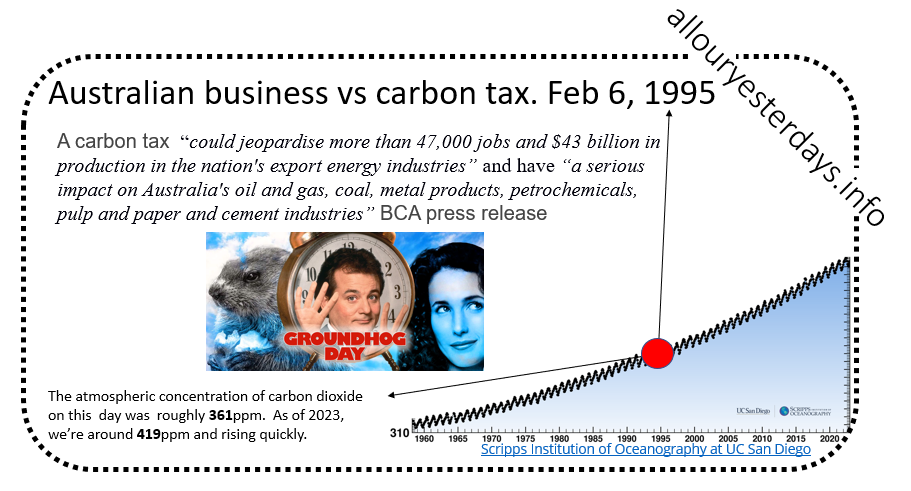
August 7, 1995 – decent Australian journo reports on utter bullshit #climate economic “modelling”

On this day, August 7 1995 journalist Gavin Gilchrist reports – front page of the Sydney Morning Herald – on the dodgy AF “MEGABARE” model

“The Keating Government is secretly developing a major diplomatic offensive that will undermine efforts to protect the world’s climate.

Confidential documents from the Department of Foreign Affairs and Trade show that the strategy relies heavily on a major government study that ignores the environmental benefits of tough action on global warming and instead highlights short-term economic costs.

It is a strategy that threatens to scuttle coming international negotiations on global emissions of harmful greenhouse gases.

The study, MEGABARE, was produced by the Australian Bureau of Agricultural and Resource Economics (ABARE) in Canberra and has been funded heavily by the coal industry, which is fighting controls on greenhouse gases.

Carbon dioxide, the major greenhouse gas, is produced by burning coal, oil or gas.

The Australian Coal Association has confirmed that it contributed $100,000 to MEGABARE. The Business Council of Australia and the coal producers BHP and CRA also contributed.

Gilchrist, G. 1995. Secret Strategy Undermines Greenhouse fight. Sydney Morning Herald, 7 August. P.1

This was months after a carbon tax proposal had been defeated. Ho hum.

On this day the level of carbon dioxide in the atmosphere was 359.33 ppm. Now it is 421ish- but see here for the latest.

Why this matters. 

The economic models were a joke, but that was not an accident. That was a feature, not a bug. Politicians could stand up and say any move from fossil fuels towards renewables would lead to imminent and unutterable chaos, cannibalism and despair.

What happened next?

MEGABARE was eventually killed off, but the use of joke economic models has continued. Too useful not to continue to be used.

Categories
Australia

May 13, 1992 – Australian business predicts economic armageddon if any greenhouse gas cuts made

On this day, May 13, 1992, Australian business groups did what they have done in the intervening 30 years – predicted imminent economic apocalypse, via “independent” studies, if even one lump of coal remained unburned.

The context was the impending Rio Earth Summit (though the text below makes it clear that threat was already receding).

The Australian business lobby had already fought a successful campaign against a carbon tax, and got lucky when Paul Keating took over from Bob Hawke as Prime Minister of Australia – Keating loathed the “Ecologically Sustainable Development” process Hawke had been forced to initiate in 1990. Keating’s loathing of greenies would escalate in the coming years.

1992 Brown, B. 1992. Pressure builds on Aust over greenhouse emissions. Australian Financial Review, 14 May, p.11. Australia may come under pressure to sign a declaration to stabilise greenhouse gas emissions, although a convention adopted at a United Nations meeting in New York last weekend set no target. Developing and European nations that could achieve stabilisation of greenhouse gas emissions at 1990 levels by the year 2000 are expected to push for this target at the Earth Summit in Rio de Janeiro in June. A United Nations Framework Convention on Climate Control agreed last weekend on a text to reduce greenhouse gas emissions, but without a specific target. The target will be considered by member governments before the Rio meeting.

But to reach the stabilisation target, Australia would need “excessively stringent government intervention”, according to one of two industry-commissioned studies released yesterday. The studies, prepared by the Canberra-based economic consultants ACIL Australia and Swan Consultants for the Business Council of Australia, said advice to the Government had seriously underestimated the economic costs of stabilising greenhouse emissions

Why this matters

Personally, I think it’s worth seeing the techniques used. Not because we can turn back time, not because the same exact tactics are still being used (though, well, basically they are). But because…? Dunno. Bearing witness?

What happened next

Australia signed and ratified the UNFCCC. It even introduced a worthless “National Greenhouse Response Strategy.” State and federal governments kept building coal-fired power plants, expanding and giving permission for more coal mines, as if there was no tomorrow.

And there isn’t much of one now, is there?