Categories
CO2 Newsletter CO2 Newsletter commentary

“It could be posts on social media today”: Ana Unruh Cohen on  the August-September 1980 CO2 Newsletter (Vol 1, No 6)

Ana Unruh Cohen, DPhil, is a climate scientist and policy expert who has served in various roles in Congress, the White House, and NGOs during her 25-year career kindly agreed to write a commentary on the CO2 Newsletter, Vol. 1, no. 6. You can read other commentaries – and issues – here.

It is April in Washington, DC as I review the ‘message in a bottle’ from 1980 that has washed up on my screen thanks to the diligence of Marc Hudson of All Our Yesterdays. Fittingly much of the August-September 1980 CO2 Newsletter Vol 1, No 6 is devoted to an April hearing that same year in the Senate Committee on Energy and Resources.

Twenty-five years ago—in the fall of 2001—I arrived in DC as a freshly-minted DPhil in Earth science ready for a new challenge in the halls of Congress. After almost 5 years in the UK in the somewhat cloistered life of a graduate student, I was aware of the climate politics playing out on the international stage around the Kyoto Protocol and what had come up in the 2000 U.S. presidential election campaign between Al Gore and the ultimate winner George W. Bush. I was ready to dive in with my climate knowledge and eager to find a way to advance climate policy. I had no idea that more than 20 years before Senators were hearing similar warnings about the risks of climate change and the need to shift our energy generation from fossil fuels to carbon-free sources like solar and nuclear power. During my time in DC, historians have done more work on the development of climate science and climate policy that has sparked my own curiosity. But it wasn’t until I opened this volume of the CO2 Newsletter that I learned about the April 1980 Senate hearing.

Opponents of policies that would curb fossil fuel use and address climate change try to make the concern about global heating seem like something new—or for those that call it a hoax, something newly made up—but as the CO2 Newsletter documents back in the spring of 1980 Senators were asking “what we politicians and Congress need to do” about the CO2 problem. This wasn’t a hearing to just explore the science though. The senators already understood that climate impacts and energy decisions were two sides of the same coin. They heard from climate science luminaries George Woodwell, Wally Broecker, and William Kellogg, but also about energy policy from Gordon MacDonald of the MITRE Corporation and David Rose of MIT. That day the senators heard predictions that proved accurate like it taking between 10 to 20 years before warming due to carbon dioxide would be detected against natural fluctuations. Fifteen years later, in 1995, the second IPCC Assessment Report concluded that “the balance of evidence suggests there is a discernible human influence on global climate.” Dr. Woodwell suggested the CO2 problem might be “the preeminent international issue in management of resources during the early decades of the next century.” The gathering of world leaders in Paris 2015 to hammer out the UNFCCC Paris Agreement lends weight to that prediction. 

In surveying the world in 2026, I’d argue that it is the most prevalent international resources issue, impacting energy, agricultural, biodiversity, immigration, and economic development around the world. One of the predictions from the 1980 hearing is still open: will the CO2 content of the atmosphere reach 500-600 ppm sometime in the first half of the 21st century? The answer to that depends on the twin focus of the Senate hearing, energy generation.

The energy debate in the Senate hearing, and captured in the rest of the CO2 Newsletter,  feels as if it could be posts on social media today—the promise of nuclear power, the risks of nuclear proliferation, the need for domestic energy security, the elevation of natural gas as a cleaner fossil fuel, and the energy paradigm shift of solar power. In 1980 the U.S. was recovering from the economic consequences of the OPEC oil embargo. Sadly in 2026, the world is suffering from the economic consequences of the U.S. joining Israel in bombing Iran and Iran’s subsequent retaliation to close the Strait of Hormuz to almost all ships. Both events force re-evaluation of energy policy for economic security that have implications for the CO2 problem.

Luckily, we now have lithium-ion batteries, and their competitors, rapidly expanding the scope of possibility for both energy security and curbing carbon dioxide pollution. Batteries are noticeably absent from the Senate hearing; understandably so since the first commercial lithium-ion batteries were not sold until 1991. They are opening up alternatives in transportation the Senators and the expert witnesses did not foresee and answering concerns about solar variability that were raised in the spring of 1980. The world is in a race to avoid the potential catastrophic impacts of the climate crisis that the CO2 Newsletter records. Coupling battery technology with wind and solar gives us some hope of avoiding the worst while enhancing energy security.

While the reporting on the Senate hearing captured most of my attention, this issue of the CO2 Newsletter reports on other important climate issues that we are still grappling with today including attribution of weather events, the melting of the Greenland ice sheet, and a report from the U.S. National Academy of Sciences on the “Economic and Social Aspects of Carbon Dioxide Increase” led by future Nobel-prize winning economist Thomas Schelling.

Looking back at the history of climate science and policy can trigger wistful thoughts of “what-if?” And relatable feelings of sadness about what we have lost and anger at fossil fuel and other vested interests that have fought to prevent climate action. Although it can be hard, we need to take the long-known climate science coupled with ever improving clean energy technologies and ask “what now?” We can never surrender our fight to curb carbon pollution and for clean energy to provide a future for all the people and amazing inhabitants of this one Earth. 

Categories
United States of America

January 28, 1987 –  Scientists warn politicians #01: United States

Thirty eight years ago, on this day, January 28th, 1987.

1987 Scientific basis for the Greenhouse effect. 

Testimony by Gordon MacDonald given to a joint hearing before the Subcommittees on Environmental Protection and Hazardous Wastes and Toxic Substances of the Committee on Environment and Public Works, U.S. Senate, One-hundredth Congress, first session, 28 January 1987.

page 123 of Abrahamson 1989

(Wally Broecker also gave testimony)

The amount of carbon dioxide in the air was roughly 349ppm. As of 2025 it is 425ppm, but check here for daily measures. 

The context was  that after the scientific meeting in Villach, Austria in October 1985 atmospheric scientists saw both an opportunity and a need to push hard on carbon dioxide build up. And so you had various bits of testimony, perhaps most famously, Carl Sagan in December 1985 . You’d had other greenhouse hearings all through the 80s, thanks in part to people like Al Gore. Some of these had been the subject of television news stories (for example Walter Cronkite in 1980). 

What’s perhaps interesting about this is you have Gordon MacDonald, who, by this time, had been writing about weather modification and carbon dioxide for 20 years, and also Wally Broecker, who had been trying to get politicians interested (see his 1980 letter toPaul Tsongas). 

What I think we can learn from this is that before the issue finally broke through in 1988 there was a steady increase, especially from the mid 80s, of scientists pushing to turn a problem into an issue. 

What happened next

The Long, Hot Summer and drought, the endless summer, as Andrew Revkin would have it, of 1988 provided the final impetus. That was the year that James Hansen gave his testimony and the Changing Atmosphere conference happened. Candidate for the presidency, George Herbert Walker Bush, talked about solving the greenhouse effect with the White House effect. And then Margaret Thatcher gave her speech at the Royal Society, and the issue had indeed arrived.

What do you think? Does this pass the ‘so what?’ threshold? Have I got facts wrong? Interpretation wrong? Please do comment on this post, unless you are a denialist, obvs.

Also on this day: 

January 28, 1969 – Santa Barbara Oil spill

January 28, 1993 – Parliament protest – “Wake Up, the World is Dying” – Guest Post by Hugh Warwick

January 28, 2013 – Doomed “Green Deal” home insulation scheme launched in the UK

Categories
Ignored Warnings Science Scientists United States of America

August 3, 1970 – Nixon warned about climate change and icecaps melting

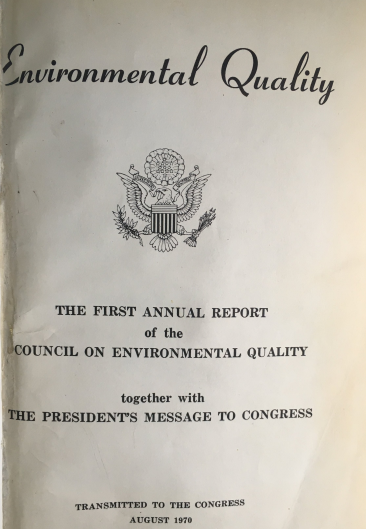
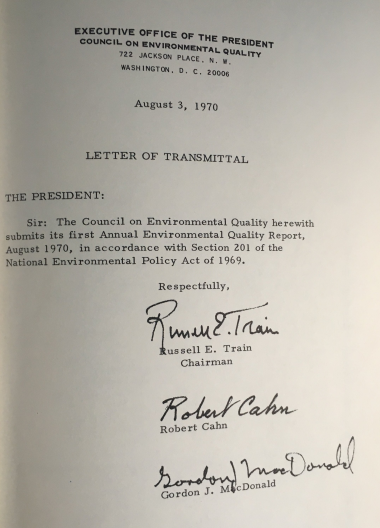
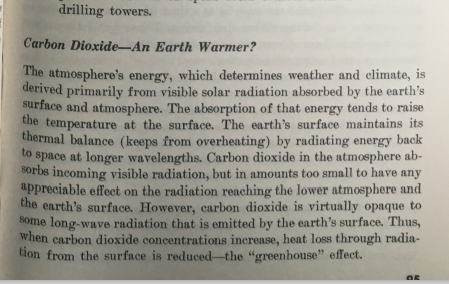
On this day, 3 August 1970, the first report of the Council on Environmental Quality was delivered to Preside Nixon. It contained a chapter on inadvertent weather modification, carbon dioxide build-up and icecaps melting. 

The CEQ had been set up as part of the legislative process that had gathered momentum under Johnson and come to fruition by late 1969.  

On this day the PPM was 324.69ppm

Now it is 421ish- but see here for the latest.

Why this matters. 

By early 1970s, folks were going “you know, this really might become a problem.”  By the mid-late 1970s the smarter ones dropped the “might”…

What happened next?

The CEQ didn’t return to the climate issue until Carter, best I can tell. And then Gus Speth, as its boss, got cracking with getting things moving, having been nudged by Gordon MacDonald and Rafe Pomerance of Friends of the Earth.

Gordon MacDonald had already been writing about this stuff (see his chapter in the Nigel Calder book). He would go on to be important in the fight against synfuels.

Categories
Science Scientists United States of America

July 23, 1979 – Charney Report people meet – will conclude “yep, global warming is ‘A Thing’.”

On this day, 23 July 1979, the  “Ad Hoc Study Group on C02 and Climate” begins at Woods Hole, giving us the  “Charney Report.”

Short version – a scientist (Gordon MacDonald) and a Friends of the Earth activist (Rafe Pomerance) had managed to get President Jimmy Carter’s science advisor (Frank Press) to get Carter to request a study on whether this “greenhouse effect” thing was gonna actually be the problem some were saying.

So folks met, under the leadership of one of the big original beasts of atmospheric science, Jule Charney.

And they came up with the view, “yes”.

See this excellent summary, written by Neville Nicholls, an Australian scientist

Here’s a flowery (but good) bit from Nathaniel Rich’s “Losing Earth”

The scientists summoned by Jule Charney to judge the fate of civilization arrived on July 23, 1979, with their wives, children and weekend bags at a three-story mansion in Woods Hole, on the southwestern spur of Cape Cod. They would review all the available science and decide whether the White House should take seriously Gordon MacDonald’s prediction of a climate apocalypse. The Jasons had predicted a warming of two or three degrees Celsius by the middle of the 21st century, but like Roger Revelle before them, they emphasized their reasons for uncertainty. Charney’s scientists were asked to quantify that uncertainty. They had to get it right: Their conclusion would be delivered to the president. But first they would hold a clambake.

They gathered with their families on a bluff overlooking Quissett Harbor and took turns tossing mesh produce bags stuffed with lobster, clams and corn into a bubbling caldron. While the children scrambled across the rolling lawn, the scientists mingled with a claque of visiting dignitaries, whose status lay somewhere between chaperone and client — men from the Departments of State, Energy, Defense and Agriculture; the E.P.A.; the National Oceanic and Atmospheric Administration. They exchanged pleasantries and took in the sunset. It was a hot day, high 80s, but the harbor breeze was salty and cool. It didn’t look like the dawning of an apocalypse.

Why this matters. 

“We” really knew enough by the late 70s. Everything since then has been footnotes.

What happened next?

Carter lost the 1980 election, handsomely. It would be another 8 years before the simulacrum of international action began.

Categories
Technophilia United States of America

 July 18, 1979 – US Senators ask for synthetic fuel implications for greenhouse warming. Told.

On this day, July 18, in 1979, Senator Abraham Ribicoff asked for some advice about “synfuels.”

The context was, the Carter Administration, desperate to reduce US dependency on problematic Middle Eastern Oil (not the dictatorships – that’s fine – it’s the interruptions to supply that’s the problem) was proposing an expensive crash program to develop synthetic fuels (synfuels).  These would be incredibly energy intensive to produce… Not everyone was convinced this was a good idea…

“In 1979  [Gordon] MacDonald wrote an article for the Washington Post arguing that subsidizing synthetic fuels, as proposed by the Carter administration, would be a mistake. He pointed out that synthetic fuels would produce even more CO2 than the current U.S. mix of fossil fuels. The article drew the attention of U.S. Senator Abraham Ribicoff (D-CT), who had recently been warned about the issue by West German Chancellor Helmut Schmidt” (Nierenberg et al. 2010: 324)

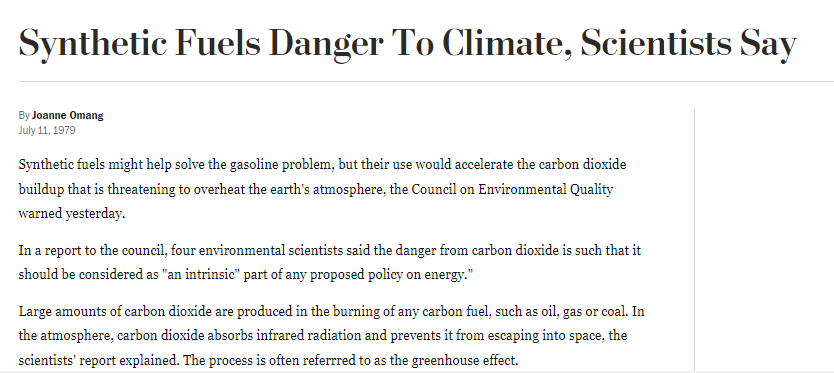
https://www.washingtonpost.com/archive/politics/1979/07/11/synthetic-fuels-danger-to-climate-scientists-say/bdbb20d2-a374-4b1c-bc82-10fb0feaf512/

MacDonald is quoted as saying

“Although many complex factors affect the climate, it is generally thought that the result of continued carbon dioxide production will be a warming of the atmosphere “that will probably be conspicuous within the next 20 years,” the report said. “If the trend is allowed to continue, climatic zones will shift and agriculture will be displaced.”

Gordon J. MacDonald, environmental studies professor ad Dartmouth College, who is one of the authors said in an interview that large-scale use of synthetic fuels — made from coal or oil shale — could cut the time involved by half.

“We should start seeing the effect in 1990 without synthetic fuels. . . . but if you use them, the effect would be much more pronounced by 1990,” he said.

[See also New York Times, also 11 July 1979]

Actually, unless I am missing something, Nierenberg et al. have got this wrong – and they don’t actually cite the “article in the Washington Post,” which is pretty poor form.

What Ribicoff appears to be responding to are articles in the Post and the Times about an actual report. This was to the Council on Environmental Quality. And it isn’t just Macdonald – “ the other authors of the report were George M. Woodwell, director of the Ecosystems Center of the Marine Biological Laboratory; Roger Revelle, a member of the National Academy of Sciences; and Charles David Keeling, professor of Oceanography of the Scripps Institute for Oceanography” (Shabecoff, 1979).

ANYWAY, that was the 11th, and this blog post is about the 18th.  And here we are – 

“One incident provides a small example of the work that the Academy does outside the formal structure of reports and out of public view. On July 18, 1979, even as the Charney panel was gathering at Woods Hole, the Academy’s president, Philip Handler, got a call from Senator Abraham Ribicoff. The Senator was cosponsoring a bill on synfuels, and he wanted to know the implications of greenhouse warming. Handler went to the National Research Council’s Climate Research Board, and the very next day, it produced a statement on carbon dioxide and energy policy. The statement confirmed that global warming could be a problem. The statement told Senator Ribicoff that the massive expenditures required to create a national synthetic fuels capability should not commit the nation to large-scale dependence on coal for the indefinite future. This is the first time that an Academy group issued a specific policy recommendation, ambiguous although it may be, related to global warming. Olson 2014 https://www.ncbi.nlm.nih.gov/pmc/articles/PMC4077050/

Why this matters. 

We. Knew. Never forget, we knew.

What happened next?

Synfuels got killed off by Reagan, along with a lot of good stuff. And we had to wait until 1988 to wake up. A decade lost (but then, we would have pissed it against the wall, I guess).

References:

Nierenberg, N. Tshinkel, W. and Tshinkel, V. (2010)  Early Climate Change Consensus at the National Academy: The Origins and Making of Changing Climate. Historical Studies in the Natural Sciences, Vol. 40, Number 3, pps. 318–349. [online here]

Olson, S. (2014) The National Academy of Sciences at 150. Proc Natl Acad Sci U S A. 2014 Jun 24; 111(Suppl 2): 9327–9364.
Published online 2014 Jun 23. doi: 10.1073/pnas.1406109111
Omang, J. (1979) Synthetic Fuels Danger To Climate, Scientists Say. Washington Post, 11 July.[online here]

Shabecoff, P. (1979) Scientists Warn U.S. Of Carbon Dioxide Peril. New York Times, 11 July