Categories
CO2 Newsletter commentary Guest post

Gus Speth – “the greatest dereliction of civic responsibility in the history of the Republic”

Gus Speth (read more about him here), very kindly wrote this to accompany the release of CO2 Newsletter Vol. 1, no. 5. (his testimony to a US Senate committee, in April 1980, is quoted extensively in it.)

Gus Speth

What does it mean that we knew enough over 50 years ago to begin serious action on climate change, and didn’t?  It certainly does not mean that the issue was forgotten or that the pleas for action were muted or that the problem was too uncertain. I recently wrote a book with MIT Press, They Knew: The U.S. Government’s 50-Year Role in Causing the Climate Crisis (2021), which disposes of those excuses. 

We can see now with some clarity that this failure, which in They Knew I referred to as the greatest dereliction of civic responsibility in the history of the Republic, was due and is still due to the confluence of several problematic factors. 

In the United States, we will never be able to go far enough, or fast enough, doing the right things on climate, as long as our political priorities are ramping up GDP, growing corporate profits, increasing the incomes of the already well-to-do, neglecting the half of America that is just getting by, encouraging unrestrained consumerism, facilitating great bastions of corporate and money power, and helping abroad only modestly or not at all.

These unfortunate factors and forces are all manifestations of a system of political economy that is not suited to today’s needs. Making the needed progress on climate change, and much else, requires an escape from the fetters of today’s system and an urgent transformation to a new—a next—political economy.

Of course, we must use today’s democracy, flawed though it be, to fight efforts seeking to rollback climate protections, to promote rapid deployment of both technology and policy to reduce greenhouse gas emissions, and to adapt to changes we cannot forestall. We must do our best in all these regards, but, beginning now, we must also start to build a new democracy that can address the climate crisis here and abroad with the authority needed—a climate-capable democracy.

Building a climate-capable democracy should proceed down two paths. First, today’s political reality cries out for many straightforward pro-democracy reforms. We know a lot about what is needed in this regard, including actions to shore up voting rights, protect election integrity, and otherwise greatly strengthen our democracy’s functioning.

Beyond such measures, however, deeper changes are needed. We need to recognize that democracy depends for its success on a great many factors in the social and economic spheres as well as the political. Consider the following ways our democracy is constrained today.

When economic inequality mocks political equality, democratic progress is difficult. When corporate power dwarfs people power, democratic progress is difficult. When money is the be all and end all of campaign success, democratic progress is difficult. When the voting public is subjected to repeated lies and endless misinformation and propaganda, democratic functioning is difficult. When future generations and the natural world are not accorded political rights, democracy is deprived and unrepresentative.

In short, there is much that must be done, both working within the current system and also building a new one. I am hopeful but by no means confident.

Gus Speth, 2026
Categories
Energy United States of America

October 20, 1970 – Memo about energy research required because power sector too fragmented

Fifty five years ago, on this day, October 20th, 1970, 

Dr Edward David memo to Nixon about federal government funding for energy research being necessary because power industry too fragmented. 

See Speth Ch 1 of They Knew

This isn’t the memo (I think), but gives the same flavour.

“On the other hand, in some cases projects are so large and the industry involved so fragmented that they are really unable to come to grips with big, expensive efforts where the risks are high and the payoff far in the future. Furthermore, many industries don’t have the R&D tradition. The tradition of R&D and the peculiar culture that surrounds it are necessary for its existence and its effectiveness. Some industries have not cultivated and have never had this tradition. It’s difficult and, indeed, almost impossible for them to begin R&D on a large scale successfully and without great waste of resources. In the next few years the nation is going to be faced with many problems concerning government action in certain R&D fields. The President decides whether a development is potentially so important that if industry doesn’t pick it up, then the Government must. He has made a number of those judgments, particularly in the environmental area. And we are doing a great deal of environmental research, for example, the unconventional automobile propulsion work at the National Air Pollution Control Administration. The question arises: Why should the Government be developing unconventional automobile engines why not the industry itself? Well, there is a delicate judgment there as to whether the Government ought to be doing such work. In this instance, we had judgments from many people both in and out of the industry that if the Government augmented the work, it would go forward a great deal more rapidly. I don’t see us taking over automotive R&D, however.”

Source – ED053968.pdf

The amount of carbon dioxide in the air was 326ppm. As of 2025, when this post was published, it is 425ppm. This matters because the more carbon dioxide in the air, the more heat gets trapped. The more heat, the more extreme weather events. You can make it more complicated than that if you want, but really, it’s not. Fwiw, I have a tattoo of the Keeling Curve on my left forearm.

The broader context was there were (as always) fierce debates going on about the “energy mix” (coal, nuclear, oil etc etc) for the US. Each had its proponents and opponents, with their varying tactics. But doing any sort of co-ordination/planning or even research is problematic in fragmented/privately owned situations.

The specific context was Nixon’s government was aware of climate change (Moynihan memo and response) and had been warned about it in the August 1970 CEQ report. But it was not high on the agenda.

What I think we can learn from this – that fragmented is not good, but centralised isn’t perfect either. Look at the UK, which at this time had the Central Electricity Generating Board, an “opaque behemoth.” 

Whatever system you have, you need an active/engaged/irrepressible civil society, of which social movements are a subset. Absent that, some brand of Bolshevik/Hayekian is going to pick your pocket and loot your future.

What happened next – the Bolsheviks and Hayekians continued to pick pockets and loot futures. And the emissions kept climbing, regardless of various “eco-awakenings.”

What do you think? Does this pass the ‘so what?’ threshold? Have I got facts wrong? Interpretation wrong? Please do comment on this post, unless you are a denialist, obvs.

Also on this day: 

October 20, 1977 – Australian petition on solar energy and carbon dioxide build-up…

October 20, 1983 – The Australian says “‘Dire consequences’ in global warm-up”. 

October 20, 1997 – Greenpeace tries to give John Howard solar panels

October 20, 2001 – Greenpeace nails Howard government over Kyoto and general climate assholery – All Our Yesterdays

Categories
United States of America

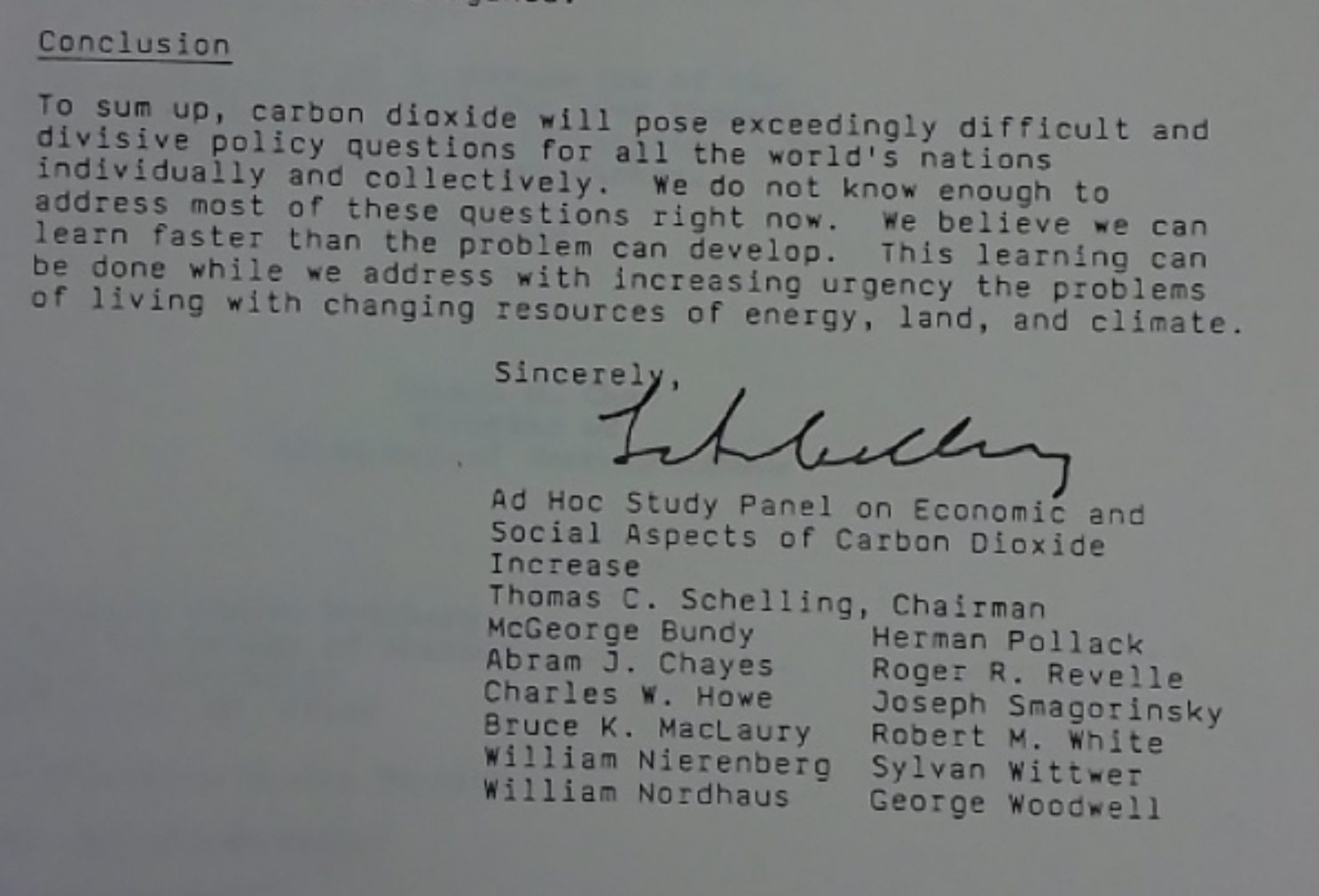
April 18, 1980 Ad Hoc Panel on Economic and Social Aspects of C02 increase reports back

Forty four years ago, on this day, April 18th, 1980, an Ad Hoc Panel of heavy hitters warned that there were not going to be ANY easy fixes for the carbon dioxide build-up issue. How right they were.

“We must recognize now that increases in energy consumption using fossil fuels will have increasingly undesirable climatic effects” NAS panel on “Economic and Social Aspects of Carbon Dioxide Increase” in letter to Dr Philip Handler, its president Cited by Speth in Global Energy Futures and Carbon Dioxide Problem ..

The amount of carbon dioxide in the air was roughly 338.7ppm. As of 2024 it is 425ppm, but check here for daily measures. 

The context was the various ad hoc panels and groupings of Department of Energy, the American Association for the Advancement of Science, IIASA etc were all pondering “well, what happens if the carbon dioxide emissions do keep climbing and the world does get warmer, what impact will that have geo politically and socially, economically?” 

What we always learn From the period of the late 70s we knew enough to be worried. And some people were worried. But idiots don’t worry(looking at you Ronald Reagan). 

What happened next? Growing concern largely came to a grinding halt when Reagan took office (It will be interesting to try to figure out who organised that 1982 conference on “carbon dioxide, science and consensus” and why).

What do you think? Does this pass the ‘so what?’ threshold? Have I got facts wrong? Interpretation wrong? Please do comment on this post, unless you are a denialist, obvs.

Also on this day: 

April 18, 1989 – begging letter to world leaders sent

April 18, 2013, Liberal Party bullshit about “soil carbon” revealed to be bullshit

Categories
United States of America

January 15, 1981 – US calls for effort to combat global environmental problems

Forty-three years ago, on this day, January 15th 1981, as the Reagan gang were about to take over, there was a plaintive plea…

Shabecoff, Philip. “U.S. Calls for Efforts To Combat Global Environmental Problems.” New York Times, January 15, 1981.

The amount of carbon dioxide in the air was roughly 340ppm. As of 2024 it is 422ppm, but check here for daily measures. 

The context 

This is the last throw of the dice for the Council on Environmental Quality under Jimmy Carter. It had done some good stuff. The CEQ staffer Gus Speth had spent the last four years trying to push climate up the agenda. There had also been the Global 2000 report, which was produced by a separate body. Carter had lost the November 1980 election to Reagan who literally does not give a damn about conserving anything but is keen for ever greater exploitation.

What we can learn from this is that we knew what needed to be done. And we kept electing people who didn’t want to do it because they appealed to our ego, or our greed or something. 

What happened next? Reagan came in and shat all over climate action, environment action. See James Watt, etc, etc. And the emissions kept climbing and it was 1988 before presidential candidates were forced to speak about it. (There’s a more interesting story of Republican senators like John Chafee and so forth, actually understanding what was at stake in the mid-80s.) And the journo who wrote this story, Shabecoff? He also wrote the June 24th 1988 story on Hansen.

What do you think? Does this pass the ‘so what?’ threshold? Have I got facts wrong? Interpretation wrong? Please do comment on this post, unless you are a denialist, obvs.

Also on this day: 

Jan 15, 1971 – greenwash before it was called greenwash #propaganda

January 15, 1990 – A political lunch with enormous #climate consequences for Australia #PathDependency #Denial