Forty five years ago, on this day, October 16th, 1981, the Financial Times reports on a warning by chief scientist of the Department of Energy, Hermann Bondi, about anti-nuclear protests and protestors.
The amount of carbon dioxide in the air was 339ppm. As of 2026, when this post was published, it is 430ppm. This matters because the more carbon dioxide in the air, the more heat gets trapped. The more heat, the more extreme weather events. You can make it more complicated than that if you want, but really, it’s not. Fwiw, I have a tattoo of the Keeling Curve on my left forearm.
The broader context was that the chief scientist at the Department of Energy, Herman Bondi, was very well aware of carbon dioxide build up, and didn’t want it to be a public issue per se. And he also wanted to try to win debates with the anti-nuclear crowd, and so here we see him reaching for the standard “you want black people to starve line,” which is pushed it out all the fucking time.
What I think we can learn from this – concern for the poor of the world is a tried and tested rhetorical flourish, from people who almost certainly do not give a rat’s arse.
What happened next ? Nuclear for dealing with greenhouse gas became a talking point again in 1988-89 and it’s still there to this day.
xxx
On this topic, you might like these other posts on All Our Yesterdays
Xx
References
xx
You can see the chronological list of All Our Yesterdays “on this day” posts here.
What do you think? Does this pass the ‘so what?’ threshold? Have I got facts wrong? Interpretation wrong? Please do comment on this post, unless you are a denialist, obvs.
If you want to get involved, let me know.
If you want to invite me on your podcast, that would boost my ego and probably improve the currently pitiful hit-rate on this site (the two are not-unrelated).
The thirteenth edition of the CO2 Newsletter, (Vol. 3, no. 1, Nov-Dec 1981) published bi-monthly by American geologist William N. Barbat between 1979 and 1982 is live. You can download a pdf and see the full text here – CO2 Newsletter Vol 3, No 1
The eight page issue has a front page story pointing out that “CO2 Continues Skyward” and that the Antarctic ice was shrinking and the Arctic warming.
Yes, 1981, before many of you doomed-youth were born.
Read it and boggle at Barbat’s prescience and hard-graft. That he failed to warn us all was not on him. Goddam what a bunch of hairless murder apes (feeling particularly doomy at mo, ignore me).
The rest of the issue is what you’ll have come to expect – quotes, carefully curated excerpts of recent reports. All horrible stuff to read in 2026, but you have to admire the man’s efforts.
Forty five years ago, on this day, August 24th, 1981,
The amount of carbon dioxide in the air was 340ppm. As of 2026, when this post was published, it is 430ppm. This matters because the more carbon dioxide in the air, the more heat gets trapped. The more heat, the more extreme weather events. You can make it more complicated than that if you want, but really, it’s not. Fwiw, I have a tattoo of the Keeling Curve on my left forearm.
The broader context was UK newspapers had been reporting on climate change intermittently since really the late 1960s/early 70s, and the Telegraph, which leaned right, had even had done a puff piece with German meteorologist Herman Flohn around the First World Climate Conference. The Telegraph wasn’t completely batshit at this point.
Thespecificcontext was that a study had appeared in Science magazine by James Hansen et al about CO2 build up, and the Telegraph was diligently reporting it.
What I think we can learn from this is that we shouldn’t judge today’s terrible so-called newspapers, as the metric of what they always were. They have been hollowed out, they have been demented. They were, they were right wing, but serious. You could still learn something from them, I suppose. You still can at the margins if you try really hard. Who’s got the time, though?
What happened next is that Hansen was punished by the Reagan administration, which took away a grant that had already been disbursed, meaning people lost their jobs, people who had relocated to take jobs. Hansen persisted, of course, and famously gave his testimony in 1988 that it was “time to stop waffling and say that the greenhouse effect was here.” (Well, that wasn’t in his testimony, that was in his comments to journalists afterwards.) The Telegraph began a long, slow, painful slide into utter crass idiocy, not even a shadow of its former self.
References
xx
You can see the chronological list of All Our Yesterdays “on this day” posts here.
What do you think? Does this pass the ‘so what?’ threshold? Have I got facts wrong? Interpretation wrong? Please do comment on this post, unless you are a denialist, obvs.
If you want to get involved, let me know.
If you want to invite me on your podcast, that would boost my ego and probably improve the currently pitiful hit-rate on this site (the two are not-unrelated).
The amount of carbon dioxide in the air was 340ppm. As of 2026, when this post was published, it is 430ppm. This matters because the more carbon dioxide in the air, the more heat gets trapped. The more heat, the more extreme weather events. You can make it more complicated than that if you want, but really, it’s not. Fwiw, I have a tattoo of the Keeling Curve on my left forearm.
The broader context was that from the early 1950s, when Gilbert Plass (building on the work of Arrhenius and Callendar) pointed out that burning fossil fuels would lead to sea-level rise etc, scientists (many American, but also other nations) had been beavering away. By the mid-late 1970s, it was all become clear enough for scientists to be going puce.
The specific context was the first World Climate Conference had happened in Geneva, and a flurry of meetings and conferences was also taking place. Those in the know, knew.
What I think we can learn from this – we can’t say we were not warned.
What happened next – more emissions, higher concentrations. We slipped into the Fafocene without even really understanding it.
On this topic, you might like these other posts on All Our Yesterdays
You can see the chronological list of All Our Yesterdays “on this day” posts here.
What do you think? Does this pass the ‘so what?’ threshold? Have I got facts wrong? Interpretation wrong? Please do comment on this post, unless you are a denialist, obvs.
If you want to get involved, let me know.
If you want to invite me on your podcast, that would boost my ego and probably improve the currently pitiful hit-rate on this site (the two are not-unrelated).
For years there have been doomsday predictions that burning of fossil fuels might bring about a climatic catastrophe. According to the most alarming theories, fossil fuels release carbon dioxide into the atmosphere where it acts as a greenhouse, blocking the escape of heat into space and thus warming the Earth’s surface. The ice caps could melt, sea levels could rise, agriculture could be disrupted and vast coastal areas might be inundated.
The chief weakness in such theories has been lack of evidence that the greenhouse effect is actually occurring. Though carbon dioxide in the atmosphere has been increasing, temperatures in the Northern Hemisphere have been falling over the last 30 years. But now seven scientists from the National Aeronautics and Space Administration claim to have found evidence that, on a global basis, carbon dioxide has already been warming the Earth for a century. They predict it will produce ”unprecedented” warming in the next century.
Their study finds that the warming predicted by various computer models of the greenhouse effect is consistent with worldwide temperature readings since 1880 – and with observations from Venus and Mars. That gave them confidence that the effect is real and that the models can predict it. Other scientists will challenge their assumptions, methods and conclusions. Some actually believe that the greenhouse effect would be beneficial to world agriculture. Conclusive observations may not be available for decades. But it is significant that a respected team of scientists has now joined the group warning of possible catastrophe.
What, if anything, should be done? The nation seems to be turning to the worst possible fuels in terms of carbon dioxide. It is depending less on solar and nuclear power, which emit no carbon dioxide at all. And among the fossil fuels, it is shifting from natural gas and oil, which emit little carbon dioxide, to coal and synthetic fuels, which emit much more.
The greenhouse effect is still too uncertain to warrant total alteration of energy policy. But this latest study offers fair warning; that such a change may yet be required is no longer unimaginable.
The amount of carbon dioxide in the air was 340ppm. As of 2025, when this post was published, it is 430ppm. This matters because the more carbon dioxide in the air, the more heat gets trapped. The more heat, the more extreme weather events. You can make it more complicated than that if you want, but really, it’s not. Fwiw, I have a tattoo of the Keeling Curve on my left forearm.
The broader context was that the New York Times, and other papers, had been reporting on carbon dioxide build-up, quite intermittently, since the 1950s.
The specific context was that the Reagan administration was busy attacking science. The New York Times’ science correspondent, Walter Sullivan, had talked to James Hansen, which ended up costing some funding. See this 2007 interview with Hansenhttps://www.pbs.org/wgbh/pages/frontline/hotpolitics/interviews/hansen.html.
Why do you think that your testimony in particular was sensitive in the [Reagan] administration, so much so that OMB would want to shade what you were saying?
Well, I think the reason it was sensitive was the fact that it got attention. In 1981 the paper that we wrote in Science — that predicted that the world would be getting warmer over the 1980s and that by the year 2000 you begin to see loss of sea ice and eventually you have opening of the fabled Northwest Passage — that article was reported on the front page of The New York Times by Walter Sullivan. As a result, we lost our funding from the Department of Energy, because, in that administration, they simply did not want that sort of attention to this problem, because it has big implications for fossil fuel industry.
What I think we can learn from this is that we knew enough and we didn’t act. We can stick that on our tombstone.
What happened next – it would be 1988 before politicians would have to start to pretend to give a damn.
What do you think? Does this pass the ‘so what?’ threshold? Have I got facts wrong? Interpretation wrong? Please do comment on this post, unless you are a denialist, obvs.
The effect of overlapping of atmospheric H2O, CO2 and O3 absorption bands on the radiation budget perturbation caused by CO2 doubling is investigated. Since the effect depends on the amount of gases in the atmosphere as well as on the strength of the absorption bands, we examine the effect associated with the variation of gas abundance using a narrow band representation for the absorption bands. This band representation allows for the absorption band structure and thus accounts for the correlation of the spectral feature of the absorbing gases.
It is found that the presence of H2O and O3 has a relatively small influence on the CO2-induced perturbation of both solar and thermal radiation in the stratosphere. However, in troposphere and surface, the overlapping effect appears to be quite significant and changes the vertical distribution of the CO2-induced radiation energy perturbation. For example, in the infrared, the effect is to reduce the effectiveness for CO2 to emit and in the mean time increases the tropospheric absorption of downward thermal flux from the stratosphere due to CO2 increase; the net effect of the overlapping of gases is to increase the tropospheric warming and decrease the surface warming caused by CO2 increase. It is also found that the overlapping effect exhibits strong seasonal and latitudinal variations due primarily to variations in atmospheric H2O.
The amount of carbon dioxide in the air was 340ppm. As of 2025, when this post was published, it is 430ppm. This matters because the more carbon dioxide in the air, the more heat gets trapped. The more heat, the more extreme weather events. You can make it more complicated than that if you want, but really, it’s not. Fwiw, I have a tattoo of the Keeling Curve on my left forearm.
The broader context was that by the early 1980s there was a noticeable uptick in the number of scientific papers examining the likely consequences of a lot more carbon dioxide in the atmosphere. Because we were putting a lot more carbon dioxide into the atmosphere, and showed no signs of wanting to stop, or even thinking that stopping might be a good idea.
The specific context was – aftermath of the First World Climate Conference, the Global 2000 report etc…
What I think we can learn from this is that we knew plenty, almost 50 years ago.
What happened next – it would be 1988 before the issue “broke through.”
What do you think? Does this pass the ‘so what?’ threshold? Have I got facts wrong? Interpretation wrong? Please do comment on this post, unless you are a denialist, obvs.
Forty four years ago, on this day, July 31st, 1981, American politicians held hearings on,
“Carbon Dioxide and Climate, the Greenhouse Effect”
Hearing Before the Subcommittee on Natural Resources, Agriculture Research, and Environment and the Subcommittee on Investigations and Oversight of the Committee on Science and Technology, U.S. House of Representatives, Ninety-seventh Congress, First Session, July 31, 1981
The amount of carbon dioxide in the air was 340ppm. As of 2025, when this post was published, it is 430ppm. This matters because the more carbon dioxide in the air, the more heat gets trapped. The more heat, the more extreme weather events. You can make it more complicated than that if you want, but really, it’s not. Fwiw, I have a tattoo of the Keeling Curve on my left forearm.
The broader context was that through the 1970s scientists – including American ones – had been studying the carbon dioxide build-up issue and become increasingly alarmed. There had been the First World Climate Conference in Geneva, in February 1979. More scientific work was being done, and there wasn’t much doubt among those studying the issue – there was trouble ahead.
The specific context was that some politicians (Paul Tsongas, Al Gore – who’d been taught by Roger Revelle at Harvard) got it. And at this point, it really had not become a culture war issue – the culture war thing happened thanks to deliberate efforts by incumbents (see Ross Gelbspan’s books on this).
What I think we can learn from this is that we could have begun to take climate action in the early 1980s. But we didn’t. And we in fact never have. And here we are.
What happened next A 1985 scientific meeting in Villach, Austria, led to scientists making bigger efforts to inform politicians and policymakers. In 1988, the issue “broke through.”
What do you think? Does this pass the ‘so what?’ threshold? Have I got facts wrong? Interpretation wrong? Please do comment on this post, unless you are a denialist, obvs.
Forty four years ago, on this day, June 8th, 1981, a workshop began. What was it on? Well
“The First Detection of Carbon Dioxide Effects:” Workshop Summary 8-10 June 1981,
Stable URL: https://www.jstor.org/stable/26223159
The amount of carbon dioxide in the air was roughly 340ppm. As of 2025 it is 430ppm, but check here for daily measures.
The broader context was that from the mid-1970s onwards, scientists were beginning to look closely at what rising carbon dioxide levels would ultimately do. Various scientific bodies (NCAR, National Academy of Science, AAAS, Swedish outfits) were looking closely. The 1979 First World Climate Conference, hosted by the World Meteorological Organisation, could have set the ball rolling, but there was blockage from the likes of John Mason of the UK Met Office.
The specific context was that various American scientists were pushing ahead.
What I think we can learn from this
As human beings is that our systems for finding out about the world aren’t bad. Our systems for stopping damaging it, they needed some work.
As “active citizens” is that there’s not much mileage in just adding “more science” to the recipe for social change. We tried that.
Academics might like to ponder their role in all this.
What happened next – The scientists kept science-ing. By 1985 they were alarmed enough – and had credibility from ozone – to start shouting.
What do you think? Does this pass the ‘so what?’ threshold? Have I got facts wrong? Interpretation wrong? Please do comment on this post, unless you are a denialist, obvs.
You can see the chronological list of All Our Yesterdays “on this day” posts here.
What do you think? Does this pass the ‘so what?’ threshold? Have I got facts wrong? Interpretation wrong? Please do comment on this post, unless you are a denialist, obvs.
If you want to get involved, let me know.
If you want to invite me on your podcast, that would boost my ego and probably improve the currently pitiful hit-rate on this site (the two are not-unrelated).
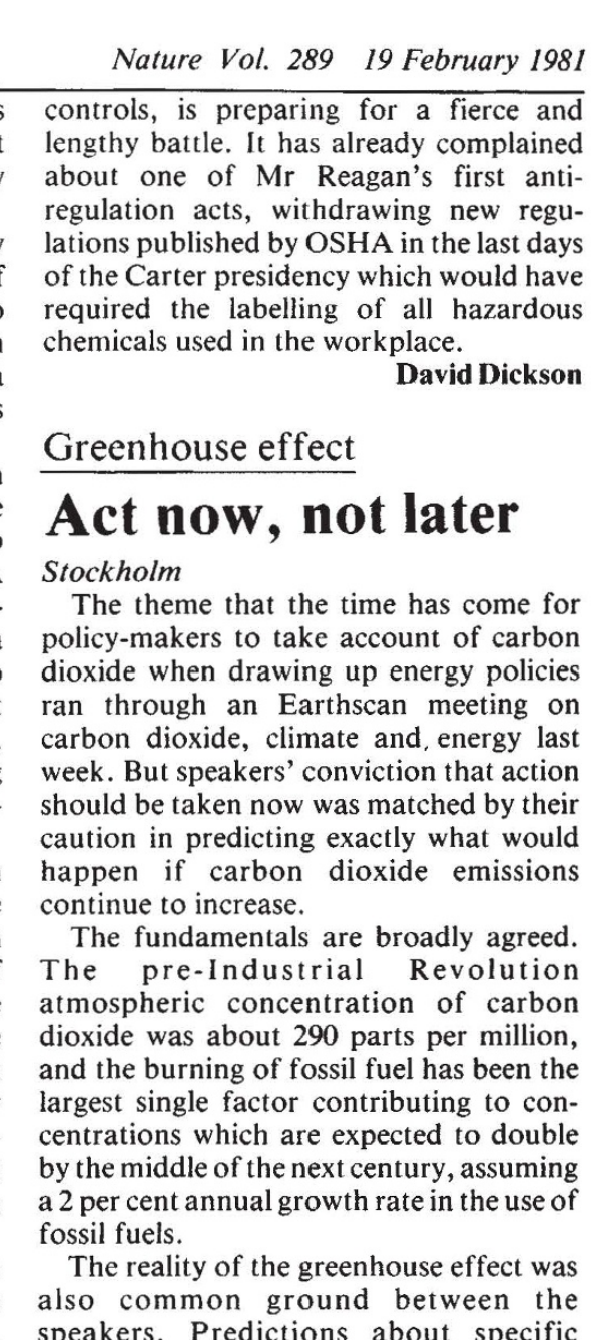
Forty four years ago, on this day, February 19th, 1981, Nature publishes an article, by Wendy Barnaby, about an Earthscan meeting the previous week in Stockholm,
The amount of carbon dioxide in the air was roughly 340ppm. As of 2025 it is 427ppm, but check here for daily measures.
The context was that the OECD and the IEA – and other bodies – were beginning to hold meetings about energy and environment and especially climate, in the context of the second oil shock the tail end of the 70s, thanks to the overthrow of the Shah.
The other context was that the United States Council on Environmental Quality had been trying to get things moving, but now Reagan was present with his goons, (and see the end of the article before the greenhouse one in the screengrab above! – it all looked a little unsure about what would happen.
And this is also in the context of the First World Climate Conference, which had taken place in February of 1979, Nature had an interesting relationship with carbon dioxide build up, shall we say, with its erstwhile editor, John Maddox, being a vehement opponent of the theory up until and including 1987 (he seems to have climbed down from this by 1995).
What I think we can learn from this is that in the late 70s, early 80s, there was a flurry of activity, awareness, and slowly growing consensus.
What happened next There was a flurry of reporting in New Scientist, the FT etc. A documentary, “Warming Warning”, by Richard Broadwas broadcast the end of that year, in part inspired by this report in Nature and other accounts.
On this day 44 years ago, (February 19, 1981) two newspapers (the Shepton Mallet Journal and the Central Somerset Gazette) reported on a meeting of the Ecology Party (now known as the Green Party). The topic? Carbon dioxide build-up and its implications.
IN THE time it takes to read this sentence, 3,000 more tons of carbon dioxide will have been released into the atmosphere.
This was just one of the astonishing statistics quoted by Mr. Fred Clarke. guest speaker at a meeting of Wells Constituency Ecology Party at the Good Earth Cafe, Wells..
He showed that pollution was more than a mere nuisance; it was a threat to the natural systems on which we depended for survival.
He demonstrated how most pollution was caused by our everyday actions rather than Torrey Canyon-like disasters. and suggested practical ways to avoid pollution. [continues].
The amount of carbon dioxide in the air was roughly 340ppm. As of 2025 it is 427ppm, but check here for daily measures.
The context was that the previous year the UK government had decided not to keep close tabs on carbon dioxide build-up (there were some scientists urging closer engagement). But the question of carbon dioxide build-up was well understood in environmental circles.
What we learn is that the Ecology Party was doing this sort of thing a lot. They knew what was coming.What happened next was that the scientific certainty that there was Serious Trouble Ahead grew, and in 1988 Margaret Thatcher was finally, nine years after she had first been briefed on the topic and had dismissed it, forced to acknowledge its existence.