Sixty two years ago, on this day, September 3rd, 1963, at the meeting of the British Association for the Advancement of Science at Aberdeen on the morning of September 3, Ritchie Calder gave a speech on “Man and his Fellow Lodgers; a Question of Co-existence”.
Discharge of combustion products into the atmosphere had increased its content of carbon dioxide by 10 per cent in a century. The ‘green house effect’ could be expected to increase average mean temperature by 3·6° C in the next 40-50 years. This would radically affect the extent of glaciers and ice-caps with resultant rise in sea- and river-levels and increasing precipitation.
The amount of carbon dioxide in the air was 319ppm. As of 2025, when this post was published, it is 430ppm. This matters because the more carbon dioxide in the air, the more heat gets trapped. The more heat, the more extreme weather events. You can make it more complicated than that if you want, but really, it’s not. Fwiw, I have a tattoo of the Keeling Curve on my left forearm.
The broader context was that Ritchie-Calder had known about the carbon dioxide problem from at least 1954 (possibly earlier). He had written an article in the News Chronicle, as their science correspondent in 1954.
The specific context was that in March 1963 the Conservation Foundation had held a one-day conference in New York. Frank Fraser-Darling was there, and may have alerted Ritchie-Calder, who was already aware of the issue (he wrote a newspaper article in 1954).
What I think we can learn from this is that members of the British scientific elite were informed about the possibility by the early 1960s (some earlier, obviously).
What do you think? Does this pass the ‘so what?’ threshold? Have I got facts wrong? Interpretation wrong? Please do comment on this post, unless you are a denialist, obvs.
Fifty six years ago, on this day, May 17th, 1969, Lord Ritchie Calder makes his warning again…
“Degradation of the Environment at Centre for Continuing Education, University of Chicago, 15-17th May 1969”
“With this combination fish are migrating, changing even their latitudes. On land the snow-line is retreating, the permafrost line in Siberia as well as in the Western Hemisphere is being altered and the glaciers are melting. In Scandinavia, land which was perennially under snow and ice are melting and the arrow heads of over 1,000 years ago when the black earth was last exposed have been found. I am advising all my friends in Britain not to take 99 year leases on properties at present sea-level.”
The amount of carbon dioxide in the air was roughly 324ppm. As of 2025 it is 430ppm, but check here for daily measures.
What I think we can learn from this is that smart people knew. But as per Schiller “against stupidity, the gods themselves contend in vain”.
What happened next Calder warned and warned (see his “Mortgaging the Old Homestead,” article and his 1975 interview on The Science Show). His son Nigel made a documentary that basically warned of a new Ice Age (The Weather Machine). Calder died in 1982, before the world “woke up”…
xxx
What do you think? Does this pass the ‘so what?’ threshold? Have I got facts wrong? Interpretation wrong? Please do comment on this post, unless you are a denialist, obvs.
Seventy years ago, on this day, March 2nd, 1954, Peter Ritchie Calder, the Scottish public intellectual, wrote about carbon dioxide build-up for a popular audience, in a major British newspaper.
It is happening: but authorities are not agreed why.
One popular theory is carbon dioxide in the air.
Normally air contains only 0.03 per cent of this gas, which acts like greenhouse glass. It lets the sun’s rays through to heat the ground and then traps this radiant heat, which remains to warm air and ground.
Experiments indicate there is a tenth more carbon dioxide in the atmosphere than 50 years ago. This could account for that 2 deg. F. rise.
But why has it increased? Is it man-made? It is estimated that each year 6,000 million tons of carbon dioxide pour into the atmosphere from burning coal.
Ritchie-Calder, P. (1954) Who Said it’s getting colder! News Chronicle, 2 March, p.4.
The amount of carbon dioxide in the air was roughly 314ppm. As of 2024 it is 425ppm, but check here for daily measures.
The context was that in May 1953, Canadian physicist Gilbert Plass had made an announcement at the American Geophysical Union meeting about the consequences of CO2 buildup, although it got no attention in the quality British dailies. Someone like Peter Richie Calder, who was extremely scientifically literate and hooked into UNESCO would have known about it. The timing indicates that this might come from an early read of a UNESCO Courier article by Gerald Wendt.
What I think we can learn from this is that readers of a newspaper like the News Chronicle, which was left-wing-ish were introduced to the idea of carbon dioxide buildup as early as 1954, 70 years ago.
What happened next
Richie-Calder kept being a public intellectual and kept warning about climate change. Three examples will suffice. In 1963 he talked to the Town and Country Planning Association. He had carbon dioxide buildup as one of the possible mechanisms for how on earth his presidential address to the Conservation Society in November 1968. And then, very shortly after that, he had an interview with a BBC researcher for Horizon “Muck Today, Poison tomorrow”, where he also raised the CO2 issue.
What do you think? Does this pass the ‘so what?’ threshold? Have I got facts wrong? Interpretation wrong? Please do comment on this post, unless you are a denialist, obvs.
Sixty two years ago, on this day, August 21, 1961, a United Nations conference on new sources of energy began.
21-31 August 1961 UN conference on new sources of energy (see Ritchie-Calder, Bulletin of the Atomic Scientists, Dec 1961)
Also his comments on 1975 30 August Science show. (interviewed by Robyn Williams)
The amount of carbon dioxide in the air was roughly 331ppm. As of 2023 it is 423ppm, but check here for daily measures.
The context was that new sources of energy especially for countries without their own supplies of oil, coal and gas were going to be needed if the world were going to “develop”. There was also the point that fossil fuel supplies were not going to last forever. Climate change was not an issue, at least not one that was publicly discussed and I doubt it got much traction anywhere, because the science was simply not mature enough or well enough known.
What I think we can learn from this is that questions about energy justice have been around for a very long time and we never quite manage to crack it, really.
What happened next, by 1968 environmental problems were obvious enough that Sweden was successful in getting the UN to agree to hold a conference. And one of the topics was what we now call “climate change.”
What do you think? Does this pass the ‘so what?’ threshold? Have I got facts wrong? Interpretation wrong? Please do comment on this post, unless you are a denialist, obvs.
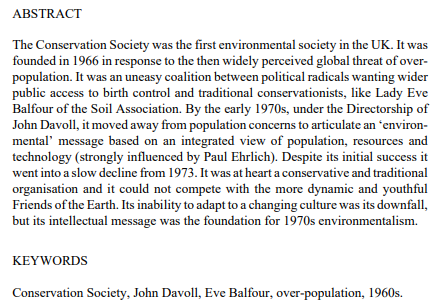
On this day, November 23, 1968 Lord Ritchie Calder gave a presidential address to the Conservation Society (a British NGO from the mid 60s to the late 1980s). Its cheerful title? Hell Upon Earth.
And among the litany of dangers ahead, this on climate change….
“It has been estimated that, at the present rate of increase (6,000 million tonnes a year) mean annual temperature all over the world might increase by 3.6 degrees centigrade in the next forty to fifty years, The experts may argue about the time factor and even about the effects but certain things are apparent, not only in the industrialised northern hemisphere but in the southern hemisphere. The north-polar ice-cap is thinning and shrinking. The seas with their blanket of carbon dioxide are changing their temperature with the result that marine plant life is increasing and is transpiring more carbon dioxide. With this combination fish are migrating, changing even their latitudes. On land the snow line is retreating and glaciers are melting.”
Calder’s speech wsa reported in the New York Times on the 24th
“Hell on Earth” NYT article – LONDON, Nov. 23 — Lord Ritchie-Calder, president of the Conservation Society, painted a gloomy picture today of the future of the world because too many “ignorant men are pretending to be knowledgeable.”
And in the Observer by John Davy
[The amount of carbon dioxide in the atmosphere was 323ppm. At time of writing it was 417ishppm- but for what it is now,well, see here for the latest.]
Why this matters.
I used to think that unless you were particularly switched on, then climate change wasn’t really on your radar until 1988. Then I pushed that back to the late 1970s… then…
What happened next?
Calder kept at it – see his widely-syndicated “Selling off the Old Homestead”, originally in Foreign Affairs, in January 1970
We need to remember that organizations come and go, and are creatures of their time, and can be “trapped” – by their own cognitive and emotional settings, by others expectations and perceptions of them. A little like humans themselves, donchathink?
What happened next?
The Conservation Society was influential and important in the late 60s – we will come back to the 1968 lecture by Ritchie Calder. Its apogee was 1971-2, when it hosted a conference with Paul Ehrlich as a guest speaker. Its decline in influence through the 1970s and 80s (it was wound up in 1987) was tied to the rise of groups like Friends of the Earth and The Ecology Party (aka The Green Party), not tied to population concerns and not perceived as old, white and conservative.