Categories
Scientists United States of America

June 20, 2005 – RIP Charles Keeling

Twenty years ago, on this day, June 20th, Charles Keeling (known as Dave) died.

The amount of carbon dioxide in the air was roughly 382ppm. As of 2025 it is 430ppm, but check here for daily measures. 

The context was Keeling had first measured atmospheric carbon dioxide levels for a Californian body funded by oil companies (see the great work of Rebecca John). He’d then done it for Roger Revelle as part of the International Geophysical Year. He spent the rest of his life measuring CO2 and warning people about the implications of the build-up.

See 1969 speech- April 25, 1969 –  Keeling says pressured not to talk bluntly about “what is to be done?” – All Our Yesterdays

What I think we can learn from this – the scientists did their job.  The media, the politicians, the “leaders” of social movement organisations?  Not so much.

What happened next – the emissions have kept on climbing, of course. 

What do you think? Does this pass the ‘so what?’ threshold? Have I got facts wrong? Interpretation wrong? Please do comment on this post, unless you are a denialist, obvs.

Also on this day: 

June 20, 1977- “Alternative Three” – An early Climate Hoax  – All Our Yesterdays

June 20, 1979 – Jimmy Carter installed solar panels on the White House – All Our Yesterdays

Categories
Uncategorized

June 20, 1997 – Australia versus the world on climate change

Twenty eight  years ago, on this day, June 20th, 1997,

Australian diplomats in Washington were asked to seek evidence casting doubt on US forecasts of the cost of fighting climate change – because they present a much rosier picture than Australia’s own estimates. Canberra’s reaction to the American economic modelling is contained in confidential cablegrams between the Department of Foreign Affairs and Trade and its embassy in Washington, which unveil Australia’s campaign against the greenhouse push by the US President, Mr Clinton.

Lobbying in the US has been intensifying ahead of the decisive climate change convention in Kyoto in December, where Australia fears that legally binding, uniform targets to cut greenhouse gas pollution will be set for developed nations.

The American “interagency modelling” estimates that Australia’s economic output would fall by only one-third of what Australia predicts if greenhouse gas emissions – which are causing global warming – are held to 1990 levels in 2010.

The interagency modelling says Australia would suffer less loss than West European nations and Canada, which is the reverse of the forecasts by the Australian Bureau of Agricultural and Resource Economics (ABARE).

“The US estimates understate the costs of climate change control to Australia both in absolute terms and relative to other countries,” says one cablegram dated June 20.

It asks the Washington embassy to investigate why all of the “peer reviewers” have not “signed off” on the modelling report. This is despite ABARE having declined to release peer reviews of its own modelling.

1997 Hogarth, M. 1997. Diplomats Told To Find Holes In Climate Figures. Sydney Morning Herald, 28 August, p.9.

The amount of carbon dioxide in the air was roughly 365.7ppm. As of 2025 it is 430ppm, but check here for daily measures. 

The broader context was that Australia had shifted from relatively enthusiastic and credible on environmental issues (whaling, the Antarctic, ozone and – initially – carbon dioxide) to near pariah state. The rot had begun under Labor Prime Minister Paul Keating, and accelerated slightly (or more) under Liberal Prime Minster John Howard.

The specific context was that Australia had agreed to turn up at the third Conference of the Parties (COP) with a plan to reduce its emissions. That had been under Keating. Howard was in no mood to follow through, and came out swinging.

What I think we can learn from this is that Howard is a climate criminal and it is not too late to get him to the Hague.  Also, economic modelling is mostly a sick joke.

What happened next is that Australia extorted a de jure “reduction” target of 108% of its 1990 emissions at Kyoto. De facto, thanks to an absurd “land-clearing clause” that negotiators were too exhausted to push back against, it was closer to 130%.  

What do you think? Does this pass the ‘so what?’ threshold? Have I got facts wrong? Interpretation wrong? Please do comment on this post, unless you are a denialist, obvs.

Also on this day: 

June 20, 1977- “Alternative Three” – An early Climate Hoax  – All Our Yesterdays

June 20, 1979 – Jimmy Carter installed solar panels on the White House – All Our Yesterdays

Categories
Activism United Kingdom

June 20, 1995 – Shell raises the white flag in Brent Spar battle

Thirty years ago, on this day, June 20th, 1995, Shell surrenders in the Battle of Brent Spar

See this from Greenpeace’s 1995 Annual Report

The amount of carbon dioxide in the air was roughly 363ppm. As of 2025 it is 430ppm, but check here for daily measures. 

The broader context was that there had been a decent run of “environmental successes” (if you squint) over the previous decade, most memorably on ozone. And a “convention” on climate change (squint a LOT, ‘kay?).  But the oil companies never sleep, and were looking for a cheap way of disposing of dozens/hundreds of old oil rigs. If they could get one done, then, well, the precedent is established, isn’t it?

What I think we can learn from this was that this was about the last time TNCs (transnational corporations) were under the cosh of the ENGOs (environmental non-governmental organisations)  (Though I’d happily be corrected).

What happened next.  The greenwashing and the lobbying kicked into higher gear. The emissions kept climbing. We are so fubarred.

What do you think? Does this pass the ‘so what?’ threshold? Have I got facts wrong? Interpretation wrong? Please do comment on this post, unless you are a denialist, obvs.

Also on this day: 

June 20, 1977- “Alternative Three” – An early Climate Hoax  – All Our Yesterdays

June 20, 1979 – Jimmy Carter installed solar panels on the White House – All Our Yesterdays

Categories
United States of America

June 19, 1989 – George Brown speech to Student Pugwash

Thirty six years ago, on this day, June 19th, 1989  Senator George Brown gave a speech to Student Pugwash, and reminisced about his 1976 hearings.

“Faced with these conflicting predictions, in 1976, as Chairman of the House Subcommittee on the Environment and the Atmosphere, I convened the first congressional hearings ever to discuss the issue of climate research. Over the course of two weeks, our Subcommittee received testimony of relevance to a bill that some of my colleagues and I had introduced to coordinate and improve national climate research efforts. In large part as a result of those hearings, we succeeded in passing in 1977 the National Climate Program Act. Passage of that legislation was a classic example of how politicians tend to deal with scientific uncertainty: we initiate efforts to study the problem further.”

The amount of carbon dioxide in the air was roughly 353ppm. As of 2025 it is 430ppm, but check here for daily measures. 

The broader context was that the Greenhouse Effect had been “discovered” by the media and was omni-present. There were these sorts of “inter-generational” efforts going on…

What I think we can learn from this is that explaining the broad sweep, the patterns and the repetitions, is really hard, especially when we all want a simple victory narrative with us near the centre…

What happened next  The wave of concern crested by 1992, and the defeat of the proposal for targets and timetables in the text of the UNFCCC was, in retrospect, the last nail in the coffin for our species and so so many others. Oh well.

What do you think? Does this pass the ‘so what?’ threshold? Have I got facts wrong? Interpretation wrong? Please do comment on this post, unless you are a denialist, obvs.

Also on this day: 

June 19, 1997/2009 – children of colour used as propaganda tools by #climate wreckers/greens do “motherhood” – All Our Yesterdays

Categories
Activism United Kingdom

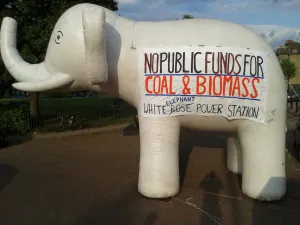
June 18, 2015 – Power station petition

Ten years ago, on this day, June 18th, 2015,

PRESS RELEASE: Power station petition signed by over 110,000 to be handed to DECC by giant White Elephant

Jun 17, 2015 | Press Releases

When: 8:30-9:30, Thursday 18th June 2015

Where: DECC offices, 3 Whitehall Place, London SW1A 2AW

Who: Biofuelwatch, London Mining Network & Care2 Petitions https://londonminingnetwork.org/2015/06/pr-biofuelwatch-white-elephant/

“The UK Government is expected to make an imminent announcement of a grant of up to £1 billion to a coal power station ‘carbon capture’ project by a consortium including Drax Plc, owners of the UK’s largest power station [1]. In response to this, campaign groups Biofuelwatch, London Mining Network and US-based Dogwood Alliance, started a Care2 petition [2] against public support for the new power station, which was signed by over 113,000 people. Campaigners plan to deliver it to the Department of Energy and Climate Change with the aid of Rosie, a giant inflatable White Elephant.”

The amount of carbon dioxide in the air was roughly 403ppm. As of 2025 it is 430ppm, but check here for daily measures. 

The broader context was that carbon capture and storage was close to getting some money…

What I think we can learn from this is that not every technofix arrives on time…

What happened next  The second competition for CCS funding fell over and was followed by a  long process of the shards of the Ming Vase being put together again, and then waiting for a long time…

What do you think? Does this pass the ‘so what?’ threshold? Have I got facts wrong? Interpretation wrong? Please do comment on this post, unless you are a denialist, obvs.

Also on this day: 

June 18, 1976- UK Meteorological Office explains things to Cabinet Office – All Our Yesterdays

June 18, 2008 – Carbon Capture and Storage is going to save Australia. Oh yes. – All Our Yesterdays

Categories
International processes

The G7 and climate change – srsly, why is anyone still pretending?

Another G7, and of course, the usual largely presentist/ahistorical “think”pieces about what the G7 can do on climate (see here, here and here).

A few fun facts for you.

Carbon dioxide was first on the G7’s lips at the Tokyo meeting in… wait for it, wait for it… 1979. NINETEEN SEVENTY GODDAMMIT NINE. Which is, (taking off shoes to count), FORTY SIX YEARS AGO.

“We need to expand alternative sources of energy, especially those which will help to prevent further pollution, particularly increases of carbon dioxide and sulphur oxides in the atmosphere.”

And the following year, in Venice? Well, they promised to increase coal production.

Together we intend to double coal production and use by early 1990. We will encourage long-term commitments by coal producers and consumers. It will be necessary to improve infrastructures in both exporting and importing countries, as far as is economically justified, to ensure the required supply and use of coal. We look forward to the recommendations of the International Coal Industry Advisory Board. 

Then in 1985, at Bonn, (then capital of West Germany) in the aftermath of the Ozone Hole discovery, more warm words.

We shall also address other concerns such as climatic change, the protection of the ozone layer and the management of toxic chemicals and hazardous wastes

Then, in 1989, in Paris, with “the Greenhouse Effect” on everyone’s lips, yet more warm words.

1989 Economic Declaration “We believe that the conclusion of a framework or umbrella convention on climate change to set out general principles or guidelines is urgently required to mobilize and rationalize the efforts made by the international community… Specific protocols containing concrete commitments could be fitted into the framework as scientific evidence requires and permits.”

Buried at Houston the following year, back on the agenda in London in 1991. And on and on and on it goes.

Seriously, I know we are trained to tug our forelocks to our Lords and Masters, that this is the KEY skill you have to learn if you want to get through the filters of higher education and into one of roles of the punditocracy (be it academic, journalistic, thinkwanky… sorry, tanky… or whatever), but really, when will we stop pretending???

That’s a rhetorical question, btw. “We” won’t. We will cling to our soothing stories of techno(crat)salvation as the waves close over our heads/the fires scorch our skin/choose your own death.

Categories
Energy United Kingdom

June 16, 2000 – Energy the Changing Climate report released

Twenty five years ago, on this day, June 16th, 2000, the Royal Commission on Environmental Pollution released a report that turned out to be pivotal.

RCEP releases influential “Energy: The Changing Climate” report, advocating 60% reduction in emissions by 2050.  Also tacitly endorses Contraction and Convergence

The amount of carbon dioxide in the air was roughly zzzppm. As of 2025 it is 430ppm, but check here for daily measures. 

The broader context was that  the UK government had been making weak promises about climate action since the late 1980s, and been able to keep them for two reasons – the UK was de-industrialising (manufacturing was heading off to China and India) and coal was being challenged as a supplier of electricity by gas, which – nominally at least – has a lower carbon intensity.  The Kyoto Protocol was still “alive” (this is before Bush was gifted the Whitehouse by his dad’s Supreme Court appointees).

The specific context was the science was pretty clear – did we really need the Third Assessment Report? Or the Fourth? The Fifth? Hallelujah…

What I think we can learn from this 

Good people at the RCEP had an impact on the “common sense views” of the policy networks. Twenty five years ago. And here we are.

What happened next   some people within Blair’s broader policy network pushed for increased ambition and action.  You can draw a not-bad line between this and the 2003 Energy White Paper.

What do you think? Does this pass the ‘so what?’ threshold? Have I got facts wrong? Interpretation wrong? Please do comment on this post, unless you are a denialist, obvs.

Also on this day: 

June 16, 1971 – “Ecology Action” formed in Sydney. – All Our Yesterdays

June 16, 1972 – David Bowie and (Five Years until) the End of the World. Also, Stockholm – All Our Yesterdays

Categories
Australia Denial

June 17, 1994 – Moron versus physics. Sorry, “Moran”

Thirty one years ago, on this day, June 17th, 1994, a genius corrected all our WrongThink with an article that has aged like a glass of milk.

Global warming is a con. There is no justification for threatening those jobs that depend on coal and thermal power stations, says ALAN MORAN

The greenhouse phenomenon has raised far more hot air than has emerged from global temperature records. Not all agree with this.

Greenpeace has launched its “Climate Timebomb” catalogue, claiming documentary evidence of global warming attributable to increased emissions of carbon dioxide….

Moran, A. 1994. “Cool appraisal time for global warming.” Australian Financial Review, June 17, p. 26.

The amount of carbon dioxide in the air was roughly 360.9ppm. As of 2025 it is 430ppm, but check here for daily measures. 

The broader context was that Australian denial had kicked into high gear in 1989 and continued, with institutional support from outfits like the IPA and the Tasman Institute, onwards.

The specific context was that the carbon tax proposal was beginning to take shape, and opponents wanted to lay down some suppressing fire.

What I think we can learn from this is that “newspapers” like the Fin were – and I suppose remain – mostly just propaganda outlets for stupid/greedy/venal people who want to (mis)shape the public discourse.

What happened next  Soft denial became mainstream thanks to the coming of the Howard Government, and the hard denial picked up speed with the formation of the Lavoisier Group in 2000.  And the emissions kept climbing.

What do you think? Does this pass the ‘so what?’ threshold? Have I got facts wrong? Interpretation wrong? Please do comment on this post, unless you are a denialist, obvs.

Also on this day: 

June 17, 2009 –  Blistering speech about how “The Climate Nightmare is Upon Us” by Christine Milne – All Our Yesterdays

Categories
United Kingdom

June 16, 1965 – Rothschild writes to Lovelock

Sixty years ago, on this day, June 16th, 1965, a senior science civil servant writes to James Lovelock, telling him to get ready to do some work on atmospheric pollution.

This request can be dated more precisely to a letter from Rothschild to Lovelock in which the former writes: “there are many problems cooking in Shell about which we shall need your help” (Victor Rothschild, letter to Lovelock, 16 June 1965, box 76, part 3, Archive Collection of Professor James Lovelock, Science Museum Library and Archives, Science Museum at Wroughton).

5. Lovelock, Gaia: A New Look at Life on Earth (New York, 1979), p. 8. 

The amount of carbon dioxide in the air was roughly xxxppm. As of 2025 it is 430ppm, but check here for daily measures. 

The broader context was that Shell had been aware of the possibility of carbon dioxide heating the planet at the ABSOLUTE latest by 1958 – see their article in New Scientist (realistically, they must have known about it from 1953 – Gilbert Plass’s announcement at the AGU in May 1953 can not have gone unnoticed). 

The specific context was in the United States, research was gathering pace. In 1963 there had been the one day meeting of the Conservation Foundation, and in February 1965 newly-elected President Lyndon Johnson had sent a special message to Congress about “Natural Beauty” that name-checked carbon dioxide build-up.

What I think we can learn from this

As human beings – sixty years ago ‘responsible’ people were beginning to think “himmm”.

As “active citizens” – responsible people will be the death of us.

What happened next  Lovelock produced reports (see here). Rothschild wanted one kept on the down low. 

What do you think? Does this pass the ‘so what?’ threshold? Have I got facts wrong? Interpretation wrong? Please do comment on this post, unless you are a denialist, obvs.

You can see the chronological list of All Our Yesterdays “on this day” posts here.

What do you think? Does this pass the ‘so what?’ threshold? Have I got facts wrong? Interpretation wrong? Please do comment on this post, unless you are a denialist, obvs.

If you want to get involved, let me know.

If you want to invite me on your podcast, that would boost my ego and probably improve the currently pitiful hit-rate on this site (the two are not-unrelated).

References

Xxx

Also on this day: 

June 16, 1971 – “Ecology Action” formed in Sydney. – All Our Yesterdays

June 16, 1972 – David Bowie and (Five Years until) the End of the World. Also, Stockholm – All Our Yesterdays
Categories
Australia

June 16, 1994 – Australian business want international allies

Thirty one  years ago, on this day, June 16th, 1994, Australian business interests were looking for people who could help them out in avoiding any significant climate commitments.

  BUSINESS groups have called on the Federal Government to form strategic alliances with other countries to maximise its negotiating position in future climate change negotiations. The suggestion at yesterday’s [June 16] round table follows widespread concern in the business community that Australia might be forced into a greenhouse response which is not in its interests. While the form of any alliance on greenhouse gas has not been spelt out, it could be modelled on the Cairns Group of 14 agricultural exporters which played a key role in the Uruguay Round of world trade talks. It is understood the Cairns Group model has been informally discussed by industry representatives concerned that Australia will have little influence in the negotiations. A paper prepared for yesterday’s round table by the Australian Coal Association and the Australian Mining Industry Council says it is “high time we stopped mouthing undefinable expressions” and pursued more precision in a so-called “burden-sharing agreement”.

Gill, P. 1994. Call to form strategic alliances.  Australian Financial Review, 17 June. 

And

“Canberra has been remarkably close-mouthed about how Australia is to reduce emissions. The Prime Minister, the Environment Minister and the Resources Minister met yesterday with the NGOs and State Government ministers to exchange views on this and related matters.”

Moran, 1994, 17 June.

And 

The Federal Government has assured business groups that Australia won’t be financially penalised in meeting its international obligations to reduce greenhouse gas emissions.

“We have got to set an example on greenhouse gases but there has always been a caveat in our negotiations that it won’t be at an economic cost to Australia,” the Minister for Resources, Mr Beddall, told The Australian Financial Review.

The Prime Minister, Mr Keating, had earlier yesterday given similar reassurances at a high-level forum on the environment in Canberra.

Mr Keating told the meeting of more than 100 business and environmental representatives that the Government was aware of the “economic implications” of adhering to international guidelines on greenhouse gas emission.

The meeting thrust the greenhouse issue onto the economic agenda, with 10 business groups demanding the Government adopt measures that reflected Australian industry’s greater use of energy before agreeing to further international targets on greenhouse gas emissions.

Environmental groups mounted a strong counter-attack at the meeting by accusing the Government of failing to match the effort of other countries in responding to the United Nations Climate Change Convention.

Dwyer, M. 1994. Greenhouse ‘won’t put us in the red’. The Australian Financial Review, 17 June, p.3.

The amount of carbon dioxide in the air was roughly zzzppm. As of 2025 it is 430ppm, but check here for daily measures. 

The broader context was that Australia had ratified the United Nations Framework Convention on Climate Change in late 1992, along with a surprising number of other nations.  The treaty was now international law, and the first Conference of the Parties was to be held in Berlin next March.  Australia was already in an awkward position – it had promised (with caveats) steep domestic emissions cuts which were not in fact happening. Meanwhile, its coal exports were raising eyebrows….

The specific context was that Environment Minister John Faukner had already floated the idea of a carbon tax, and business was nervous.

What I think we can learn from this

The solutions – or some of them – were staring us in the face.  The rich didn’t like those solutions, so they kicked the can down the road. And down the road. And here we are in 2025.

What happened next  Faukner’s carbon tax proposal met fierce, fierce opposition and came to a grisly end in February 1995.  The Berlin COP happened and Australia signed on to turn up at the 3rd meeting with a plan to reduce its emissions.  But by then it was no longer Keating in charge – John Howard became Prime Minister in March 1996, and had other ideas…

What do you think? Does this pass the ‘so what?’ threshold? Have I got facts wrong? Interpretation wrong? Please do comment on this post, unless you are a denialist, obvs.

References

Xxx

Also on this day: 

June 16, 1971 – “Ecology Action” formed in Sydney. – All Our Yesterdays

June 16, 1972 – David Bowie and (Five Years until) the End of the World. Also, Stockholm – All Our Yesterdays