Categories
Australia

August 7, 1995 – decent Australian journo reports on utter bullshit #climate economic “modelling”

On this day, August 7 1995 journalist Gavin Gilchrist reports – front page of the Sydney Morning Herald – on the dodgy AF “MEGABARE” model

“The Keating Government is secretly developing a major diplomatic offensive that will undermine efforts to protect the world’s climate.

Confidential documents from the Department of Foreign Affairs and Trade show that the strategy relies heavily on a major government study that ignores the environmental benefits of tough action on global warming and instead highlights short-term economic costs.

It is a strategy that threatens to scuttle coming international negotiations on global emissions of harmful greenhouse gases.

The study, MEGABARE, was produced by the Australian Bureau of Agricultural and Resource Economics (ABARE) in Canberra and has been funded heavily by the coal industry, which is fighting controls on greenhouse gases.

Carbon dioxide, the major greenhouse gas, is produced by burning coal, oil or gas.

The Australian Coal Association has confirmed that it contributed $100,000 to MEGABARE. The Business Council of Australia and the coal producers BHP and CRA also contributed.

Gilchrist, G. 1995. Secret Strategy Undermines Greenhouse fight. Sydney Morning Herald, 7 August. P.1

This was months after a carbon tax proposal had been defeated. Ho hum.

On this day the level of carbon dioxide in the atmosphere was 359.33 ppm. Now it is 421ish- but see here for the latest.

Why this matters. 

The economic models were a joke, but that was not an accident. That was a feature, not a bug. Politicians could stand up and say any move from fossil fuels towards renewables would lead to imminent and unutterable chaos, cannibalism and despair.

What happened next?

MEGABARE was eventually killed off, but the use of joke economic models has continued. Too useful not to continue to be used.

Categories
Australia

August  6, 1992 – Australian environmentalists and businesses united… in disgust at Federal bureaucrats  #auspol #climate

On this day, 6th August 1992, at what turned out to be the death of the “Ecologically Sustainable Development” process, there was… a mass walk out.

The ESD policy process had been set up after the March 1990 federal election, by the returned ALP government as a kind of payment for support to the ‘green movement’. There were working groups, meetings, bold policy proposals (including – gasp a carbon tax) that – inevitably – got watered down. The process really died when Bob Hawke was replaced as Prime Minister by Paul Keating in late 1991, but the momentum carried it on for a few more months. And so

“Finally the National Greenhouse Steering Committee, comprising officials from all levels of government, produced a draft Greenhouse Response Strategy. It was largely oriented towards investigations, exhortations, negotiation and a pious faith in market forces. The report was released for public comment in 1992, but it received little support. 

“A two-day forum to discuss the report became a fiasco. First, even the environmental groups which had co-operated totally in the ESD process – the World-wide Fund for Nature and the Australian Conservation Foundation – denounced the forum and refused to participate. Then those who did attend, from industry, farming, the union movement and community groups, attacked the report. They said that they had worked hard in the ESD groups to negotiate workable agreements, combining environmental responsibility with conditions to promote economic development, only to have the agreements altered by faceless bureaucrats. The officials had planned to divide the forum into small working groups, but the participants refused to go until their concerns were discussed. There was no basis for moving into small groups to discuss details, as the whole approach was unacceptable. 

“At five o’clock, after a day of battering, the shell-shocked officials announced that the planned second day was cancelled. The level of discontent is illustrated by the fact that the conservative Institution of Engineers, Australia (IEA) issued a press release condemning the report. The IEA were concerned that the bureaucrats had altered the conclusions of the ESD groups, giving the impression that the small groups of officials had decided that they knew better than the rest of the community.”

Lowe, I. (1994) The greenhouse effect and the politics of long-term issues. In (eds) Stephen Bell and Brian Head,  State, Economy and Public Policy in Australia. Oxford:  Oxford University Press., p321-2.

Hutton and Connors, in their  1999 History of the Australian Environmental Movement tell a similar story – 

“… submissions went to committees of state and federal public servants; these committees weakened or even omitted many of the original recommendations and no action plans or timelines were determined. By this stage, conservation groups were so outraged at the gutting of the working groups’ recommendations that they boycotted the process. Even non- conservation groups were angered by the public servants’ actions. These bureaucrats were so attacked by industry, farmers, engineers and unions at a two-day conference in late 1992 that the second day was called off. Several of the conservation representatives on the working groups later related that they often found industry representatives, despite their vested interests, easier to work with than the bureaucrats. In a phenomenon seen many times in environmental disputes, bureaucrats in industry facilitation departments were even more committed to cutting corners on the environment to ensure short-term industry profitability than were the industries themselves.”

See also

Chamberlin, P. 1992. Greens boycott strategy talks. Sydney Morning Herald, 7 August, p. 3.

On this day the atmospheric carbon dioxide level was 354.99 ppm. Now it is 421ish- but see here for the latest.

Why this matters. 

It is good to remember that the state is an actor in this, or rather, state administrators have a role…Environmentalist trying to protect rainforests and other kinds of forest had grokked this some time previously of course!

What happened next?

The “National Greenhouse Response Strategy” was launched in December 1992. And instantly forgotten.

Categories
Australia Denial

August 5, 1997 – Australian politician calls for “official figures” on #climate to be suspended because they are rubbery af

On this day, August 5  1997 Australian Democrat Senator Kernot called for the Federal Government to 

“suspend use of the dubious ABARE greenhouse models until the completion of a full Ombudsman’s investigation.”

(Duncan, 1997:75)

The context is this – the Australian Bureau of Agricultural and Resource Economics had spent the previous seven years producing dubious “reports” based on a ludicrous economic model called MEGABARE which always magically proved that any attempt to tax carbon dioxide/coal would be cataclysmic.

The development of the MEGABARE “model” was paid for by oil, gas and coal companies. Of course it was. [See August 7th post on this site…]

And the Minister would trot these numbers out, it would get reported by journalists and become received wisdom.

AND THIS HAPPENED UNDER KEATING BEFORE IT HAPPENED UNDER HOWARD.

Sorry for shouting, but the catastrophe that has been Australian climate and energy policy has been bipartisan. Labor has a faction that doesn’t want to cook the planet, that’s all.

On this day the PPM was 362.4. Now it is 421ish- but see here for the latest.

Why this matters. 

Ah, official reports, with their big sounding numbers. Gramsci. Hegemony. Weaponised Common Sense. Et cetera. Et Cetera.

What happened next?

The Ombudsman’s report (forced to happen by Australian Conservation Foundation action) came out in January 1998. You can read it here.

.ABARE’s numbers kept getting used by the Howard government. Too useful not to.

There’s great stuff about this in Clive Hamilton’s two books – “Running from the Storm” and “Scorcher” and also in Guy Pearse’s “High and Dry.”

Categories
Activism United Kingdom

August 4, 2008 – Police pepper spray #climate campers

On this day, August 4, 2008, the forces of law and order provided law. And order. Forcefully.

At the Third Climate Camp

“Police used pepper spray on the crowd at the Climate Camp 2008. It was around 6am Monday 4th August and campers had been woken to the alarm of ‘cops on site’. They were trying to seize vehicles that campers had parked at a top gate of the camp. It was denied later the same day by Sir Ian Blair that any pepper spray would have been used, but this footage clearly shows its unnecessary use.

This was the same Climate Camp where the Met put it about that police had suffered injuries and been hospitalised. A Labour Minister said 70 police had been injured.

The right wing media picked this up (of course) and ran stories about crazed violent eco-anarchists.  

But guess what, it turned out that NONE OF THIS WAS TRUE.

The Liberal Democrats put in a Freedom of Information Act request. The answer 

“showed that no officers in the £5.9m police operation at Kingsnorth power station in Kent during August had been injured by protesters. Instead, police records showed that their medical unit had dealt mostly with toothache, diarrhoea, cut fingers and “possible bee stings”.

https://www.theguardian.com/environment/2008/dec/16/kingsnorth-environment-police-inquiry-injuries

And, of course

Vernon Coaker, the Home Office minister, told MPs at Commons question time yesterday [December 15]: “I was informed that 70 police officers were hurt and naturally assumed that they had been hurt in direct contact as a result of the protest. That clearly wasn’t the case and I apologise if that caused anybody to be misled.”

“If”. Yeah, sweet non-apology apology. Stay classy, Vern.

On this day the PPM was 384.32 ppm. As of August 2021  it is 421ish- but see here for the latest.

Why this matters. 

The media love a good beat-up. And most are in a symbiotic relationship with our lords and masters.

What happened next?

Climate Camp imploded (it wasn’t just down to the undercover cops, btw). Various groups kept the NVDA flame alive. Extinction Rebellion came along in 2018 and learnt absolutely nothing from the history. Nothing. Nada. Nowt.  

Oh well.

Categories
Ignored Warnings Science Scientists United States of America

August 3, 1970 – Nixon warned about climate change and icecaps melting

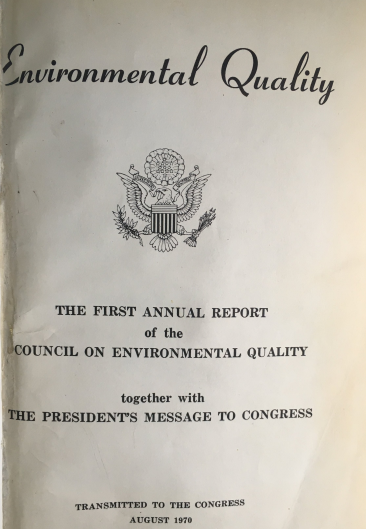
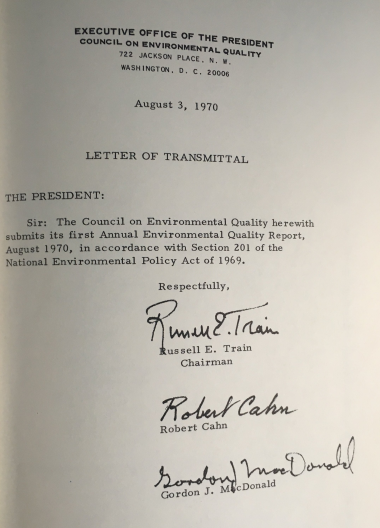
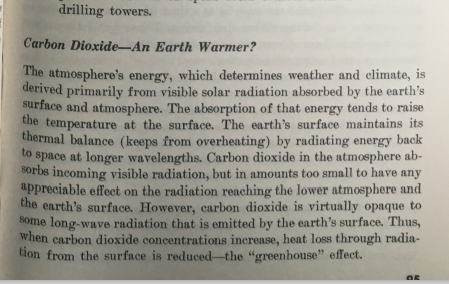
On this day, 3 August 1970, the first report of the Council on Environmental Quality was delivered to Preside Nixon. It contained a chapter on inadvertent weather modification, carbon dioxide build-up and icecaps melting. 

The CEQ had been set up as part of the legislative process that had gathered momentum under Johnson and come to fruition by late 1969.  

On this day the PPM was 324.69ppm

Now it is 421ish- but see here for the latest.

Why this matters. 

By early 1970s, folks were going “you know, this really might become a problem.”  By the mid-late 1970s the smarter ones dropped the “might”…

What happened next?

The CEQ didn’t return to the climate issue until Carter, best I can tell. And then Gus Speth, as its boss, got cracking with getting things moving, having been nudged by Gordon MacDonald and Rafe Pomerance of Friends of the Earth.

Gordon MacDonald had already been writing about this stuff (see his chapter in the Nigel Calder book). He would go on to be important in the fight against synfuels.

Categories
Australia

August 2, 1994 – Australian Prime Minister Paul Keating says greenies should ignore “amorphous issue of greenhouse”

On this day, August 2nd in 1994, Australian Prime Minister Paul Keating was on ABC Radio and

“chastised environmentalists for their attention to the “amorphous issue of greenhouse” and suggested they instead celebrate their previous victories on forestry conservation.”

(Mildenberger, 2015: 317-318) ABC National News Interview, 2 August, cited in Taplin, R. (1994). Greenhouse: an overview of Australian policy and practice. Australian Journal of Environmental Management 1(3): 142-155.

The context was this – Keating, as Treasurer, had already stopped Graham Richardson from introducing a 20% reduction target [see July 25th blog post], watered down the next pledge, and gotten the Industry Commission to investigate the economics of climate (in order to squash the issue). When he took over as Prime Minister in December 1991 the “Ecologically Sustainable Development” process was killed off (see blog post on this site on 6th August). He had then conspicuously absented himself from the June 1992 Earth Summit (the only OECD leader not to attend.)

Why this matters

Our leaders have, mostly, not got it, not cared.

What happened next

Keating’s Environment Minister, John Faulkner, tried to get a carbon tax through Cabinet, but did not succeed. The emissions kept climbing. The atmospheric concentrations kept climbing.

Categories
Australia Energy Industry Associations

 August 1, 2015 – World Coal Association tries to say coal is lifting people out of poverty.

On this day, 1st August 2015, the World Coal Association tried once again to distract people from coal’s civilisation and eco-system destroying nature. That’s (part of) its job, that’s what member companies expect in return for their subscription.

The World Coal Association (WCA) called on the World Bank to recognize the vital role of coal in bringing electricity to people in developing and emerging economies

Anon, 2015. WCA Calls on World Bank to Recognize Coal’s Critical Role. Engineering & Mining Journal, Volume 216; Issue 8, 26 1 August.

This has been going on for decades, of course. Smear competing technologies (nuclear, renewables), say you’re indispensable etc.

My personal favourite of the genre is Peabody’s brazen “Advanced Energy for Life” effort from the previous year. They must have been delighted when Australian wrecking ball turned Prime Minister Tony Abbott had parrotted that line (saying “coal is good for humanity”)  when opening a (what else) coal mine later that year.

This, from the Australia Institute in 2014, is useful

“Ahead of the G-20 meeting in Australia later this week, a new report by an Australian think-tank convincingly punctures coal industry claims that coal is an essential part of the solution to lack of access to electricity in the developing world.

Zeroing in on Peabody Energy’s “Advanced Energy for Life” global public relations campaign, which contends coal-fired power is a cheap, effective way to provide power to the large impoverished areas of India, Pakistan and elsewhere that now have none, the new study by the Australia Institute states that, “Peabody’s only contribution to energy poverty is maintaining a website and social media page which promotes coal as the solution to the problem…. Despite extensive searches and contact with companies and mining lobby groups, we could not find a single example where coal companies have supported coal-powered energy poverty alleviation projects.” 

Meanwhile, billions of people need reliable cheap electricity, and if we had got on with developing decent sources of renewables, with storage, instead of allowing our “best minds” to make missiles, surveillance and marketing algorithms and assorted nonsense, we’d probably be a lot closer to that. Oh well.

As per this website, on this day the atmospheric CO2 ppm was 399.11

Now it is 421ish- but see here for the latest.

Why this matters. 

We need remember that threatened technologies rarely go down without a fight, and that for coal, playing the “we’re indispensable” card.

What happened next?

They keep at it. Personal favourite is the recent claim that coal is a “transition” fuel in light of the war in the Ukraine sending gas prices through the roof.

Categories
Ignored Warnings United States of America

July 31, 1981 – US politicians hold “carbon dioxide and climate” hearings.

On this day, 31st July 1981, US congressmen got to hear from scientists.

Carbon Dioxide and Climate : The Greenhouse Effect House Committee on Science and Technology 31 July 1981.  https://catalog.hathitrust.org/Record/002758619 

“carbon dioxide and climate, the greenhouse effect:” hearing before the Subcommittee on Natural Resources, Agriculture Research, and Environment and the Subcommittee on Investigations and Oversight of the Committee on Science and Technology, U.S. House of Representatives, Ninety-seventh Congress, first session, July 31, 1981.

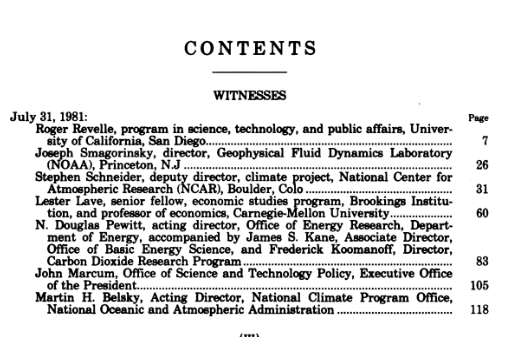
Here’s who was there. By now you probably recognise Roger Revelle and Stephen Schneider….

You have to wonder what they were thinking/hoping, given the wrecking ball that was the Reagan Administration. But, then, what else were they supposed to do?

According to Nathaniel Rich in Losing Earth

Though few people other than Rafe Pomerance seemed to have noticed amid Reagan’s environmental blitzkrieg, another hearing on the greenhouse effect was held several weeks earlier, on July 31, 1981. It was led by Representative James Scheuer, a New York Democrat — who lived at sea level on the Rockaway Peninsula, in a neighborhood no more than four blocks wide, sandwiched between two beaches — and a canny, 33-year-old congressman named Albert Gore Jr….

The Revelle hearing went as [Gore’s fixer] Grumbly had predicted. The urgency of the issue was lost on Gore’s older colleagues, who drifted in and out while the witnesses testified. There were few people left by the time the Brookings Institution economist Lester Lave warned that humankind’s profligate exploitation of fossil fuels posed an existential test to human nature. “Carbon dioxide stands as a symbol now of our willingness to confront the future,” he said. “It will be a sad day when we decide that we just don’t have the time or thoughtfulness to address those issues.” That night, the news programs featured the resolution of the baseball strike, the ongoing budgetary debate and the national surplus of butter.

Why this matters. 

If you know you’re history…

What happened next?

Reagan

Categories
United States of America

July 30, 1979 – scientists warn US Senators about synfuels and carbon dioxide build-up

On this day 30 July 1979 Committee on Governmental Affairs one day symposium on c02 build up, synfuels and energy policy, chaired by Senator Abraham Ribicoff –

A group of scientists, warning of potential ecological imbalances and climatic changes, yesterday urged the government to slow its pursuit of a large-scale synthetic fuels program.

The scientists said the ecological changes could result from higher levels of carbon dioxide in the atmosphere — one assured by-product of a switch to synfuel production.

They described the so-called “greenhouse effect” whereby heat is trapped close to the earth by increased levels of carbon dioxide, and predicted some long-term effects might be erratic world food production, severe droughts in some regions and costal flooding in others

Ellison, K. (1979) Panel Warned of Synthetic Fuel Danger. Washington Post, July 31.

Why this matters. 

We need to remember that some so-called solutions can make things worse – wicked problems and all that.

What happened next?

Synfuels were killed off by the Reagan Administration (not because they care about, or even knew about the scientific critique, but because they didn’t fit the narrative etc).

Categories
United Kingdom

July 30, 1989 – UK Conservative politician warns “we have at most 25 years to take action.”

On this day, July 30  1989 Conservative Politician Sir Ian Lloyd was quoted in The Sunday Times as saying ‘we have, at the most, a quarter of a century to make the assessments and take action. The life of the planet may be at stake.’

Wikipedia has him saying “civilisation is clinging by our fingernails to the cliff”. 

The man led an interesting life.

Also from wikipedia.

“He was a member of the Select committee on Technology for 10 years, and then chairman of the Select Committee on Energy for 10 years. He drove the establishment of the Parliamentary Information Technology Committee (Pitcom), and the Parliamentary Office of Science and Technology (POST)”

for which academic (and other) researches owe him a debt of gratitude.

Lloyd was a prescient guy who, well, later started wittering on about pyramids of uncertainty, and Bjorn Lomborg. It happens. It’s sad when it does, but it happens. See obituary here.

Why this matters. 

Did the rhetoric help us resist our own death grip? No, it didn’t. It never does.

What happened next?

We tightened the death grip on ourselves.