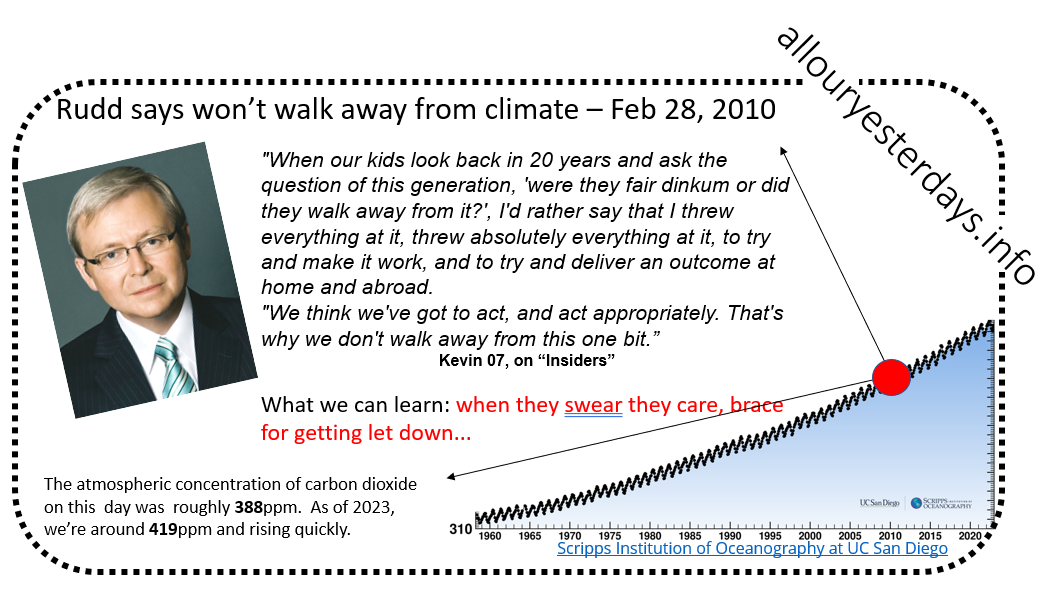
Thirteen years ago, on this day, February 28, 2010, Australian Prime Minister Kevin Rudd was on a then-quite-good ABC TV program called “Insiders.”
He said this: “When our kids look back in 20 years and ask the question of this generation, ‘were they fair dinkum or did they walk away from it?’, I’d rather say that I threw everything at it, threw absolutely everything at it, to try and make it work, and to try and deliver an outcome at home and abroad.
“We think we’ve got to act, and act appropriately. That’s why we don’t walk away from this one bit.”
The amount of carbon dioxide in the air was roughly 391ppm. As of 2023 it is 419ppm, but check here for daily measures.
The context was
Kevin Rudd had skilfully come to power in late 2007 by using climate change as a wedge against his political opponents – first Prime Minister John Howard, and then, once he got the top job, against opposition leaders Brendan Nelson and Malcolm Turnbull. But then, in 2009, he came up against junkyard dog Tony Abbott, and he lost his nerve. He was advised to call an election (see December 23 blog post from last year). He didn’t, and then didn’t figure out a way of climbing down from his climate position. He dismissed a proposal from the Greens for an interim carbon tax. He … ah, I could go on.
What I think we can learn from this
Politicians who talk about “great moral challenge” without showing skill or guts are worse than useless, because they encourage cynicism and fatalism, making it that much harder for those who come after them.
What happened next
Rudd bailed on climate. This tanked his previously high approval ratings (which were already taking a dent, it’s true) Rudd then ran off on a Mining Tax crusade. That came to an end, almost by accident, when his long-suffering and until-then loyal deputy Julia Gillard challenged for the leadership in June 2010. Gillard got some carbon pricing legislation through, but at the cost of, well, everything.
This was all unnecessary. If Rudd had had skill or guts….
NB, for any ALPers – nope, never been a member of the Greens, and when you focus on their actions during the CPRS vote, you reveal that you are unwilling to admit that your guy was not as smart or courageous as he thought, or as he needed to be.
What do you think? Does this pass the ‘so what?’ threshold? Have I got facts wrong? Interpretation wrong? Do comment on this post.
Thirty one years ago, on this day, February 27, 1992, denialists released a denial statement during what were supposed to be the last negotiations before the “Earth Summit”, the one where a text was supposed to be agreed that could then lock-in the attendance of Prime Ministers and Leaders…
In February 1992 the Science and Environmental Policy Project (SEPP) published the “Statement by Atmospheric Scientists on Greenhouse Warming” objecting to the United Nations Conference on Environment and Development Earth Summit planned for Rio de Janiero in June 1992.[1]
The signatories to the letter complained that the Earth Summit “aims to impose a system of global environmental regulations, including onerous taxes on energy fuels, on the population of the United States and other industrialized nations. Such policy initiatives derive from highly uncertain scientific theories. They are based on the unsupported assumption that catastrophic global warming follows from the burning of fossil fuels and requires immediate action. We do not agree.”
The amount of carbon dioxide in the air was roughly 357.2ppm. As of 2023 it is 419ppm, but check here for daily measures.
The context was
The climate negotiations were coming to a crunch. The whole thing might fall over. The US administration, with George Bush senior as the boss, was blocking blocking blocking, but there was always the fear they might – with a US Presidential election pending – make concessions. The denialists wanted to make that more unlikely by making it more costly….
What I think we can learn from this
Those fearful of change will keep pushing even if “their guy” (and it usually is a guy) is ‘rock solid’. They take little/nothing for granted. That attitude, and all their money, and their structural position within the economy, explains why they win so often…
What happened next
Bush held firm. The French blinked on the question of targets and timetables for emissions reductions in the climate treaty. There were extra “negotiations” in May in New York, but they were just really a white flag being run up. Everyone went to Rio for a grip and grin.
The following 30 years have been about trying to claw back a mechanism by which rich countries would actually cut emissions. It was never going to be easy, but the Bush Whitehouse rendered it actually impossible.
Am so very very glad I did not breed, because I’d have had to try to teach my kid a whole bunch of survival skills for a shituation whose particular needs are pretty impossible to specify.
What do you think? Does this pass the ‘so what?’ threshold? Have I got facts wrong? Interpretation wrong? Do comment on this post.
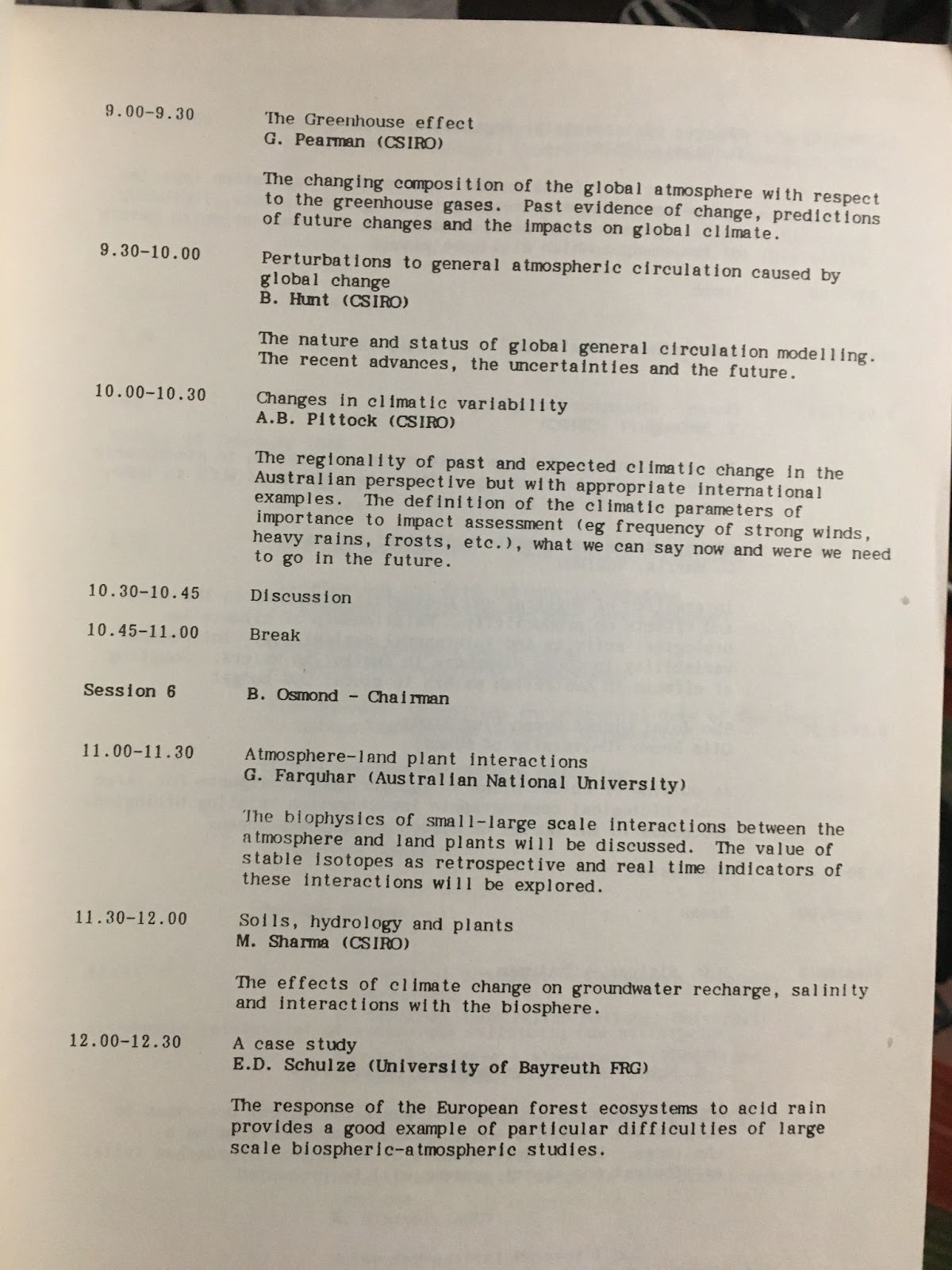
Thirty five years ago, on this day, February 27, 1988, a conference about, well, Global Change, finished in Canberra.
1988 Australian Academy of Science (1988) Global change, Proceedings of the Elizabeth and Frederick White Research conference 24-27 February 1988.
[fill in, take photo of contents page]
The amount of carbon dioxide in the air was roughly 351ppm. As of 2023 it is 419ppm, but check here for daily measures.
The context was
The Australian Academy of Science had been looking at climate change since a 1975-6 report (with a 1980 conference, and then another in 1987). Meanwhile, the problems of Amazonian deforestation, ozone, acid rain etc were all very much ‘in the news’.
What I think we can learn from this
Smart people will identify problems, in great detail, but, fearful of being labelled “political” are hesitant to name the names of the people, organisations, motives and processes that are perpetuating the problems, or talk about what would actually need to be done, beyond vague “change in legislation/change in mindsets” stuff. They bring an ethical knife to a power gunfight….
What happened next
More fine words. More emissions. And here we are.
What do you think? Does this pass the ‘so what?’ threshold? Have I got facts wrong? Interpretation wrong? Do comment on this post.
Forty two years ago, on this day, February 26, 1981, science writer John Gribbin had a long detailed piece in the Guardian about the state of the art of climate science, and the geopolitical implications, based on a briefing for Earthscan. “Carbon dioxide, the climate and man“
Read it and weep…
The amount of carbon dioxide in the air was roughly 340.5ppm. As of 2023 it is 419ppm, but check here for daily measures.
The context was
The Carter administration had just ended. The willingness of US politicians to even talk about the climate problem would plummet, and efforts like the “Global 2000” report were on the scrap heap. (The workshop Gribbin mentions will have been organised before Reagan won the November election.)
What I think we can learn from this
We knew a lot quite early. By the late 1970s there was momentum growing. The First World Climate Conference could have been consequential, but people like John Mason (Met Office supremo) played a blocking role. Still, salvageable, if Thatcher and Reagan hadn’t… ach, we’d have pissed it against the wall and still been in the same omni-messes now, let’s be honest.
The lack of any digital record (I could find) about the carbon dioxide workshop of the IEA and OECD is intriguing, and makes me want to know who was there!….
What happened next
It took another seven years for the issue to climb high enough up the agenda for it to be too costly for so-called “conservative” politicians to ignore it.
References
Gribbin, J. 1981. When the climate becomes too hot to handle. The Guardian, February 26
Twenty five years ago, on this day, February 26, 1998, yet more promises of clean coal were made in Australia, by eerie coincidence the world’s number one coal exporter…
RESEARCH laboratories where scientists will work to make Australian coal the “cleanest” in the world, will be opened by Premier Bob Carr today.
The Ian Stewart Wing of the chemical engineering laboratories at Newcastle University form part of the co-operative research centre for black coal utilisation.
The centre, partially government funded, was established in 1995 to carry out world class research to maximise the value and performance of Australian black coal resources
Anon. 1998. Tests for green coal. Daily Telegraph, 26 February.
The amount of carbon dioxide in the air was roughly 366.1ppm. As of 2023 it is 419ppm, but check here for daily measures.
The context was
At a Federal level, Prime Minister John Howard was resolutely anti-climate action (even after extracting an amazingly generous deal at Kyoto). At the state level, New South Wales and Queensland wanted to export more and more coal, obviously.
The CSIRO, having been lukewarm/opposed to renewables for yonks, was talking up the prospects of “clean coal.”
What I think we can learn from this
Research and Development organisations are largely captured by powerful/rich actors, via various mechanisms that are not hard to understand but unless understood ‘in the round’ can be dismissed as ‘conspiracy theory’. New technologies find it very very hard to get traction…. (Mark Diesendorf has written extensively about this, by the way).
What happened next
Clean coal is still coming, just like full communism was under Brezhnev, and just like nuclear fusion is. Now, about that bridge you were interested in buying from me you know, the one in Sydney… I can bribe the official writing the tender documents, but I need some cash from you up front…
What do you think? Does this pass the ‘so what?’ threshold? Have I got facts wrong? Interpretation wrong? Do comment on this post.
Hello to all new Twitter followers – thanks, I hope you like the site.
Let’s start with the unjustly obscure English punk/folk singer TV Smith. Don’t worry, we will quickly get to Australia’s climate wars and the long con of carbon credits.
Smith has been around since, well, punk began in the mid-1970s. I’ve described him – fairly I think – as “Chomsky meets Leonard Cohen, but punk.” The man can do things you don’t often associate with punks. Like, properly sing. And write – the man is an insightful compassionate poet and keen observer of, well everything. (1)
He can write about nature, technology, about the sense of futility but endurance in resistance. And he can about the ways that elites seek to discourage challenge. Which is where this story begins.
In his song “More Than This” on his album Misinformation Overload, Smith sets the scene
So the bankers take their seats
With the party elite
In a billionaire’s retreat
Safely out of reach.
And they blame the workers, blame the unions
Blame the slump and blame the boom
And the consumer, blame the system
Blame the losers, blame the victims
And then, the second verse…
So the policies are planned
That we won’t understand
Then the members all shake hands
And the meeting disbands
And they blame the downturn, blame the climate
Even though they’re the ones behind it
Blame the third world, blame the markets
Blame the decoys, blame the targets
And when I watch or read the brilliant coverage of the carbon credits scam (more on those pieces in a minute) my mind is drawn back to those lines
“So the policies are planned
That we won’t understand”
That is to say, I want to make the basic point that a dense and incomprehensible policy, well that is a FEATURE not a bug. Making it eye-wateringly, brain-shreddingly complex means that the conversation can stay at the level of soundbites, that most people give up trying to understand it and those who do persist seem weird to their friends and are disheartened and CRUCIALLY – you need a lot longer to unpack bullshit than to throw it, and if you’re having to explain it in detail, you are irritating/frustrating potential supporters. It becomes a “well, we should just leave it to the people who study this all day long.”
This tactic, when used by creationists to try to cast doubt on evolution by natural selection, is called a Gish Gallop, after its main proponent, Duane Gish. Basically, someone gallops through a whole load of nonsense, and their opponent is then left to either let a load of lies/half-truths go unchallenged (and strengthened) or else take up five or ten more times trying to unpick it all, and probably strengthen it into the bargain. It’s a no-lose situation for the bullshitters.
Which brings us to the carbon credits saga, the latest in the long line of astonishingly successful tactics used by Australian fossil-fuel interests over the last thirty five years.
They toyed with (but mostly abandoned/subcontraced it out deniably) outright denial. Then they put out the “too expensive” argument, and enlisted various other groups (looking at you CFMEU) to resist both a carbon tax and then an ETS. They talked with a straightface about technofixes, and got the taxpayer to dig deep. They have now morphed into using a policies-are-planned/Gish Gallop approach, alongside being the fox in the henhouse and benefitting from the fact that lots of potential critics never survived – at an organizational level – the drop in radical-end-of-resistance funding after the Global Financial Crisis. The big groups that might call bullshit are mostly – not all, but mostly – cowed or captured.
The “complexity” takes us back to the days of the tax versus ETS debates (which go back further than 2009, and further than Shergold in 2006/7, but I digress). An ETS is supposed to be more “efficient” (though that is asserted rather than supported with evidence). But the key benefit, I suspect, beyond being able to make banks and consultancies rich via various wheezes that are politely called “regulatory arbitrage” and the like (academics don’t like to use words like “thievery” or “rorting” – it’s too close to the truth) was this – ETS is complicated compared to a tax, which would be easy to understand, easy to “sell,” if sold right.
And so when the Greens, in early 2010, tried to save something from the wreckage Rudd had caused (see that cartoon by the brilliant @davpope), one of the points was that it would remove the eye-watering complexity.
And they were, ignored.
Look, a con man wants to distract you, to make you think you are seeing one thing when you are actually seeing another. There are various ways to do that. Flattery is one, but so is its opposite. They want you to believe them, not your “lying eyes” and they want you to doubt your sense-making ability. So they complicate, they “complexify”, they gish gallop, they bullshit.
Finally, here are three things I’ve read/watched of late that I think are just brilliant at explaining the carbon credits scam. Doubtless there are others.
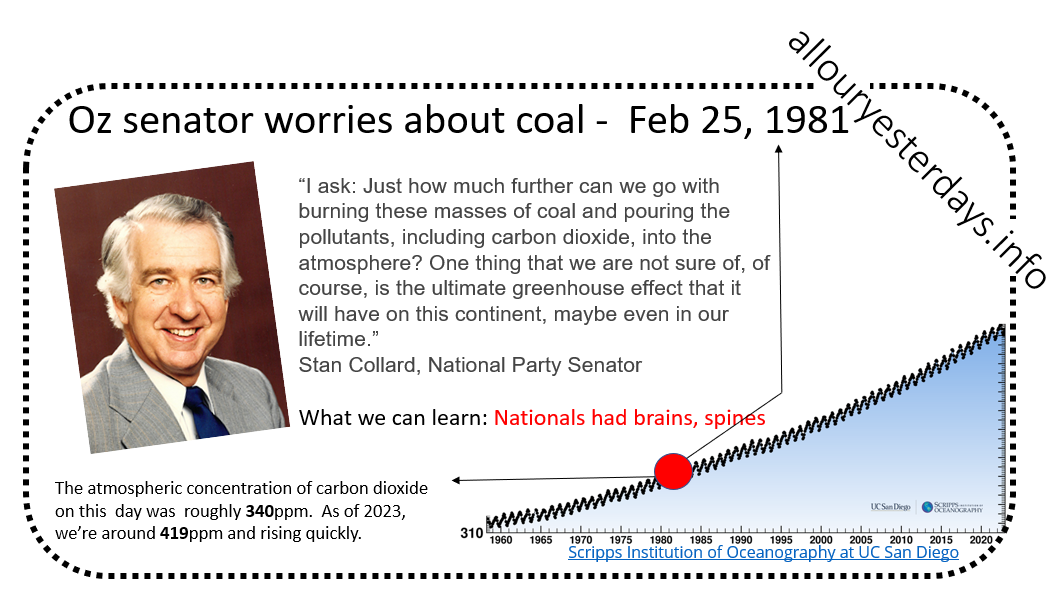
Forty two years ago, on this day, February, 25, 1981, Stan Collard, National Party senator (yes, you read that right) worried about climate change aloud, in parliament.
“Our steaming coal exports are mounting. I have no objection to that, except for one thing. I ask: Just how much further can we go with burning these masses of coal and pouring the pollutants, including carbon dioxide, into the atmosphere? One thing that we are not sure of, of course, is the ultimate greenhouse effect that it will have on this continent, maybe even in our lifetime. I think we must consider quite reasonably just where to cry halt to the burning of masses of steaming coal and where we can bring in one of the cleanest methods of power generation, that is, nuclear power generation, until something cleaner and better comes along. I reject the suggestion that the Government is lacking in its planning, but I welcome the opportunity to take part in this debate.”
Twenty years ago, on this day, February 24, 2003, the UK Blair Government released a very consequential white paper.
On 24 February 2003 the Government published its Energy White Paper “Our energy future – creating a low carbon economy”. The White Paper set out a new energy policy, designed to deal with the three major challenges that confront the UK’s energy system: the challenge of climate change, the challenge of declining indigenous energy supplies, and the need to keep the UK’s energy infrastructure up to date with changing technologies and needs.
The amount of carbon dioxide in the air was roughly 375.8ppm. As of 2023 it is 419ppm, but check here for daily measures.
The context was
The Blair government was realising that carbon emissions reductions were easy to promise, not quite so easy to deliver. A 2000 report by the Royal Commission on Environmental Pollution had proposed a target of 60% reduction by 2050, and this was adopted in the Energy White Paper. Crucially, the White Paper saw no role for nuclear….
What I think we can learn from this
Getting new ideas into government is an achievement.
Keeping them there is really hard, and the work of generations. And movements.
What happened next
The Nuclear lobby fought back (of course) and by 2005 had converted Tony Blair. Then more fun and hilarity ensued, but no actual building of new nuclear power stations, which always run over budget and behind schedule.
What do you think? Does this pass the ‘so what?’ threshold? Have I got facts wrong? Interpretation wrong? Do comment on this post.
Forty six years ago, on this day, February 23, 1977, as per the wonderful article by Jon Agar, the UK’s Chief Scientific Advisor wrote a prescient memo about carbon dioxide build up…
However, ‘one complicating factor, which will have to be taken seriously’ was carbon dioxide: …” as a result of the increasing use of fossil fuels the atmospheric carbondioxide [sic] content has increased by 10 per cent over the last century. Increased atmospheric carbondioxide leads, via the ‘greenhouse’ effect to an increase in temperature. However, carbondioxide production is usually associated with the production of dust (especially from coal) and particulate material in the atmosphere scatters light and thus leads to a decrease in temperature. It is possible that these two effects cancel, to a first approximation, but it is something that gives rise to a lot of debate; especially among those who wish to build nuclear power stations. Carbondioxide is, of course, soluble but it will take about 1,000 years for equilibrium to be reached between the atmosphere and the ocean; if the dust settles out faster than the carbondioxide dissolves there might be some interesting short-term effects”.
Rounding off a review of climate change, Ashworth gave a prediction:
‘Future forecast—changeable and probably getting worse’. The note is significant because it is the first, recorded instance of the UK’s senior government adviser passing up the chain of command a firm view about climate change, in this case that natural climatic change was an understood fact and anthropogenic climate change a distinct possibility’ TNA CAB 184/567. ‘The weather’, Ashworth to Berrill, 23 February 1977
The amount of carbon dioxide in the air was roughly 333.1ppm. As of 2023 it is 419ppm, but check here for daily measures.
The context was
The Germans, Swedes and most of all Americans were looking at carbon dioxide build-up and saying “we may have a serious problem”. So was the World Meteorological Organisation. The idea of an ice age had been put to one side after a Norwich meeting in 1975. Ashworth was trying to get Berrill and Mason to take it seriously.
What I think we can learn from this
Getting dinosaurs to tap dance, to spot problems on the horizon, is hard going.
What happened next
Ashworth’s efforts were ‘rewarded’, at last, with an interdepartmental committee in late 1978, which produced a “nothing to see here” report. Members of Thatcher’s government tried to keep it from seeing the light of day, but it finally limped out in February 1980. When Ashworth briefed Thatcher, her response was incredulity and “you want me to worry about the weather?”
Meanwhile, the opportunity to start doing something was, of course, lost.
What do you think? Does this pass the ‘so what?’ threshold? Have I got facts wrong? Interpretation wrong? Do comment on this post.
References
Agar, J. (2015). “Future forecast – changeable and probably getting worse”: the UK Government’s Early Response to Anthropogenic Climate Change” Twentieth Century British History, Volume 26, Issue 4, Pages 602–628, https://doi.org/10.1093/tcbh/hwv008 See here.
This is a guest post by Sakshi Aravind (full bio at end of post).
Dr Sakshi Aravind
Where should we look if we must begin to believe adjudication is one of the ways to achieve climate justice? Investing hope in courts may appear unrealistic if, for instance, one were to look at UK courts. This February, the Inner Crown Court sentenced an activist with Insulate Britain to prison for contempt of court.
From what has appeared in the press, the presiding judge had asked the defendant not to refer to climate change as motivation for their actions (where the defendant, along with three others, had blocked a busy junction in the City of London on the 25th October 2021 as a part of Insulate Britain climate campaign). The defendant appears to have referred to climate change in his closing speech, thereby earning the absurd wrath of the Court.
Now, on the face of it, the outcome appears preposterous. This was, after all, a case where people were being prosecuted for protesting on climate change grounds. Surely, they can argue on an accurately reasoned ground that explains why they were blockading the junction in the first place? Was this an instance of misreporting, or did the judge relinquish the need for reasoning, let alone legal reasoning? I can only find out if someone is willing to fill in a wordy form to obtain the transcript from the Court and pay the fees, just like the Digital Support Officer from the registry tells me I should do.
One can imagine why the question of courts, justice and accessibility remain narrowly interpreted and do not extend to interrogating the aftermaths of litigation, including holding the judges accountable in a way that makes more than legal sense.
Should I bother with this little absurdity when the higher courts in the UK have consistently thrown out most of the climate-related strategic litigation in the last few years, even as most other jurisdictions are turning to innovation and curiosity?
On 16th February, it appeared that the Wolverhampton Magistrate Court assumed a different approach to the Just Stop Oil protestors, who were before the Court for blocking the distribution of oil from the Esso Fuel Terminal in Birmingham in April 2022. While the defendants were given a conditional discharge and ordered to pay costs, the presiding judge was also sympathetic towards their motivation. The judge was alert to the realities of climate change and termed the defendants’ actions one with an “admirable aim”. However, the Court believed that the necessities of consistency and legitimacy—those that characterise the rule of law in the UK—had to be upheld and the defendants convicted. To quote from the sentencing remark:
“Trust in the rule of law is an essential ingredient of society, and it will erode swiftly if judges make politically or morally motivated decisions that do not accord with established legal principles. Indeed I would become the self-appointed sheriff if I acted in such a way.
…
if good people with the right motivation do the wrong thing it can never make that wrong thing right, it can only ever act as substantial mitigation.”
We only have access to this sentencing remark because the Judicial Office contacted the media to clarify after Just Stop Oil went on a gloating spree misquoting the judge. Not unusual for predominantly white activist groups in the UK to do something cringe-worthy now and then.
Why do the first and the second instance feel equally absurd? Should one look for hope in environmental movements in the wrong place and lie to themselves and others until the very thing they are hoping for materialises miraculously? Is strategic litigation successful only when a judge pats you on the head and provides a cinematic twist in adjudication?
Whatever the answer to these questions, investing hope in courts must be clear about two things.
First, adjudication is a refined strategy, which may or may not always provide the best possible outcome. But when it does, it is going to be significant and lasting.
Second, where the legal cultures are restrained, one must have realistic expectations about the kinds of environmental litigation that goes to courts.
While self-proclaimed environmental activists are prosecuted, not all cases can be considered environmental litigation, despite how damning such cases may turn out for the domestic criminal justice system. So, there is no need to be disingenuous about the judicial outcome. If we desire indulgence from legal systems and teary-eyed judges, we distract ourselves from the real problem—that of an impenetrable legal system and absurd procedural apparatus that can sweep you away from the system for the most inconsequential of faults.
If we use adjudication for our ends, we must focus on the content and strategy and less on the actors. Unlike the BIPOC fighting for environmental rights elsewhere against murderous regimes that do it lucidly, those in privileged spaces might require some practice. But it is entirely worth the effort.
While hope and optimism are a matter of individual and collective responsibility to some extent, when there comes the point where we must say “F*** hope!” like Australian academic Chelsea Watego tells us, we must understand and wholeheartedly endorse that moment.
Bio:
Sakshi is a Lecturer in Law and Social Justice at the Newcastle Law School, where she teaches environmental law, land law, constitutional law and jurisprudence. She completed her PhD at the University of Cambridge and her BCL at the University of Oxford. She works on comparative environmental law, legal theory, political economy, and climate justice.
You can read her previous guest post on All Our Yesterdays (on environmental racism in NGOs) here, and an interview “Indigenous resistance to extractivism and academic allyship” FULL of insights and also links to post-colonial and indigenous thinkers here, on the Environmental Politics website.