Categories
Australia Denial

February 16, 2007 – Liberals say climate is a “mass panic”

Sixteen  years ago, on this day, February 16, 2007, as the second big wave of climate awareness was kicking off in Australia, a senior Liberal politician was… being himself.

 It SHOULD not be seen as a sin to be cautious about the science of global warming, a senior Federal Government minister has warned.

Finance Minister Nick Minchin says “there remains an ongoing debate about the extent of climate change” and the extent of human activity’s role in global warming.

Murphy, K. 2007. Lib scorns mass ‘panic’ on climate. The Age, February 16 http://www.theage.com.au/news/national/lib-scorns-mass-panic-on-climate/2007/02/16/1171405441792.html

The amount of carbon dioxide in the air was roughly 384ppm. As of 2023 it is 419ppm, but check here for daily measures. 

The context was

Nick Minchin had been successful in defeating an emissions trading scheme in the year 2000. And he had remained one of John Howard’s staunch culture warriors on the question of climate. From late 2006 people in Australia started to become reawakened to the climate problem and Minchin was pushing back in the way that old white men so often do. By this I mean pointing the finger at people and calling them hysterical and accusing them of panicking without bothering to think that maybe there is something to panic about. 

What I think we can learn/remember from this

Just a reminder that just because someone is “successful” does not mean they cannot be a harmful dolt.

The sorts of things that Minchin accuses others of doing – cherry picking data, being unscientific – that’s all projection, that’s what he’s doing.

There are always old white men who will come out with this bullshit and of course now they’ve painted themselves into a corner and would have to admit that they had been wrong which would be psychologically devastating for them.

What happened next

Labor won the Federal election at the end of the year and fundamentally bollocksed up the politics and policy.  Well done, Kevin. You’re from Queensland and you’re here to really screw things up.

What do you think? Does this pass the ‘so what?’ threshold? Have I got facts wrong? Interpretation wrong?  Do comment on this post.

Categories
Australia Carbon Pricing Economics of mitigation

February 15, 2013 – the carbon bubble, will it burst?

Ten years ago, on this day, February 15, 2013, a journo for the Melbourne Age writes a piece about the then-all-the-rage topic of “unburnable carbon”

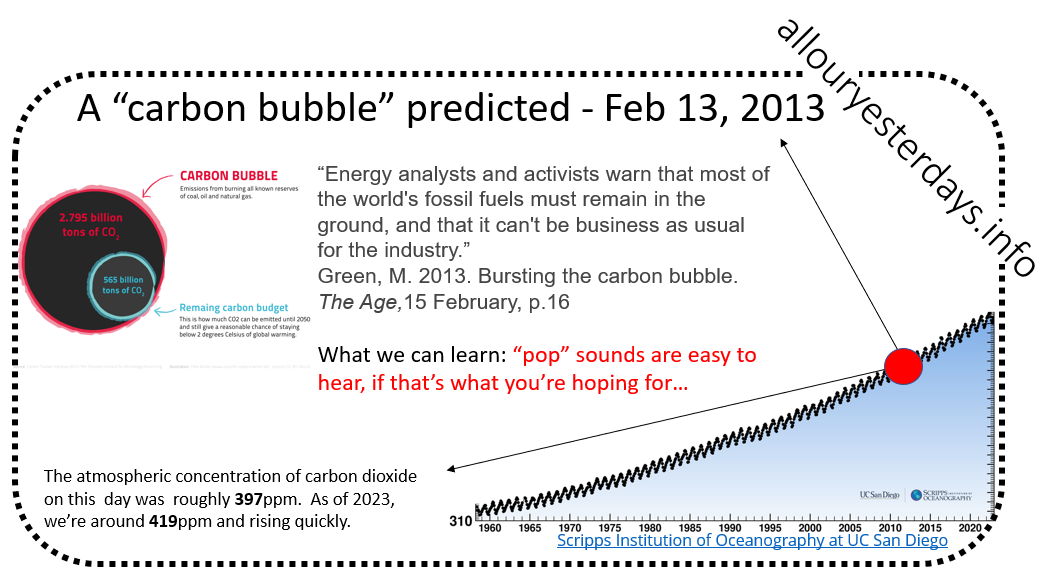
Energy analysts and activists warn that most of the world’s fossil fuels must remain in the ground, and that it can’t be business as usual for the industry.

Green, M. 2013. Bursting the carbon bubble. The Age,15 February, p.16.

The amount of carbon dioxide in the air was roughly 397ppm. As of 2023 it is 419ppm, but check here for daily measures. 

The context was

This “unburnable carbon”/”carbon bubble rhetoric was all the rage 10 years ago. It looked like the UNFCCC process was going to be a slow route back to feeling that the system could deliver. Copenhagen had been a failure, Paris was two and a half years off and it was still not clear that it would provide anything. So all those people who need to believe that there are levers and buttons in the policy sphere that we can push turn their attention to the idea that investors rather than statesmen could solve the problems; they just needed to be given stark advice that investing in stranded assets was a bad idea. 

How do you strand an asset? Well, ultimately, you need to have markets and regulations that make some investments,a bad idea and other investments a better one. How would you do that on carbon? Well, you would need a strong legally binding international agreement (which you can’t get), and therefore, we’re all toast. 

.

What I think we can learn from this

Using one “part” of the financial system – whether it is the re-insurers, the insurers, the institutional investors as the leverage point, the secret push-this-button-to-change-the-system is a long-standing and soothing idea for a certain kind of climate-motivated person. Some of them are super-smart. This does not mean they are right.

Unburnable carbon as a meme allowed people to hold conferences, put out press releases, videos, get interviewed on Newsnight and podcasts and generally feel that things were still salvageable. Am I too cynical? My therapist says so.(1)

What happened next

You hear less about unburnable carbon these days, now that Paris and Net Zero are flooding the zone.

What do you think? Does this pass the ‘so what?’ threshold? Have I got facts wrong? Interpretation wrong?  Do comment on this post.

  1. As someone who read this before publication said – “I understand the dynamics of hoping there is a secret lever to pull, but in dismissing that at the same time as providing a psychological sort of explanation for why people keep coming back to this, you might be throwing the baby out with the bath water. There may not be a simple lever we can pull, but even if a mass movement formed which highly organized, highly effective and coordinated, competent, resourceful and dedicated, in the way you would like to see, it would still end up having to deal with the power of capital and would be highly involved in trying to pull these various “levers”

References and See Also

IPIECA on the concepts…

https://seors.unfccc.int/applications/seors/attachments/get_attachment?code=6IPYS06R1TK33GFX33NA3I1IDOJ9OHB5

July 2022 “Unburnable Carbon Ten Years On.”

Categories
anti-reflexivity Australia Science Scientists

 February 13, 2007- Industry is defo allowed to silence scientists…

Sixteen years ago, on this day, February 13 2007, a Canberra Times journalist had a cracking story about the politics of knowledge.

The CSIRO has confirmed coal industry bodies have the power to suppress a new report questioning the cost and efficiency of clean-coal carbon capture technologies because they partly funded the research. Dr David Brockway, chief of CSIRO’s division of energy technology, told a Senate estimates committee hearing yesterday it was ”not necessarily unusual” for private-industry partners investing in research programs – such as Cooperative Research Centres – to request reports be withheld from public release if findings were deemed to be not in their best interests. His comments followed questions by Australian Greens Senator Christine Milne regarding the release of an economic assessment by a senior CSIRO scientist of a new carbon capture technology to reduce greenhouse emissions from coal-fired power stations.

Beeby, R. 2007. Industry can gag research: CSIRO. Canberra Times, 15 February.

The amount of carbon dioxide in the air was roughly 384ppm. As of 2023 it is 419ppm, but check here for daily measures. 

The context was

John Howard and his government had been systematically undermining all other organisations that might keep tabs on them, or forcefully propose alternatives.  Have a look at “Silencing Dissent” by Clive Hamilton and Sarah Maddison for the gory (and they are gory) details.

What I think we can learn from this

Those who want things to stay the same will do whatever it takes to poke out the eyes and stuff up the mouths of anyone with brains and other ideas, while rewarding lackeys and toadies.

What happened next

Nothing good. The demolition of the CSIRO has, basically, continued. Oh well.

What do you think? Does this pass the ‘so what?’ threshold? Have I got facts wrong? Interpretation wrong?  Do comment on this post.

Categories
Australia

 February 11, 1993 – Liberal Party plans would not meet climate goals, says expert

Thirty years ago, on this day, February 11, 1993, with a Federal election campaign underway, an academic ran the numbers on the Liberal Party’s Fightback! policy and what it would mean…. 

According to the director of science and technology policy at Murdoch University, Fightback! would result in a six per cent increase in car use immediately, and 28 per cent in a few years.

The table shows that Australia is the third worst polluter in the OECD region and that our poor performance is very much related to low fossil-fuel prices.

If Australia is to get its carbon emissions down to a level comparable with other OECD countries, some form of carbon tax will have to be introduced.

International pressure to move in this direction is likely to intensify over the next decade

Davidson, K. 1993. Hewson Error Of Emission. The Age, 11 February, p.13. 

The amount of carbon dioxide in the air was roughly 357ppm. As of 2023 it is 419ppm, but check here for daily measures. 

The context was

From late 1991 Opposition Leader John Hewson had been successfully attacking Labor with an even more neoliberal set of policies than Labor had been using. He called it “Fight Back!” Hewson had spooked a tired Bob Hawke and this gave Hawke’s former Treasurer Paul Keating an opportunity for a second bite at the leadership cherry.  Fight back indeed!  Fight Back!  marked the end of the Liberal experiment with appearing green, (see, January 15, blog post).

But Fightback! would, as per this report, mean that environment issues would be further down the policy agenda. And the quality of the human and natural environment would further decline.

What I think we can learn from this

The intense battles in the realm of politics, often two bald men fighting over a comb, bear no relation to the actual problems that the society or species faces. We mustn’t mistake all of that heat for light. 

The Green Party’s and greens of the world have been saying this for decades, I’m saying precisely nothing new here. But hopefully, by dint of repetition, it will get into my own head. 

As per February 5 blog post, we mistake the shadows on the wall for the reality. We think that because some planet-destroying goon is getting laughed out then progress is being made. And on the whole, it’s not. 

What happened next

Hewson went on to lose the unlosable election to Paul Keating. Environmental matters were nowhere to be seen.  Hewson over time, has had a semi Damascene conversion. I don’t know that anyone has ever asked him if he regrets the Fightback! stuff. 

What do you think? Does this pass the ‘so what?’ threshold? Have I got facts wrong? Interpretation wrong?  Do comment on this post.

Categories
Australia

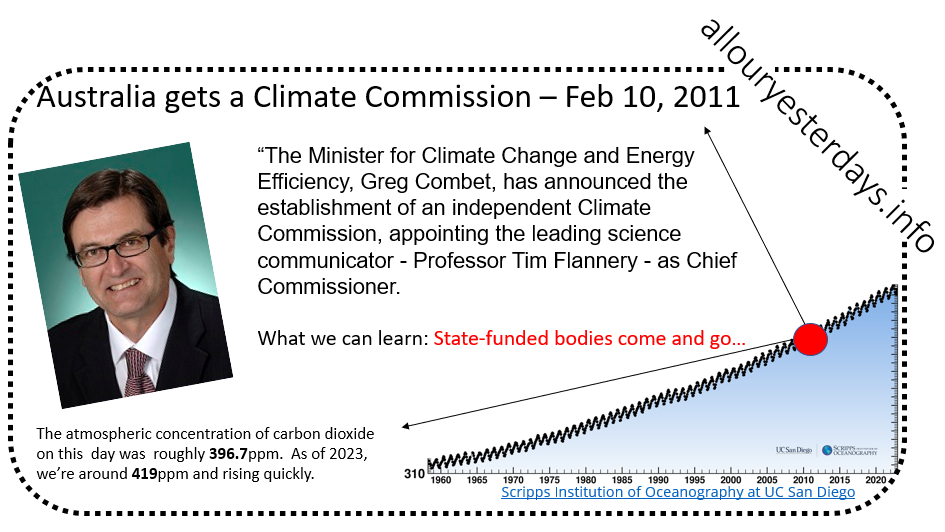
February 10, 2011 – Australia gets a “Climate Commission”

Twelve years ago, on this day, February 10 2011, Australian Environment Minister Greg Combet had something to say…

“The Minister for Climate Change and Energy Efficiency, Greg Combet, has announced the establishment of an independent Climate Commission, appointing the leading science communicator – Professor Tim Flannery – as Chief Commissioner.

Combet said the Climate Commission would provide expert advice and information on climate change to the Australian community.

“The Climate Commission has been established by the Gillard government to provide an authoritative, independent source of information for all Australians,” he said. “It will provide expert advice on climate change science and impacts, and international action. It will help build the consensus required to move to a clean energy future.”

The Climate Commission would have a public outreach role, he said, to help build greater understanding and consensus about reducing Australia’s carbon pollution.

Other members of the Climate Commission are Professor Will Steffen, Professor Lesley Hughes, Dr Susannah Eliott, Gerry Hueston and Roger Beale. The commissioners have expertise in a range of areas including climate change science, science communications, business, public policy and economics.

https://www.sustainabilitymatters.net.au/content/sustainability/news/launch-of-the-climate-commission-739695248

The amount of carbon dioxide in the air was roughly 396.7ppm. As of 2023 it is 419ppm, but check here for daily measures. 

The context was

Australian Prime Minister Julia Gillard was trying to make a move in the climate wars which had sprung up from late 2009 when the Liberal Party’s Tony Abbott decided to call the science of climate change “absolute crap.” He became a lightning rod for a lot of people’s dissatisfaction, especially in the National Party. The idea of a commission was, I believe, that of Christine Milne of the Greens, not that Labor would necessarily be willing to admit that; Labor had been forced into an uneasy collaboration with the Greens because of the finely balanced 2010 election. The Greens insisted that Labor grasp the climate change nettle again, rather than kicking it all into the long grass.

What I think we can learn from this

These sort of top-down groups of experts are useful, but they need to be supplemented by vibrant, long lasting civil society organisations and social movement organisations. However, that requires people to innovate and do stuff differently and not fall victim to the usual movement pathologies such as the smugosphere, the emotacycle, ego-foddering etc.

What happened next

The Commission was destroyed by Tony Abbott, and then had no trouble setting up as “The Climate Council” in September 2013 (see this Guardian article).

What do you think? Does this pass the ‘so what?’ threshold? Have I got facts wrong? Interpretation wrong?  Do comment on this post.

Categories
Australia Carbon Pricing Uncategorized

February 6, 1995 – Australian business versus a carbon tax

Twenty seven years ago, on this day, February 6 1995, co-ordinated action to defeat a carbon tax was on display

 “As part of its media strategy, the network sent out a series of five news releases on 6 February 1995 under the banner Carbon Tax Threatens Regional Jobs. The releases focused on the regions that would be most affected by the introduction of carbon tax.”

(Worden, 1998: 87)

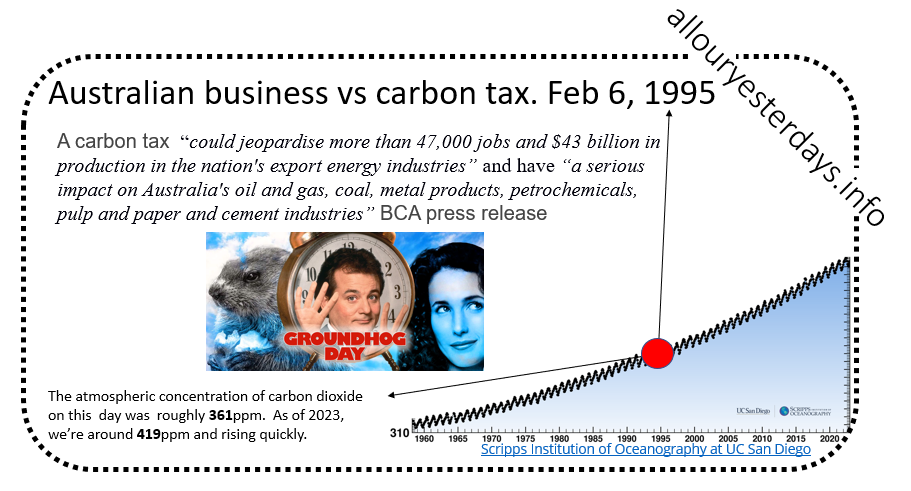
The Business Council of Australia press release is a corker. A carbon tax  “could jeopardise more than 47,000 jobs and $43 billion in production in the nation’s export energy industries” and have “a serious impact on Australia’s oil and gas, coal, metal products, petrochemicals, pulp and paper and cement industries” (Thomas 1995)

The amount of carbon dioxide in the air was roughly 361ppm. As of 2023 it is 419ppm, but check here for daily measures.

The context was

John Faulkner, the Federal Environment Minister, had a proposal for a carbon tax that would fund research and development of renewable energy. Business organisations hated this so they dusted off their 1990-2 playbook and improved it. Press releases from various actors were coordinated, to influence the minds of those people (especially ministers) who were attending two round tables on consecutive days.

What I think we can learn from this

When threatened (or merely feeling threatened), business is very good at putting aside their individual differences and presenting a united front. They have the resources, and Secretariat usually, to do that. Whereas those advocating for a better world tend to be running on the sniff of an oily rag.

What happened next

Faulkner’s plan was defeated. Australia didn’t get a price on carbon until 2012.

What do you think? Does this pass the ‘so what?’ threshold? Have I got facts wrong? Interpretation wrong?  Do comment on this post.

References

Thomas, C. 1995. Business Council Hits Plan For Carbon Tax. The Age, 7 February, p.50.

Categories
Australia

February 5, 2007 – Australian Prime Minister trolled by senior journalist

Sixteen years ago, on this day, February 5, 2007, Australian Prime Minister John Howard got ridiculed on an ABC television programme.

Howard’s problem was that he had changed his policy but not his political strategy. He refused to genuflect before the icons: Al Gore’s scare, the drought as proof of a climate transformation, and Kyoto sanctification. For the ABC, Howard was now a figure of undisguised ridicule. His Lateline interview of 5 February 2007 began with this mocking question from Tony Jones: ‘Can you recall exactly when it was that you ceased being a climate change sceptic and became, in effect, a true believer?’

(Kelly, 2014:131)

The amount of carbon dioxide in the air was roughly 384ppm. As of 2023 it is 419ppm, but check here for daily measures. 

The context was

Australian Prime Minister John Howard had a track record of 10 years of successful opposition to any action on climate, using all means fair and foul. He had finally been pushed because of an impending election into appointing one of his mandarins, in this case, Peter Shergold to examine an emissions trading scheme. Therefore journalists were beginning to have fun with Howard’s U-turn. Howard had to do the U-turn beacuse climate concern was being expertly used as a wedge issue by new opposition leader, Kevin Rudd.

What I think we can learn from this

Journalists who don’t really “get it” can still land blows. But the real problem is that the landing of these blows has an emotional release effect on viewers who think “ah, the system is working, the system is correcting, this bad person who I don’t agree with  will be gone soon”. They don’t then think about what they need to do for the long-term. It’s a kind of court jester catharsis thing.

What happened next

Howard was defeated. In the November 2007 election, Kevin Rudd came in with lots of promises, but no real action and poisoned the well, creating cynicism, which is still present.

References

Kelly, P. 2014. Triumph and Demise: The broken promise of a Labor generation. Melbourne University Press.

What do you think? Does this pass the ‘so what?’ threshold? Have I got facts wrong? Interpretation wrong?  Do comment on this post.

Categories
Australia

February 4, 1993 – Australian business versus the future (spoiler: business wins)

Thirty years ago, on this day, February 4 1993, Australian business interests continued their fight against the future of the human species.

The Federal Government’s ratification of an international climate change agreement last month is a chance for Australia to rewrite its greenhouse policies and perhaps even argue for a national increase in greenhouse gas emissions instead of a cut.

That’s according to Woodside Petroleum managing director Charles Allen, who told the Outlook conference yesterday it was time for a “reappraisal” of Australia’s greenhouse policies.

Mr Allen said “emotional media and political treatment” of the greenhouse issue had obscured the real problem. While it was clear greenhouse was happening, he said, there were many scientific uncertainties about its magnitude and speed.

He said Australia produced only about 1.5 per cent of the world’s greenhouse gases, even though per head of population emissions were on a par with major greenhouse producing nations. 

Mussared, D. 1993. Increase Australia’s greenhouse emissions: Woodside. Canberra Times, 5 February, p.13.

AND 

THE Federal Government would have to consider unpopular measures such as a carbon tax if wanted to achieve its goal of reducing greenhouse gas emissions by 20 per cent by 2000, according to the Australian Bureau of Agricultural and Resource Economics.

A senior ABARE minerals economist, Mr Barry Jones, told the Outlook ’93 conference yesterday that the measures announced in the Government’s Greenhouse Response Strategy would not be enough to stabilise greenhouse gas emissions by 2000 compared with 1988 levels, or to cut them a further 20 per cent by 2005

Garran, R. 1993. Rethink needed on greenhouse The Australian Financial Review, 5 February, p.7.

The amount of carbon dioxide in the air was roughly 357ppm. As of 2023 it is 419ppm, but check here for daily measures. 

The context was

Australian business interests were trying to claw back ground that had been lost, sort of, in 1992 when the Australian government had signed and ratified the UNFCCC. This was also taking place ahead of an impending federal election. The context was that the Hawke government had, in October 1990, agreed to the Toronto target (a 20% decrease in emissions by 2005) with caveats. Now business wanted to emphasize the costs and to point to the fact that other nations were not doing very much.

What I think we can learn from this

No battle is ever won. Your opponents will, if they have capacity – and business often does – try to undermine you, to clawback territory. This will not be big news usually, but they never sleep, they keep fighting. Often, therefore, they win. An analogy would be the fight against women’s reproductive rights and bodily autonomy in the United States. It took them decades, but they rolled back Roe v Wade…

What happened next

In Australia, there was a proposal for a carbon tax in 1994/95. It was defeated and then Australia switched to talking about an emissions trading scheme. There was prolonged debate about this finally in 2012. A scheme was introduced within a year, then abolished.

What do you think? Does this pass the ‘so what?’ threshold? Have I got facts wrong? Interpretation wrong?  Do comment on this post.

Categories
Australia

Australian films “The Coal Question” and “What to do about C02” – interview with Russell Porter

The Australian documentary maker Russell Porter kindly agreed to an interview about two of his films for the CSIRO, “the Coal Question” (1982) and “What to do about C02” (1984).

The short version (though you really would benefit from reading the whole thing) is this – we knew. We really did. Skilled communicators got hold of scientists who knew how to communicate.

The Coal Question: (watch here)

Can you remember, did Film Unit ‘pitch’ to energy institute’, or did the energy unit come knocking and say ‘we’d like you to do a film about coal’

1. The film project selection system worked in various ways. In some cases we would identify a subject that looked interesting and then discuss it with the relevant experts, and if it was broadcastable in theme and scope, we would talk perhaps to the ABC Science commissioning editors. In other cases, the Institutes (or Divisions as they became) within CSIRO would express interest in having a film made about their work, and my job would be to liaise with the scientists involved and prepare a script, which was then sent back in a few stages to be revised and refined. I was always keen to avoid them looking too “institutional” and boring. 

In this case I think the energy Institute expressed an interest in publicising their work, I developed the script and, once it was approved, it formed the basic blueprint for making the film. Shooting and post-production on 16 mm was expensive, so we used to aim for a ratio of about ten to one (of material shot to the final edited length), so pre-scripting was essential. (Ratios these days are often 50 or 100 to one – false economy because the saving by shooting on inexpensive digital video are lost in lengthy post-production, and the craft and quality elements that come from careful preparation also suffer.)

Where did your information re: climate come from (did you already know Graeme Pearman from, say, the 1980 climate conference he organised)

2. The film unit was located in the old Information and Media (or some such) Centre in Albert St East Melbourne. which also housed a large library full of journals and editorial departments for specialist publications. It also housed the very experimental computing research division (where they were trying out a kind of prototype internet/electronic data-base sharing system, in collaboration with Harvard and Oxford). I tried to keep on top of interesting-looking developments or program as they came through the internal bulletins and publications like New Scientist (which I still subscribe to). CSIRO was a big and highly respected organisation in those days, with over 7,000 very bright employees engaged in often pure and original science. The climate conference was before my time (I joined in 1982), but the subject was beginning to create some lively debates within the organization. 


Was there any attempt to control the script/content before it was released? 

3. I don’t remember there being any attempt to “control” the content,  but as I say they had to approve the final draft of the script. The heads of the Divisions and their scientists were the experts, and I deferred to them. But they were all also pretty smart characters with considerable social awareness and sense of responsibility. I loved the fact that they would not say or allow any opinions that were not based on hard empirical evidence. Proper old-school scientific rigour. With films for a general audience I used to say that if they could make me understand what they were doing, I could interpret that for the public. 

Was there any overt ‘push back’ from anyone (within coal industry, government CSIRO etc) after it was released? If so, from who, what kind of push back?

4. I can’t remember any negative reaction to the coal film – there may have been some, but it would have been at a level that didn’t reach me. The industry lobby groups were also fairly docile in those days, and the politicians were less obsessed  with pleasing their neo-liberal constituencies – that came later I think. I remember feeling that I had to be careful not to be promoting an industry that to me, even back then, I saw as environmentally destructive, so the  “balance” in it, regarding emissions etc, was at my instigation – and they went along with it.

Are there other, earlier films I should be aware of? Or films about renewable energy?

5.  In terms of other CSIRO films, if you go to the website http://www.scienceimage.csiro.au/ you can search by subject,and it will then give you the option of images or videos. “Climate” + “videos” for example yields this: http://www.scienceimage.csiro.au/search/?tags=&newkeyword=climate&keyword=&library=&assettype=video&rgb=&deviation=30&page=1 

I made “Mysteries of the Lleeuwin” which is mainly about oceanography rather than energy / climate issues per se, and “The Heat is On” (2001) was after my time, but seems to be one of the “Sci-Files” shorts, which replaced the old “Researchers” series which were originally screened as fillers on commercial TV. There is another two-minuter in the series called “Oil from Plants”. A search on the site for “solar” yields these:

http://www.scienceimage.csiro.au/search/?tags=&newkeyword=solar+&keyword=&library=&assettype=video&rgb=&deviation=30&page=1 HIAF was the only one I worked on.

Anything else you’d like to say about the Coal Question

6. I think “The Coal Question”  was aired on the ABC Quantum programme, as was my film on Australian trees called “Green Envoys“, shot in Zimbabwe and Southern China in 1986, funded by the Fed government as part of the Australian contribution to the International Year of Peace. (1986)It was originally planned to make it about two CSIRO research projects in Africa, trees in Zimbabwe and dry land soil farming techniques in Kenya. I went over to research it in February, returned with the crew in June, shot the trees project and then discovered that the Kenyans had withdrawn our permission to film at the last minute. It was due to go to air in September so we had to frantically re-schedule and re-write, and decided to make it all about trees. We had to get the then Foreign Affair Minister (Bill Hayden) to fast-track permits and visas etc, and off we flew to remote areas of southern China (Guangxi and Leizhou).  http://www.scienceimage.csiro.au/video/12230/green-envoys/

What to do About CO2? (watch here)

Where did the impetus for “What to do about C02?” come from?

1. “The Greenhouse effect” as it was known then, was certainly an emerging interest of mine, and I think the ABC also wanted to do something on it. Much of the research was coming out of Atmospheric Physics Division in Aspendale so I went there first and met Graeme Pearman and I think Barrie Pittock, They were both keen to spread the word, and very charismatic interview “talent” (unlike many scientists). 

You interviewed Bert Bolin – did he happen to be in Australia at the time?

2.Bert Bolin was in Australia at the time, I´m not sure why, but he was already internationally renowned for his work on climate change, so we took him to a Melbourne beach and interviewed him there. Similarly I heard that botanist and broadcaster David Bellamy was addressing a crowd at the Myer Music Bowl in Melbourne, we ran down there from the Unit´s base and grabbed him after the talk. He was quite a famous figure in those days for his arrest during protests against the damming of the Franklin River in Tasmania. He became an all-purpose environmental issue commentator, so  we got the interview opportunistically. He was discredited  (and banned  by the BBC a least) when he became a denier of anthropogenic climate change, calling it “poppycock”. https://www.azquotes.com/author/30827-David_Bellamy).

Was there any attempt to control script/content?

3 No I don´t think there was any attempt to control the content. CSIRO and its scientists were kind of national sacred cows in those days, a source of national pride. This was before the whittling away and push to commercialize and downsize the organisation. This was also before the age of the internet, so here was much less official manipulation of media and ideas. Fake news, and the rot of anti-science and anti-intellectualism that has since taken over Australia, at least in terms of the people in power, were still decades away.

Can you recall any effort to get a politician (e.g. Barry Jones) to talk in the show about carbon dioxide as a problem?

4. No we didn´t approach the sainted Barry Jones. The Film Unit was intended and I think mandated to be non-partisan politically, and the feeling was that our brief was to stick to scientists, but in retrospect he would have been good value. The choice of Jeff Watson as the presenter was made by the ABC I think. He had a lot of cred as the founder of Beyond 2000, and he was a good choice.

What was the response? Positive? Negative? Any attempt to ‘push back’ from anyone?

5. The response to the film was generally good, it got a few positive reviews in the press and was deemed suitable by the Education department to be distributed to high schools. My own kids saw it at school. The Unit never promoted the films we made much, apart from within CSIRO´s general educational outreach through magazines etc. I don´t recall any pushback, but I can imagine the outcry from the conservative heads-in-the-sand brigade if it was made today with government money. Bob Hawke and Keating were in government for most of the time I was there.

Anything else you’d like to say about the film?

6. Not much more to say about it, other than I have used it quite a bit when teaching documentary in the USA and elsewhere, usually to positive feedback. It is old fashioned didactic filmmaking in a way, which has almost disappeared in the current digital point and squirt observational/reality style filmmaking. I´m currently working at the Uni of Tasmania making a series of films/online courses about identifying, living with and managing dementia (via the Wicking centre). Some of my colleagues there have seen it, and one said it is the best film they have seen on climate change issues, despite being made over three decades ago. 

For more about the CSIRO’s Film Unit, see

Hughes, J. 2018. From cold war to hot planet: Australia’s CSIRO film unit. Studies in Documentary Film., Vol 12, no 1.

Categories
Australia Science Scientists

Vale Will Steffen: gutsy, intelligent, compassionate climate scientist

I will add obituaries and appreciations to the man as they appear (please alert me to any you know of that aren’t on this list.)

Here’s a really good piece by Graham Readfern of the Guardian Australia.

Here’s a lovely tribute by former Chief Scientist Penny Sackett

Here’s a piece in the Sydney Morning Herald.

Here’s his Wikipedia page.

Here’s a tribute page on the Climate Council website. If you ever met him, or were influenced by him, please do leave a message.

Short version: he moved to Australia from the US in 1977, and spent the rest of his life there. He was a KEY communicator of the science, as well as being a very good scientist indeed. I think of him in the same bracket as the late Stephen Schneider (that’s about as high as praise goes, btw).

I remember him at the 2011 climate conference in Melbourne, during the white hot debates on Gillard’s so-called “carbon tax.” I spoke to him briefly, and watched him engage with other people who he didn’t know from Adam. He was courteous, thoughtful, calm (and this was at the time of lunatics brandishing nooses), and his answers to questions were supremely rich in fact and insight. He did this without ever ever seeming pompous or condescending.

He is a HUGE loss to the Australian (and global) science community.