Categories
Australia

CMI releases completely moronic advert about carrots and oil both involving … hydrocarbons.

A new campaign by an Australian climate organisation has raised eyebrows, with an…. ‘interesting’ … argument that because vegetables and fossil fuels both contain the element carbon, then fossil fuels are part of your healthy five a day. Or something.

The Completely Moronic Institute (CMI) has released an image that has been circulated widely on social media platforms as Musker (formerly known as Twitter).

The attempt to cover oil with the halo of healthy food has left some  anti-everyone-dying-in-a-fiery-carbonated-apocalypse activists bewildered and wondering if April 1st has been brought forward.

Speaking on behalf of the Institute of the Australian Majority Bleakly Imperilled by Climate Chaos (IAMBIC) spokesperson Dan Dennis said

“The carrot is a favourite of mine;

While carbon is a deadly form of heat

To claim a link between the two is fine

… if you’re a fool whose biz is dying meat”

Contacted for comment, a CMI intern who would only give his initials and age (IQ, 65) said

“Well, we’re kinda hoping that nobody notices this is really just a re-tread of the whole “Greening of Planet Earth” meme that Western Fuels came out with 25 years ago to try to confuse people about the dangers of carbon dioxide build0up.  We don’t really have two brain cells to rub together, or a single leg to stand on, so plagiarism is all we got.”

He continued

“Wait, did I say that or just think it?”

A detailed investigation (five second google image search) has confirmed this –

Categories
Australia

December 11, 1975 – German scientist gives stark climate warning in Melbourne

On this day, December 11, 1975, German scientist Hermann Flohn addressed a number of Australian scientists at Monash University, Melbourne, as part of a conference about… climate change.

“Now if we allow man’s interference with climate to increase exponentially as it has done in recent years, we sooner or later come to a state where this 10% rises to 100%, resulting in continuous warming made by man superimposed on these natural fluctuations of cooling and warming. This would be a really dangerous situation in that in the Northern Hemisphere we have this extremely sensitive area of the Arctic sea-ice. The few people who have dealt with models of the sea-ice have the feeling that this is in fact an extremely sensitive system which will reflect very early and very substantially any sizeable warming of the Northern Hemisphere.  The lifetime of individual ice floes is 5 or 10 years, certainly not more than 10 years, and once the ice is removed the present situation would not allow the reforming of permanent ice cover as we have it today. My feeling is that if man’s interference with the climatic system is uncontrolled for some decades, together with uncontrolled growth of energy use, sooner or later during the next century the warming will overwhelm natural factors which usually produce cooling. Then the Arctic sea-ice could disappear rather rapidly, some models say in a period of 10 years or less.”

Herman Flohn, speaking on 11 December 1975

A book was published, edited by the wonderful Barrie Pittock –

[The amount of carbon dioxide in the atmosphere was 331ppm. At time of writing it was 419ishppm- but for what it is now,well, see here for the latest.]

The context was this – In 1974 legendary Australian civil servant Nugget Combs had convinced the Whitlam government to ask the Australian Academy of Sciences to investigate the possibility of climate change (this was partly in the context of the CIA report and US Secretary of State Henry Kissinger talking about potential food shortages). The AAS researched the matter and on this day in 1975 at Monash University Herman flown eminent German climatologist said the above.

Why this matters. 

We really did know enough to be worried by the mid late 70s and to start acting on the fact that the climate issue did not hit the headlines until 1988 is a travesty but the fact that since 1988 human emissions have gone up by over 60% is beyond a travesty. It is the beginning of a nightmare, or rather the continuation and amplification of a nightmare.

What happened next?

The AAS report was released in early 1976. It sank without trace because it did not say “yes there most definitely is a problem” (to have done so would have been ahead of the evidence). And in any case, Australia was in political turmoil because the elected government of Gough Whitlam had been removed by John Kerr the governor-general (If this had happened in another country we would have talked about it being a CIA coup there have been more dead bodies but I digress).

Categories
Australia

December 6, 2006-  Turns out 0.1% of a Very BIG NUMBER is … quite a lot…

On this day, December 6 in 2006, Australian journo Elizabeth Farrelly points out that, despite those grifters hiding behind the “only 0.x% of emissions” want you to believe, 0.x% is still a big deal.

Elizabeth Farrelly of the Sydney Morning Herald was alive to the same issue when she questioned whether the 0.1 per cent of global emissions which would come from Anvil Hill was ‘in fact so small when even 0.1 per cent of the Stern review’s estimated $9.1 trillion cost of climate change gives $9.1 billion.

(Bonyhady, 2007: 17)

Farrelly, E. 2006. Victories for the Environment Turn Up Heat. Sydney Morning Herald, 6 December. 

[The amount of carbon dioxide in the atmosphere was 382ppm. At time of writing it was 419ishppm- but for what it is now,well, see here for the latest.]

The context was this – 

The coal mining boom was in full swing. Its defenders needed to find ways to avoid scrutiny.


Also, vale Pete Gray.

Why this matters. 

It’s a basic point – don’t let people bullshit you with percentages, when it is the absolute numbers wot matter.

What happened next?

The coal mine got built. Of  course it did.

Categories
Australia Carbon Capture and Storage

December 5, 2002 – Australian Government CCS support begins…

On this day, December 5 in 2002 the Australian “Prime Ministers Science and Industry Council” released a report called  “Beyond Kyoto- Innovation and Adaptation.”

This can be seen as the starting gun for Carbon Capture and Storage in Australia (it had already started moving in the UK).

[The amount of carbon dioxide in the atmosphere was 373ppm. At time of writing it was 419ishppm- but for what it is now, well, see here for the latest.]

The context was this – 

John Howard had managed to get an absurdly sweet deal for Australia at the Kyoto conference in December 1997. Nonetheless, Australia had delayed ratifying, and on World Environment Day in June 2002 Howard finally did what people had long assumed – he copied George W. Bush in saying “nope.”  That meant that he’d have to put forward some other”solutions” to a problem he did not believe (and still does not believe?) is a problem.

It didn’t hurt that the chair of the PMSEIC, his chief scientist, Robin Batterham, was only doing the job part-time, i.e. when he wasn’t working for … Rio Tinto.

Why this matters. 

CCS for energy systems is absurd (CCS might have a role to play for industry, if the business models can be made to work).

What happened next?

A really good critique of the PMSEIC report was released shortly afterwards – see here.

Large sums of public money in Australia got wasted on CCS, with really nothing to show for it. But it’s too useful a rhetorical move to ever be finally killed off… And so here we are, twenty years later…

Categories
Australia Economics of mitigation

December 4, 1989 – first anti-climate action economic “modelling” released in Australia

On this day, December 4 in 1989, the first anti-climate action “economics modelling” in Australia came out, and was reported by the business press. Oddly, they neglected to mention that the funding for this “research” came from… a company that was digging up and selling coal.  Can only have been space constraints that stopped them mentioning it, oh yes….

Australia will have to suffer the consequences of reduced economic growth to achieve the proposed international goal of a 20 per cent reduction in greenhouse gas emissions over 15 years, according to a group of leading economists.

A paper to be presented to a conference entitled Greenhouse and Energy, which starts at Macquarie University in Sydney today, states that, among other effects, the fight against the greenhouse effect will result in increased electricity bills and reduced increases in real wages.

Lawson, M. 1989. Fighting Greenhouse has an economic cost. Australian Financial Review, 4 December.  

[The amount of carbon dioxide in the atmosphere was 353ppm. At time of writing it was 419ishppm- but for what it is now,well, see here for the latest.]

The context was this – 

Everyone was talking about emissions cuts and how much (earlier in the year the Thatcher government had shat all over the Toronto Target (see here).

Why this matters. 

The “models” do not “reflect” reality. They are just made up bullshit.

John Kenneth Galbraith said it best – “The only function of economic forecasting is to make astrology look respectable.”

What happened next?

Those who want to stop climate action – because it would cut their profits and/or power, because it offends them, will always find some shonky “modellers” to give them the answers they want. Then equally shonky “journalists” will uncritically run the crap on page 1, and it will get picked up by shonky politicians… and presto, “common sense” is created.

See also – May 13, 1992 – Australian business predicts economic armageddon if any greenhouse gas cuts made

Categories
Australia

December 2, 1991 – “Ecologically Sustainable Development” bites the dust…

On December 2 1991, the Australian policy experiment of “Ecologically Sustainable Development” basically ended, just over a year after it began. It had been set up because the ALP’s Bob Hawke needed small-g green (the Greens didn’t exist yet) votes to win the 1990 election.  The ESD process had rattled along,and there’s lots of interesting stories (see AOY posts here and here).


Well, with Hawke mortally wounded (politically), and the Fight Back! by fossil interests (including right-wing Labour and Federal bureaucrats – this isn’t just Those Evil Capitalists Over There), the ESD’s days were numbered.

“The Ecologically Sustainable Development Working Groups final report received a “cautious welcome” yesterday, although there were fears the Government might not act to implement the report’s recommendations.

Union, conservation, business and political groups were generally pleased with the 272-page report which contains more than 300 recommendations for measures to achieve development which is consistent with preservation of the environment. The report was issued yesterday by the heads of the working group, Professor Stuart Harris and Professor David Throsby. However, some groups believed the report had “not gone far enough.”

The president of the Australian Council of Trade Unions, Martin Ferguson, said the working group process had been “very useful” for setting an agenda but not for “developing solutions to Australia’s economic and environmental problems.”  [THAT? Martin Ferguson??? Yes, that one… ]”

Iffland, K. 1991. Ecology report finds approval. Canberra Times, 3 December, p.3.

and

“When the chairmen released their work on Monday [2nd December], they took the opportunity to say the Opposition’s plan to cut the price of petrol would make it harder for the Government to meet its targets on reduction of greenhouse gases. Reducing the price of petrol by up to 19 cents a litre, as proposed by Dr John Hewson, could lead to greater use of petrol, in contrast to the theme of the Ecologically Sustainable Development taskforce of reducing energy use.”

Peake, R. 1991. A Tapestry That Weaves The Green With The Gold. The Age, 4 December, p.13.

[The amount of carbon dioxide in the atmosphere was 355ppm. At time of writing it was 419ishppm- but for what it is now,well, see here for the latest.]

The context was this – 

Why this matters. 

There was a time ‘rational’ (or at least sane and understanding of limits) policymaking could be cosplayed. Now, not so much. We should remember where we failed for the last consequential time. It will soothe us so much as everything falls apart.

What happened next?

The next Prime Minister, Paul Keating, buried the ESD. The next Prime Minister after him, Honest John Howard, buried Australia’s chance of responding to climate change in ways that could have saved something from the wreckage. And here we are.

Categories
Australia

November 29, 1973 – Australian politician warns of climate change

On 29 November 1973, Don Jessop, a Liberal senator for South Australia, made this statement in the Australian parliament:

“It is quite apparent to world scientists that the silent pollutant, carbon dioxide, is increasing in the atmosphere and will cause us great concern in the future. Other pollutants from conventional fuels are proliferating other gases in the atmosphere, not the least of these being the sulphurous gases which will be causing emphysema and other such health problems if we persist with this type of energy source. Of course, I am putting a case for solar energy. Australia is a country that can well look forward to a very prosperous future if it concentrates on solar energy right now.”

http://historichansard.net/senate/1973/19731129_senate_28_s58/#subdebate-21-0


Don Jessop – wikipedia

Jessop may have learned from Sept 1972 Friends of the Earth conference at University of Adelaide

[The amount of carbon dioxide in the atmosphere was 327ppm. At time of writing it was 417ishppm- but for what it is now,well, see here for the latest.]

The context was this – 

Energy was in the, um, air, because the “first Oil Shock” was under way

Why this matters. 

We need to remember we have been failing to do anything serious about climate change for a very very long time, and while this or that recalcitrant politician or devious mofo of an oil industry shill is certainly blameworthy,they are a symptom as much as a cause of the underlying problem…

What happened next?

A collective shoulder shrug.  Though to be fair, legendary Australian civil servant Nugget Coombs did, the following year, get the Minister of Science to ask the  Australian Academy of Science to look into the climate issue…

Categories
Australia

November 27, 1978 – “Impacts of climate on Australian Society and Economy” begins…

On this day, November 27, 1978 a three day conference on “Impacts of climate on AustralianSociety and Economy”, sponsored by the CSIRO, began on Philip Island, near Melbourne.

In a report on its first 30 years the  Australian Academy of Technological Sciences and Engineering wrote- 

As 2005 Australian Academy of Technological Sciences and Engineering (ATSE)  document continues –

“The Phillip Island conference had a substantial impact on government approaches to the management of climate variability and laid the foundation for a subsequent major contribution of the Academy to the problem of human-induced climate change over the following decades.” (p. 10).

[The amount of carbon dioxide in the atmosphere was 335ppm. At time of writing it was 417ishppm- but for what it is now,well, see here for the latest.]

The context was this – 

There had been an inconclusive AAS report in 1976 (no shade on the scientists involved – the evidence wasn’t there). But from 1976 onwards, the carbon dioxide drumbeat got louder, internationally…

Why this matters. 

We knew. Let us not forget that we knew.

What happened next?

The scientists kept working on it all. The politicians ignored them. Starting from 1988 the politicians didn’t ignore them, at least in public. But they never let the science get in the way of a “good” investment decision. And civil society was unable to stop them.  —-. And here we are.

Categories
Australia Economics of mitigation

November 26, 1996 – Australian climate modelling is ridiculed

On this day, November 26, 1996  an Australian politician ripped into the “official” modelling on which Australian governments (BOTH LABOR AND LIBERAL) had relied to say “oh, no, can’t do anything that might reduce the acceleration of our coal mining and coal exporting, or else the sky will fall.”

Leader of the Democrats, Senator Cheryl Kernot stated in the Senate:

“Let us not forget who ABARE is. It is the ideological cousin of the Industry Commission and it never misses an opportunity to slip the boot into environmental or social causes, churning out statistics from its largely discredited macro-economic modelling, showing how much better off we would all be if only we mined more coal, produced more electricity and puffed more carbon dioxide every day. I am willing to bet that if ABARE existed 150 years ago, it would have produced a whopping great spreadsheet proving that the economy could not afford to ban child labour in the coal mines”

(Senate Hansard 26.11.96 p 6014).

On ABARE, see also  “High and Dry” by Guy Pearse and “Scorcher” by Clive Hamilton.

On economic forecasting – I recently learnt the brilliant John Kenneth Galbraith quote – ““The  only function of economic forecasting is to make astrology look respectable,”

[The amount of carbon dioxide in the atmosphere was 362ppm. At time of writing it was 417ishppm- but for what it is now,well, see here for the latest.]

The context was this – 

Australian governments were looking for excuses to do nothing to slow down the acceleration of Australian coal exports. ABARE helped to provide those excuses.

Why this matters. 

The way economic modelling is used to justify all sorts of horror (usually the continued enrichment of the already filthy rich, and/or the galloping desolation of our being-murdered planet), is a) by now very obvious and b) never-ending, despite a).

What happened next?

ABARE and its “MEGABARE” nonsense was thoroughly exposed and discredited(see here). Which did nothing to stop the Howard Government from continuing to use it.

Categories
Australia United States of America

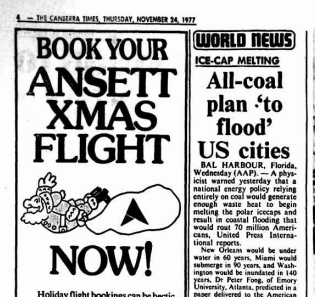
November 24, 1977 – Canberra Times reports “all coal” plan would “flood US cities”

On this day, November 24 in 1978, the Canberra Times ran a story “All coal plan to flood cities”, based on a UPI wire story about an American Physical Society meeting the day before in Florida where Dr Peter Fong called an all-coal energy policy “tantamount to suicide”

, 

1977 All coal plan to flood cities Canberra Times…p. 4.

https://trove.nla.gov.au/newspaper/article/110879451?searchTerm=All%20coal%20plan%20to%20flood%20cities#

[The amount of carbon dioxide in the atmosphere was 334ppm. At time of writing it was 417ishppm- but for what it is now,well, see here for the latest.]

Why this matters. 

By the late 1970s, carbon dioxide from coal and other fossil fuels was beginning to be publicly talked about as a SERIOUS long-term threat, around the world.

What happened next?

There was a late 1970s attempt to get international action. It failed. We went instead for a second Cold War, bleeding the Soviet Union to death and then rolling drunk on triumphalism into the 1990s…  By which time the chance to take a different path was… well, you know the rest…