Categories
Australia

November 22, 2002 – private business battles on #climate become public in Australia

On this day, November 22 2002, the nasty spat within Australian business over whether to call for Australia to ratify the Kyoto Protocol broke out into public., with an article “Big business splits over greenhouse” by Miranda McLachlan in the Australian Financial Review

The dominant big business association, the Business Council of Australia, had backed Prime Minister John Howard in not ratifying the Kyoto Protocol (even though Australia had been able to extort an absurdly generous “reduction” target of … an 8 per cent increase in emissions (more once you added the land-clearing loophole.

But over time, key business leaders – proponents of renewables, carbon trading etc, fought within the BCA for a change in its position.  They fought each other to a standstill, as reported in the Fin, and the BCA went to a “no position” position on Kyoto ratification…

See also – Bell, S. (2008). Rethinking the Role of the State: Explaining Business Collective Action at the Business Council of Australia. Polity, Vol. 40,. 4, 464-487

[The amount of carbon dioxide in the atmosphere was 373ppm. At time of writing it was 417ishppm- but for what it is now,well, see here for the latest.]

The context was this – 

Why this matters. 

When the business lobby splits, that’s when the fun starts. Which is why incumbent actors work so hard to stop those splits…

What happened next?

Howard held the line. Public pressure on climate only really kicked in in Australia in the second half of 2006.  The BCA promptly moved to various fall back positions.

The emissions kept climbing. The atmospheric concentrations kept climbing. Then came the ‘natural’ disasters.
Categories
Australia Carbon Pricing

 November 16, 1994 – Industry lobbyists trot out “sky will fall” argument against emissions cuts. Again. Of course. As ever.

On this day, November 16 in 1994, in the midst of another flare up in the “should we put a price on carbon?” battles, the Aluminium industry released more “evidence”.

THE Commonwealth’s current targets for reducing greenhouse gas emissions will cost the economy almost $200 billion over the next decade, wiping out Australia’s aluminium industry in the process, a new study released yesterday claims.

Dwyer, M. 1994. Emission cuts ‘to kill aluminium industry’. The Australian Financial Review, 17 November, p.13.

[The amount of carbon dioxide in the atmosphere was 359ish ppm. At time of writing it was 419ishppm- but for what it is now,well, see here for the latest.]

The context was this – 

The fossil fuel lobby and its mates were determined to kill any carbon taxes/prices at birth. This was part of the effort.  Basically, find an economist willing to produce a “report” that shows the sky will fall, that the economy will collapse and we will all be reduced to living in mud huts and eating each other’s corpses if so much as a molecule less of coal/oil/gas is extracted.  Time the release of the “report”, give it to your tame mates in the media, then get tame mates in Parliament to quote the report and newspaper coverage. Bish bosh…

Why this matters. 

Think where we might have got to with political leaders with spine!!  We might be as much as 10 per cent less doomed than we are now!!

What happened next?

No carbon tax.  A carbon price in Australia didn’t kick in until July 2013. And then was killed off a year later.  Ha ha ha ha .

Categories
Australia Denial Fossil fuels

November 13, 2008 – Coal industry tries to get some ‘love’

On this day, November 13, 2008, the Australian Coal Industry launches a propaganda (that’s what “public relations” is called when our official enemies do it) campaign, dangling the promise of “NewGenCoal.”

THE coal industry feels unloved. Its polling tells it Australians have no idea what, if anything, it is doing to reduce its greenhouse gas emissions – and most say they’ve never heard of carbon capture and storage.

So the coalminers want to convert us. Today the Australian Coal Association launches a $1.5million ad campaign – and a $1million website – to tell us what it’s doing to develop what it calls “NewGenCoal”.

Association executive director Ralph Hillman predicted that carbon capture and storage would be commercially viable by 2017, and said the industry was investing $1 billion to ensure coal a future as a low-emission technology.

Colebatch, T. 2008. Coal industry reaches out for love. The Age, 13 November, p.3.

(Check how they put land-clearing and intensive agriculture AHEAD of fossil fuels!)

On this day the atmospheric PPM for carbon dioxide was roughly 385.

Now it is 419ish- but see here for the latest.

Why this matters. 

We need to remember just how much effort (you might even say energy) goes into trying to polish the turds…  How much the fossil fuel industry sector invests in trying to keep its legitimacy, and having people think well of it…

For an overview of Australian coal industry efforts, see https://theconversation.com/recycling-rules-carnival-of-coal-is-a-blast-from-the-pr-past-45819

What happened next?

Prime Minister Kevin Rudd played politics, failed to get his terrible legislation through. The climate wars. The ACA was wound up in 2013 or so I think, but the coal lobby did a reverse takeover of the Minerals Council of Australia.  My proof?  Scotty from Marketing and that lacquered lump…

Categories
Australia

November 12, 1999 – John Howard and mates say “nope” to renewables

On this day, November 12, 1999 the cabinet of Prime Minister John Howard said “nope” to a pitifully small renewables target.

A proposal by the Minister for the Environment, Senator Robert Hill, implementing the Federal Government’s target of a 2 percentage increase in renewable energy was rejected by Cabinet because of industry concerns.

“Howard’s 2 per cent target has fallen victim to industry lobbying, again,” said Dr Clive Hamilton, executive director of Canberra policy research centre, The Australia Institute.

Two weeks ago, Senator Hill put a submission to Cabinet, arguing, according to industry sources, that meeting the target be made mandatory for business.

Hordern, N. 1999. Cabinet rejects energy target. Australian Financial Review, 12 November, p.17.

[The amount of carbon dioxide in the atmosphere was 368ppm. At time of writing it was 419ishppm- but for what it is now,well, see here for the latest.]

The context was this – 

In 1997 John Howard, desperate to prevent Australia having to adopt emissions reductions at the impending Kyoto Conference, had made various promises about renewable energy and so forth.  Once the moment had passed (Australia got an absurdly generous deal at Kyoto), he didn’t need to keep those promises (like any conman). And the industry lobbyists got to work, with their usual aplomb…

Why this matters. 

Australia could have been a renewable energy superpower.  Could have led the way.

What happened next?

In 2004 Howard got his fossil fuel mates to further undercut renewables in 2004, but the minutes of the “LETAG” meeting leaked. 

Categories
Australia Denial United Kingdom

November 9, 1991 – Australian TV station SBS shows demented ‘”Greenhouse Conspiracy” ‘documentary’

On this day, November 9 in 1991, the Australian TV station  SBS shows ‘The Greenhouse Conspiracy’, a deluded documentary throwing shade on basic science, which had been broadcast in the UK on 12th August 1990.

The Institute of Public Affairs had bought and tried to get the ABC to show (see John Stone letter to Australian, 3 December 1990)

“This particular [program] concluded greenhouse was the product of a coalition of self-interested-researchers hungry for funds, politicians looking for a cause, journalists eager for a story.”

Cribb, J. 1991. The Greenhouse Conspiracy Effect. The Weekend Australian, 7-8 Dec, p.28

[The amount of carbon dioxide in the atmosphere was xxxppm. At time of writing it was 421ishppm- but for what it is now,well, see here for the latest.]

The context was this – 

The Australian denialists were desperately flinging whatever mud they could. This was part of it all.

Why this matters. 

The lack of action on climate is not an accident. It is not TOTALLY the fault of “those evil guys over there” – there is inertia and stupidity in human systems, sure – but the guys who tried to stop anything getting done have names, and should be at the Hague…

What happened next?

Australian governments decided vague promises (of technology, trading, hopium) were an adequate response to the threat.  Civil society never managed to get its act together. The end (literally).

Other batshit crazy “documentaries” also got made – the last one that had any real traction was “The Great Global Warming Swindle” in 2007.

Categories
Australia Cultural responses

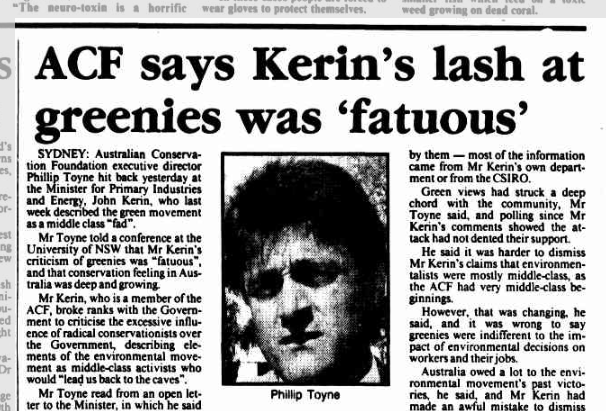
November 8, 1989 – ALP Minister says environmentalism a “middle-class fad” – “greenies” respond…

On this day, November 8 1989, greenies respond to a Labor Minister who declared environmentalism to be a “middle class “fad.”

SYDNEY: Australian Conservation Foundation executive director Phillip Toyne hit back yesterday at the Minister for Primary Industries and Energy, John Kerin, who last week described the green movement as a middle class “fad”.

1989 Anon, 1989. ACF says Kerin’s lash at greenies was ‘fatuous’. Canberra Times, 9 November, p.7.

http://trove.nla.gov.au/newspaper/article/120858727

[The amount of carbon dioxide in the atmosphere was 351ppm. At time of writing it was 416ppm- but for what it is now,well, see here for the latest.]

The context was this – 

Australians had begun to really get their heads around environmental degradation, the Greenhouse Effect (see Dan Cass’s brilliant essay on this site).  In May 1989 Tasmanian Greens had done very very well at the elections there. Labor saw the Liberals trying to outflank them on climate (true story). Business was beginning to organise its pushback.  The speech by Kerin can be seen as the beginning of the general reaction…

Why this matters. 

There’s always a pushback.  In Australia’s case, it’s gone on “successfully” for three decades. But then, the country was always a quarry with a state attached…

What happened next?

The pushback.

Categories
Australia

November 6, 2009 – Kevin Rudd playing politics with the climate

On this day, November 6 in 2009, Australian Prime Minister Kevin Rudd gave a speech at the Lowy Institute about climate change, ahead of his second go at getting legislation through Parliament, and with the Copenhagen Conference coming up.  And he enjoyed poking Opposition Leader Malcolm Turnbull in the chest

“The clock is ticking for the planet, but [the] vested interests at work are simply too great”

Rudd had not really done very much talking about climate change over the previous two years (except when a policy document was landing). A February 2010 article by journo Peter Hartcher  claimed Rudd’s climate silence had been deliberate, since it meant the media would be attacking Liberals a lot. Who knows. Certainly Rudd could have been out there explaining the basics and explaining the danger, instead of occasional soundbites. 

[The amount of carbon dioxide in the atmosphere was xxxppm. At time of writing it was 416ppm- but for what it is now,well, see here for the latest.]

The context was this – 

Turnbull had made false accusations about Rudd and corruption a few months previously (“Godwin Gretch”). Rudd was enjoying the Liberals and Nationals fighting each other, weakening Turnbull.

Why this matters. 

No issue – even the end of the world – is off limits to politicians engaged in their usual positioning and fighting. An active civil society might have kept a lid on that, a bit, I guess. We’re so toast.

What happened next?

Turnbull got replaced by Tony Abbott.  Rudd’s legislation failed, (and yes, the Greens didn’t vote for it), Copenhagen was a disaster and Rudd didn’t have the spine and good sense to do what his advisers were begging him to do – call a double dissolution election about climate change.  He then pissed off Julia Gillard one time too many, she rolled him and…. Oh, it’s so exhausting to recount.

Categories
Australia

November 5, 1992 – Jeremy Leggett calls Australian petrol price cuts “insane”

On this day, November 5 in visiting British geologist and Greenpeace climate adviser gave a speech at the National Press Club. With a Federal Election imminent in March 1993) he weighed in on Australian domestic policy, days before the so-called “National Greenhouse Response Strategy” is launched., 

A visiting environmental scientist — an expert on the greenhouse effect — has branded as “insane” the federal Coalition’s promise to cut petrol prices if it is elected.

Dr Jeremy Leggett, who works for the environmental group Greenpeace in Britain, told a National Press Club lunch yesterday that the Coalition’s plan to cut petrol prices flew in the face of world concern about global warming.

“You reduce petrol prices at the direct peril of generations of Australians to come,” he said.  And – In Canberra yesterday the World Wide Fund for Nature launched what it called a “green print” for Australia’s future over the next three years.

The document called for endangered species protection legislation to be enacted this year, for the Federal Government to act on the recommendations of its ecologically sustainable development process and for ratification of conventions on climate change and biodiversity.

Leggett’s speech – “Accounting for Global Warming, Financial Institutions Wake Up To the Impacts”

Mussared, D. 1992. Pledge to cut petrol prices ‘insane‘. Canberra Times, Friday 6 November, page 5

[The amount of carbon dioxide in the atmosphere was xxxppm. At time of writing it was 416ppm- but for what it is now,well, see here for the latest.]

The context was this – 

Australian ambition to do anything about climate change had been wilting for a year, and in 1992 new Prime Minister Paul Keating had basically binned all the ‘green crap’ (to use a term David Cameron later used).

All that was left was the names and jargon to throw around, disconnected from any reality, any ambition, any responsibility.

Why this matters. 

We know who did this.

What happened next?

Decades of denial – hard or soft,  predatory delay, “triangulation” etc.

Categories
Australia

November 4, 2006 – Australians “Walk against Warming”

On this day, 16 years ago, a few months into one of the periodic explosions of concern about climate change, a Big Event happened in Sydney (and elsewhere)

“The Walk against Warming in Sydney on 4 November 2006, connected to similar events around the country, provided further cause to worry about the environment movement’s strategic grasp of the change opportunity now emerging. Business in many guises is now a key part of driving climate action, yet there was no formal sign of this at the rally. The speakers were the usual suspects: an environmental group, a trade unionist, Greens leader Bob Brown, the then ALP environmental spokesman Anthony Albanese and a church leader. Not a business leader or commercial voice to be heard, and when the Sunday papers reported the event the next morning, they were mainly interested in a celebrity participant, the Hollywood star Cate Blanchett.”

(Hogarth, 2007:62)

For an account – see here.

For my two cents, see this piece in The Conversation from 2018 about the (limited) utility of marches

[The amount of carbon dioxide in the atmosphere was 382ish ppm. At time of writing it was 416ishppm- but for what it is now,well, see here for the latest.]

Why this matters

We may be beyond ups and downs in public awareness now, with the wreckage piling up around us all the time. But even within that “pervasive awareness” there will be lulls, when “normal life” seems to be returning. So, good to remember this pattern.

What happened next

The climate wars – Howard versus Rudd, Abbott versus Gillard.  Exhaustion for the small groups that tried to make a (local/national/global) difference.  Lost opportunities, wasted time that we didn’t have. So, you know, the usual.

Categories
Australia Denial

November 3, 2000 – Australian denialists get American scientist to testify about Kyoto Protocol, smear IPCC

On this day, November 3 in 2000,  American scientist Richard Lindzen  testified to an Australian Senate investigation of Kyoto Protocol, at the behest of the denialist group that grandly and inanely took the name of a French chemist called  Lavoisier…

According to the final senate report

“Professor Richard Lindzen, a Professor of Meteorology from the Massachusetts Institute of Technology, questioned the idea of ‘scientific consensus’ of reports of the IPCC. He claimed that the IPCC has hundreds of scientists, each working on a couple of pages, with none ever polled to assent to the summary. This, he claimed, is used as a bludgeon for questioning. Further, he claimed that scientists permit this to happen for their own self-preservation and to maintain an interest in the science.”

[The amount of carbon dioxide in the atmosphere was 369 or soppm. At time of writing it was 416ish ppm- but for what it is now,well, see here for the latest.]

The context was this – 

Australia had extorted an absurdly good deal at the December 1997 climate conference in Kyoto, with a “reduction” target of … an 8% increase in emissions,  and a huge loophole for “avoided emissions” for deforestation.

But Prime Minister John Howard really didn’t want to ratify it.

There was argy-bargy back and forth, as climate was used as a chip in the “culture” war.

A Senate Investigation was underway and the so-called Lavoisier Group invited Richard Lindzen to give testimony.  (The links between Australian and the USA on climate denial go back to the very early 1990s).

Why this matters. 

The creation of ignorance and doubt about basic scientific facts has been a favoured tool in the hands of those who want things to carry on as they are.

What happened next?

Howard, on June 5 2002 (World Environment Day) announced he was not going to ratify Kyoto.