Fifty five years ago, on this day, May 29, 1968, the United Nations said “let’s talk” about a Swedish proposal to have a conference.
On 29 May 1968, the Economic and Social Council decided to place the question of convening an international conference on the problems of the human environment on the agenda for its mid-1968 session. It did so on the proposal of Sweden
The amount of carbon dioxide in the air was roughly 325.6ppm. As of 2023 it is 423ppm, but check here for daily measures.
The context was that in December of 1967 the Swedes had put forward this as an idea.
What I think we can learn from this
The wheels grind slowly. And you need to have some people who really know how to navigate the system, which the Swedes had.
This “matters” because climate change gets on the agenda here. Atmospheric global global atmospheric pollution levels are starting to be talked of as something that is going to require international cooperation. By now. Westphalian state is going to be a West failure. If you’ll pardon my terrible pun.
What happened next
Sure enough, in June of 1972, the Stockholm conference happened. And it was not as much a success as it needed to be. But at least we got the United Nations Environment Programme for what that’s worth.
What do you think? Does this pass the ‘so what?’ threshold? Have I got facts wrong? Interpretation wrong? Please do comment on this post, unless you are a denialist, obvs.
Fifty five years ago, on this day, May 29, 1968, the United Nations said “let’s talk” about a Swedish proposal to have a conference.
On 29 May 1968, the Economic and Social Council decided to place the question of convening an international conference on the problems of the human environment on the agenda for its mid-1968 session. It did so on the proposal of Sweden
The amount of carbon dioxide in the air was roughly 325.6ppm. As of 2023 it is 423ppm, but check here for daily measures.
The context was that in December of 1967 the Swedes had put forward this as an idea.
What I think we can learn from this
The wheels grind slowly. And you need to have some people who really know how to navigate the system, which the Swedes had.
This “matters” because climate change gets on the agenda here. Atmospheric global global atmospheric pollution levels are starting to be talked of as something that is going to require international cooperation. By now. Westphalian state is going to be a West failure. If you’ll pardon my terrible pun.
What happened next
Sure enough, in June of 1972, the Stockholm conference happened. And it was not as much a success as it needed to be. But at least we got the United Nations Environment Programme for what that’s worth.
What do you think? Does this pass the ‘so what?’ threshold? Have I got facts wrong? Interpretation wrong? Please do comment on this post, unless you are a denialist, obvs..
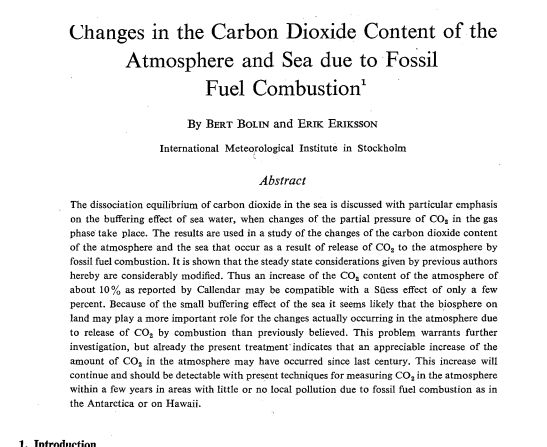
December 30, 2007 – Bert Bolin dies. He was a Swedish scientist, did more than anyone else (I would argue) from the 1950s to the 1980s to get carbon dioxide build-up on the political agenda (he was most certainly not alone in doing this – proper group effort). Find posts about him on this site here.
Bolin’s death was exquisitely well-timed. He had been the first chair of the IPCC, and that organisation had been awarded the Nobel Peace Prize a couple of weeks earlier. The COP meeting of the UNFCCC in Bali had agreed – over US objections – a two year plan of negotiations for a big important/solve the post-Kyoto problem meeting to be held in Copenhagen in December 2009.
Bolin, I hope, died believing that, finally, at last, possibly too late, the rich nations were being successfully corralled into doing something serious on the issue he had been so responsible for.
Bolin’s book – A History of the Science and Politics of Climate Change: The Role of the Intergovernmental Panel on Climate Change – is fairly dry, but great if you’re a geek like me
Btw, at that time atmospheric CO2 was 384ppm. It’s roughly 418 now
On this day in 1967, Swedish diplomats proposed a big international conference on the (human) environment. It would happen, 4 and a half years later, in Stockholm…
“It was during this autumn of surging environmental awareness that three influential Swedes engaged with the United Nations—Inga Thorsson, Alva Myrdal and Sverker Åström—concluded that Sweden should pursue a UN conference on the human environment. To this end, a proposal was put forward at the [United Nations General Assembly] on December 13, 1967 by Börje Billner, Deputy Head of the Swedish UN Mission,”
Paglia, E. (2021) The Swedish initiative and the 1972 Stockholm Conference: the decisive role of science diplomacy in the emergence of global environmental governance. HUMANITIES AND SOCIAL SCIENCES COMMUNICATIONS | (2021) 8:2 | https://doi.org/10.1057/s41599-020-00681-x
Billner’s statement included this
“The impact of the technological revolution that is taking place around us is felt by all peoples, irrespective of their present technological level. It has far-reaching effects on the environment of man. The human body and the human mind are subjected to serious and ever-increasing inconveniences and dangers. These are caused by air pollution, water pollution, sulfur fall-out waste, etc. – in short by all the secondary effects related to the process of industrialization and urbanization”
The context was this – everyone was starting to get freaked out about possible global (as opposed to ‘merely’ local environmental issues.
Atmospheric carbon dioxide was roughly 322ppm (it’s now 418ish).
Why this matters
We’ve been talking about doing something for a very long time. It’s almost as if talking and knowledge isn’t the problem…
What happened next
The usual – a gabfest. It gave us UNEP, and also got the climate ball rolling…
On this day, December 11 in 1895, Swedish scientist Svante Arrhenius read his would-eventually-be-’famous’ paper On the Influence of Carbonic Acid in the Air upon the Temperature of the Ground at the Swedish Academy of Science.
Hamblyn, R. 2009. The whistleblower and the canary: rhetorical constructions of climate change. Journal of Historical Geography, Vol. 35, pp.223-236
[The amount of carbon dioxide in the atmosphere was 295ppm. At time of writing it was 419ishppm- but for what it is now,well, see here for the latest.]
Why this matters
This has become the touchstone for “how long we’ve known” pieces.
What happened next
Arrhenius’ assumptions (and those whose work he drew on) were challenged by Angstrom et al. The idea that a build up of carbon dioxide could cause warming was thrown in the dustbin, and – despite Guy Callendar – only really got pulled out in the 1950s…
November 28, 1974 Olof Palme tells Sweden “The risk of a changed climate… is of utmost importance.”
Swedish Prime Minister Olof Palme, in a newspaper interview, nails the big long-term threat.
“Three months after the conference, the momentum concerning the threat of climate change seems to have led Olof Palme to speak out on the issue. In an article structured as a duel, Palme and the leader of the Conservative Party (Moderaterna), Gösta Bohman, talked about their vision of Sweden in 2000. Palme was asked which threat concerned him the most and answered: ‘The risk of a changed climate due to human activities … To me, this question seems of utter importance.’”
Tom Selander, ‘Partiledare om Sverige år 2000’, SvD 29 Nov. 1974,
[The amount of carbon dioxide in the atmosphere was 315ppm. At time of writing it was 421ishppm- but for what it is now,well, see here for the latest.]
The context was this –
Through the 1950s, American and Swedish scientists (and others) were looking at carbon dioxide levels in the atmosphere and saying to themselves “now that’s interesting.”
Why this matters.
We knew
What happened next?
Bolin? It became Bolin’s life work. He shepherded the climate science agenda forward with skill and patience for decades. He was a key player all through the 1970s and 1980s. First chair of the IPCC. Thank goodness for him he died when he did, before the farce of Copenhagen and so on.
Below is a brilliant guest post, by Swedish historian Kristoffer Ekberg. If there are other folks out there who want to write guest posts – please do get in touch! drmarchudson@gmail.com
14 June 1979 and the messy inclusion of climate change in energy politics
Kristoffer Ekberg
On this date, 14 June 1979, the Swedish government gave the state-owned utility Statens Vattenfallsverk AB or short Vattenfall (meaning water fall) the task of undertaking a large scale investigation into ways of introducing more coal into the energy mix without harming the environment or the health of the population, Kol-Hälsa-Miljö (Coal-Health-Environment).
The aim was to increase the use of coal. The task might not seem strange given the fear of volatile oil prices during the 1970s and the fact that in the beginning of the 1970s up to 75% of Sweden’s energy consumption came from imported oil. Transitioning to a source of energy that was seen as more secure due to the possibility to source it from the proximity in northern Germany seems like a rational choice when only looking at this development.
But understanding this as a strategic move based on solely energy security shows only part of the picture and obscures the dubious enterprise, given the already-existing knowledge of climate change present among the political elites.
Famously hosting the first UN meeting on the human environment in 1972 the issue of climate change was already present among the leadership of the Social democratic party and Swedish political leadership. Bert Bolin (who would later become the first chairman of IPCC), had the year before also convened with the world’s leading climate scientists in Sweden.
In 1974 the Swedish prime minister Olof Palme publicly stated that climate change was one of the most pressing issues in the period up to the year 2000. In 1975 climate change was mentioned in the energy plan that would guide Sweden’s actions the coming years, clearly influenced by Bolin’s work. Climate change science was not unanimous but the Swedish leadership nonetheless engaged with the threat.
Olof Palme, Swedish Prime Minister (source: Wikipedia)
In these years, climate change became a useful argument for a Social Democratic leadership wanting to push for nuclear power. As opposition to nuclear grew larger and more forceful every year, partly resulting in the loss in the election of 1976 ending a 40 year period in power, nuclear became a problem but so was oil.
In governmental reports in 1978, climate change, which had initially been framed as a concern in relation to national energy production and consumption became associated solely with future threats on a global scale.
Even though the coal investigation was tasked with incorporating all available knowledge, the issue of climate change and CO2 was in most parts excluded, despite the previous reports from Bolin and others. Further, during the investigation the issue of CO2 came to the fore through trips to – for example – the Department on Energy, in the US but was deemed a problem not for Sweden but for high emitters like USA, Soviet Union and China.
When finished in 1983, the report mentioned climate change but these formulations were critiqued by the Swedish Meteorological and Hydrological Institute (SMHI) arguing that the investigation had failed to account for the impact on CO2 emissions from introducing more coal.
Why this matters
The episode told here speaks to the messy ways in which climate change entered discussions and speaks to the different strategies that have been used to keep climate change of the table in periods when energy issues are highly debated. The construction of delaying arguments is not new in contemporary society but is something that has happened constantly since climate change entered on the political arena.
Kristoffer Ekberg is an historian working at Chalmers University of Technology, Sweden. His research focuses on the political history of climate change and the environment, corporate anti-environmentalism as well as social movements and utopian thought.