Categories
United Kingdom

July 14, 1967 – “The rights of man and the rape of his environment: a blueprint for a peaceful revolution”

Fifty-nine years ago, on this day, July  14th, 1967, Edward Mishan, had a long article in the Spectator (back when it was still a serious publication).

The rights of man and the rape of his environment: a blueprint for a peaceful revolution

Mishan, Edward J The Spectator; Jul 14, 1967;

“Of course, it happens innocently enough. Machines that are employed to produce services for some simultaneously produce ‘dis- services for others. The recipients of the services acknowledge their value by a willingness to pay for these services. Symmetrical reasoning would require that the recipients of the disservices should receive payment for absorbing these disservices. Things have not worked out this way, however. It is true that such nice calculations would not matter much in a society with only rudimentary technology and an abundance of land relative to its population but this is not the condition of Britain today. 

“With the postwar growth of technology and population these disservices or ‘spillover effects the noise, smell, smoke pollution or other noxious by-products of the operation of industry or their products have become too conspicuous to be ignored any longer by civilised countries.

They range from the strangulation by traffic of cities, resorts and once-quiet hamlets to the extermination of wild life by the indis- criminate use of pesticides; from ubiquitous jets to the spreading plague of beach transistors; from the destruction by mass tourism. of the world’s dwindling resources of natural beauty to the neighbour’s petrol lawn-mower. Indeed, together these spillover effects represent the most outstanding example of postwar growth yet recorded.”

The amount of carbon dioxide in the air was 321ppm. As of 2026, when this post was published, it is 430ppm. This matters because the more carbon dioxide in the air, the more heat gets trapped. The more heat, the more extreme weather events. You can make it more complicated than that if you want, but really, it’s not. Fwiw, I have a tattoo of the Keeling Curve on my left forearm.

The broader context was that the ‘diseconomies’ were steadily growing, with the coming of motorways, airport expansion etc. Yes, some things (visible air pollution in cities) seemed to be improving, but overall, the trajectory was not great. In 1961 Rachel Carson’s Silent Spring had been published. In 1966 the Conservation Society had been founded/

The specific context was a couple of months before this (but after the book had been written), the Torrey Canyon oil spill had been perpetrated….

In 1965, while at the LSE, he wrote his seminal work The Costs of Economic Growth,[2] but was unable to find a publisher until 1967.[3] In this work he expanded on his original 1960 thesis[4] which stated that the “precondition of sustained growth is sustained discontent”, warning developing nations that “the thorny path to industrialisation leads, after all, only to the waste land of Subtopia”.[5]  

What I think we can learn from this – the roots of the upsurge of environmental concern were there in the mid-1960s, in publications conservative and liberal…

What happened next

The Spectator went off a cliff. Is now edited by Michael Gove.

On this topic, you might like these other posts on All Our Yesterdays

References

xx

You can see the chronological list of All Our Yesterdays “on this day” posts here.

What do you think? Does this pass the ‘so what?’ threshold? Have I got facts wrong? Interpretation wrong? Please do comment on this post, unless you are a denialist, obvs.

If you want to get involved, let me know.

If you want to invite me on your podcast, that would boost my ego and probably improve the currently pitiful hit-rate on this site (the two are not-unrelated).

Also on this day: 

July 14, 1996 – Australian Medical Association and Greenpeace 

July 14, 2000 – Miners versus the ALP/ and climate action 

July 14, 2000 – Wind power providers want carbon labelling… 

July 14, 2011 – “Four Degrees or More: Australia in a Hot World” conference closes 

Categories
United States of America

May 19, 1967 – Debate on Pollution, Rockefeller University with Barry Commoner, Rene Dubois, Athlene Spilhaus

Fifty nine years ago, on this day, May 19th, 1967,

Debate on Environmental Pollution, Rockefeller University, New York, Barry Commoner, Rene Dubois, Athlene Spilhaus.

The amount of carbon dioxide in the air was roughly 322ppm. As of 2026 it is 430ppm, but check here for daily measures. 

The broader context was that the pollution issue is beginning to break through beyond simply air pollution in cities. People are beginning to think about the long term, longer term implications. This is partly due to the fact that you’ve had books like Silent Spring published in 1963 based on the 1962 New Yorker articles and a flurry of other books. So you have three interesting people here talking at Rockefeller University in New York, and one of them is Spilhaus, who had studied under Roger Revelle, and whose cartoons about science had appeared in newspapers around the United States, including the greenhouse cartoon in 1958 Spilhaus was well aware of the dangers of carbon dioxide buildup.  Commoner’s book Science and Survival had come out the previous year and it had also had a section on carbon dioxide build-up…

The specific context was that the Vietnam War was raging, the ‘hippies’ were protesting etc.

What I think we can learn from this intellectuals had been saying what was at stake for a very long time. The problem with intellectuals, well, there are many, but one of them is they’re not very good at helping social movements think through the implications of those social movements’ current strategies for maintaining hope or momentum or whatever, and how those strategies might hinder the growth and expansion of the social movement framing.

No one particularly is; I could give it a go, but I’m too idle and dispirited. 

What happened next.  Commoner ran for President in 1980.

The emissions kept climbing.
Btw, if you’re reading this in the US and can get hold of  a recording and transcript, that’d be ace – would be fascinating to know if carbon dioxide build-up came up… 

What do you think? Does this pass the ‘so what?’ threshold? Have I got facts wrong? Interpretation wrong? Please do comment on this post, unless you are a denialist, obvs.

Also on this day: 

May 19, 1937 – Guy Callendar’s carbon dioxide warning lands on someone’s desk

May 19, 1957 – LA Times asks “Is your smoke helping to melt polar icecaps?” – All Our Yesterdays

May 19, 1982 – House of Lords debate on “Coal and the Environment” 

May 19, 1993 – President Clinton begins to lose the BTU battle…

May 19, 1997 – an oil company defects from the denialists. Sort of.

May 19, 1997 – BP boss says “If we are to take responsibility for the future of our planet, then it falls to us to begin to take precautionary action now.”

Categories
Sweden

October 24, 1967 – Acid Rain

Fifty eight years ago, on this day, October 24th, 1967,

“The early theory of acid rain came from a Swedish scientist, Svante Oden, who published it first not in a scientific journal, but in a newspaper, the October 24, 1967, issue of Dagens Nyheter”

The amount of carbon dioxide in the air was 322ppm. As of 2025, when this post was published, it is 425ppm. This matters because the more carbon dioxide in the air, the more heat gets trapped. The more heat, the more extreme weather events. You can make it more complicated than that if you want, but really, it’s not. Fwiw, I have a tattoo of the Keeling Curve on my left forearm.

The broader context was that sulphur dioxide in the atmosphere would screw with buildings and lungs was a long established fact, dating back centuries – by the time of the Industrial Revolution it got so bad in some English cities that – gasp- the British State created an Alkali Inspectorate.

The specific context was Sweden was noticing changes to the acidity of their lakes, and biological impacts on trees, fish etc. And they wondered if the problem might be coming from perfidious Albion…

What I think we can learn from this is that there were plenty of cognate issues to do with atmospheric pollution alongside climate – ozone, nuclear war etc.

What happened next the British politicians ignored, denied etc. etc. that it was their fault. Of course they did. Read more about it here.

What do you think? Does this pass the ‘so what?’ threshold? Have I got facts wrong? Interpretation wrong? Please do comment on this post, unless you are a denialist, obvs.

Also on this day: 

October 24, 1967 – editor of Science warns about C02 build-up

Categories
Activism United States of America

October 7, 1967 – RIP Ruby Doris Smith Robinson

Fifty eight years ago, on this day, October 7th, 1967,

Ruby Doris Smith-Robinson (April 25, 1942 – October 7, 1967)[1] worked with the Student Nonviolent Coordinating Committee (SNCC) from its earliest days in 1960 until her death in October 1967.[2] She served the organization as an activist in the field and as an administrator in the Atlanta central office. She eventually succeeded James Forman as SNCC’s executive secretary and was the only woman ever to serve in this capacity. She was well respected by her SNCC colleagues and others within the movement for her work ethic and dedication to those around her. SNCC Freedom Singer Matthew Jones recalled, “You could feel her power in SNCC on a daily basis”.[3] Jack Minnis, director of SNCC’s opposition research unit, insisted that people could not fool her. Over the course of her life, she served 100 days in prison for the movement.[1]

October 7 1967 Ruby Doris Smith Robinson dies – https://snccdigital.org/people/ruby-doris-smith-robinson/

The amount of carbon dioxide in the air was 322ppm. As of 2025, when this post was published, it is 425ppm. This matters because the more carbon dioxide in the air, the more heat gets trapped. The more heat, the more extreme weather events. You can make it more complicated than that if you want, but really, it’s not. Fwiw, I have a tattoo of the Keeling Curve on my left forearm.

The broader context was the Black Civil Rights movement was in full swing. It gave wider society so much (was an initiator for second wave feminism, anti-war, ecology, gay rights etc etc). But has of course been pacified and diminished in the history books.

The specific context was that life was never particularly easy for women of colour in these movements.

What I think we can learn from this – we should remember, celebrate and learn from these people

What happened next – exhaustion, co-optation and repression did what they always do – by the early 1970s, things were very different… (See Debbie Louis’ And We Are Not Saved).

What do you think? Does this pass the ‘so what?’ threshold? Have I got facts wrong? Interpretation wrong? Please do comment on this post, unless you are a denialist, obvs.

Also on this day: 

October 8, 1988 – Aussie poet and activist Judith Wright in final speech, warns of environmental problems ahead… 

October 7, 1989 – Alexander Downer says mining lobby”weak and gutless”, too soft on greenies – All Our Yesterdays

Categories
Air Pollution United States of America

June 9, 1967 – New York Times reports on temperature drop…

Fifty seven years ago, on this day, June 9th, 1967,

“Temperature dip tied to particles,” New York Times, June 9.


The amount of carbon dioxide in the air was roughly 322ppm. As of 2024 it is 422ppm, but check here for daily measures. 

The context was that in the northern hemisphere, at least, temperatures had been dropping. We now know that that was because of all the extra aerosols sulphates in the air, bouncing a certain amount of the sun’s heat away. Keeping the winters nice and chill. And this seemed like a problem for the theory of carbon dioxide induced warming. It wasn’t but it’s still being held up as one.

What we learn is that it wasn’t crystal clear. People like Keeling and Plass would not deny. There was still uncertainty.

What happened next? There was for the next five years or so, the whole Ice/Heat debate. Things started edging towards the heat trap side. C02 buildup was reported in The Times as a cause of concern in 1972. And then, by the late 70s, it was clear what was going to happen. 

What do you think? Does this pass the ‘so what?’ threshold? Have I got facts wrong? Interpretation wrong? Please do comment on this post, unless you are a denialist, obvs.

Also on this day: 

October 9, 1979 – Hermann Flohn warns Irish of “possible consequences of a man-made warming”

October 9, 1991 – Greens get labeled religious fanatics, don’t like it.

Categories
Swtizerland

June 5, 1967 –  Working Group on Atmospheric Pollution and Atmospheric Chemistry

Fifty eight years ago, on this day, June 5th, 1967, some scientists met in Geneva. I know, fascinating eh…

REPORT OF MEETING – METEOROLOGICAL ASPECTS OF ATMOSPHERIC POLLUTION AND ATMOSPHERIC CHEMISTRY

(Received 23 January 1968)

IN THE week of 5 June 1967 the Working Group on Atmospheric Pollution and Atmospheric Chemistry, established by the Commission for Atmospheric Sciences (formerly Commission for Aerology) of the World Meteorological Organization met for the first time in Geneva.

The following persons act as members of the W.G.:

F. H. Schmidt (Chairman), Netherlands

E. Eriksson, Sweden

A. G. Forsdyke, England

R. E. Munn, Canada

Mrs. E. S. Selezneva, U.S.S.R.

Atmospheric Environment, Pergamon Press 1968. Vol. 2, pp. 423-426.

The amount of carbon dioxide in the air was roughly 322ppm. As of 2025 it is 430ppm, but check here for daily measures. 

The broader context was that from the early 1950s questions around atmospheric pollution – first sulphur dioxide, but then latterly carbon dioxide and others – worked their way through the science-policy system.

The specific context was that the President’s Scientific Advisory Council had released a report in late 1965 that did more than name-check carbon dioxide.  Shell and others were beginning to pay attention… 

What I think we can learn from this is that the wheels of the WMO and WHO and so on grind slow, but grind they do. (Given time, I’d like to trace this process more.)

What happened next – by the late 1960s, word was getting through, thanks not so much to these sorts of meetings (that was not their purpose!) but thanks to various popularisers, e.g. Peter Ritchie-Calder.

What do you think? Does this pass the ‘so what?’ threshold? Have I got facts wrong? Interpretation wrong? Please do comment on this post, unless you are a denialist, obvs.

Also on this day: 

June 5, 1993 and 2011- let’s have a march for #climate… It will make us feel good. – All Our Yesterdays

Categories
United States of America

January 27, 1967 –  Time Magazine talks carbon dioxide build-up

Fifty eight years ago, on this day, January 27th, 1967,

After the usual litany of localised issues, it ends with this remarkable set of paragraphs. 

Other scientists are concerned about the tremendous quantities of carbon dioxide released into the air by the burning of “fossil fuels” like coal and oil. Because it is being produced faster than it can be absorbed by the ocean or converted back into carbon and oxygen by plants, some scientists think that the carbon dioxide in the atmosphere has increased by about 10% since the turn of the century. The gas produces a “greenhouse” effect in the atmosphere; it allows sunlight to penetrate it, but effectively blocks the heat generated on earth by the sun’s rays from escaping back into space.

No Apocalypse. 

There has already been a noticeable effect on earth—a gradual warming trend. As the carbon-dioxide buildup continues and even accelerates, scientists fear that average temperatures may, in the course of decades, rise enough to melt the polar ice caps. Since this would raise ocean levels more than 100 feet, it would effectively drown the smog problems of the world’s coastal cities.

The waters, however, need never rise. Within his grasp, man has the means to prevent any such apocalyptic end. Over the short run, fuels can be used that produce far less pollutant as they burn. Chimneys can be filtered so that particulate smoke is reduced. Automobile engines and anti-exhaust devices can be made far more efficient. What is needed is recognition of the danger by the individual citizen and his government, the establishment of sound standards, and the drafting of impartial rules to govern the producers of pollution. Over the long run, the development of such relatively nonpolluting power sources as nuclear energy and electric fuel cells can help guarantee mankind the right to breathe.

The amount of carbon dioxide in the air was roughly 322ppm. As of 2025 it is 425ppm, but check here for daily measures. 

The context was that Time had first covered the possible problem of C02 build-up in 1953, in response to Gilbert Plass’s statements at the AGU meeting. The more immediate context was that questions of pollution, air, water, noise had been exercising American journalists and writers for several years. There’s the wonderful song Pollution by Tom Lehrer two years earlier. 

And the crucial context, perhaps, is not so much Lyndon Johnson’s message to Congress in February 1965 but Philip Abelson’s editorial in Science two weeks before Time published this 

What I think we can learn from this is that if you were reading either Science or Time magazine or both back then, the idea of carbon dioxide build up as a problem was there at the beginning of 1967 which is 58 years ago. This was not arcane. This was not bizarre. This was 1967. Alongside this, you also had, of course the book Science and Survival, by Barry Commoner, that had come out the previous year. 

What happened next

Time and Newsweek kept doing the sort of hand wringing, “What have we done?” reports As did US News and World Report. And then, really, by late 1969 the environment “took off” as an issue.

What do you think? Does this pass the ‘so what?’ threshold? Have I got facts wrong? Interpretation wrong? Please do comment on this post, unless you are a denialist, obvs.

Also on this day: 

January 27, 1967 – James Lovelock told to keep schtum about climate change by Shell science boss

January 27, 1989 – UN General Assembly starts talking #climate

January 27, 1986 – Engineers try to stop NASA launching the (doomed) Challenger Space Shuttle

Categories
United States of America

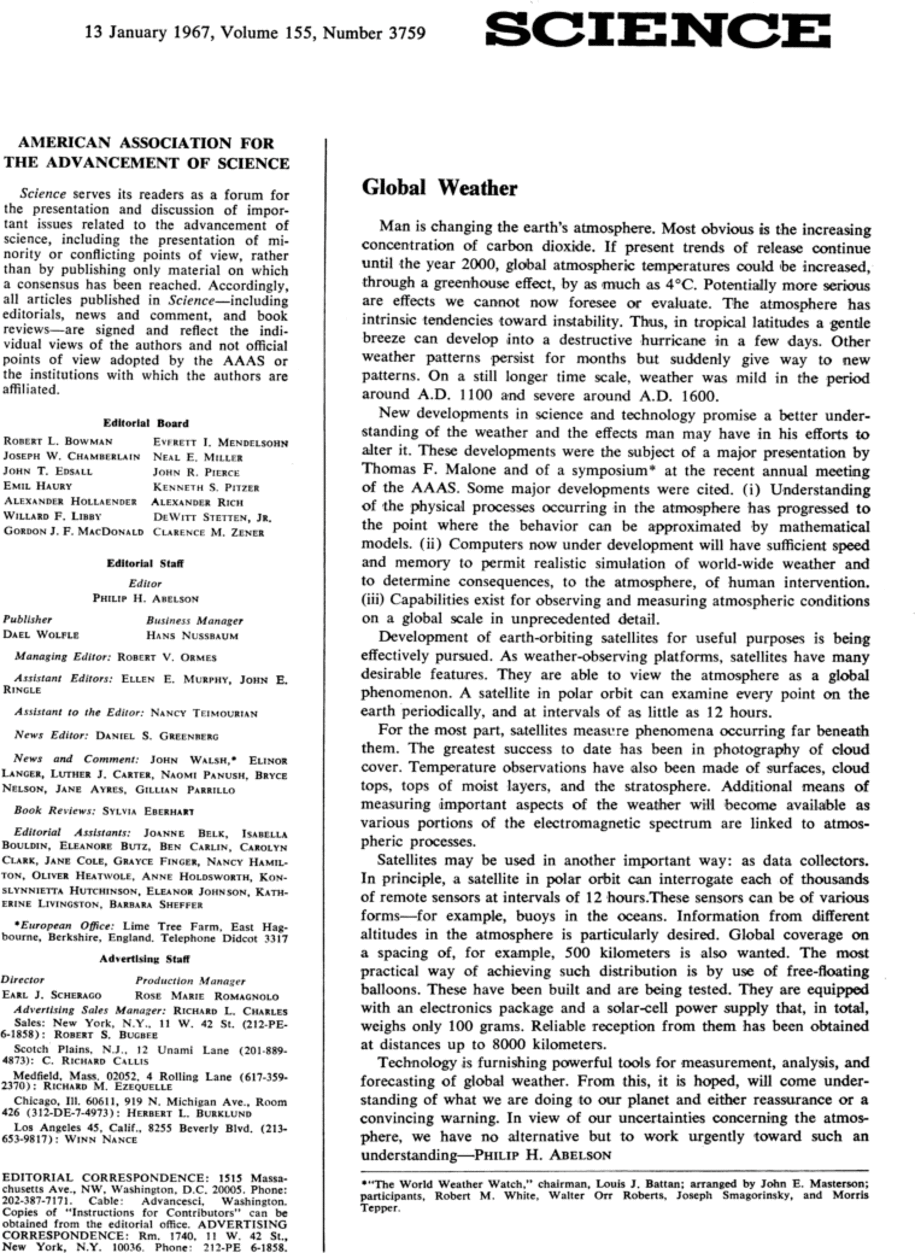
January 13, 1967 – crucial editorial in Science – “Man is changing the earth’s atmosphere…”

Fifty eight years ago, on this day, January 13th, 1967, the editor of the most prestigious American scientific journal, Science, writes about the carbon dioxide threat,

“Man is changing the earth’s atmosphere.  Most obvious is the increasing concentration of carbon dioxide.

The amount of carbon dioxide in the air was roughly 322ppm. As of 2025 it is 425ppm, but check here for daily measures. 

The context was that almost exactly two years before Lyndon Johnson, President of the United States, had made an address to Congress that included mention of CO2 build up. And in the intervening period, there had been a report in November 1965  by the President’s Scientific Advisory Panel Council and other reports. Abelson, who had trained as a nuclear physicist, clearly had his finger on the pulse (part of the job spec for editor of the premier scientific journal in the United States!) 

What we learn is that at the beginning of 1967, readers of the journal Science would have been aware of this as a potential issue. Now, it turns out that the estimates of temperature increase were vastly overblown, overstated. The word could is doing a lot of work. Nonetheless, it shows us that this was an issue that scientific political elites were aware of. 

What happened next  Ableson did keep talking about CO2. So for example, there’s him at a symposium later that year

What do you think? Does this pass the ‘so what?’ threshold? Have I got facts wrong? Interpretation wrong? Please do comment on this post, unless you are a denialist, obvs.

Also on this day:

January 13, 1965 – President Lyndon Johnson gets a memo about carbon dioxide build-up and climate change

January 13, 2004 – Bob Carr rallies states for emissions trading

January 13, 2005- UN Secretary-General calls for “decisive measures” on climate change

January 13, 2021 – New Scientist reports on types of intelligence required to deal with #climate change  

ps – from Wikipeia-

Abelson was outspoken and well known for his opinions on science. In a 1964 editorial published in Science magazine, Abelson identified overspecialization in science as a form of bigotry. He outlined his view that the pressure towards specialization beginning in undergraduate study and intensifying in PhD programs leads students to believe that their area of specialization is the most important, even to the extreme view that other intellectual pursuits are worthless. He reasoned that such overspecialization led to obsolescence of one’s work, often through a focus on trivial aspects of a field, and that avoidance of such bigotry was essential to guiding the direction of one’s work.[7]

Categories
United Kingdom

December 7, 1967: Towards Tomorrow “Assault on Life”

Fifty seven years ago, on this day, December 7th, 1967,

Speaking of a programme that was broadcast on 7th December 1967, Roy Battersby wrote in his memoir. 

 I went back to do some more documentaries for him in a series called Towards Tomorrow. The first, the subtly-titled Assault on Life, about biological research into cloning, fertilization in vitro, sperm banks, genetic engineering etc. created a lot of discussion. It began with commentary over a shot of a foetus in utero:

“If he asks why polluted air for his first breath, why the rivers are dying, the animals disappearing, the ice caps in danger of melting, if he asks about war and the countless millions killed this century, what shall we tell him: That we have the secret of life?”

The support of Professor Waddington and Sir Alex Haddow and Barry Commoner was of great importance in the specially televised public debate that followed, and in keeping the BBC’s nerve.

(Battersby, 2014: 19)

The amount of carbon dioxide in the air was roughly 322 ppm. As of 2024 it is 425ppm, but check here for daily measures. 

The context was that Roy Battersby had already made one film mentioning carbon dioxide buildup – that was Challenge, which had been released at the beginning of 1967. This was the first in a new series called Towards Tomorrow, which ran for two seasons and caused a bit of a stir.

What we learn is that the questioning of technoscience will get you labelled as a troublemaker/hysterical luddite/whatever, because the arguments for unbridled technological development are actually quite thin and rather than address those they’ll go ad hominem on you. 

What happened next Battersby we made another film for Towards Tomorrow. But his third film Hit Suddenly Hit was well there’s no other word for it suppressed. Meanwhile all the things he warned about in his films has potential problems pretty much come to pass and here we go 

What do you think? Does this pass the ‘so what?’ threshold? Have I got facts wrong? Interpretation wrong? Please do comment on this post, unless you are a denialist, obvs.

Also on this day: 

December 7, 1928 – Noam Chomsky born

December 7, 1967 – Swedish “Monitor” program talks environmental crisis

Categories
United States of America

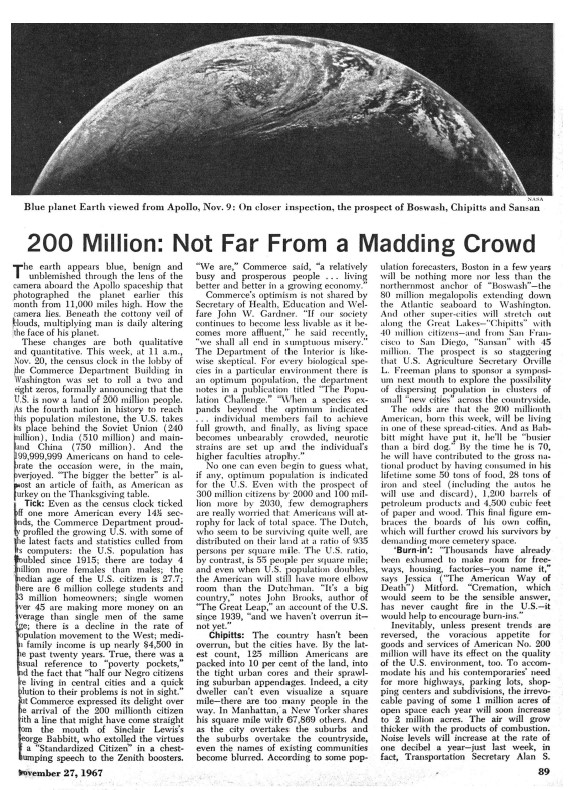
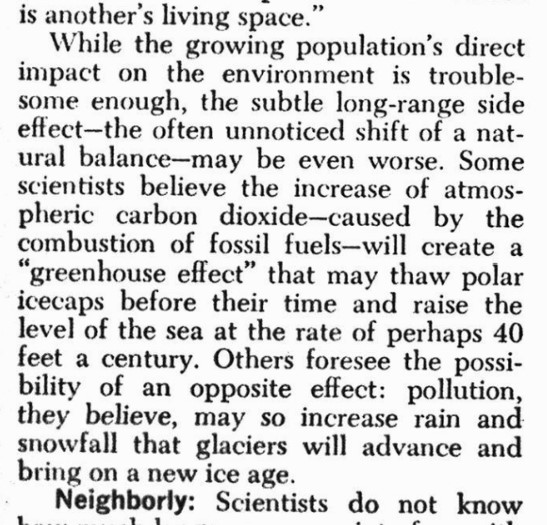
November 27 1967 – Newsweek wrings its hands about future ecological problems, including carbon dioxide

Fifty-seven years ago, on this day, November 27th,1967, Newsweek flagged carbon dioxide build-up as one thing to worry about..

The amount of carbon dioxide in the air was roughly 322ppm. As of 2024 it is 423ppm, but check here for daily measures. 

The context was that the weekly news magazines like Time and Newsweek were beginning to wring their hands about smog, water pollution, air pollution, etc. It sold newspapers and probably resonated with a proportion of voters. Lyndon Johnson had already in 1965, given his seal of approval to the issue by doing a special message to Congress. And I suppose in 1967, it was possible – if you wanted to criticise the state of the world, but you didn’t want to criticise your government and say anything about Vietnam – you could find another issue i.e. the environment, which was “less controversial.” Though, of course, you’d soon start offending the advertisers. And the local Chamber of Commerce, if you named too many names.

What we learn is that 1968-69 and especially ‘69 really is when the whole thing takes off.

What happened next? Time and Newsweek ran stories about, you know “our polluted planet” and all the rest of it. And then it really kicked into much higher gear after the Santa Barbara Oil Spill in January 1969. And politicians like Edmund Muskie, and Scoop Jackson for getting hold of the issue as well. As was new President Tricky Dick Nixon with his idea for a government subcommittee that he would chair. And the emissions kept climbing. 

What do you think? Does this pass the ‘so what?’ threshold? Have I got facts wrong? Interpretation wrong? Please do comment on this post, unless you are a denialist, obvs.

Also on this day: 

November 27, 1956 – New York Times science writer who covered C02 build-up dies.

November 27, 1969 – Canberra Times runs pollution article, mentions melting ice-caps

November 27, 1978 – “Impacts of climate on Australian Society and Economy” begins…