Categories
Science United Kingdom

June 22, 1976 – Times reports “World’s temperature likely to rise”

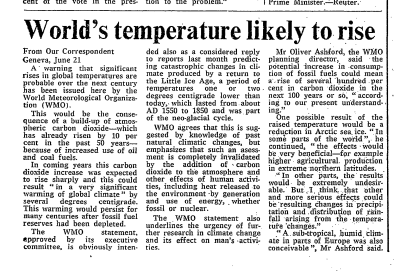
On this day 22nd June, 1976, the Times (pre-Murdoch) ran a story with the headline “World’s temperature likely to rise”’, buried at the bottom of page 9.

“A warning that significant rises in global temperature are probable over the next century has been issued here [Geneva] by the World Meteorological Organisation (WMO).

This would be the consequence of a build-up of atmospheric carbon dioxide – which has already risen by 10 per cent in the past 50 years – because of increased use of oil and coal fuels.”

WMO were, it turns out, having a spat with the “Ice Age is coming” folks… 

Why this matters. 

We. Knew. Enough. To. Be. Worried. And taking action, by the late 1970s. This was not a deep dark state secret. This was in the fricking newspapers.

What happened next?

Sank without trace. In 1979 the WMO held the First World Climate Conference, also in Geneva. Momentum, but not enough to survive the arrival of the Thatchers and Reagans of this world…

Categories
Cultural responses United Kingdom

June 20, 1977- “Alternative Three” – An early Climate Hoax 

On June 20 1977 the mockumentary (as we would now call it) “Alternative 3” was broadcast. It was supposed to go out on April 1st, but a strike scuppered that.
So, the documentary, which – well, let’s go to Wikipedia –

 Purporting to be an investigation into the UK’s contemporary “brain drain“, Alternative 3 uncovered a plan to make the Moon and Mars habitable in the event of climate change and a terminal environmental catastrophe on Earth…

It was claimed that scientists had determined that the Earth‘s surface would be unable to support life for much longer, due to pollution leading to catastrophic climate change. Physicist “Dr Carl Gerstein” (played by Richard Marner) claimed to have proposed in 1957 that there were three alternatives to this problem. The first alternative was the drastic reduction of the human population on Earth. The second alternative was the construction of vast underground shelters to house government officials and a cross section of the population until the climate had stabilised, a solution reminiscent of the finale of Dr Strangelove. The third alternative, the so-called “Alternative 3”, was to populate Mars via a way station on the Moon.[6]

Why this matters. 

Atmospheric consequences were well enough known in the mid 70s to be the stuff of parody. I have a copy of the book – it’s WILD

What happened next?

There are still people out there who believe it.

It’s a bit like the (wonderful) Report from Iron Mountain, by Leonard Lewin.

Categories
Science Scientists Uncategorized United Kingdom

June 18, 1976- UK Meteorological Office explains things to Cabinet Office

On this day, June 18 1976 the UK Meteorological Office’s director, John S. Sawyer, replied to a request from the Cabinet Office. Two days earlier they’d asked for his take on Reid Bryson, a prominent US atmospheric scientist. Bryson was predicting imminent climate change (but NOT from the build up of carbon dioxide, which he considered a non-issue.


Sawyer was scathing – Bryson was “completely misleading and alarmist”.

The context is that by the mid-70s, with a series of “weird weather events” (including the 1976 drought, then underway), policymakers were beginning to wonder if something was up with the weather.

You can read more about this,and where I got the above information from, in the excellent paper Computing the Climate: When Models Became Political“by Janet Martin-Nielson. The specific quote is this –

In 1976, the Cabinet Office wrote to the Meteorological Office’s director of research, John S. Sawyer, asking for his views on Bryson’s work. Bryson is ‘‘completely misleading and alarmist,’’ replied Sawyer only two days later, and, he continued, ‘‘the evidence that a permanent climatic change of significant magnitude is in train is at best exceedingly sketchy.’’42

 J. S. Sawyer to D. C. Thomas, 18 Jun 1976, KEW, CAB 164/1379  Martin-Nielson, 2018 Computing the Climate

Why this matters. 

We need to remember that it wasn’t a straight line, that carbon dioxide build-up was only one of the ways that scientists thought the weather could change. That uncertainty can be hard to recollect in the aftermath of 1985 onwards…

What happened next?

Bryson refused to accept that carbon dioxide was driving observed climatic changes. These things happen – people don’t like to admit they backed the wrong horse.

A report on climatic change finally got presented to Margaret Thatcher in 1980. Apparently her response was incredulity and “you want me to worry about the weather.” And this, from a chemist.
Categories
Cultural responses International processes United Kingdom

June 16, 1972 – David Bowie and (Five Years until) the End of the World. Also, Stockholm

On this day, June 16, in 1972 the  UN Conference on the Human Environment in Stockholm, concluded. Four years in the making it had acted as a magnet for lots of various concerns.  It also acted as a punctuation point – the end of the first big wave of public concern about environmental matters (the next wave wouldn’t really get going until the mid-late 80s).

What did Stockholm give us? Well, the United Nations Environment Program, albeit at a much lower size and heft than some wanted.  UNEP proved crucial as an institutional ally for the World Meteorological Organisation and various groups of scientists trying to get carbon dioxide build up properly on and then up the agenda.

But on the same day, and more interesting,, was the release of the song “Five Years” by David Bowie (it had been recorded in November 1971).

Pushing thru the market square
So many mothers sighing
News had just come over,
We had five years left to cry in

News guy wept and told us
Earth was really dying
Cried so much his face was wet
Then I knew he was not lying

Why this matters. 

Stockholm, Bowie – yeah. Well, here we are. Fears of imminent (ecological) catastrophe have been with us before (that does not automatically mean that the latest rash of fears is unwarranted).

What happened next?

Stockholm became the major example of “how you do international environment conferences” I think, and the template has been replayed and replayed. 

Categories
Activism United Kingdom

June 13, 2008 – activists stop coal train, throw coal off. Convictions eventually quashed…

On June 13 June 2008 climate activists involved in the whole “camp for climate action” thing stopped a train heading to Drax power station in Yorkshire (the site of the first Camp for Climate Action, in August-September 2006).

They shovelled coal off it before the police arrived and arrested them all.

See Indymedia for more pictures.

They went on trial A year  later 

“Twenty nine people were convicted in July following a four-day jury trial at Leeds crown court. Today, at the same court, Judge James Spencer QC, ordered five, who had previous convictions, to do 60 hours unpaid work and three were ordered to pay £1,000 in costs and £500 compensation to Network Rail. The judge said the loss to the company had been almost £37,000. Twenty one members of the group were given conditional discharges for 12 months.”

And in January 2014… those convictions were quashed because the driver for the activists had been… undercover cop Mark Kennedy.

A re-do action by Greenpeace in September 2014 got no coverage, as best I can tell…

Why this matters. 

We should know about the brave history of direct action on climate change. It didn’t start with Extinction Rebellion.

What happened next?

Drax is now telling the world it will be storing its emissions under the North Sea

Categories
United Kingdom

May 16, 2006 – UK Prime Minister Tony Blair goes nuclear…

On 16 May 2006 UK Prime Minister Tony Blair speech gave a speech at a Confederation of British Industry event, basically saying that regardless of the outcome of the then-current “consultation” about nuclear energy, his government would forge ahead anyway.

The 2003 Energy White Paper had been very lukewarm on nuclear indeed, and this speech by Blair was the culmination of a determined lobbying fightback…

Why this matters

We need to remember that most “consultations” are window-dressing. They’ll be heavily publicised if they go the “right” way, and used as a stick to beat those opposed as “anti-democratic”. If the results aren’t what those in power wanted, they’ll be buried (released at 5pm on a Friday afternoon etc) and dismissed as “having been hi-jacked by well-organised special interests.”

What happened next

Greenpeace took the government to court over the shonkiness of the consultation, and in February 2007 they won, for what it is worth.

Despite all the plans and announcements, the nuclear power stations were not built – one in the last 12 years, massively over-budget.

Meanwhile, energy efficiency and onshore wind are ignored as ever., and the overarching question of energy demand reduction is deep in the hole.

Categories
United Kingdom

May 8, 1972 – “Teach-in for Survival” in London

Guest post by Roger of superb Green History website.

On this day, May 8, 50 years ago, students at Queen Elizabeth College, London University held a one day “Teach-in for Survival” inspired by the Ecologist publication of the “Blueprint for Survival” special issue in January 1972. They managed to get some quite high profile people to give talks and with minimal publicity the numbers booking to attend snowballed and the venue had to be switched to the Great Hall at Imperial College – over 500 people came on the day. Read the full story below.

Why This Matters

The Ecologist Blueprint had caused quite a stir in the chattering classes and even in the popular press. The students wanted to explore whether technology could reverse the negative trends (pollution, population, resource depletion, and ecological stress leading to human societal collapse) that Blueprint identified, and also to look for opportunities for practical action. In the event it became clear that only bottom up system change driven by grass roots action to transform the social political and economic system could avert the coming disaster.

What Happened Next

After an inspiring day the students returned to take their exams and get on with life. A few spent the next 50 years going on protest marches about this and that, or telling people how the ecological problems were getting much worse, or trying to get elected to get environmental action up the political agenda – completely forgetting the main lesson from the Teach-in and from Blueprint: that the changes needed require a completely different social system, not engagement with the old system.

And here we are, still making the same mistakes and time has so nearly run out.

You can read the full article on which this blog post is based here.

Categories
Carbon Capture and Storage Technophilia United Kingdom

May 2, 2012 – CCS is gonna save us all. Oh yes.

On this day (May 2nd) in 2012 the UK government announced a “Carbon Capture andStorage” Cost Reduction Taskforce which would

“to advise the government and industry on the steps needed to reduce the cost of CCS, so that it could compete with other low carbon technologies in the 2020s.” (see also this press release).

CCS has long been the get-out-of-jail-free card for industry (esp oil and gas) and a lot of time and money has been spent on it. But it still ain’t here. Maybe this time will be different…

Why this matters

We need to remember that these salvationary technologies have fallen over repeatedly, and ask ourselves “gee, maybe we could focus on, you know, just using hella lot less energy?”

What happened next

CCS fell over, got picked up and dusted off, and is again flavour of the month.

Categories
United Kingdom

April 22, 1975 – UK Civil Service scratches its head on #climate

Blah blah Earth Day 1970.

On this day 22nd of April 1975, a meeting of the World Trends Committee of the Cabinet Office had an (inconclusive) discussion about climate change. A very small number of people within the UK state (as distinct from the government) was beginning to pay attention to the build-up of carbon dioxide doing nothing particularly was happening in public.

“Warren, who was one of its two secretaries, suggested putting a position paper on climatological research to the World Trends committee.36 The Met Office provided a paper that covered climate change for discussion in 1975.37 The ‘conclusion of the paper was that it was all very difficult and that ‘‘fundamental understanding has not reached a stage which permits a reliable computation of future climate. Moreover, natural climate time-series can give no useful indication of future trends’’’.

38 NA CAB 134/3974.  Sawyer, ‘Problems of assessing the future climate’, WT(75)7, 4 April 1975. 

The paper was discussed at WT(75)2nd meeting, 22 April 1975.”

Source – see brilliant paper by Jon Agar here).


Why this matters. 

We have to remember that there was a significant but largely ignored history before Thatcher gave her speech at the Royal Society in September of 1988. And this has been excavated by Gabriel Henderson and Jon Agar, among others.

What happened next?

The Civil Service bureaucracy did produce a report,  that was finally released in 1980. And when the Chief Scientific Advisor to the UK, John Ashworth, tried to brief Margaret Thatcher in 1980 she said apparently “incredulously” “you want me to worry about the weather?”

Categories
Greenwash United Kingdom

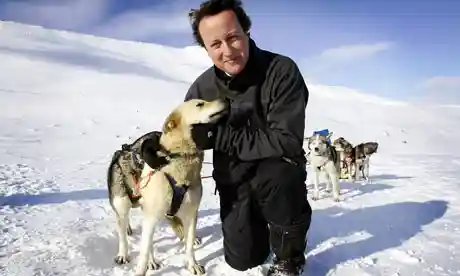
April 20, 2006 – David Cameron does “hug-a-husky” to detoxify the Conservative “brand”

On this day, April 20 2006, David Cameron, newly-minted opposition leader in the UK, the head of the Conservative and Unionist Party, had his photo op with a husky in the Arctic. The context was that Cameron needed to detoxify the Conservative brand. And he’s chosen environmentalism as the way to do that, in much the same way that Kevin Rudd would use climate and environment as a wedge issue against John Howard a year or so later in Australia.

Why this matters. 

We really, really really need to learn not to take anything a politician, any politician says at face value. And we need to help other people understand that – or rather, we need to get beyond information deficit and deference, to a sense of the power that (potentially) rests in social movements. Or did. Probably too late to do anything now.

What happened next?

Gordon Brown became Labour Prime Minister, and bottled calling an election in 2007. The global financial crisis hit and then there was an air of inevitability around Cameron becoming Prime Minister which he did, thanks to the Liberal Democrats in May of 2010. In 2012

In January 2012 the Guardian reported that

“The head of the charity that helped to arrange David Cameron’s memorable husky photoshoot in the Arctic, launching the Conservatives’ rebranding as the nice-not-nasty party, has warned that the PM’s lack of leadership on environment issues risks “retoxifying” their image.”

In 2013, Cameron infamously commanded “get rid of all the green crap”. Which is costing ordinary people money now.

History does not record what happened to the husky.