Five years ago, on this day, August 20, 2018, Greta Thunberg did her first school strike.
The amount of carbon dioxide in the air was roughly 408ppm. As of 2023 it is 423ppm, but check here for daily measures.
The context was Greta Thunberg was the daughter of a famous Swedish opera singer and her very supportive dad. She had been in severe emotional mental distress because of climate change, not eating/agoraphobic etc. You can read about it in her book and I recommend you do.
It was a simple straightforward protest that has become mythology-sized and some people want to believe that she is the pawn of a globalist movement and everything is mediated and manipulated. And they find “proof” of this, to their own satisfaction. And on and on we go.
What I think we can learn from this is that the media latch on to to young people and ‘odd’ “people as the “stars” of a movement…
Greta is very smart and very very funny.
What happened next
The climate movement went up like a rocket and has come down like a stick because it doesn’t know how to do anything other than marches and rallies and sleepovers.
There’s an impressive amount of Just Stop Oil action, but the broader movement doesn’t have a granular capacity… Oh well, too late now anyway.
What do you think? Does this pass the ‘so what?’ threshold? Have I got facts wrong? Interpretation wrong? Please do comment on this post, unless you are a denialist, obvs.
Fifty five years ago, on this day, August 19, 1968, a major US news magazine asks the right question…
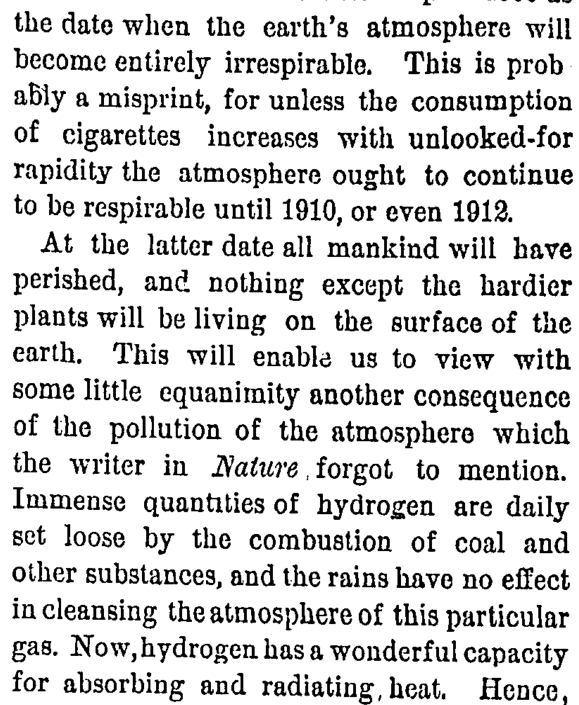
August 19 1968. “Is Man Spoiling the Weather? What the Experts Say,” U.S. News and World Report, August 19, 1968, p. 61.
The amount of carbon dioxide in the air was roughly 323ppm. As of 2023 it is 423ppm, but check here for daily measures.
The context was that further work by US scientists was beginning to look more closely at carbon dioxide. There have been reports by the National Academy of Science and the beginnings of more confident minority statements. But this time and even much later the article was still, understandably, couched in a “will we die in fire or will we die in ice?” kind of thing.
What I think we can learn from this nothing much except that the media was talking about this for a long time.
What happened next
1970 is the year that you really start to say carbon dioxide is emerging as a prominent member of the various threats that people are putting forward as long-term problems.
What do you think? Does this pass the ‘so what?’ threshold? Have I got facts wrong? Interpretation wrong? Please do comment on this post, unless you are a denialist, obvs.
Forty eight years ago, on this day, August 18, 1975, a bunch of people who had been thinking about man’s impact on the climate for quite a while get together in Norwich, England, for a meeting about what’s coming. They decide that there’s no ice age on its way but there IS a decent chance of a large amount of warming…
1975 18-23 August 1975 Norwich meeting which ended speculation about possible cooling.
The amount of carbon dioxide in the air was roughly 331ppm. As of 2023 it is 423ppm, but check here for daily measures.
The context was that everyone was interested in the weather – was it getting colder? was it getting warmer? There had been public pronouncement in both directions including, infamously, the 1971 Rasool and Schneider paper. The popular version of this was The Weather Machine by Nigel Calder which became a BBC documentary. And there were questions asked in the House of Commons.
But the people who actually studied the climate issue were looking closely at carbon dioxide and by now beginning to think this is the issue – we’re going to get warming not a cooling. Wally Broeker’s paper in Science had just been published a month earlier and the National Academy of Science had started its 2-year study on understanding climate.
What I think we can learn from this is that although doubt continued in public because bad ideas and stories have a long half-life this workshop was the moment at which any lingering doubts about the cooling were put to one side, at least in the minds of people who knew what they were talking about.
What do you think? Does this pass the ‘so what?’ threshold? Have I got facts wrong? Interpretation wrong? Please do comment on this post, unless you are a denialist, obvs.
The amount of carbon dioxide in the air was roughly 366ppm. As of 2023 it is 423ppm, but check here for daily measures.
The context was that the Australian government had extorted an extremely sweet deal at the Kyoto conference in December 1997. This was the starting gun for the idea of emissions trading schemes in different countries which would ultimately linked up and make bankers and traders rich while, as a sideline, “saving the world on the cheap.”
The Australian government had signed the Kyoto protocol document in April of 1998. The leak about ratification only happening if the Americans ratified will still a month away, so at this precise moment the idea of Australia having its own emissions trading scheme that then linked up to other emissions trading schemes was not the fantasy that we would look on it as with 25 years of bruising experience.
What I think we can learn from this is that standing committees/senate inquiries house of reps stuff, it’s all nice busy work or undergrowth for policy wonks where they can can justify their money they are on, make professional connections and try to create a common sense agreement around whatever their particular pet solution is. Policy subsystems, policy constituencies etc etc.
What happened next is a proposal for an emissions trading scheme for Australia went to John Howard’s cabinet in the year 2000 killed off by Nick Minchin from South Australia the Sydney’s future exchange never got off the drawing board.
What do you think? Does this pass the ‘so what?’ threshold? Have I got facts wrong? Interpretation wrong? Please do comment on this post, unless you are a denialist, obvs.
Thirty four years ago, on this day, August 17, 1989, more silly technofixes got proposed.
A giant and costly space screen to reduce sunlight and the effects of global warming is proposed by a Canterbury University scientist.
**FULL_TEXT Mr Michael Mautner writes in a letter in yesterday’s Washington Post that if atmospheric means of reducing the effects of greenhouse warming fail, “it may be possible to erect a space screen that would reduce the incident sunlight on Earth.”
Anon. 1989. Space shield plan to cut sunlight. New Zealand Herald, 17 August.
The amount of carbon dioxide in the air was roughly 353ppm. As of 2023 it is 423ppm, but check here for daily measures.
The context was everyone was running around with their pet opinion about the greenhouse effect and “technological solutions”. The prospect of an international climate treaty was rising, and the need therefore for technological fixes was becoming apparent (because Gaia forbid that you do anything about imperialism and consumerism).
What I think we can learn from this is that the dream of controlling the weather and planetary engineering had been around at least since the 1950s as a realistic prospect (see for example all of the effort around weather modification in the 50s and 60s see Jason Fleming’s book for this).
People always reach for the outlandish and eye-catching because it will get them attention.
What happened next
We still do not have space mirrors but the idea of solar radiation management from seeding clouds with sulphur still seems to have a life see for example the journal environmental politics and it’s articles about solar geoengineering.
What do you think? Does this pass the ‘so what?’ threshold? Have I got facts wrong? Interpretation wrong? Please do comment on this post, unless you are a denialist, obvs.
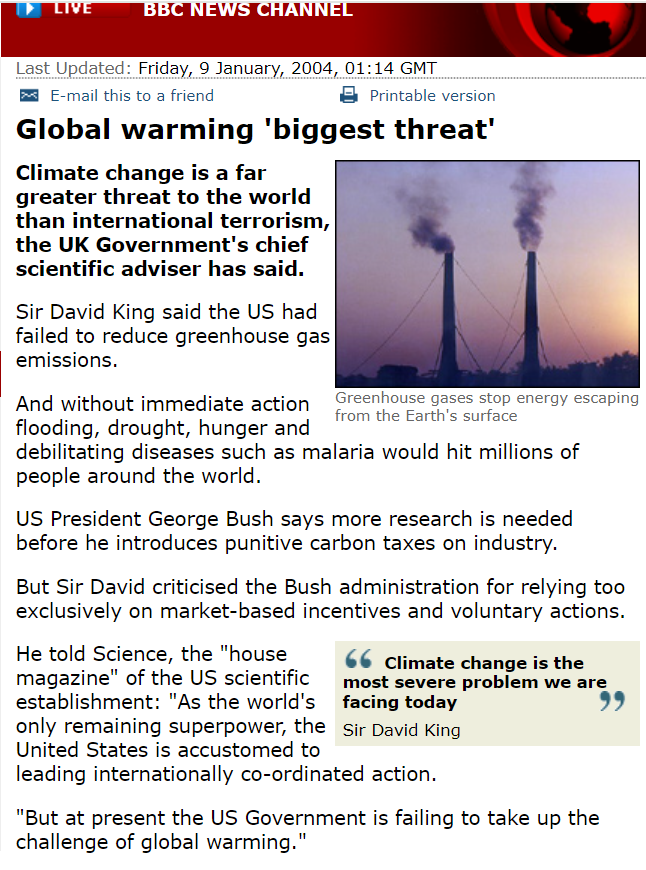
Forty one years ago, on this day, August 17, 1982, UK diplomat Crispin Tickell warned us all we might get crispy…
Tickell, C. (1982) The experiment that could become too hot to handle. The Times, August 17, p.8.
The amount of carbon dioxide in the air was roughly 341ppm. As of 2023 it is 423ppm, but check here for daily measures.
The context was that Tickell had been beavering away on the climate issue for seven years by this stage. And earlier in the year, James Hansen and Herman Flohn had made some pretty big bold statements at the American Association for the Advancement of Science meeting in Washington DC that had been reported in the New York Times. The IEA and the OECD, were continuing to hold workshops, so was the UNEP. And for Tickell the issue couldn’t wouldn’t go away because he understood what was at stake. Bless him.
What I think we can learn from this
Elites really knew. And didn’t act. Some “elites” (the upper crust is just a bunch of crumbs sticking together).
What happened next
Tickell and others (John Houghton etc) finally got through to Thatcher in 1988. She gave her speech and that made it possible to talk about the issue/impossible not to…
What do you think? Does this pass the ‘so what?’ threshold? Have I got facts wrong? Interpretation wrong? Please do comment on this post, unless you are a denialist, obvs.
Twenty one years ago, on this day, August 16, 2002, The Times Newspaper reports
Conservative lobbyists in the US funded by Esso have urged President Bush to derail the Earth summit in Johannesburg because it is anti-freedom, anti-people, anti-globalization and anti-Western.
Browne, A. 2002. USA: Oil Lobby Urges Bush to Keep Climate Change Off the Table at Earth Summit ,The Times, August 16
The amount of carbon dioxide in the air was roughly xxxppm. As of 2023 it is 423ppm, but check here for daily measures.
The context was it was 10 years since Rio and the United Nations does like a good round number conference. George Dubya Bush had recently been doing some talk about “clean skies” and technology, this and that.
And the anti Climate Lobby groups just wanted to make sure that he didn’t slip. So this was laying down some “suppressing fire” and to force proponents of action to expend energy in simply keeping climate change (literally) ‘on the agenda.’
What I think we can learn from this
What’s interesting, what we can learn is, this is what they do. They’re constantly laying down “suppressing fire”, which didn’t really work as well as they’d hoped. But it makes you feel good when you do it, keeps you in a job, makes you test your ammo, and your guns, so why not? I can say the language is extraordinary, but nothing special. They do genuinely frame it as liberty and freedom and democracy versus the evil globalist at least for public consumption.
What happened next
Climate stayed on the agenda. Bush stayed a prick. The carbon dioxide kept accumulating.
What do you think? Does this pass the ‘so what?’ threshold? Have I got facts wrong? Interpretation wrong? Please do comment on this post, unless you are a denialist, obvs.
Thirteen years ago, on this day, August 16, 2010, protestors tried to keep issues on the agenda
Even outside the venue, the protestors simply went through the motions. There were four anti-abortion advocates with basic placards, a huge plastic marijuana joint, two people dressed as polar bears, and another dressed as a blue elephant. But they were not so much demonstrating as loitering.
(Cassidy, 2010:202)
The amount of carbon dioxide in the air was roughly 388ppm. As of 2023 it is 423ppm, but check here for daily measures.
The context was that this was the middle of an election campaign. And even the polar bear can’t be bothered. Everyone’s just going through the motions.
What I think we can learn from this
The polar bear costumes just don’t work. They should be hung up.
What happened next
Gillard was faced with painful electoral math and therefore had to bring carbon pricing back on to the table.
What do you think? Does this pass the ‘so what?’ threshold? Have I got facts wrong? Interpretation wrong? Please do comment on this post, unless you are a denialist, obvs.
More than 500 protesters gathered by Lake Burley Griffin and marched to Parliament House yesterday to demonstrate their support for climate change action. Walk against Warming, held simultaneously around the country, was timed to coincide with the lead-up to Saturday’s federal election. Tens of thousands of people took part across Australia, with 10,000 filling the streets of Sydney’s CBD. Protesters also marched in Adelaide, Brisbane, Darwin, Hobart, Melbourne and Perth.
Kretowicz, E. 2010. TURNING UP THE HEAT; Climate crusaders walk against warming. Canberra Times, 16 August, p.4.
The amount of carbon dioxide in the air was roughly xxxppm. As of 2023 it is 423ppm, but check here for daily measures.
The context was as per the BZE post a couple of days ago, the air has kind of gone out of the issue. People are confused, frustrated, bored, fed up, disappointed. They feel they were conned by Kevin Rudd, who had been revealed to be just another cowardly scuzzy politician. And what’s the point of going on a march for that especially when there’s an election coming and you don’t know who might win it. People get tired of marching.
What happened next?
Labor’s Julia Gillard, because of the electoral math, was forced to reintroduce an emissions trading scheme. This was a non negotiable with both the Greens but also some of the Independents like Tony Windsor and Rob Oakeshott.
What do you think? Does this pass the ‘so what?’ threshold? Have I got facts wrong? Interpretation wrong? Please do comment on this post, unless you are a denialist, obvs.
Twenty one years ago, on this day, August 14, 2002, Aussie economists tried to get the smallest, most inadequate action taken…
“In a further response to what many see as Australia’s failure on the environment, more than 270 of the country’s academic economists called on 14 August [2002] for Prime Minister John Howard to ratify the Kyoto Protocol without delay. Howard rejected the Kyoto Protocol in June this year, stating that it would not be in the country’s interest to ratify without the inclusion of the US and developing nations. This is despite the fact that a recent survey of Australian citizens revealed that 71% believe it would be in the country’s interest to ratify.
“As economists, we believe that global climate change carries with it serious environmental, economic and social risks and that preventive steps are justified,” says a statement by the economists. “Policy options are available that would slow climate change without harming employment or living standards in Australia, and these may in fact improve productivity in the long term.”
However, Environment and Heritage Minister Dr David Kemp, told journalists on 19 August that Australia intends to keep to the targets laid out in the Kyoto Protocol, despite the fact that the country will not ratify.”
Excerpt from report by Radio Australia on 14 August
The Australian government is under further pressure to ratify the Kyoto Protocol on climate change in the lead-up to the World Environment Summit in Johannesburg later this month. Samantha Hawley reports:
[Hawley] More than 250 economists have sent a message to the federal government, urging it to sign up to the protocol before the Johannesburg summit begins. Clive Hamilton, from the policy think tank, the Australia Institute, says the economists believe it will increase jobs and living standards.
[Hamilton] It really does throw the question to the prime minister on what basis is he making these claims on the economic cost ofKyoto. [End of recording]
[Passage omitted]
[Hawley] The call comes as the government moves to release its long-awaited greenhouse gas abatement figures tomorrow, which were originally due out before the election.
The amount of carbon dioxide in the air was roughly 371ppm. As of 2023 it is 423ppm, but check here for daily measures.
The context was that Australian Prime Minister John Howard had, on Earth Day (June 5) announced he would not send the Kyoto Protocol for ratification through the Australian parliament. Clive Hamilton/Australia Institute got 270 economists together to do an open letter.
What I think we can learn from this
This is the sort of thing you have to do to raise the cost of bad behaviour, show that other people see the world differently. It didn’t work, but that’s not the fault of the people who tried it.
What happened next
Howard continued to be an asshat. Knocked down an Emissions Trading Scheme in 2003.
What do you think? Does this pass the ‘so what?’ threshold? Have I got facts wrong? Interpretation wrong? Please do comment on this post, unless you are a denialist, obvs.