Categories
International processes Italy

June 23, 1980 – G7 in Venice aims to sink Venice…

Forty four years ago, on this day, June 23rd, 1980, the G7 rolled back from previous “concern”

Together we intend to double coal production and use by early 1990. We will encourage long-term commitments by coal producers and consumers. It will be necessary to improve infrastructures in both exporting and importing countries, as far as is economically justified, to ensure the required supply and use of coal. We look forward to the recommendations of the International Coal Industry Advisory Board. They will be considered promptly. We are conscious of the environmental risks associated with increased coal production and combustion. We will do everything in our power to ensure that increased use of fossil fuels, especially coal, does not damage the environment.

23 June 1980 – G7 declaration in Venice (poor Crispin!!) 

The amount of carbon dioxide in the air was roughly 337ppm. As of 2024 it is 426ppm, but check here for daily measures. 

The context was that the year before the G7 had at least paid lip service to the problem of CO2 buildup as something to be remarked on, albeit alongside words about increasing coal production. Here at Venice, the CO2 was absent but the coal was there, bigger and badder than ever. In Venice of all places, which is exquisitely vulnerable to sea level rise. UK diplomat Crispin Tickell must have been heartbroken about it. What can you do?

What we learn is that the fine words are just that – just fine words. You can’t expect anything more of them. 

What happened next? More G7 meetings, more warm words. The next G7 at which climate is a big deal is Paris 1989. It’s not on the agenda at all in Houston in 1990 because Bush, because oil companies of course.

And then again, I think in 91 John Major makes a song and dance about it. And then, really it’s not until it’s not until 2005 Gleneagles that all the bullshit about climate change generally and CCS really gets a boost. 

(Btw, the G7 was never supposed to be a permanent thing. But he gives the leaders a chance to schmooze each other in nice settings and strut and fret, of course, they’re gonna grab it with both hands, and it’s gonna persist.)

What do you think? Does this pass the ‘so what?’ threshold? Have I got facts wrong? Interpretation wrong? Please do comment on this post, unless you are a denialist, obvs.

Also on this day: 

June 23, 1988 – it’s time to stop waffling and say the greenhouse effect is here

June 23, 1997 – RIP Hermann Flohn

June 23, 1997 – Australian Prime Minister skips climate meeting to fanboy Thatcher #auspol

Categories
AFrica Caribbean

June 10, 1980 – Redemption Song unleashed on the world (“If you know your history…”)

Forty four years ago, on this day, June 10th, 1980, a crucial song came out, on the album Uprising.

The amount of carbon dioxide in the air was roughly 339ppm. As of 2024 it is 426ppm, but check here for daily measures. 

The context was that Bob Marley by this time was dying – though I don’t think he knew i – because he’d refused to have a cancerous growth on his foot dealt with. Redemption Song, what else is there to say? The deeper context is the words taken from Marcus Garvey (who had died 40 years earlier, to the day). If you know your history, you will know where you’re coming from. And that’s what this website is all about, isn’t it? If you know your history, you will know where you’re going to – that being hell in a handbasket. 

Without wanting to create pure, “noble savage” myths, there is something that white people, liberals and radicals could learn by paying close attention to people who’ve been on the pointy end of racism, imperialism, etcetera. 

What happened next, Marley died a year later. RIP – rest in power 

What do you think? Does this pass the ‘so what?’ threshold? Have I got facts wrong? Interpretation wrong? Please do comment on this post, unless you are a denialist, obvs.

Also on this day: 

June 10, 1969 – pro-nukers mention carbon dioxide in a New York Times article

June 10, 1986 – scientist tells US senators “global warming is inevitable. It is only a question of the magnitude and the timing.”

Categories
United States of America

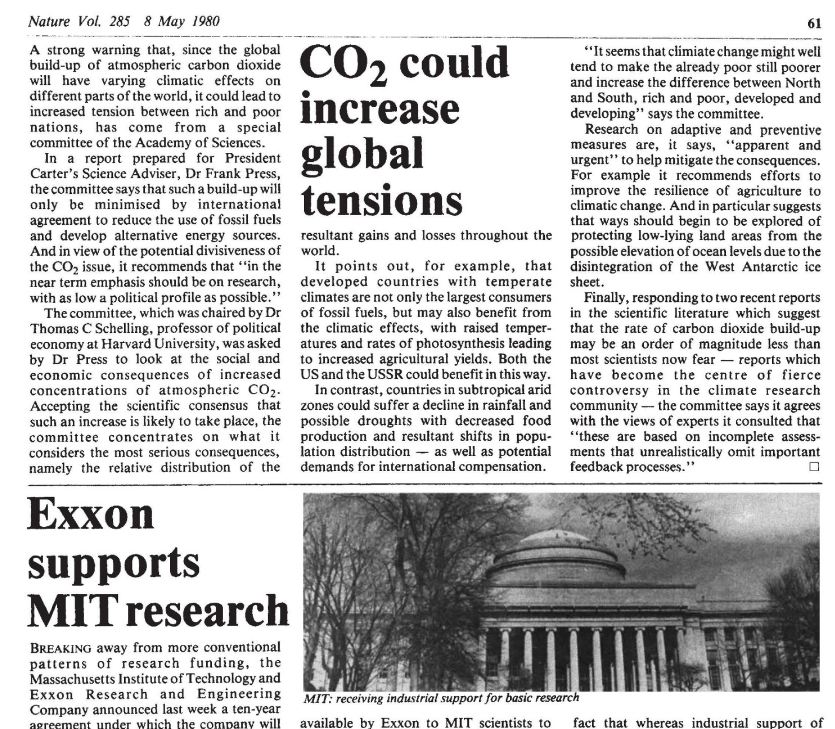
May 8, 1980 – Nature article “CO2 could increase global tensions.” Exxon discussed underneath. Delicious ironies abound.

Forty four years ago, on this day, May 8th, 1980, there was an ironic juxtaposition in the British science journal Nature…

The amount of carbon dioxide in the air was roughly 338.7ppm. As of 2024 it is 425ppm, but check here for daily measures. 

The context was that the synfuels battle had just happened. And Americans, political leaders had been warned about the geopolitical consequences of CO2. Other people were saying the same stuff. 

What we learn is that CO2 was a really live issue in the late 70s, early 80s. People knew what was coming, they couldn’t say exactly when. And history is full of these delicious little moments, I guess.

What happened next, Exxon gave up on renewables and being vaguely responsible and all the rest of it and switched to denial very effectively. American politicians continued to be aware of CO2. There were congressional hearings, Senate hearings and then after 1985 it really picked up steam. 

What do you think? Does this pass the ‘so what?’ threshold? Have I got facts wrong? Interpretation wrong? Please do comment on this post, unless you are a denialist, obvs.

Also on this day: 

May 8, 1972 – “Teach-in for Survival” in London

May 8, 1992 – UNFCCC text agreed. World basically doomed.

May 8, 2013 – we pass 400 parts per million. Trouble ahead.

May 8, 2015 – denialist denies in delusional denialist newspaper

Categories
United States of America

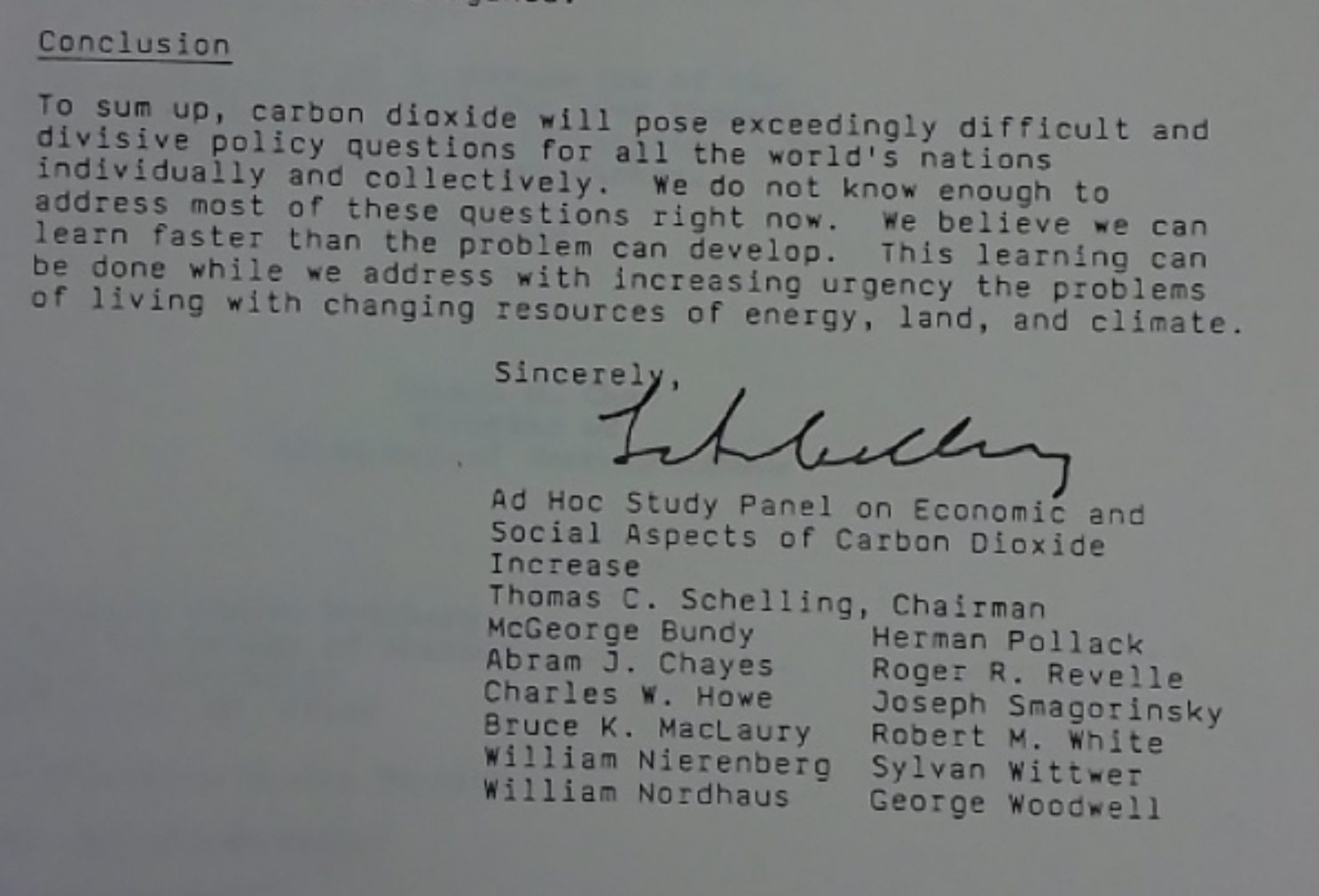
April 18, 1980 Ad Hoc Panel on Economic and Social Aspects of C02 increase reports back

Forty four years ago, on this day, April 18th, 1980, an Ad Hoc Panel of heavy hitters warned that there were not going to be ANY easy fixes for the carbon dioxide build-up issue. How right they were.

“We must recognize now that increases in energy consumption using fossil fuels will have increasingly undesirable climatic effects” NAS panel on “Economic and Social Aspects of Carbon Dioxide Increase” in letter to Dr Philip Handler, its president Cited by Speth in Global Energy Futures and Carbon Dioxide Problem ..

The amount of carbon dioxide in the air was roughly 338.7ppm. As of 2024 it is 425ppm, but check here for daily measures. 

The context was the various ad hoc panels and groupings of Department of Energy, the American Association for the Advancement of Science, IIASA etc were all pondering “well, what happens if the carbon dioxide emissions do keep climbing and the world does get warmer, what impact will that have geo politically and socially, economically?” 

What we always learn From the period of the late 70s we knew enough to be worried. And some people were worried. But idiots don’t worry(looking at you Ronald Reagan). 

What happened next? Growing concern largely came to a grinding halt when Reagan took office (It will be interesting to try to figure out who organised that 1982 conference on “carbon dioxide, science and consensus” and why).

What do you think? Does this pass the ‘so what?’ threshold? Have I got facts wrong? Interpretation wrong? Please do comment on this post, unless you are a denialist, obvs.

Also on this day: 

April 18, 1989 – begging letter to world leaders sent

April 18, 2013, Liberal Party bullshit about “soil carbon” revealed to be bullshit

Categories
United States of America

 April 14, 1980 – Carter’s scientist, Frank Press, pushes back against CEQ report

Forty four years ago, on this day, April 14th, 1980, the US chief scientific advisor was not happy about people bigging up the carbon dioxide threat…

The following April, Frank Press, the head of the OSTP, reacted angrily to a draft of a Council on Environmental Quality report that he felt greatly overemphasized the dangers and underplayed the uncertainty. “At this moment of great national trauma with respect to energy, inflation, and foreign affairs, I believe it is a serious disservice to the public to raise widespread concern about an issue with hazards, that are, at the moment, so speculative and uncertain.”27

Early Climate Change Consensus at the National Academy: The Origins and Making of Changing Climate Author(s): Nicolas Nierenberg, Walter R. Tschinkel, Victoria J. Tschinkel
IN: Historical Studies in the Natural Sciences, Vol. 40, No. 3
(Summer 2010), pp. 318-349

The amount of carbon dioxide in the air was roughly 338.7ppm. As of 2024 it is 425ppm, but check here for daily measures. 

The context was that American scientists had been banging the drum for a while. And Frank Press had been on the receiving end of this, as Jimmy Carter‘s Chief Scientific Adviser. There’s a memo from 1977. There was the Global 2000 report underway. 

This, from the Council on Environmental Quality is a separate issue. The CEQ had been set up in 1970 under Nixon. I think Press was probably worried that too much attention was being paid to what was still possibly regardable as a speculative issue, despite the previous year’s Charney Report. 

It was an election year, and anything that could pin Carter as a nervous ninny was to be avoided. This was difficult since the man had already sat there dressed in the cardigan and given a “malaise speech.” But that’s the context. 

What we learn is that scientific advice is never just about the science, especially from a political appointee. 

What happened next? 

Well, I didn’t know how much influence Press had. The CEQ report did finally come out that maybe it was ready before January 1981 when it was released. Maybe it was held back until after the election?

The CEQ report was released in January 1981. But it was a dead duck because the Reagan administration was about to take office. 

What do you think? Does this pass the ‘so what?’ threshold? Have I got facts wrong? Interpretation wrong? Please do comment on this post, unless you are a denialist, obvs.

Also on this day: 

April 14th, 1989 – 24 US senators call for immediate unilateral climate action

April 14, 1964 – RIP Rachel Carson
Categories
United States of America

February 29, 1980 – Texaco and Exxon talk about setting up a greenhouse taskforce…

Forty four years ago, on this day, February 29th, 1980,

Bruce S. Bailey of Texaco offered “for consideration” the idea that “an overall goal of the Task Force should be to help develop ground rules for energy release of fuels and the cleanup of fuels as they relate to CO2 creation,” according to the minutes of a meeting on Feb. 29, 1980. 

The minutes also show that the task force discussed a “potential area” for research and development that called for it to “‘Investigate the Market Penetration Requirements of Introducing a New Energy Source into World Wide Use.’ This would include the technical implications of energy source changeover, research timing and requirements.”

The amount of carbon dioxide in the air was roughly 338.7ppm. As of 2024 it is 422ppm, but check here for daily measures. 

The context was that Exxon had known about the climate issue, and had been offering to do further research more recently than that. And obviously, outfits like Texaco and Exxon were in talks about what could be done; “Oh, I know, let’s set up a workshop”

What we learn

Corporates have their pressures and it is akin to that MacMillan Manoeuvre thing, but it’s also a necessary first step. So what we learn here is that oil companies were on it in the late 70s, early 80s. In the same period that Carter was talking about Global 2000.

And they didn’t speak up when Reagan came in and started backpedalling/ignoring this stuff (James Watt, Anne Gorsuch) because it helped them take their foot off the gas (or maybe, more accurately, put their foot on the gas).

 What happened next Exxon changed its tune. And then in 1988, began serious resistance to the climate issue.

What do you think? Does this pass the ‘so what?’ threshold? Have I got facts wrong? Interpretation wrong? Please do comment on this post, unless you are a denialist, obvs.

Categories
Austria

February 4, 1980 – IIASA taskforce on Climate and Society

Forty four years ago, on this day, February 4th, 1980, smart people in the orbit of the International Institute for Advanced Systems Analysis began another of their meetings.

The Task Force meeting on the Nature of Climate and Society Research, 4-6 February 1980, was the third major event in climate  studies at the International Institute for Applied Systems Analysis.

The amount of carbon dioxide in the air was roughly 339ppm. As of 2024 it is 422ppm, but check here for daily measures. 

The context was that IASSA had been scratching its head about climate for a few years now. In 1975 it had hosted Nordhaus and others on the economics of mitigation. It had famously also supported the work of Cesare Marchetti on carbon capture and storage. It had held a workshop in 78 and it was doing energy studies stuff. So what we see here is not an early “outlier” but a continuation of an existing process with Americans and Europeans working cheek by jowl. And don’t forget, the First World Climate Conference had taken place in February of the previous year… 

What we learn is that from the early mid 70s onwards, intelligent and/or high status, well-connected people in the scientific advice giving game were alive to the issues.

What happened next? Kellogg wrote a book that was published on the first of January 1981. Other people were beavering away on the same issues including Schneider. There’s also the Great Adaptation and so forth.

What do you think? Does this pass the ‘so what?’ threshold? Have I got facts wrong? Interpretation wrong? Please do comment on this post, unless you are a denialist, obvs.

References

Ausubel, J.H. & Biswas, A.K. (1980). Climatic Constraints and Human Activities; Proceedings of a Task Force on the Nature of Climate and Society Research, February 4-6, 1980. Oxford: Pergamon Press. ISBN 978-0-08-026721-0

https://pure.iiasa.ac.at/id/eprint/1222/

Also on this day: 

February 4, 1963 – A UN conference on technology for “less developed areas” starts

February 4, 1993 – Australian business versus the future (spoiler: business wins)

Feb 4, 2002- Global Climate Coalition calls it a day (“Mission accomplished”)

Categories
Australia

October 25, 1980 – Australian radio’s The Science Show talks about climate change…

Forty-three years ago, on this day, October 25, 1980, episode 234 of the Science Show had the following – Letter re Science Show; Flight from Maths; Hepatitis B Vaccine Success; Carbon Dioxide and Climate; Kakadu National Park; Northern Territory Wildlife.

The amount of carbon dioxide in the air was roughly 339ppm. As of 2023 it is 419ppm, but check here for daily measures. 

The context was that there were more and more people writing about potential climate change. The Australian Academy of Science had just had its first big conference. And so getting a brief item about (I think this one was about starting to make measurements at Cape Grim)something else was not a big surprise. And, as I’ve said before the very first Science Show, in the middle of 1975, had talked climate with Lord Ritchie Calder. 

What I think we can learn from this

Again, that subset of Australian politicians who listen to the Science Show, which is probably a much smaller proportion than the national average, would have known about the problem Long, Long ago.

What happened next

We kept talking about it. Everyone has kept talking about it. In the late 1980s the denial campaigns kicked into gear, once it was clear action was needed, and that oil, coal and gas were in the cross-hairs.

What do you think? Does this pass the ‘so what?’ threshold? Have I got facts wrong? Interpretation wrong? Please do comment on this post, unless you are a denialist, obvs.

Categories
United States of America

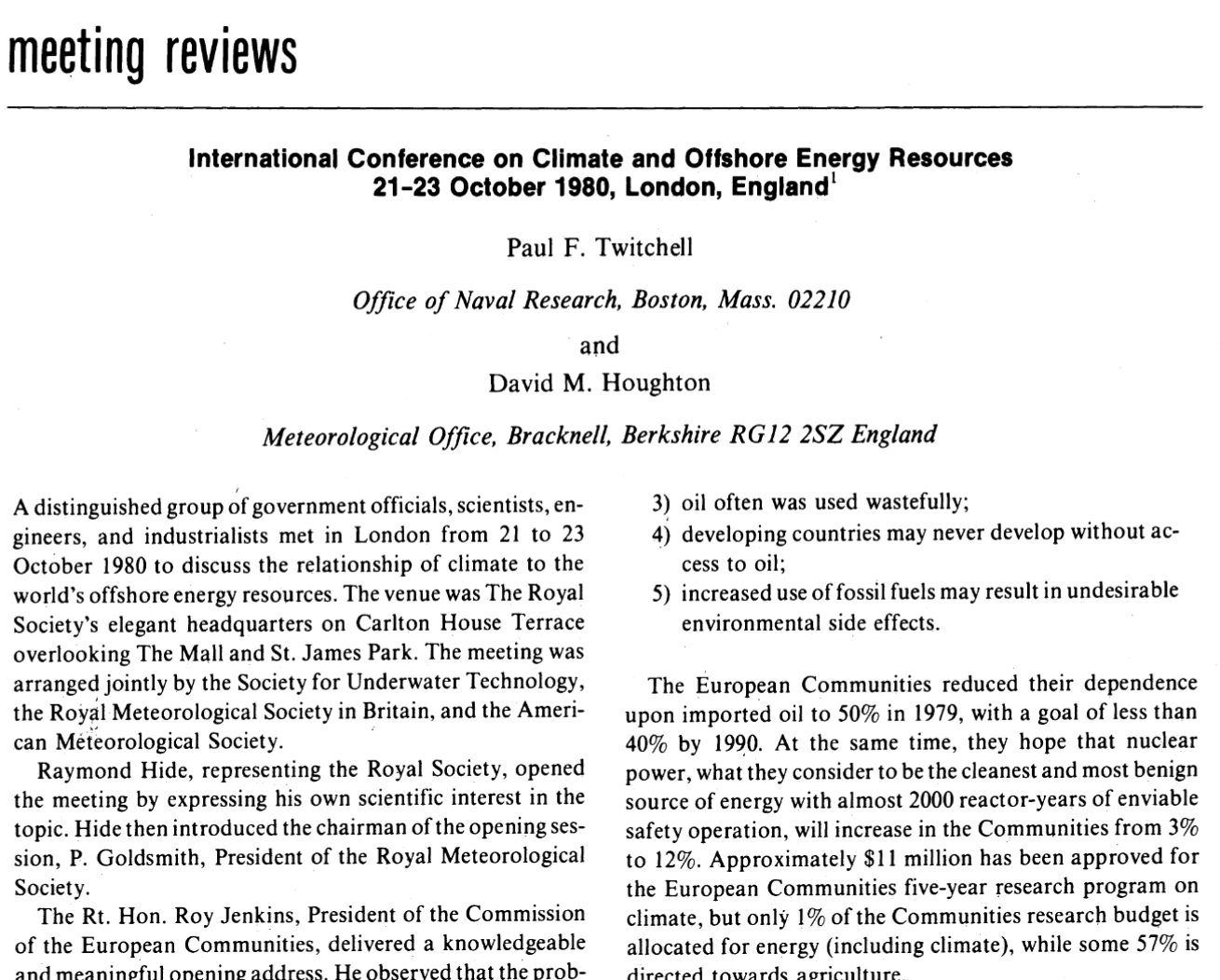
August 1, 1980 – Wall Street Journal does excellent #climate reporting

Forty three years ago, on this day, August 1, 1980, The Wall Street Journal ran a seriously good report on the problem of climate change. It included professors (inc David Rose) and also the view from trade bodies like the National Coal Association. You will be shocked, shocked to learn that they were not sold on the idea that their product was gonna create global chaos… And here we are…

The amount of carbon dioxide in the air was roughly 338ppm. As of 2023 it is 423ppm , but check here for daily measures. 

The context was that more and more scientists were coming out and saying carbon dioxide was going to be a serious factor in climate change. There had been the NAS report in 1977, but more recently, the First World Climate Conference, the Charney report and the G7 meeting in Tokyo, and the Global 2000 report.

So it’s unsurprising that the business press, (the Wall Street Journal fancies itself as the equivalent of the Financial Times but it’s not even close, would want to cover the issue). What’s a little surprising is just how good the article was. There’s a lovely dismissive quote from the coal lobby.

What I think we can learn from this is (1) as ever, if you really want to understand what’s going on in the world, quality business press is the way forward and (2) that the National coal Association was all over the issue. Of course they were. 

What happened next

Three months later, Jimmy Carter lost the presidency and America and the world lost the momentum though it continued to some extent in Europe. 

What do you think? Does this pass the ‘so what?’ threshold? Have I got facts wrong? Interpretation wrong? Please do comment on this post, unless you are a denialist, obvs.

Categories
United States of America

July 24, 1980 – “Global 2000” report released.

 On July 24, 1980, President Carter addressed the public about his signature achievement. 

“Never before had our government or any other government attempting to take such a comprehensive, long-range look at interrelated global issues . . . I believe America must provide special leadership in addressing global conditions,” he urged 

(Source – Henderson thesis)

The context was that the concerns raised about “The Limits to Growth” hadn’t gone away entirely, but morphed. By the mid-1970s, they’d been able to gain a toe-hold in the US science policy-making bureaucracies, and in 1977 Carter had announced that a report would be produced…

What we can learn

Any attempt to get environmental limits onto the agenda will be met with fierce resistance.

What happened next

The Global2000 people tried to keep the momentum going, even after Reagan’s victory. The Heritage Foundation did everything it could to slow that momentum, with considerable success.  And here we are.

What do you think? Does this pass the ‘so what?’ threshold? Have I got facts wrong? Interpretation wrong? Please do comment on this post, unless you are a denialist, obvs.