Categories
New Zealand

January 23, 1957 – New Zealand scientist warns about consequences of carbon dioxide build-up  


Sixty six years ago, on this day, January 23, 1957, New Zealand scientist Athol Rafter laid out what was ahead of us, at an ANZAAS meeting

“A New Zealand scientist said that if the existing percentage of carbon dioxide gas in the air was doubled, the earth’s temperature would rise enough to melt polar ice caps and flood many major coastal cities.”

and

The amount of carbon dioxide in the air was roughly 314ppm. As of 2023 it is 419

The context was that with the coming of the ability to do carbon-14 dating, it was obvious that carbon dioxide levels in the atmosphere were indeed climbing (at this point Charles David Keeling’s meticulous measurements at Mauna Loa were still over a year away from starting).  The International Geophysical Year was about to begin, and everyone was rather excited…

What I think we can learn from this

The science of this did not used to be controversial, and people have known for a hella long time…

What happened next

The scientists kept going, with their pesky impact science, measuring the problems caused by production science….

What do you think? Does this pass the ‘so what?’ threshold? Have I got facts wrong? Interpretation wrong?  Do comment on this post.

Categories
Australia Science Scientists

September 16, 1969 – Nobel-prize winning Australian scientist warns about carbon dioxide build-up. Yes, 1969

On this day September 16 1969, Sir Macfarlane Burnet, an extremely eminent Australian scientist pointed to carbon dioxide as a serious potential problem. Yes, 1969.

Call to keep world at 2,000m

MELBOURNE, Monday. — The world population should be adjusted and maintained at perhaps 2,000 million, distinguished scientist Sir Macfarlane Burnet said today.

It was one of five minimum requirements that he set down for a “stable human eco-system” or an harmonious world.

Sir Macfarlane was delivering a paper at the Felton Bequests Symposium at the Royal Australasian College of Surgeons in Melbourne.

Sir Macfarlane said the other requirements included a stabilisation of the level of carbon dioxide in the atmosphere to avoid the possibility of disastrous climatic change.

The theme of the symposium was the influence of scientific advances on the future of mankind. It was arranged by the Walter and Eliza Hall Institute of Medical Research in honour of Sir Macfarlane’s 70th birthday.

Anon, 1969. Call to keep world at 2000m. Canberra Times, 16 September, p.3.

On this day the PPM was 323 ish. Now it is 420ish- but see here for the latest.

The context is that by the late 1960s smart people were paying attention to – and starting to get worried about – carbon dioxide build-up. Burnet was not alone in this.

Why this matters.

Let no-one tell you this was a sudden surprise in 1988 (and even if it were, we’ve had a generation to start taking action).

What happened next?

More and more people became aware of the problems.  But awareness is not political and economic power, and those who were doing nicely from the sale of deliciously cheap and abundant fossil fuels saw no reason to stop. And every reason to stop those who wanted them to stop. So that’s what they did, very well, for a very long time. Eternity, effectively.

Categories
Australia

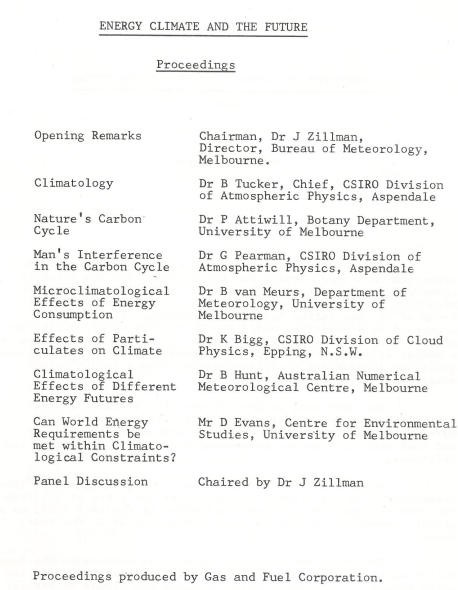
August 10, 1980 – “Energy, Climate and the Future” seminar in Melbourne

On this day, August 10, 1980, the Australian And New Zealand Association for the Advancement of Science held a seminar with the ominous title “Energy, Climate and the Future.”

The wonderful Alan Pears takes up the story (from an interview conducted in 2015)

 I was on the Victorian organising committee for a scientific seminar on climate research, which included presenters like Graeme Pearman, Barrie Pittock and a range of those people. And at it my question to them was ‘why aren’t you out on the streets telling everyone about this?’ 

And what did they say?

And Graeme Pearman’s response, which was a very measured one was ‘Well, look, we’ll know for certain by the turn of the century. And at the moment we can’t say for certain. ‘ But certainly the laws of physics did apply in [then], just as they apply now

On this day, atmospheric carbon dioxide was 3367.67 ppm. Now it is 420ish- but see here for the latest.

Why this matters. 

People have been studying this for a very long time.

What happened next?

There was a symposium in Canberra, a monograph published. Once Barry Jones became Science Minister and was able to create the “Commission for the Future” – which created “The Greenhouse Project”, it started to move forward. But that wasn’t till 1987…