Categories
Australia Denial

July 10, 2012 – Denialists on tour in Australia

Fourteen years ago, on this day, July 11, 2012,

“Last night I attended the Sydney talk of Canadian author and blogger Donna Laframboise, whose book, “The Delinquent Teenager who was mistaken for the world’s top Climate Expert” has recently been published here in Australia.” [some defunct blog]

The amount of carbon dioxide in the air was 394ppm. As of 2026, when this post was published, it is 430ppm. This matters because the more carbon dioxide in the air, the more heat gets trapped. The more heat, the more extreme weather events. You can make it more complicated than that if you want, but really, it’s not. Fwiw, I have a tattoo of the Keeling Curve on my left forearm.

The broader context was that climate denialism had been around all along. One early example in Australia was John Daly and his book “The Greenhouse Trap.”  In the late 2000s, when the prospect of – gasp – a price on carbon dioxide emissions – became a live political issue – the denialists swamped the airways. Various nutjobs were invited on tour. 

The specific context was the Gillard ETS scheme had come into effect, having passed through Parliament in 2011. The antis (rightly) anticipated that a Tony Abbott-led government would abolish it. 

What I think we can learn from this. We are a muppet species.

What happened next. Abbott did indeed repeal the actual emissions trading portions of Gillard’s Clean Energy Package.  Globally, emissions kept climbing, and atmospheric concentrations kept climbing.  The Fafocene has begun.

You can see the chronological list of All Our Yesterdays “on this day” posts here.

What do you think? Does this pass the ‘so what?’ threshold? Have I got facts wrong? Interpretation wrong? Please do comment on this post, unless you are a denialist, obvs.

If you want to get involved, let me know.

If you want to invite me on your podcast, that would boost my ego and probably improve the currently pitiful hit-rate on this site (the two are not-unrelated).

Also on this day: 

July 10, 1976 – Seveso 

July 10, 1985 – French state commits terrorist act

July 10, 1996 – National Greenhouse Advisory Panel cops a serve

July 10, 2008 – first Australian #Climate Camp begins, near Newcastle
July 10, 2010 – Rio Tinto amplifies the message…

July 10, 2015 – Zero carbon homes policy abolished  

Categories
Australia United Kingdom

January 8, 2018 – Joe Root doesn’t come back to bat

Seven years ago, on this day, January 8 2018, English batsman Joe Root didn’t come out to play…

But on Monday morning he was taken to hospital suffering from severe dehydration and diarrhoea. It was assumed that this was a consequence of his being in the field for almost all of Sunday when temperatures in the middle soared as high as 57 degrees, initially trying to marshal England’s flagging attack, then defiantly batting for some pride and the draw.

Marks, 2018.

The amount of carbon dioxide in the air was roughly 408ppm. As of 2025 it is 425ppm, but check here for daily measures. 

The context was

Australia has always had some hot days, but they’re getting hotter. And why could that be? Why this matters is we’re beginning to see cultural events and sporting events being affected by the extremes. but we dismissed them because “here always been heat waves” or whatever. 

And there are sports where it’s simply becoming too dangerous to play, or it will become too dangerous to play at certain times of day. 

But in response, these concerns will be derided as woke and people will point to one off days in 1930s when it was hotter.

NB  further on Marks writes “Later, it transpired that Root had a viral gastroenteritis bug and that his illness had noting to do with heat exhaustion, although the temperatures on Sunday could not helped his condition.”

What I think we can learn from this

Yeah, like we ever learn anything…

What happened next

Root is still playing and batting “quite well” shall we say?

He’s now the highest scoring English batsman and might reasonably expect to overtake at least Ricky Ponting quite soon and who knows, conceivably overtake Sachin Tendulkar to score the most runs in Tests

Sidebar, Just Stop Oil protesters tried to interfere with the 2023 Ashes and Johnny Bairstow picked one up and removed him from the field. Stewart Lee had something good to say about this

Also on this day

Jan 8, 1958 – “The masters of infinity… could control the world’s weather”, says LBJ

January 8, 1968 – LaMont Cole to AAAS about running outta oxygen, build-up of C02 etc

January 8, 2003 – Energy firms plan to “bury carbon emissions”…

January 8, 2013 – Australian Prime Minister connects bush fires and #climate change

Categories
Australia

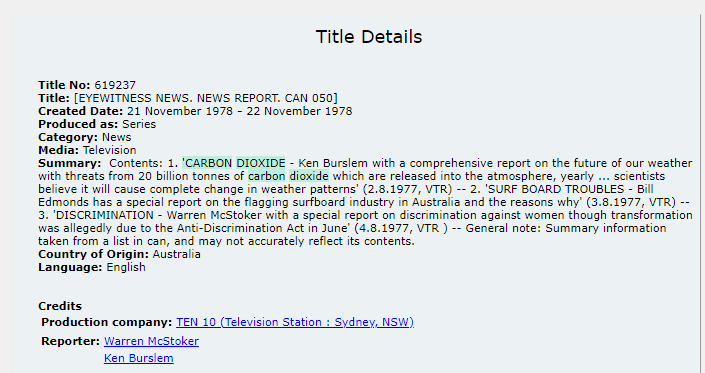
November 21, 1978 – Sydney Channel Ten news on Carbon Dioxide build-up and trouble ahead

Forty-six years ago, on this day, November 21st, 1978, people in Sydney got a news broadcast about Trouble Ahead…

The amount of carbon dioxide in the air was roughly 335ppm. As of 2024 it is 423ppm, but check here for daily measures. 

The context was that the CSIRO had started to make serious noises about CO2. There’d been a documentary called A Change of Climate in 1976. There’d been, more importantly for these purposes, a conference being held on Phillip Island in Victoria. That was CSIRO Australian Academy of Science and someone else. And so it was a nice little hook for the journo, alongside some modelling work released. 

What we learned is that by 1978, the carbon dioxide issue was being explained to people in Sydney. Whether they were paying much attention or not, is another question. 

What happened next? CO2 kept appearing in the newspapers with perhaps a little bit more frequency. In 1980 the Canberra Times covered the conference hosted by the Australian Academy of Science. In 1983, the Australian covered the EPA’s report. But it wasn’t really till 1986/87/88 (especially ‘88) that the issue started getting serious traction. Meanwhile, the emissions kept climbing. 

What do you think? Does this pass the ‘so what?’ threshold? Have I got facts wrong? Interpretation wrong? Please do comment on this post, unless you are a denialist, obvs.

Also on this day: 

November 21, 1994 – Skeptic invited to engage with IPCC (Spoiler, he doesn’t)

November 21, 2013 – “Cut the Green Crap” said UK Prime Minister

Categories
Australia

August 24, 1989 – a Sydney council takes greenhouse suggestions on-board (or says it will).

Thirty four years ago, on this day, August 24, 1989, Sydney councillors start to take note of citizen ideas for tackling “the greenhouse effect”. And use it to put the spotlight on the feds.

A concerned citizen’s letter has prompted Leichhardt Council to send three submissions to a Senate committee inquiring into ways of reducing the impact of the greenhouse effect.

The submissions, from Alderman Issy Wyner, as chairman of the council’s environment pollution control panel, Dr Ken Sullivan, president of the Clean Air Society of Australia and New Zealand, and Mr John Mara, council’s deputy chief health and building surveyor, were posted on Friday.

Mr N. G. Hyde, of Kingsgrove, had written to Leichhardt Council, expressing his concern about the greenhouse effect and depletion of the ozone layer.

“He probably wrote to every council but it stimulated a response from us,”Mr Mara said.

“We kept the matter on the agenda by writing to the Federal Environment Minister, Senator Richardson, and his NSW counterpart, Mr Moore, for advice, and picking up information from newspapers and journals.”

Bilic, J. 1989. Council officers greenhouse tips. Sydney Morning Herald, 24 August. 

The amount of carbon dioxide in the air was roughly xxxppm. As of 2023 it is 423ppm, but check here for daily measures. 

The context was that everyone was running around with urgency and ideas for dealing with what was then called the greenhouse effect. People who understood it knew that early action was not only preferable but necessary because once it has got out of hand it wouldn’t just be “too expensive to do anything about” but “impossible ti do anything about.”

This was at a federal state and local level in Australia. (Of course we had had the Brundtland Report by now, which emphasised the importance of local action).

What I think we can learn from this is that all the rhetoric about responsive government, citizen engagement citizen participation have been with us for generations. And on whole, in most places, it has not taken. And even in the places where it has taken it needs persistent consistent effort because the culture of atomization of neoliberalization of techno-salvationism is very very strong.

What happened next – they gave us the language of Local Agenda 21, but local councils went back to doing what they do best – being secretive, flogging off state assets including publicly-owned land to developers in exchange for brown envelopes and acting as a career launch pad and finishing academy for ambitious young politicians wanting to be an MP, and general “snout in the trough” opportunities for others

What do you think? Does this pass the ‘so what?’ threshold? Have I got facts wrong? Interpretation wrong? Please do comment on this post, unless you are a denialist, obvs.

Categories
Australia Social Movements

June 16, 1971 – “Ecology Action” formed in Sydney.

On this day (ish) in 1971, “Ecology Action” was formed in Sydney. There had been a series of campaigns about specific patches of nature that were about to be bulldozed or mined etc, and well, people decided to get together to take action on Ecology.

________________________________________

Ecology body is formed

SYDNEY : Ecology Action has been formed recently here by people wanting to “take action to prevent irreversible destruction of life on earth.”

It is working closely with the Society for Social Responsibility in Science (SRS) and other conservationist and anti-pollution groups. Ecology Action is calling a meeting tonight (Wednesday June 16) at 7.30 pm, at the Stephen Roberts Theatre, Sydney University, to hear Dr. Stephen Boyden of the ANU speak and to discuss action proposed by Ecology Action. Ecology Action, with SRS and the National Trust is holding a meeting on June 28, at the Sydney Town Hall at 8 pm to discuss and protest the proposed Clutha development on NSW South Coast. Ecology Action’s address is Box K404, P.O., Haymarket, NSW, 2000.

Tribune, Wednesday 16 June 1971, page 12

Except, well, it was about a month earlier – see this from The Bulletin, near the other end of the political spectrum (Tribune was communist).

Why this matters. 

We’ve been here before! Repeatedly. And see below…

What happened next?

Ecology Action lasted until about 1980.  I’ve looked at the material in the National Library – newsletters and so on.  Climate is not mentioned (and understandably so – still too abstract) but it seems there was the usual pattern of a few committed folks begging others to get involved… And then, well, it just fizzled out, I think.  I don’t know for sure. That is NOT a criticism of those involved. I am sure they spent countless hours trying to slow down the apocalypse. And here we are.