The third issue of the “El Niño Digest Times” is out now. It’s 8 pages of excerpts, quotes and images about the events unfolding as you read this. Download as a pdf or a word doc or read below
Tl;dr – there are going to be astonishing impacts, we’re at the end of the first (“antici….pation”) phase moving into the real stuff. Comments/suggestions welcome.
Deep Impact(s)

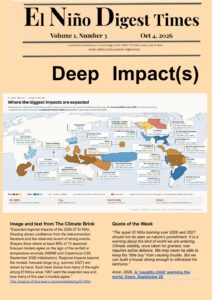
Image and text from The Climate Brink
“Expected regional impacts of the 2026-27 El Niño. Shading shows confidence from the teleconnection literature and the observed record of strong events. Shapes show where at least 80% of 13 seasonal forecast models agree on the sign of the rainfall or temperature anomaly (NMME and Copernicus C3S, September 2026 initialization). Regional impacts beyond the models’ forecast range (e.g. summer 2027) are drawn by hand. Each label shows how many of the eight strong El Niños since 1957 went the expected way and how many of this year’s models agree.”
The impacts of this year’s record-shattering El Niño
Quote of the Week
“The super El Niño looming over 2026 and 2027 should not be seen as nature’s punishment. It is a warning about the kind of world we are entering. Climate stability, once taken for granted, now requires active defence. We may never be able to keep the “little boy” from causing trouble. But we can build a house strong enough to withstand his tantrums.”
Anon, 2026. A ‘naughty child’ warming the world. Dawn, September 28
Welcome to the third of many (several?) weekly issues of the El Niño Digest (previously “Some Of Our Tomorrows digest”). The why should be self-explanatory, but here’s a FAQ anyway. We are still just about in the first of the three phases of El Niño but not for long…
Here’s the database I’ve begun (but almost certainly will not maintain). It’s largely based on two Google Alerts for “El Niño” and “Impacts” and “Godzilla”. Plus things people send me
There are a lot of good El Niño explainers out there – this one, by Al Jazeera is really good and I will link to it at the top of every digest until someone suggests a better one (ideally with the url written on a £50 note).
In lieu of a blog about What It All Means, this week I posted a long interview with Dr George Adamson,of King’s College London. You can read excerpts on page 4-5.
The three phases of El Niño
- The Antici…pation
From early this year until … (looks at watch)… about now. Scientists saying they’ve double-checked and triple-checked and they’re as sure as they can be. Disaster management folks pleading for money and decent plans. Politicians telling us to stock up, or declaring States of Emergency in advance, with an eye on their 2028 Presidential run… Journalists writing SEO-ed disaster porn speculations. Everyone holding their breath, putting their fingers in their ears to not hear the Doomers gloating “I told you so.”
- “Then someone yelled out ‘Contact!’”
The rolling roiling disasters, especially salient when (rich) White People in Peril can be filmed. The shark in the shopping mall meme resurfaces. The re-insurers point to their fine print, and some insurers go belly-up. The rich libertarians squeal for state bail-outs. Food prices through the roof. Hard-to-replace infrastructure washed away.
- Back to the perfect paradise
The wreckage is quietly swept away, the global machine reboots, and the important (rich white) people continue their merry way. The End. (Actual outcomes may vary; always read the label).
“Pragmatism is a weird and weaselly word. Its official definition is “a practical approach to problems and life that focuses on what works in reality rather than on fixed theories, abstract rules, or ideal ideologies”, which sounds great, but who gets to decide what works and what constitutes an ideal ideology? It has its roots in the Greek word ‘pragma’ meaning ‘deed’ or ‘action’, but often pragmatism is deployed in defence of the status quo, as a rationale for not acting. When it first emerged in English in the 16th century it meant ‘opinionated or meddlesome’, before later morphing to refer to state affairs, business matters, and a general sense of straight forward matter-of-factness. “For some, it is now evolving again to become an ideology itself and a cover for sophistry and cynicism.”
Podcasts
Just Have a Think: Godzilla El Niño is about to hit the Arctic. How bad will it be? – YouTube (20 mins)
“A Super El Niño is here. We’ve all heard about it in the news. But what effect will it have on an already rapidly warming Arctic? I ask a proper scientist for some guidance.”
Dr Gilbz What does the “super” El Niño mean for Antarctica? – YouTube (18 mins)
“We’ve all heard the chorus of dire warnings about the impacts of the growing “super” El Niño on global food prices, temperatures and trade. But is the climate pattern going to have impacts further afield? And crucially – will it drive further sea ice loss in Antarctica? I’m joined by the fabulous Dave Borlace from Just Have a Think”
Physical impacts
To paraphrase Aristotle “Anybody can become terrified— that is easy, but to be terrified about the right horrorshow and to the right degree and at the right time and for the right purpose, and in the right way — that is not within everybody’s power and is not easy.”
Earth
Testable prediction – “The Philippine rainfall crisis under the 2026-2027 super El Niño and Indian Ocean variability is expected to unfold in two phases: floods amid a negative Indian Ocean Dipole (IOD) from July to September 2026, followed by an abrupt transition to drought from October 2026 to May 2027.”
Mendoza, T. 2026. Two phases, one crisis: Floods and drought under super El Niño. Inquirer.net, September 29
Money
(always the fifth element, whatever Aristotle had to say)
A London hedge fund’s bet on super El Niño
Zulfiqar Ali now runs a boutique hedge fund in London, Bloomberg reports. The former Balyasny Asset Management trader expects to amplify returns by anticipating how an evolving super El Niño will affect markets [paywalled].
THESIS 1: COLLAPSE IS A SYSTEMIC PHASE SHIFT, NOT A SINGLE EVENT
People often habitually imagine societal collapse as some sort of sudden cataclysm—a single season of ruin when everything falls apart. However, the archaeological and historical records tell a different, much stranger story. Rather than a sudden event, the collapse of civilizations and cultural orders should been understood as a process, a critical transition in which a complex system crosses a threshold and reorganizes into something new. It unfolds unevenly across regions, propagates at different rates through various coupled subsystems, and then only ever becoming legible as “collapse” in retrospect, when the architecture of the previous order has given way and those left standing can look back to evaluate how something fundamental has changed.
Servigne and Stevens capture this essential quality when they warn that collapse will arrive not as a single event but as “waves of overlapping crises which our society has blinded itself to and is incapable of preventing.” The cascading character of a system of systems in fatal decline means that the intervals between crises shrink, resilience erodes bit by bit, and what might once have been ameliorated in isolation now arrives as completely unmanageable.
*******
“We can’t just assume that this El Niño is going to be the same as the last because there are so many challenges that have been stacking on top of each other.”
“We have come to a stage where climate change is putting so much pressure on us – on our existing, already crumbling or structurally unsound, systems…. Nature will force us to have a reckoning.”
Elyssa Kaur Ludher, a climate and food security expert based in Singapore.
Cited in Holmes et al, 2026. ‘Forcing a reckoning’: How Asia is preparing for a ‘supersized’ El Niño. The Guardian, September 18
Interview with Dr George Adamson
Dr George Adamson of Kings College London very kindly conducted an hour-long interview about, well, El Niños and the history of how they’ve been conceptualised, what we might expect and what to watch out for. I think it’s an excellent use of your time. It’s been lightly edited, but meaning preserved. Excerpts here, but the full thing’s online.
Hudson Is this El Niño different, and if so, how?
George Adamson It is different in the sense that it’s stronger. The warming is more intense. So the way that global scientists tend to define El Niño now is the way it’s defined in America; and there’s a whole other history there about why the American definition gets taken up by everyone else, which I won’t go into. But that defines El Niño through temperature rises in a region called Niño- 3.4, and there’s a history of that region which I won’t go into…. A guy wrote it down literally on the back of a napkin. But it’s a rectangular block of water in the equatorial Pacific, towards the eastern side of the Pacific, but not actually hitting the coast, which gets the maximum level of warming during El Niño events – or most El Niño events.
It’s also an area where temperature there has most impact on the weather patterns in the USA, which is why NOAA, the National Oceanic and Atmospheric Administration took it up, which then got taken up by the World Meteorological Organisation. That is hitting very, very warm temperatures. In fact, we’ve hit record temperatures already.
Normally in September it doesn’t usually peak – certainly, the ones that we’ve got measured – haven’t peaked until much much later than that. So it is different. You have to bear in mind that the background is changing as well. So the ocean as a whole is getting warmer. So a direct comparison doesn’t quite work. In fact, NOAA has started to use a slightly different measure, rather than just looking at what’s called the ONI, Oceanic Niño Index, which is how much warmer is it than the average. It’s a measure that takes account of the fact that the average is moving. That doesn’t give quite so high extremes, but it is still unusually warm. And of those that we have good measurements for, which is early 80s-ish onwards, depends on how you measure it, maybe early 70s onwards. This one looks like it will be by far the strongest.
So El Niño, as I said, is a term that has changed over the years. It was originally used by Peruvian fishermen to refer to an annual water current, which you get every single year off of South America. And as more and more attention was focused on it, it shifted in meaning towards

this multi-year, variable Pacific-wide global phenomenon that we talk about now.
So whilst the meaning of El Niño has changed, it has changed organically. La Niña was very specifically introduced. It was introduced in the 1980s. And it was introduced because you know when there’s warm years, those warm years are followed by cold years. When there’s years where it’s particularly wet over Peru and particularly dry over Indonesia, there’s also a reverse. You know the kind of extremes of the norm. If you want to be cynical about this, then you can just say that if you normalise anything, so you have the y-axis going through the zero, you’re necessarily going to have a negative and a positive…. And people were throwing around words for these ‘negative’ El Niño events. One I really liked was El Viejo, so the old man for El Niño is young man. I almost wonder just the whole connotations of what we now call La Niña is, and even what El Niño is, would have been very different if it was the old man and the young man. But that didn’t stick.
So El Niño, the more you personalise something, the easier it is to blame, and “Godzilla” does that as well. You know this idea of the Godzilla. It interests me that that idea of Godzilla is circulating so much this year because that was thrown out in 2014 or 2015 because that 2015 El Niño took a year longer to develop than people thought. So somewhere during that period and it was Bill Patzert, a climate scientist at NASA who came out with it, and the general feeling amongst the community was, “this is ridiculous”. I mean, I interviewed a whole bunch of American El Niño scientists in late 2016, and they went, “you know, there’s this term Godzilla knocking around, and none of us pay any attention to it,” and then suddenly this year [2026], it’s common parlance. You know, I have people in India coming to me and saying, “Oh, George, you know, you work in El Niño. Like we’re all talking about how it’s going to be a Godzilla El Niño.” Yeah. So that’s just as an academic interest, I find that fascinating.
Hudson: Can I interject a second on the Godzilla thing? Well, I mean, obviously we both know that the Godzilla monster comes from the Japanese, post-Hiroshima, feeling that there will be revenge, that there will be a reckoning. And it also occurs to me that there is a subset of climate activists so exhausted by their inability to get policy change that they’re wishing for and wanting some sort of enormous “slap”. You know that Batman meme where he slaps Robin, where people are hoping that an outside agent – a Godzilla – will just come and cut through all the flimflam and make it easier to talk about – and take – action to fix our broader problem. So El Niño itself and Godzilla El Niño especially, become a hoped for saviour almost.
Adamson: That’s so interesting because that was happening in 2015 as well. So 2015 was a really strong drought year in California, and it was being described as the reason that it was in drought was because there was a an unusual mass of warm water sitting somewhere off the coast of California, which was deflecting away the the rains that would usually hit them, and that mass got called the Blob.
And what happened in 2015 was that people were hoping that El Niño would come and fight the Blob. I think that is actually one of the Godzilla monsters, as he fights something called the Blob. So there’s cartoons out there, Godzilla versus the Blob, which I use in some of my lectures…
What blame shifting will happen, and how might the denialists or lukewarmers use El Niñoto push their perspectives?
Adamson: I’d say based on El Niño on previous El Niños, it will do nothing to climate and energy policy.
Hudson: But what about politicians’ efforts to reframe? I mean, you think that they won’t use it, or
Adamson They will use it in disaster management. So this is the discourse with this El Niño is new because climate change is so strongly woven into it. It was a bit in 2015-16 in the two previous big ones, the 1982 and the 1997 El Niños, climate change wasn’t really being talked about. Politicians were using it to deflect against poor disaster management. Like, “oh, it flooded here.” “Well, you know, the flood defences have fallen apart over the last 20 years,” “oh yeah, but it’s El Niño.” It’s not. I think it probably will depend on the politician. You know, in this country, I don’t imagine that our Prime Minister will say anything about El Niño at all. I can imagine that you know the esteemed president of the USA might mention it once or twice…
Hudson: I want to say El Niño allows you to do is to not talk about or think about climate change because climate change is so painful. Because, you and I and anyone older than us has been warned about this for three, four decades now. And to admit that we’re now living with the consequences of having ignored previous warnings is quite painful. And so, El Niño will be a useful, almost willed distraction, where everyone can worry about it so that they don’t have to think about the underlying press disturbance. And with El Niño is just the pulse disturbance. But it’ll be useful to individuals in that way. Okay, that’s worth thinking about.
Adamson: I absolutely agree with you, and I think it’s always worth keeping in mind that we can focus on deniers, you know, and there clearly are people out there who just like to disagree with what things that people like me and you talk about just because they don’t like us for whatever reason. But everybody does it to an extent, you know, and because, as you said, it’s like climate change is hard. It’s so hard. I’ve been working- I started my PhD in 2009. I started my undergraduate degree in 2001 – So, to a greater or lesser extent, I’ve been working in this area for 25 years. And it’s not just the fact we haven’t dealt with it that makes it clear how hard it is. It’s just the more that I look into it, the more I realise how hard it is to deal with. So yeah, I mean I can see the temptation of saying, “Oh, but there’s a natural event which is going to come and cause…” you know it’s almost like a relief for a little bit.
Besides your own work, who else should people be reading on El Niño, either the science or the sociology or whatever.
Adamson There was a book published in the early 2000s , Chagnon et al, that’s all about the media coverage of the El Nino in 1997. There is a really good paper if you’re interested in the power of discourse by someone called Marika Sturken. She’s a cultural theorist, I suppose you’d say, called “Desiring the Weather: El Niño, the media, and California identity”, which was published in 2001, and it was all about how the Weather Channel and the way that it presented El Niño and how that spoke to California’s view of itself, and particularly Californian men in the late ’90s post Cold War era, that one is absolutely fascinating.
Anything else you’d like to say?”
Adamson Just to reiterate, no one should ignore what’s happening in the Pacific. You know, there is a phenomenon that takes place in the Pacific which is related to the movement of warm water, and that affects global weather patterns. And this year, it looks like it’s going to be very strong. It will be the strongest we’ve ever recorded. Whether it’s the strongest ever, I don’t know. I mean, when you see people say, “Oh, the tree ring records suggest there’s been nothing that strong” I mean, there’s so much uncertainty in the tree ring record. I would take that with a bit of a pinch of salt. It is significant. People should be taking the forecast of El Niño seriously, particularly if you’re responsible for agriculture or disaster management on either side of the Pacific, or in fact almost anywhere in the tropics. You know, you should really be taking this seriously. However, as a consumer of the media, particularly in the UK, read everything you read about El Niño with a critical lens.
Excerpts from a MUST-READ interview with Daniel Swain…
“Daniel Swain has made a name for himself studying the extremes of a warming planet. Fires, floods, droughts, heat, storms: if it’s a record breaker, Swain has probably studied it. As a climate scientist at the California Institute for Water Resources of the University of California Agriculture and Natural Resources program, a division of the UC Office of the President, Swain has dedicated his life to understanding so-called “outlier events” and how climate change is super-charging them. Then, he explains them, and not just to fellow scientists. He devotes over 1,000 hours a year to climate communication for the public.”
“We may see temperatures next year that are close to that 1.7 degree centigrade range, and could even be higher than that. It’ll give us a taste of what well above 1.5 degrees looks like. That will be next year’s climate in terms of temperature, extreme rain, extreme drought and wildfire. And that’s something we would not fully glean just from this RONI index…
DIETZ: I’ve heard it being called the “Godzilla” El Niño?
SWAIN: Well, this one is shaping up to be monstrous. Though to be clear, that isn’t an actual category. That tops out at “very strong.” We don’t have a categorization for this. Interestingly and alarmingly, the forecast for this fall suggests that it’s going to strengthen so much more that it will no longer matter which index we use, it will most likely be record breaking by late autumn either way. It’s going to further separate from the pack. This year is going to be tumultuous.
“…. the likelihood of record breaking coastal flooding in California is pretty high in November and December especially. And remember, in California, the highest risk of coastal flooding isn’t always along the oceanic coast, ironically, but it’s in places like San Francisco Bay.
“But this affects millions of people, including people who might not think about it as much because they don’t live by the ocean, but they’re within a few feet of sea level on a tidally connected bay or estuary. That’s the number one issue.
“And I mentioned it first because it’s almost certain to happen…. I focus a little more on the coastal impacts because they’re a near certainty. They do not depend on El Niño bringing particularly heavy

rainfall. I think it probably will, but that’s still in very probable territory rather than certain. But this sea level elevation is unavoidable with an El Niño of this magnitude. And the impacts will likely be quite large. I mean, think about the impact we saw in ‘82-’83 or ‘97-’98, and then we add the effects of cumulative sea level rise since then.
DIETZ: Can you give some idea of the ‘97-’98 impacts?
SWAIN: In California these resulted in massive coastal erosion. Think California’s Highway One, for example. There were huge landslides taking out highways and transportation corridors.
Just the first few inches of elevation in Southern California have already caused enough erosion to close the Amtrak line along the coast, and this is just the beginning.
In the past, some of the worst flooding was in ocean-facing harbors like Santa Cruz, by waves washing past the typical shoreline. Some of the most disruptive stuff has been places like the interior of San Francisco Bay, where places like Marin County, Napa County and the Palo Alto even experienced major flooding because the bay rose up over the levees and the seawalls and flooded neighborhoods and freeways with significant depth. And just last year, we saw record-breaking coastal flooding without a strong El Niño in some of these places. There are a number of critical transportation arteries, Highway 1, Highway 101; many of the major Bay Area Airports; most of the big tech firms, Facebook, Google; these are all in places that are susceptible to significant flooding from the bay. I think some of the greatest impacts from this might be in places like the San Francisco Bay Area, which is not always intuitive, but there’s a huge amount of people and infrastructure within six feet of sea level there…
Face-palming of the Week
“Now, an even stronger El Niño is here, but NOAA will be responding with a scaled-back research effort. The agency is sending a handful of unmanned watercraft to sail into the El Niño zone, but says it won’t be matching the field campaign from last time. Any other research projects depend on Congress passing a budget, something that may not happen until December, when El Niño is already peaking.”
OMFG(s) of the week

(See also The Evening total-lack-of-any Standard for a classic of the genre.)
First, Betteridge’s Law. Second, after various suggestive and semi-truthy nudges, we get the meat –
“Forecasters cautioned that there is no current indication of how the polar vortex could impact London and is just one factor meteorologists will consider when assessing weather patterns” (emphasis added).
This is journo code for “a meteorologist pleaded with us “please stop putting words in our mouths for the sake of a non-story, you grub.”
Yadav, N. 2026. Is a polar vortex going to hit London
Stuff to watch for in the next week
Monday 12th October 1pm – 2pm UK BST for a special El Niño webinar. We’re delighted to announce that we’ll be joined by NEB extreme weather and food experts Professors Hayley Fowler and Paul Behrens who will outline why the record-breaking El Niño poses a serious threat to the UK – and why informing the public is more important than ever.
Videos
What Happens When Super El Niño Hits California? – YouTube (11mins)
California faces a record-breaking winter forecast because of this Super El Nino. Pacific Ocean temperatures are record-hot, nearly 6°F above normal! That’s fueling an intense, Super El Niño which prompted Gov. Gavin Newsom to declare an early state of emergency across California.
In this video, Emmy Award-winning meteorologist Chase Cain breaks down the science behind this historic ENSO cycle, separating real forecasts from online hype. Learn what this means for Californians facing atmospheric rivers, beach erosion, Kelvin waves, King Tides, snow in the Sierra Nevada mountains, and the possibility of the Central Valley’s ‘ghost lake’ returning to haunt farmers and make groceries more expensive.
[And a comment –
“With all this breathless hype I’m going to be severely disappointed if there isn’t total carnage.”]
Links
For a FAQ see here. The comedy of El Nino (no, really) it’s a 1997 video. El Nino acronyms El Nino quotes
El Nino videos El Nino timeline up to 2025
Disclaimers
I am not a climate scientist. I am mostly collating what other people say, not pushing my own “angle”. I will get things wrong – when I do, I’ll fess up, no fuss. I will quote from “reputable” sources, but sometimes the truth is an outlandish outlier.
Blah blah information provided for lulz only. No responsibility taken for your failure to create broad-based social movements that prevent shit getting even worse and instead leading us into the pit of Sarlac.
The digest is inspired by the awe-inspiring and heart-breaking “CO2 Newsletter published by American geologist William Barbat from 1979 to 1982.
“And what happened in 2015 was that people were hoping that El Niño would come and fight the Blob. I think that is actually one of the Godzilla monsters, as he fights something called the Blob. So there’s cartoons out there, Godzilla versus the Blob, which I use in some of my lectures. So yeah, I hadn’t really thought about it that way. Maybe it’s the same kind of thing. That actually people want it. People want Godzilla to come out and start smashing buildings, so that people go, ‘Oh yeah, there’s a there’s a problem here.’ Yeah, I mean, my sense is that won’t work.”
Dr George Adamson (see pages 4-5).