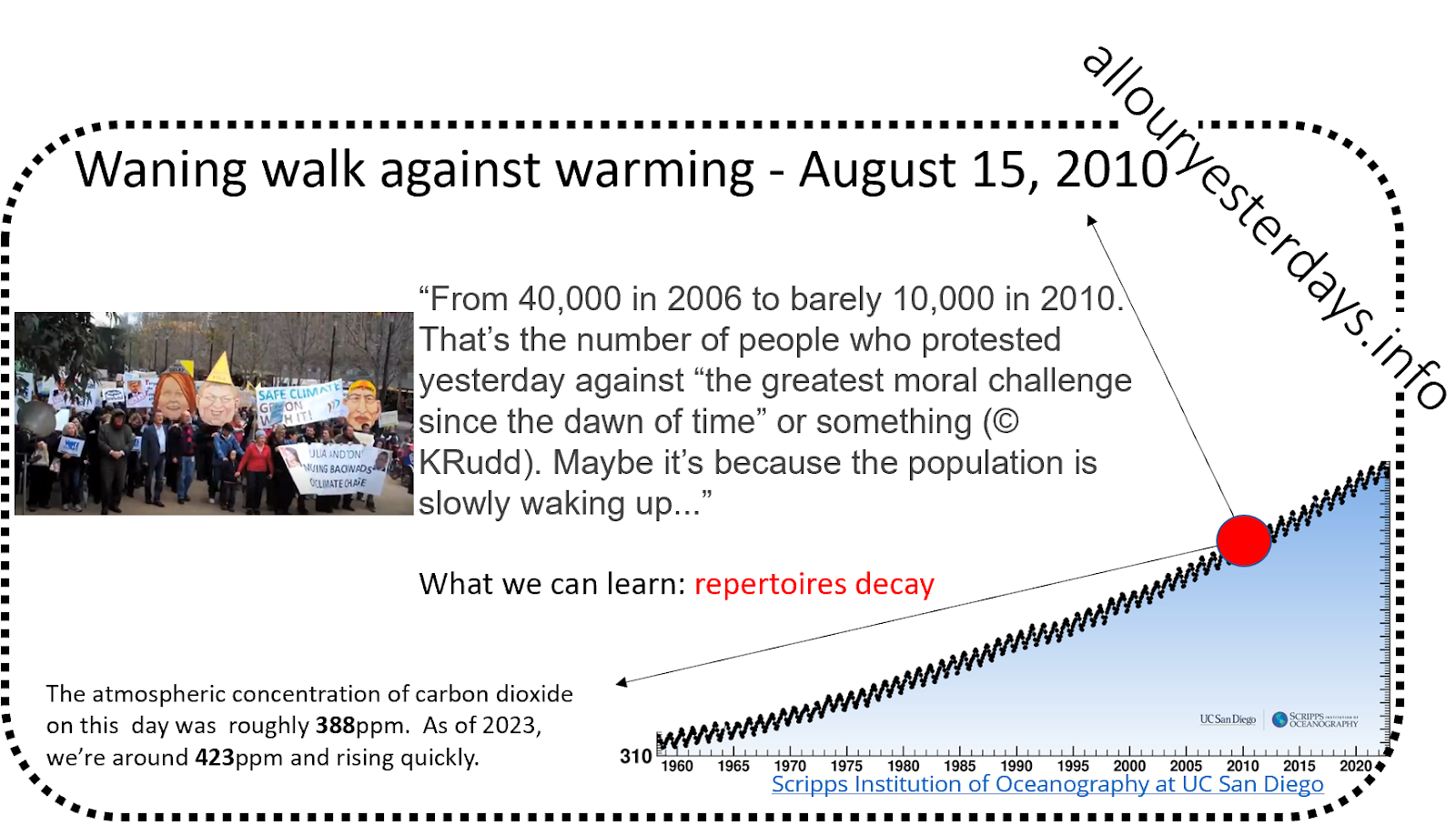
Thirteen years ago, on this day, August 12, 2010, the activist group “Beyond Zero Emissions” holds a Sydney launch of its “Stationary Energy Plan”, with recently toppled Opposition Leader Malcolm Turnbull on the stage…
The amount of carbon dioxide in the air was roughly 388ppm. As of 2023 it is 423ppm, but check here for daily measures.
The context was that the Rudd government’s entirely unambitious climate policies the CPRS had taken up all the oxygen in 2009. The CPRS had then fallen on its face, and Rudd had been unable to summon the courage to call an election on the issue, or take up the suggestion of the Greens for a carbon tax. The activist group Beyond Zero Emissions decided to try to change the narrative with a plan for well beyond zero emissions.
What I think we can learn from this
This sort of bold policymaking from outside the mainstream is really good at forcing the government of the day and the opposition to slightly raise their ambition – or at least ramp up their rhetoric, albeit usually within pre existing and very technocratic boundaries The kind of breakthrough transformational stuff that is proposed, rarely, if ever, gets adopted wholesale, especially if the agenda is mature (i.e. there are lots of middle-class and rich people in and funding think tanks designed to maintain their positions).
What happened next
BZE staggered on, there were personality conflicts. And then after a while it stops being quite so fresh. It became obvious to everyone that the moment has passed, and it was someone else’s 15 minutes next time…
What do you think? Does this pass the ‘so what?’ threshold? Have I got facts wrong? Interpretation wrong? Please do comment on this post, unless you are a denialist, obvs.
Eighteen years ago, on this day, August 11, 2005, Australian activists took action.
On 11 August 2005 approximately 50 student environmentalists and Greenpeace volunteers unfurled a “Quit Coal” banner outside the plant while 12 activists occupied the brown coal pit, with two locking themselves to coal dredging equipment. This action drew worldwide attention to Hazelwood’s CO2 emissions and their harmful impacts on the global climate. (Wikipedia on Hazelwood)
The amount of carbon dioxide in the air was roughly xxxppm. As of 2023 it is 423ppm, but check here for daily measures.
The context was that the Victorian Government was continuing to talk about expanding and continuing with Hazelwood, which was burning brown coal. This, while abundant, was truly filthy. So Greenpeace were doing their best to keep the issue on the agenda, and to accelerate the demise of Hazelwood.
What I think we can learn from this
Transitions take a long time. Involve a lot of blood sweat and tears.
What happened next
It took a long while. But finally, they won. Hazelwood is Toast and Victoria is going for wind and renewables.
What do you think? Does this pass the ‘so what?’ threshold? Have I got facts wrong? Interpretation wrong? Please do comment on this post, unless you are a denialist, obvs.
Fifteen years ago, on this day, July 3, 2008, Greenpeace occupied Australia’s most polluting coal-fired power plant
“At dawn on July 3, 2008, 27 Greenpeace activists entered the 2,640 megawatts Eraring Power Station site north of Sydney to call for an energy revolution and take direct action to stop coal from being burnt. Twelve protesters shut down and chained themselves to conveyors while others climbed onto the roof to paint ‘Revolution’ and unfurled a banner reading ‘Energy Revolution – Renewables Not Coal’. The action preceded the Australian government’s climate change advisor Professor Ross Garnaut’s delivery of his Draft Climate Change Review on July 4. Police arrested 27.”
The amount of carbon dioxide in the air was roughly 388ppm. As of 2023 it is 423ppm, but check here for daily measures.
The context was that the new Rudd Government had appointed economist Ross Garnaut to look at climate economics, and was also appointing other panels, there was going to be a lot of green papers and white papers and speeches. What Greenpeace were, quite rightly, saying is, well, if these speeches and policy papers don’t accelerate the closure of coal-fired monstrosities – death factories in James Hansen’s term – then they’re not worth that much.
What I think we can learn from this
It’s so difficult for an NGO, or any set of NGOs really, to be both trying to engage in the finer points of policy and simultaneously making broader societal points. Because if you go out and do the radical stuff, you’ll find yourself uninvited and disinvited to the policy roundtables, or not taken seriously when you make serious points. All the more reason why you need a very broad-based, well-funded, set of organizations within a movement and that that movement has ways of discussing what counts as “selling out,” being caught up to being a fig leaf, and what counts as constructive engagement. And there’s never going to be the final solid answer and there will always be people who disagree.
As of 2022, Eraring is still pumping out its death, but it is scheduled for final closure shortly.
What do you think? Does this pass the ‘so what?’ threshold? Have I got facts wrong? Interpretation wrong? Please do comment on this post, unless you are a denialist, obvs.
Fifty years ago, on this day, June 14, 1973, the UK based “Conservation Society” tried to lay out what would be needed for, you know, a future…
It begins with the prescient words – “We are in the presence of another climacteric more dramatic than any the human race has yet experienced.”
Yep.
June 14 1973 The Conservation Society launches “Education for our Future” Fairhall, J. (1973) Preparing young for crisis. The Guardian, June 14, p.6.
The amount of carbon dioxide in the air was roughly 332ppm. As of 2023 it is 423ppm, but check here for daily measures.
The context was
Everyone was running around talking about survival and education. And what that would look like. There had been a seminar in 1972 in London, and this Conservation Society effort probably drew on that.
What I think we can learn from this
We’ve been talking about the skills that we would need to educate the young for 50 years that’s included lots of nice words like holistic and environmental and ecological and we have not done it for the most part.
What happened next
Obviously we did not educate ourselves for a new society. If we had, projects like this would not even exist.
The Conservation Society wound up in 1987, ironically just before the next big wave
What do you think? Does this pass the ‘so what?’ threshold? Have I got facts wrong? Interpretation wrong? Please do comment on this post, unless you are a denialist, obvs.
On May 28, 1969, there was a ‘teach-in’ in Berkeley, California.
BERKELEY—About 2,000 persons attended—off and on—a six hour teach-in on “Ecology and Politics in America” May 28 at the U-C Berkeley campus. The idea was to relate the People’s Park issue to broader questions of planetary survival. A lot of language under a hot sun—but hopefully the thing will get made into a book to help people past the old politics and into a root politics of ecology. Sponsors were American Federation of Teachers locals 1474 and 1795. Their leaflet for the occasion put it succinctly where it’s at:
“The battle for a people’s park in Berkeley has raised questions that go far beyond the immediate objects of public attention. They are questions about the quality of our lives, about the deterioration of our environment and about the propriety and legitimacy of the uses to which we put our land. The questions raised by this issue reach into two worlds at once: the world of power, politics and the institutional shape of American society on the one hand, and the world of ecology, conservation and the biological shape of our environment on the other.
“The People’s Park is a mirror in which our society may see itself. A country which destroys Vietnam in order to liberate it sees no paradox in building fences around parks so that people may enjoy them. It is not at all ironic that officers of the law uproot shrubbery in order to preserve the peace. It is the way of the world! Trees are anarchic; concrete is Civilization.
“Our cities are increasingly unlivable. The ghettos are anathema to any form of human existence. Our back country is no retreat; today’s forest is tomorrow’s Disneyland. Our rivers are industrial sewers; our lakes are all future resorts; our wildlife are commercial resources.
“The history of America is a history of hostility and conquest. We have constituted ourselves socially and politically to conquer and transform nature. We measure ‘progress’ in casualties, human and environmental, in bodies of men or board-feet of lumber.
“Ecology and politics are no longer separate or separable issues…”
The context was that people were realising that what was being done to the people of Vietnam – wanton murder and mayhem using ‘advanced technology’ was, (checks notes) also being done at a planetary level, with fewer explosions. And people were (rightly, it turns out) worried about the long-term viability of such a strategy.
What happened next
The momentum stalled as the war wound down, the first oil shock sealed the deal and although the struggle continued, we were doomed…
The amount of carbon dioxide in the air was roughly 393.2ppm. As of 2023 it is 423ppm, but check here for daily measures.
The context was the UK climate “movement.” for want of a better word, had basically collapsed with the failure of Copenhagen because all the eggs had been put in the “let’s have a big march in London in December” basket; the so-called “Wave”. Climate Camp had been neutered as a Radical Space and everything was turning to shit; and this was before the revelation of all the undercover cops.
What I think we can learn from this
The collapse of morale and organisational capacity in the aftermath of some big international defeat is entirely predictable and was in fact predicted with regards to Copenhagen. These vigils remind me of the animals huddling together singing “Beasts of England” after they have witnessed the latest atrocity organised by the pigs – I’m talking about Animal Farm.
If we are to take citizen action seriously we should expect and even demand that organisers of groups warn members that everything is going is likely to turn to s*** and help them get ready for it. But as if. They’re hope-mongers, and that’s what they monger…
What happened next
The UK climate movement entered a long-term period of confusion.
Anti-fracking campaigns became the centre of attention, but the broader strategic remit was lost.
In 2018 the issue returned with the coming of the social movement organisation XR but by 2022 it was gone again…
What do you think? Does this pass the ‘so what?’ threshold? Have I got facts wrong? Interpretation wrong? Please do comment on this post, unless you are a denialist, obvs.
The amount of carbon dioxide in the air was roughly 394.4ppm. As of 2023 it is 420ppm, but check here for daily measures.
The context was that the prospects for action on climate change in the United States – at least at the federal level – were bleak af. Obama had not bothered to fight for the Democratic energy package and climate package, and wasn’t going to punch that tar baby again. The Copenhagen summit had revealed the weakness of the international process and there was more rising despair and rising apathy than Rising Tide.
What I think we can learn from this was
Activist groups are obsessed with “days of action”, perhaps because these give them a sense of punctuation for the meaning of building up to something. It’s not necessarily a bad mobilising tactic but it doesn’t automatically mean that you are movement-building when you are repeatedly mobilising. See my articles about the emotacycle.
What happened next
Rising Tide US I think is dead, but I could be wrong. There are a broad range of other groups sunrise movement etc etc who are are more in the news.
It’s important though to remember that those people who protested were right even if they lost and and that cannot be taken away.
What do you think? Does this pass the ‘so what?’ threshold? Have I got facts wrong? Interpretation wrong? Please do comment on this post, unless you are a denialist, obvs.
Sixteen years ago, on this day, April 27, 2007, a US gas company had to stop smearing coal…
Washington – The founder of a group that ran a series of newspaper ads attacking the coal industry for selling a product that they called “filthy” says the campaign is ending.
The effort, promoted as pro-environment, was sponsored by a rival energy company, a natural-gas-production company, and sparked a round of protests from members of Congress and trade associations.
Fialka, J. 2007. Ad Campaign Bashing Coal Is Ended After Uproar. Wall Street Journal, 27 April.
“the ads were placed anonymously by a two-week-old group called the Texas Clean Sky Coalition. Only one of the nation’s largest gas producers, Chesapeake Energy Corp., acknowledged helping finance the advertising campaign — which easily cost several hundred thousand dollars.”
The amount of carbon dioxide in the air was roughly 386.7ppm. As of 2023 it is 420ppm, but check here for daily measures.
The context was that a natural gas company had been trying to use climate concerns to boost its own product. And this is something that the gas industry has been looking at with more or less interest in – throwing coal under the bus, framing coal as the dirtiest fuel. Therefore gas automatically becomes sort of some kind of “transition fuel”.
What I think we can learn from this
It’s a seductive myth. That, yes, we need a long term transition. But while we’re getting there, gas can help. What we learn is that this fossil fuel industry is not in any sense united, though, we should note that people who do gas and oil tend to have the same bosses.
What happened next
Didn’t the guy who founded Cheseapeake Energy do suicide by Porsche? Yes, yes he did.
And threw loads of money the Sierra Club’s way to help them fund their anti-coal campaigns…
What do you think? Does this pass the ‘so what?’ threshold? Have I got facts wrong? Interpretation wrong? Please do comment on this post, unless you are a denialist, obvs.
Thirty four years ago, on this day, April 11, 1989, the flash-in-the-pan UK environment group “Ark” released a report about potential sea level rise that tanked its credibility
1989 Ark Sea-level rise report, “by 2050″…
The amount of carbon dioxide in the air was roughly 355.7ppm. As of 2023 it is 420ppm, but check here for daily measures.
The context was
Ark, launched in December 1988, was trying to outflank the existing outfits like Greenpeace and Friends of the Earth. It needed big claims to grab attention… Ooops.
What I think we can learn from this
It is hard to join a “cartel” and big big claims may grab attention, but they can also come with a big big downside.
What happened next
Ark crashed and sank, within months.
What do you think? Does this pass the ‘so what?’ threshold? Have I got facts wrong? Interpretation wrong? Please do comment on this post, unless you are a denialist, obvs.
Below is an interview with Ro Randall, a psycho-analyst who has worked on climate issues extensively. She is one of the authors of a new “Living with the Climate Crisis” project, which will be launched on Monday 17th April. The transcript below has been lightly edited/airbrushed…
Marc 0:10
Great. So the first thing Rosemary, is what’s happening on Monday, the 17th of April, the launch?
Rosemary
Monday, the 17th of April is the launch of a new project called “Living with the Climate Crisis,” which I’ve been involved with as one of the main authors. And so, I’m a psychotherapist and I’ve been involved in the climate movement for about 20 years. And my interest has always been in what my profession can bring to the movement, that it doesn’t otherwise have. And primarily, that’s paying attention to how people feel when they engage with what is actually happening to the climate. Because in general, people’s experiences range through all kinds of feelings and distress:,anger, fear, desperation, despair, shock, grief, rage, anxiety.
You can go on, you can name a whole gamut of emotion. And very often, when you’re caught up in the urgency of action, those emotions get swept to one side. They go a bit under the carpet, and maybe it doesn’t feel possible to pay attention to them.
And so what this project is doing is promoting the establishment of groups, led by skilled facilitators, where people can take the time to do three things.
And the first is to look at what they’re feeling and to speak about the feelings that they’re having. And to try to find some resolution, some kind of resting place out of the grief, and the despair and the shock and all of the rest of it – a great range of feelings, I think.
The second is to learn a bit more about what is possible to do across a very broad spectrum of action. And there’s a focus partly on how to communicate better, that’s a big chunk of it, around climate – whether you’re speaking to your family and your close friends, or whether you’re speaking to a public meeting.
And the third bit of it is this sense of looking at the climate movement as an ecosystem, which requires all kinds of different people to be in it, and all kinds of different activities to be going on in it. And so the third part of these groups is looking at, what is it that you can do that is going to be sustainable, that you’re going to be able to be in for a long, long term? And that’s likely to be a mix of different things. And it’s likely to change as time goes on. And so the groups are looking at those kinds of issues. And our hope is that people will be able to come to these and use them in the communities that they’re already part of. We want this to be a locally-based activity rather than an online one. Although obviously, we’re holding the launch online because we reach more people that way.
So that’s essentially what the project’s about.
Marc
Thank you. And it emerged or, is a continuation of work that I know that you’ve been doing since 2007, with “Carbon Conversations.” So how does this work reflect on the successes and failures of Carbon Conversations? And what does it do that Carbon Conversations didn’t or couldn’t do?
Rosemary 4:15
In 2007, when we started the carbon conversations project, we were in the middle of a period of increased government commitment to action on climate change. Government was preparing the Climate Change Bill, which became the Climate Change Act. There was quite a lot of money around in local authorities and coming from government sources to promote community activity about climate change. And although, like all activists, I saw what the government was doing as inadequate, it was there. And it felt like the role for a community organisations was to work with our local communities and get people to understand the basics of what life needed to look like in a much lower carbon society, and to help people take the steps in that direction that they could in their own lives.
So the Carbon Conversations project brought people together to talk about the emotions associated with these major changes that we hoped were coming, and to start acting. And we created materials that could be used by just about anybody, with a short bit of training. Those groups were taken up nationally, and then internationally as a model of how to bring people together in communities.
But so much has changed since then. And so much needs to change because we have seen, since the failure of the Copenhagen negotiations in 2009 and the advent of a Conservative government, such backtracking on climate issues, that people coming to the climate movement now are facing different issues from those that were being faced then. Some issues are the same, some are more intense. And so we’ve been realizing for a time that the Carbon Conversations project had really run its course. It was a good thing in its time, but the materials were out of date, they weren’t dealing with the issues that were troubling people. And so we began to talk about what we could do instead.
In the new project, we’ve drawn together material from different workshops that we’ve run over the years, into a kind of coherent whole, that addresses these three questions I was talking about earlier; how do we cope with the feelings? How do we talk about this very difficult issue? How do we make our action sustainable?
And that’s what we came together to do with Rebecca Nestor, who’s been around in the climate movement for a long time herself, mostly in community action, and is an organisational consultant. And my third colleague is Daniela Fernandez-Catherall, who is a community psychologist with a lot of experience of working psychologically in the community, away from the consulting room, and engaging diverse groups in community action.
So it’s a shift of emphasis away from the carbon reduction aspects of climate issues, and into something which has much more focus on the well-being of activists and their capacities to continue to deliver in very difficult circumstances.
Marc
Thank you. So we’ve talked about the past, let’s talk about the future. Let’s say it’s Wednesday the 17th of April, 2024. And it’s a year after the launch of “Living with Climate Crisis,” what’s changed? Who has been using the materials? And what sort of feedback have you been getting about the materials? And how have you responded to that feedback?
Rosemary 9:21
I’m hoping that there will be groups running in a number of places in the UK. We know that we’ve got groups starting in the places where Daniela and myself and Rebecca are based. We’ve also got some people we know who are going to be using it in Wales. And we’re hoping to see gradually more people using it in different places. Also, over this coming year we’re going to be offering some more in depth introductory workshops, which will be done online for people who wish to facilitate the groups
We’re doing one for some people in Canada shortly. And we’ve got another one for people in the UK coming up in April. And we anticipate doing more of those.
We will be offering monthly support sessions for people using the materials, which will also take place online.
We’re planning on a meeting next September, which we hope will be a face-to-face meeting where people who have been beginning to use it can come together to share experiences.
We’re hoping that people will be taking the materials and using them in a lot of different ways. We’re quite explicit that we want people to adapt what we’re suggesting to their particular circumstances and the audiences they’re working with. And it’s very important to us to acknowledge that these materials have come out of our experience in some groups, that these may be a starting point, not an end point, that people may take one part of what we’ve suggested, and not another.
And we’re hoping that people who come from the psychological professions and associated professions, anybody really who’s got good facilitation skills, will feel that this is something which they can do as a contribution to the climate movement.
So we’re hoping to see groups happening, we’re hoping to see people being supported, and that support work is all being done through the Climate Psychology Alliance, which is sponsoring and supporting the project. And we’re hoping that it will take on a life of its own.