Categories
France International processes

August 23, 1853 – first International Meteorological Conference

One hundred and eighty years ago, on this day, August 23, 1853, scientists from around the world got together in Belgium to hash out some standardised approaches to measuring things.

Enduring cooperation began with the First International Meteorological Conference, held on 23 August 1853 in Brussels. This conference standardised meteorological observations to be taken from ships, by establishing a set of instructions for how to take measurements, and a standard form for recording them. It was organised at the initiative of a naval officer, Lieutenant MF Maury of the United States Navy.

Paterson, M (1996) page 18

https://en.wikipedia.org/wiki/International_Meteorological_Organization#:~:text=Matthew%20Fontaine%20Maury%2C%20of%20the,the%20Minister%20of%20the%20Interior.

https://en.wikipedia.org/wiki/Matthew_Fontaine_Maury

The amount of carbon dioxide in the air was roughly xxxppm. As of 2023 it is 423ppm, but check here for daily measures. 

The context was with the coming of the telegraph, and thus international communication and collaboration in collecting measurements became much easier in real time. But then this raises the question of who is using which measures at which time so that you can have a decent database of comparable/accurate info.

What I think we can learn from this is that the nitty gritty work of doing science of measuring things and thinking about causal relations requires good data which requires cooperation and we’ve been doing that successfully for a long time 170 years.

What happened next

The 19th century saw the ongoing assault on nature, the colonisation of Africa (“colonisation” is one nice word – attack, hyper-extraction would do), the development of new Industries (especially chemistry), the coming of electricity, the industrialisation of Europe, and chunks of of the United States. that’s quite some century and in the short-term, on climate science, a few years later you’ve got Eunice Foote and a few years after that John Tyndall…

What do you think? Does this pass the ‘so what?’ threshold? Have I got facts wrong? Interpretation wrong? Please do comment on this post, unless you are a denialist, obvs.

References

Zilman, J. 2018.

Categories
Denial International processes United States of America

August 16, 2002 – “Oil Lobby Urges Bush to Keep Climate Change Off the Table at Earth Summit”

Twenty one years ago, on this day, August 16, 2002, The Times Newspaper reports

Conservative lobbyists in the US funded by Esso have urged President Bush to derail the Earth summit in Johannesburg because it is anti-freedom, anti-people, anti-globalization and anti-Western.

Browne, A. 2002. USA: Oil Lobby Urges Bush to Keep Climate Change Off the Table at Earth Summit ,The Times, August 16

The amount of carbon dioxide in the air was roughly xxxppm. As of 2023 it is 423ppm, but check here for daily measures. 


The context was it was 10 years since Rio and the United Nations does like a good round number conference. George Dubya Bush had recently been doing some talk about “clean skies” and technology, this and that. 

And the anti Climate Lobby groups just wanted to make sure that he didn’t slip. So this was laying down some “suppressing fire” and to force proponents of action to expend energy in simply keeping climate change (literally) ‘on the agenda.’ 

What I think we can learn from this

What’s interesting, what we can learn is, this is what they do. They’re constantly laying down “suppressing fire”, which didn’t really work as well as they’d hoped. But it makes you feel good when you do it, keeps you in a job, makes you test your ammo, and your guns, so why not? I can say the language is extraordinary, but nothing special. They do genuinely frame it as liberty and freedom and democracy versus the evil globalist at least for public consumption. 

What happened next

Climate stayed on the agenda. Bush stayed a prick. The carbon dioxide kept accumulating.

What do you think? Does this pass the ‘so what?’ threshold? Have I got facts wrong? Interpretation wrong? Please do comment on this post, unless you are a denialist, obvs.
Categories
Industry Associations International processes

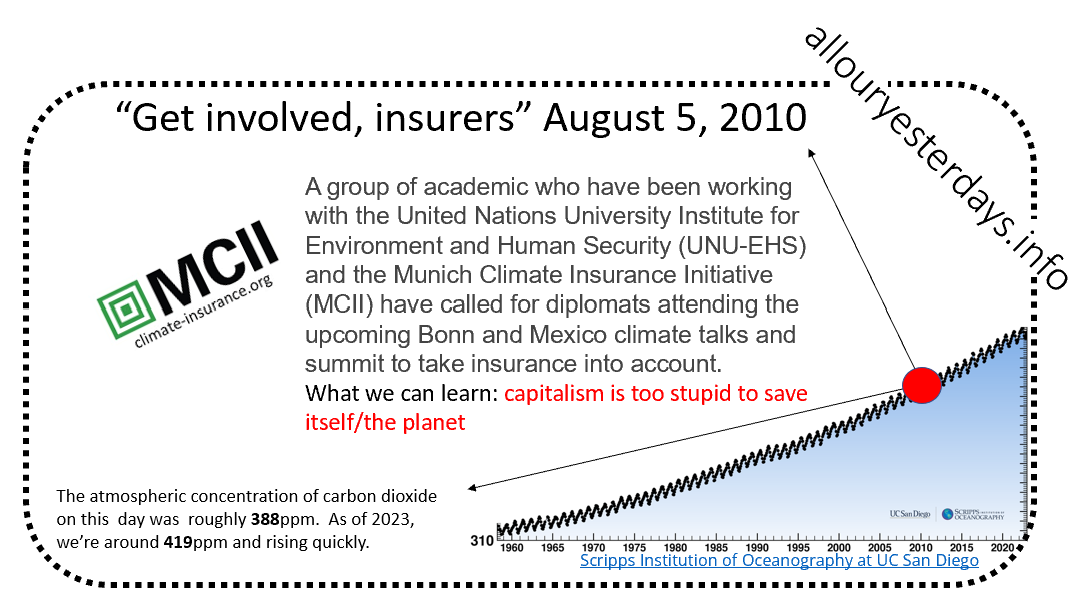
August 5, 2010 – academics call for insurance industry to get involved in climate fight

Thirteen years ago, on this day, August 5, 2010…

A group of academics who have been working with the United Nations University Institute for Environment and Human Security (UNU-EHS) and the Munich Climate Insurance Initiative (MCII) have called for diplomats attending the upcoming Bonn and Mexico climate talks and summit to take insurance into account.

A policy brief issued by the academic groups calls for insurance to play a key role in reducing climate change risks and influencing climate adaptation projects.

“Our research over the past years has shown that insurance solutions – with coordinated public-private action and some international support – has the potential to help vulnerable countries and people adapt to climate change”, stated Koko Warner (UNU-EHS), lead author of the policy brief ‘Solutions for Vulnerable Countries and People’. “Now it is time to move from knowledge to action. The need to link DRR and insurance and scaling them up is greater than ever to get the critical mass for adaptation”, Dr. Warner continued. 

https://www.artemis.bm/news/academics-say-insurance-could-play-key-role-in-reducing-climate-change-risks/

The amount of carbon dioxide in the air was roughly 388.7ppm. As of 2023 it is 423ppm, but check here for daily measures. 

The context was the Copenhagen gathering had been a complete failure. And so academics thought that if they could geinsurance companies involved, then it might shake loose some of the intransigence. I don’t know if they knew it, but Greenpeace had tried the same shtick 15 years earlier at the first COP, in Berlin, with very limited success. 

What I think we can learn from this is that people always think that there is a button that can be pushed, a lever that can be pulled, to get us out of this fix. But it probably would require Cthulhu pushing and pulling with all of its tentacles repeatedly to make the machine shift. 

What happened next

The insurance companies put out some glossy reports and there was some hand-wringing and the carbon dioxide kept accumulating, 

What do you think? Does this pass the ‘so what?’ threshold? Have I got facts wrong? Interpretation wrong? Please do comment on this post, unless you are a denialist, obvs.

Categories
International processes Sweden United Nations

July 30, 1968 – the UN says yes to an environment conference

Fifty five years ago, on this day, July 30, 1968, the top committee of the United Nations says yes to a environment conference, something the Swedes had been pushing for.

1968 July 30 Resolution 1346 (XLV) recommends that the General Assembly consider a conference on environmental problems.

The amount of carbon dioxide in the air was roughly 324ppm. As of 2023 it is 423ppm, but check here for daily measures. 

The context was as per previous blog posts here (May 1968)and here (December 1967). Earlier in the year one of the diplomats had given a speech, which was the first mention of climate change, though it wasn’t, because he didn’t call it that. 

What I think we can learn from this

Regardless of the names/terminology, we have known about this for a long time.

What happened next

In December 1968 , the UN General Assembly nodded it through. And then in 1972 the Stockholm conference happened. 

What do you think? Does this pass the ‘so what?’ threshold? Have I got facts wrong? Interpretation wrong? Please do comment on this post, unless you are a denialist, obvs.
Categories
International processes United States of America

 July 9, 2008 – President Bush operating at his peak intellectual capacity

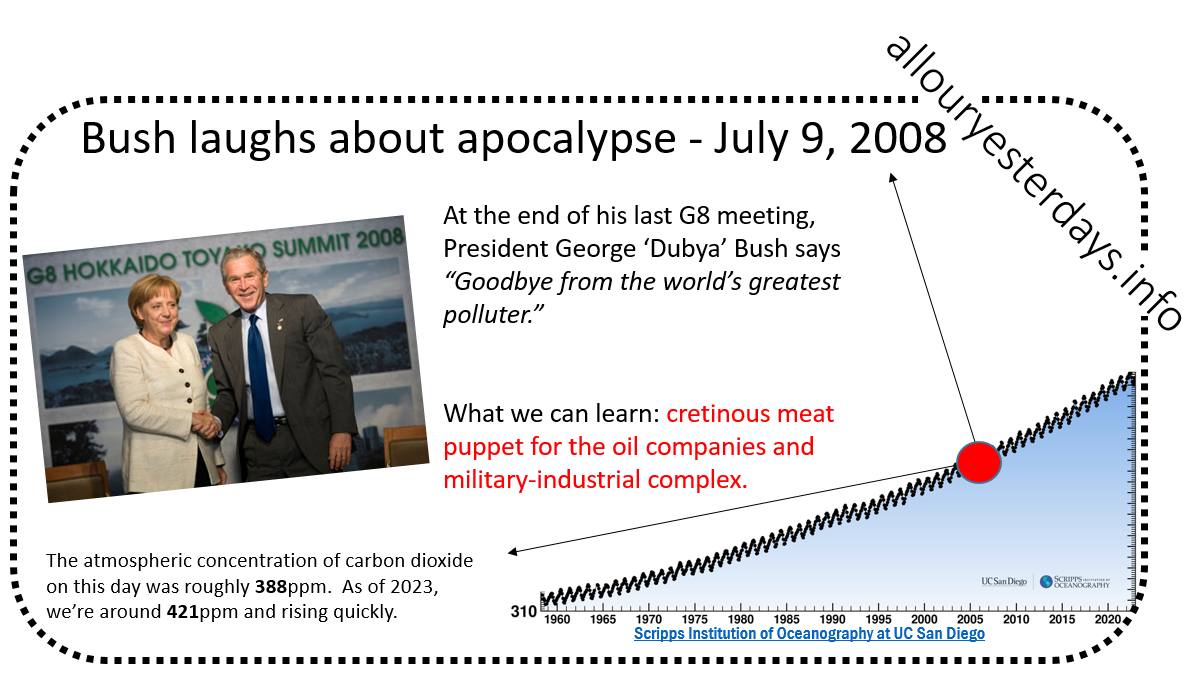
Fifteen years ago, on this day, July 9, 2008 George Bush, who had been President thanks to his dad’s mates on the Supreme Court, told the G8 “Goodbye from the world’s greatest polluter.”

The amount of carbon dioxide in the air was roughly 386.6ppm. As of 2023 it is 423ppm, but check here for daily measures. 

The context was that George Bush had served two terms as President having been handed the first one by the Supreme Court and then legitimately winning the second albeit with some boxy help, during the second debate with John Kerry

Bush at the G8  had that typical smirk and wanted to, as we now call it, “own the libs,” which he was very good at. And he conceded that yes, the US is the world’s biggest polluter. And it goes back to notions of the United States “way of life” being non negotiable, as his spokesperson had said in early 2001. 

What I think we can learn from this is that when high carbon behaviours are “non-negotiable” and you don’t have any decent forms of mass provision, then yeah, you’re gonna be the world’s biggest polluter, and it’s actually not something to be proud of, or joke about, asshole. 

What happened next

The world’s biggest polluter kept at it. Obvs.

What do you think? Does this pass the ‘so what?’ threshold? Have I got facts wrong? Interpretation wrong? Please do comment on this post, unless you are a denialist, obvs.

Categories
International processes Japan United Kingdom

June 29, 1979 – Thatcher uses carbon dioxide build-up to shill for nuclear power

Forty four years ago, on this day, June 29, 1979, at the G7 meeting in Tokyo, new UK Prime Minister Margaret Thatcher gave a radio interview to journalist Bob Friend where she explicitly mentioned the greenhouse effect, in order to defend/extend nuclear (this during G7 meeting in Tokyo).

The amount of carbon dioxide in the air was roughly 339ppm. As of 2023 it is 423ppm, but check here for daily measures. 

The context was that an interdepartmental committee set up by the Labour government was in process of delivering its findings. The Thatcher government wanted to bury it. Meanwhile Thatcher was a big fan of new nuclear… Thatcher had been briefed about the reality of climate change by her Chief Scientific Advisor, John Ashworth and according to an interview with him she responded with incredulity and the statement ‘you want me to worry about the weather?’

What I think we can learn from this

Thatcher knew about the greenhouse effect and was willing to use it as a wedge issue against anti-nuclear greens.

What happened next

The G7 communique name-checked climate change, which then largely disappeared from these sorts of meetings for ten years. It would be 1988 before she started talking sense possibly after Crispin Tickell finally got through to her.

What do you think? Does this pass the ‘so what?’ threshold? Have I got facts wrong? Interpretation wrong? Please do comment on this post, unless you are a denialist, obvs.

Categories
Canada International processes

June 28, 1988 – Greenies want deep emissions cuts. Doesn’t happen. #TorontoTarget

Thirty five years ago, on this day, June 28, 1988, NGOs suggested deep deep cuts. Ha ha ha

Developed nations should commit themselves to a 50 per cent reduction in the use of fossil fuels by 2015 to slow and then stop the warming of the Earth, a group of non-governmental organizations said yesterday at a conference in Toronto on the atmosphere.

McInnes, C. 1988. Cut use of fossil fuels by half, group urges. The Globe and Mail, 29 June.

The amount of carbon dioxide in the air was roughly 353ppm. As of 2023 it is 423ppm, but check here for daily measures. 

The context was the Changing Atmosphere conference was a mix of NGOs and scientists and the engineers were pushing for a very ambitious target, as this press release based report shows, a 50% reduction by 2015

What I think we can learn from this

It was the NGOs who knew what was needed and and were “Demanding The Impossible” or “the necessary,” as you might also look at it

What happened next

The actual target presented at the end of the conference was a watered-down compromise of 20% reduction by 2005.  And this was adopted with caveats by various nations but did not succeed in the United Nations process. which called merely for stabilisation by the year 2000 of rich nations (which none met) – his was of course a farce and a betrayal

What do you think? Does this pass the ‘so what?’ threshold? Have I got facts wrong? Interpretation wrong? Please do comment on this post, unless you are a denialist, obvs.

Categories
International processes Norway

June 24 1985 – Climate change rears its head at a development meeting…

Thirty eight years ago, on this day, June 24, 1985, the question of climate change was brought to the development table (not for the first time).

The third meeting of the world commission on environment and development began in Oslo today with serious concern over acid rain and greenhouse effects, according to a report from oslo. The seven-day meeting started with two days of public hearings at which non-government organizations testify on marine mammal conservation, possible irreversibility of acid rain effect and greenhouse effect on other energy-related issues. Dr. Irving Mintzer from the World Resources Institute (WRI) reviewed greenhouse effect by which carbon dioxide in the atmosphere impedes the ability of the earth to radiate back into space the heat from the sun. He also warned that other gases like methane and chlorofluorocarbons may amplify the warming effect of carbon dioxide. As an effect of greenhouse, the sea level would rise 70 to 100 cms and cause coastal flooding and salt water intrusion into rivers and ground water reservoirs which would disrupt the life of 40 percent of the world’s population dwelling in coastal areas, mainly in Bangladesh, vietnam, Egypt, the Netherlands and the U.S. gulf coastal areas.

The amount of carbon dioxide in the air was roughly 348.6ppm. As of 2023 it is 423ppm, but check here for daily measures. 

The context was that in 1983 the World Commission on Environment and Development had been set up kind of a sequel or extension of the Brandt report published in 1980 and is clear from this meeting that climate was already well on the agenda.

What I think we can learn from this is that it is now 40 years since international bureaucrats were joining the dots about specific problems that would be faced.

What happened next

The Brundtland report was released in 1987. It gained a lot of traction because the second Cold War was winding down and everybody needed something new to talk about. And the environmental problems were becoming very clear especially thanks to the Amazon deforestation and the Ozone hole… Climate would explode in mid-1988.

What do you think? Does this pass the ‘so what?’ threshold? Have I got facts wrong? Interpretation wrong? Please do comment on this post, unless you are a denialist, obvs.

Categories
France International processes

June 16, 1993 – Oooh, an international conference….

Thirty years ago, on this day, June 16, 1993, an OECD/IEA conference “International Conference on the Economics Of Climate Change” ended in Paris.

What a doomed species we are.

The amount of carbon dioxide in the air was roughly 359.6ppm. As of 2023 it is 423ppm, but check here for daily measures. 

The context was

The Earth Summit happened. And now everyone was gonna have to figure out the economics of climate change. The IEA and the OECD were good venues for this, both of them with one foot in the technology. So see for examplethe carbon disposal symposium in Oxford earlier in the year. And IEA had been playing around with the science since well, February of 1981, at the latest. IEA had been looking ideas about what would you do about the economics of climate change? This stuff had been discussed as far back as the mid 1970s by Nordhaus for IASSA 

What I think we can learn from this

And the same sets of ideas get moved around the chessboard. And then a new game starts and they set the chess pieces up. And round and round and round it goes. Questions of political and social cultural power, are, of course, bracketed or sidestepped altogether, because that would be normative and not easily quantified. And might take you towards things like new international economic orders, an old unpopular (with the rich) idea from the 1970s…

What happened next

The carbon dioxide kept accumulating. And the economists and so forth, kept flying from conference to conference. 

See also – Stern admits he under-estimated speed of changes

What do you think? Does this pass the ‘so what?’ threshold? Have I got facts wrong? Interpretation wrong? Please do comment on this post, unless you are a denialist, obvs.

Categories
Denial Industry Associations International processes UNFCCC United Nations United States of America

February 27, 1992 – climate denialists continue their effective and, ah, well EVIL, work

Thirty one years ago, on this day, February 27, 1992, denialists released a denial statement during what were supposed to be the last negotiations before the “Earth Summit”, the one where a text was supposed to be agreed that could then lock-in the attendance of Prime Ministers and Leaders…

In February 1992 the Science and Environmental Policy Project (SEPP) published the “Statement by Atmospheric Scientists on Greenhouse Warming” objecting to the United Nations Conference on Environment and Development Earth Summit planned for Rio de Janiero in June 1992.[1]

The signatories to the letter complained that the Earth Summit “aims to impose a system of global environmental regulations, including onerous taxes on energy fuels, on the population of the United States and other industrialized nations. Such policy initiatives derive from highly uncertain scientific theories. They are based on the unsupported assumption that catastrophic global warming follows from the burning of fossil fuels and requires immediate action. We do not agree.” 

https://www.sourcewatch.org/index.php/SEPP_and_the_Statement_by_Atmospheric_Scientists_on_Greenhouse_Warming

The amount of carbon dioxide in the air was roughly 357.2ppm. As of 2023 it is 419ppm, but check here for daily measures. 

The context was

The climate negotiations were coming to a crunch. The whole thing might fall over. The US administration, with George Bush senior as the boss, was blocking blocking blocking, but there was always the fear they might – with a US Presidential election pending – make concessions. The denialists wanted to make that more unlikely by making it more costly….

What I think we can learn from this

Those fearful of change will keep pushing even if “their guy” (and it usually is a guy) is ‘rock solid’.  They take little/nothing for granted. That attitude, and all their money, and their structural position within the economy, explains why they win so often…

What happened next

Bush held firm. The French blinked on the question of targets and timetables for emissions reductions in the climate treaty. There were extra “negotiations” in May in New York, but they were just really a white flag being run up. Everyone went to Rio for a grip and grin.

The following 30 years have been about trying to claw back a mechanism by which rich countries would actually cut emissions.
It was never going to be easy, but the Bush Whitehouse rendered it actually impossible.

Am so very very glad I did not breed, because I’d have had to try to teach my kid a whole bunch of survival skills for a shituation whose particular needs are pretty impossible to specify.

What do you think? Does this pass the ‘so what?’ threshold? Have I got facts wrong? Interpretation wrong?  Do comment on this post.