Categories
Australia Kyoto Protocol

July 27, 2001 – Minerals Council of Australia versus the Kyoto Protocol

On this day in 2001 the Minerals Council of Australia (the lobby group for the big mining outfits tried to stiffen the Howard government’s stance on the Kyoto Protocol with a media release with the catchy title “Government Must Stand firm on Kyoto.”.

Australia had extracted/extorted a sweet sweet deal at the 1997 negotiations about rich countries reducing their emissions. It had signed the deal, but NOT ratified it. At this particular moment, the USA had pulled out, but Australia had not. There was an election coming, and one that was not looking safe for Howard (this is pre-Tampa…) Would Howard ratify in order to deprive Labor of a stick to beat him with? The MCA wanted to make sure that unlikely event did not come to pass…

Why this matters. 

Keep your eyes on what the big trade associations are saying (and – to the best you can – doing).

What happened next?

Business ended up splitting on Kyoto – the Business Council of Australia had to move from “don’t ratify” to “we have no settled position” because there was a stalemate between the pro- and antis within the members of the organisation.

See also Howarth, N. and Foxall, A. (2010)  “The Veil of Kyoto and the politics of greenhouse gas mitigation in Australia”. Political Geography. Volume 29, Issue 3, Pages 167-176. https://doi.org/10.1016/j.polgeo.2010.03.001

They argue that

“‘Kyoto’ has created a veil over the climate issue in Australia in a number of ways. Firstly, its symbolic power has distracted attention from actual environmental outcomes while its accounting rules obscure the real level of carbon emissions and structural trends at the nation-state level. Secondly, a public policy tendency to commit to far off emission targets as a compromise to implementing legislation in the short term has also emerged on the back of Kyoto-style targets. Thirdly, Kyoto’s international flexibility mechanisms can lead to the diversion of mitigation investment away from the nation-state implementing carbon legislation. A final concern of the Kyoto approach is how it has shifted focus away from Australia as the world’s largest coal exporter towards China, its primary customer….”

Categories
Australia

July 26, 1977 – Australians warned about cities being flooded #CanberraTimes

On this day, July 26, 1977 the Canberra Times had a story with the cheerful title cities could be flooded.

And, yes – for the third day a row, I am writing about events that happened FORTY FIVE YEARS AGO.

This is the Canberra Times getting a story off “the wire” about that National Academy of Science report that I have been banging on about for the last two days.

With the benefit of hindsight, this closing sentences are amusing.

“The report said there was no cause for panic. But Mr Revelle said, “We have to be prepared to go to other sources than coal in about 50 years”.”

Why this matters. 

The Canberra Times is one of the newspapers for the big decision makers in Australia. “We knew.” But the lurer of coal was too strong…

What happened next?

Four years later the Office of National Information (a spy/analyst outfit) wrote about the Greenhouse effect. Speedy, huh? Another four years or so and we got the Greenhouse Project, courtesy of Barry Jones’ “Commission for the Future.” But I am getting ahead of myself…

Categories
Kyoto Protocol UNFCCC United States of America

July 25, 1997 – US says, in effect, “screw our promises, screw the planet”

On this day, July 25  1997 the US Senate unanimously (95–0) passed Senate Resolution 98 (also referred to as the Byrd-Hagel Resolution.

It said – contra what the USA had already agreed when it ratified the 1992 UNFCCC – that it would sign no deals that didn’t include the developing world making cuts as well. You know, those peoples who had done nothing to cause the problem, and were already on the pointy end.

This was the at the culmination of a very well-funded and well-executed campaign by US corporate interests to reframe international environmental agreements as an attack on US sovereignty, and on the employment prospects of US workers – see for example this and this..

Why this matters. 

Shows you the power of corporate mobilisations, dunnit?

What happened next?

The US negotiated a deal at Kyoto, and signed it, but it was never going to get through the Senate, even if Gore hadn’t had the 2000 election pinched from him by the Supreme Court.  Then George W. Bush pulled out of Kyoto altogether, in March 2001. 

And here we are.

Categories
Ignored Warnings United States of America

July 25, 1977 – New York Times front page story “scientists foresee serious climate changes”

On this day, 25 July, 1977 the New York Times ran a front page story, by its science reporter, Walter Sullivan. Its title – “Scientists Fear Heavy Use of Coal May Bring Adverse Shift in Climate

“Highly adverse consequences” may follow if the world, as now seems likely, depends increasingly on coal for energy over the next two centuries, according to a blue‐ribbon panel of scientists.

“In a report to the National Academy of Sciences on their two‐and‐a‐half‐year study, the scientists foresee serious climate changes beginning in the next century. By the latter part of the 22nd century a global warming of 10 degrees Fahrenheit is indicated, with triple that rise in high latitudes.”

Sullivan, W. (1977) Scientists Fear Heavy Use of Coal May Bring Adverse Shift in Climate New York Times, July 25, p.1
Here’s the report.

Two days later, it made its way into The Times

Why this matters. 

We knew enough by the late 1970s to move from watching brief to “action!”. 

“We” didn’t do that.

What happened next?

Briefed in 1980 by her Chief Scientific Advisor, Margaret Thatcher was incredulous “You want me to worry about the weather.”

Categories
Australia

July 25, 1989 – Australian Environment Minister admits was blocked by Treasurer on emissions reduction target

On this day, July 25, 1989, the Australian Minister for the Environment, Graham Richardson, gave a speech at the National Press Club. He admitted he had been blocked by Treasury in his bid to announce on a strong target for Australian emissions reductions.

“As the Minister for the Environment, Senator Richardson, yesterday [25 July 1989] talked tough to the States about using constitutional powers to override their decisions, he admitted he had been defeated by his Cabinet colleagues on a stronger federal environmental statement.

He confirmed that the Treasurer, Mr Keating, had been a prime mover in defeating his proposal that Australia aim to reduce greenhouse emissions by 20 per cent by 2005….

His frank comments at the National Press Club were clearly aimed at shielding himself against criticism from the conservation movement and the public that he did not fight hard enough for the environment.

But they might also add to tensions between himself and Mr Keating.

Referring to a report by Michelle Grattan, The Age newspaper’s chief political correspondent, that he had been rolled, Senator Richardson said that she had not been aware that a meeting between “Paul Keating and myself was to take place the morning after the Cabinet meeting to settle the wording of the statement of this issue”.

In Senator Richardson’s view this had resulted in considerable improvement –

“None the less, my old cobber was right in suggesting I was rolled on the setting of a target for a reduction of greenhouse gases,” he said.

“I had asked Cabinet to agree to the target agreed upon by the Toronto Conference, i.e. 20 per cent reduction in carbon dioxide emissions by 2005.

“… When I put this target to our Cabinet, I came under close questioning by the economic ministers. I couldn’t sustain my argument with sufficient science.”

“I haven’t yet learnt how to lose gracefully so I was angry. I delved into the department’s records so that I could write to my Cabinet colleagues and demand a reconsideration. The cupboard, however was bare, and the letter was never written.”

Dunn, R. 1989. Cabinet reduces greenhouse target. Australian Financial Review, 26 July.

Why this matters. 

So. Many. Missed. Opportunities.

What happened next?

Australia got a carefully hedged announcement about emissions reductions, so the next Federal Environment Minister could go to the Second World Climate Conference – which was the starting gun for the international negotiations for a treaty – with something in her hand.

See here for more about that.

Richardson well…

Categories
Ignored Warnings United States of America

July 24, 1977 –  Climate change as red light? “No, but flashing yellow.”

On this day, July 24, American climate scientist Thomas F. Malone used the imagery of traffic lights while discussing the two and a half year study by the National Academy of Science into climate change.

“During a press conference convened in late July 1977, for instance, Malone cast the climate problem as a “flashing yellow light,” a clear indication of the academy’s desire to seriously consider the risks of climate change without investing too much in crafting policies that could inflame public anxieties and, in turn, sanction a red-light approach to fossil fuel emissions.” (Henderson 2019: 401)  

See also – “Study Warns of Overreliance on Fossil Fuels,” Colorado Springs Gazette-Telegraph, 25 Jul 1977.

See also Omang (1979).

Why this matters. 

We knew.

What happened next?

You know.


And sorry, but tomorrow’s post is also about this NAS report.

Categories
Science Scientists United States of America

July 23, 1979 – Charney Report people meet – will conclude “yep, global warming is ‘A Thing’.”

On this day, 23 July 1979, the  “Ad Hoc Study Group on C02 and Climate” begins at Woods Hole, giving us the  “Charney Report.”

Short version – a scientist (Gordon MacDonald) and a Friends of the Earth activist (Rafe Pomerance) had managed to get President Jimmy Carter’s science advisor (Frank Press) to get Carter to request a study on whether this “greenhouse effect” thing was gonna actually be the problem some were saying.

So folks met, under the leadership of one of the big original beasts of atmospheric science, Jule Charney.

And they came up with the view, “yes”.

See this excellent summary, written by Neville Nicholls, an Australian scientist

Here’s a flowery (but good) bit from Nathaniel Rich’s “Losing Earth”

The scientists summoned by Jule Charney to judge the fate of civilization arrived on July 23, 1979, with their wives, children and weekend bags at a three-story mansion in Woods Hole, on the southwestern spur of Cape Cod. They would review all the available science and decide whether the White House should take seriously Gordon MacDonald’s prediction of a climate apocalypse. The Jasons had predicted a warming of two or three degrees Celsius by the middle of the 21st century, but like Roger Revelle before them, they emphasized their reasons for uncertainty. Charney’s scientists were asked to quantify that uncertainty. They had to get it right: Their conclusion would be delivered to the president. But first they would hold a clambake.

They gathered with their families on a bluff overlooking Quissett Harbor and took turns tossing mesh produce bags stuffed with lobster, clams and corn into a bubbling caldron. While the children scrambled across the rolling lawn, the scientists mingled with a claque of visiting dignitaries, whose status lay somewhere between chaperone and client — men from the Departments of State, Energy, Defense and Agriculture; the E.P.A.; the National Oceanic and Atmospheric Administration. They exchanged pleasantries and took in the sunset. It was a hot day, high 80s, but the harbor breeze was salty and cool. It didn’t look like the dawning of an apocalypse.

Why this matters. 

“We” really knew enough by the late 70s. Everything since then has been footnotes.

What happened next?

Carter lost the 1980 election, handsomely. It would be another 8 years before the simulacrum of international action began.

Categories
Activism United Kingdom

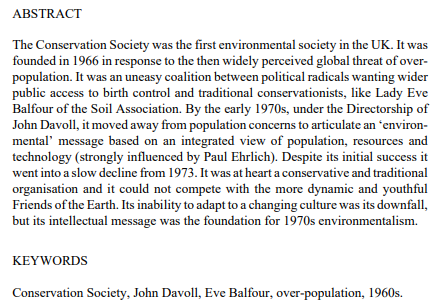
July 22, 1966 – “The Conservation Society” holds launch event

On this day, July 22, 1966, the Inaugural meeting of the “Conservation Society”

There’s this corking article if you’re interested-

Herring, H. (2001) The Conservation Society: Harbinger of the 1970s Environment Movement in the UK. Environment and History 7, 4 pp. 381-401.

Why this matters. 

We need to remember that organizations come and go, and are creatures of their time, and can be “trapped” – by their own cognitive and emotional settings, by others expectations and perceptions of them. A little like humans themselves, donchathink?

What happened next?

The Conservation Society was influential and important in the late 60s – we will come back to the 1968 lecture by Ritchie Calder. Its apogee was 1971-2, when it hosted a conference with Paul Ehrlich as a guest speaker. Its decline in influence through the 1970s and 80s (it was wound up in 1987) was tied to the rise of groups like Friends of the Earth and The Ecology Party (aka The Green Party), not tied to population concerns and not perceived as old, white and conservative.

Categories
Ignored Warnings Science United States of America

July 22, 1968 – Gordon Macdonald tries to warn about carbon dioxide build-up…

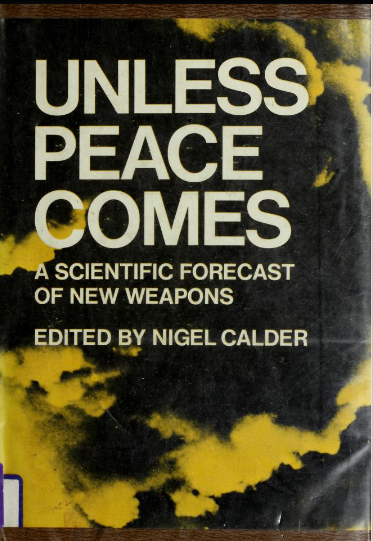
On this day in 1968 Gordon Macdonald’s  chapter on weather and climate modification, under the title “How to Wreck the Environment” (pdf here) appeared  Nigel Calder’s book “Unless Peace Comes a Scientific Forecast of New Weapons” was published 

July 22, 1968 – Viking Adult – ISBN: 978 067 074 1140

A shortened version of the chapter had already appeared in New Scientist in April of the same year

“How to wreck the environment.” New Scientist. 25 April 1968):180- 82;

MacDonald noted 

“There has been much controversy in recent years about conjectured overall effects on the world’s climate of emissions of carbon dioxide to the atmosphere from furnaces and engines burning fossil fuels, and some about possible influences of the exhaust from large rockets on the transparency of the upper atmosphere. Carbon dioxide placed in the atmosphere since the start of the industrial revolution has produced an increase in the average temperature of the lower atmosphere of a few tenths of a degree Fahrenheit. The water vapour that may be introduced into the stratosphere by the supersonic transport may also result in a similar temperature rise. In principle it would be feasible to introduce material into the upper atmosphere that would absorb either incoming light (thereby cooling the surface) or outgoing heat (thereby warming the surface). In practice, in the rarefied and windswept upper atmosphere, the material would disperse rather quickly, so that military use of such a technique would probably rely upon global rather than local effects”

Why this matters. 

Anyone who had their eyes open knew there was probably trouble ahead. By the late 70s, that trouble was unmistakable. 

What happened next?

Ten years later Macdonald, with Rafe Pomerance, would get the wheels rolling for the Charney report (see Nathaniel Rich’s “Losing Earth”).

By then MacDonald was also appearing on the Macneil Lehrer hour (1978) and so on. There’s a nice oral history interview here– 

Basically, Macdonald is one of the (forgotten) good guys.

See this nice biographical memoir of the man (he died in 2002) by Munk, Oreskes and Muller

Categories
Australia

July 21, 1991 – “Greenhouse Action for the 90s” conference leads to “The Melbourne Declaration”

On this day, July 21, 1991, a three-day international conference “Greenhouse Action for the Nineties”, co-hosted by UNEP, The Climate Institute (the US version) and the short-livedNGO “Greenhouse Action Australia” began in Melbourne. At the end of it, a declaration. It gives you a sense of the earnestness and the technological primitivism (by today’s standards) that this

“was approved at the final plenary… constructed by a consensus process, using computer projection of wordings drafted in workshops conducted throughout the conference.”

The declaration called on

  • Australian governments at all levels to accelerate the development of programmes to convert interim planning targets into action, with priority funding for implementation;
  • local government authorities to participate more actively in the global climate debate and develop sustainable cities and living areas;
  • industries to seize opportunities afforded in the development of new and environmentally sound technologies to meet the global climate challenge; and
  • individuals to take personal responsibility for life-style changes that would lead to climate stabilisation and ecological sustainability.

Specifically on energy, there was this –

The context is that, around the world – and especially in Australia (thanks to the ground-laying work of Barry Jones (Hawke’s Science Minister 1983-1990), the Commission for the Future and the CSIRO Atmospheric Research Division (Graeme Pearman, Barrie Pittock and others) – people were taking “the greenhouse effect” seriously. Greenhouse Action Australia was part of that –

People thought something could and would be done about the problem. They saw it was, unless dealt with, going to lead to horror. They started groups, they held conferences, they made declarations….

Looking back, it’s “obvious” that they underestimated

a) the difficulty of keeping an issue (and groups) “live” and vibrant.

b) the sheer ferocity and skill of the industry-led pushback and the way that it would lead to a “culture war.”

That wasn’t their fault, on the whole. The reason we are in this godawful mess is not the fault of the people who tried (though they could have tried harder, smarter – but you can always say that). The fault – and the indictments at the Hague – though we had best hurry on that score – lay elsewhere.

Why this matters.

We need to (try to) learn from past mistakes (but remember that Hegel jibe too).

What happened next

The “greenhouse effect” became old news (pushed out by the first Western military action against Iraq, and by the sense that an international treaty, signed in Rio in 1992, had ‘solved’ the problem.

But the industry figures knew it would come back, as an issue, and they made sure they were ready. By then, most of the groups that had sprung up – like Greenhouse Action Australia – had died, so the industry figures had a much easier time spreading their lies. And with the 1996 arrival of the Howard government, it got easier still. The rest is “history”…