Categories
United Kingdom

November 20, 1974 – BBC airs “The Weather Machine”

On this day, November 20, 1974, the BBC showed a documentary “The Weather Machine”, which makes glancing and largely dismissive mention of carbon dioxide build-up as a cause of the changing weather patterns by then being studied more intently…

“On Wednesday evening, immediately  following The Frost Interview, the BBC broadcast its much heralded, prestige extravaganza The Weather Machine (BBC2, November 20, 9.00 p.m.); the latest in a series of annual productions which began so successfully back in 1970 with Violent Universe. Excellently assisted by the studio commentary of Magnus Magnusson, the modulated narrative tones of Eric Porter and, more importantly, by the availability of a six figure budget, producer Alec Nisbett endeavoured to squeeze into 120 minutes of airspace the fruits of twelve months globetrotting “

Nature 22nd November1974

[The amount of carbon dioxide in the atmosphere was 330ppm. At time of writing it was 417ishppm- but for what it is now,well, see here for the latest.]

The context was this – from the early 1970s, a series of extreme weather events made the weather, well, newsworthy….

Why this matters. 

We should be fair to folks back then- there was a lot of different data and arguments out there. With hindsight it is “obvious” that carbon dioxide was definitely the culprit. Hindsight is famously 20/20…

What happened next?

Through the 1970s climate scientists became more and more convinced of what was going on, what was coming – sooner or later.  They tried to raise the alarm…

Categories
Carbon Capture and Storage United Kingdom

November 19, 2007 – Gordon Brown announces first Carbon Capture and Storage competition at WWF event

On this day, November 19, Prime Minister Gordon Brown announced the first CCS competition

Carbon capture Government ministers have been giving speeches about the carbon capture competition for months. Mr Darling talked about it in the Pre-Budget Review. But Gordon Brown’s speech did not hesitate to bring it forward as a completely new idea. ‘I can announce today that we are launching a competition to build […] one of the […] first commercial CCS […] projects’.

He also mentioned the agreement between China and the UK to work together on Near Zero Emission Coal. He said it was the first of its kind. It was not. Australia and China signed a similar deal in September.

CCS had been swirling around for a few years by now. BP had wanted to get it going (with Enhanced Oil Recovery) at a site in Scotland, but Treasury wouldn’t give it the ROCs (renewable obligation certificates) to make the numbers add up….

Why this matters

If you know you’re history, you will know where you’re coming from…

What happened next

First CCS competition fizzles out in 2011. Second one, begun 2012, killed off abruptly in November 2015.  Third time lucky?

Categories
International processes

November 19, 1990 – “The US should agree to stabilising CO2 levels”

On this day, November 19, 1990, recently-sacked from the White House official William (“Bill”) Nitze (see here and here) had a letter published in the Financial Times (all the smartest people have, of course).

Sir, The US should join other OECD nations in committing itself to the stabilisation of carbon dioxide emissions at current levels by 2000 or shortly thereafter, as I have argued at greater length in my report, Greenhouse Warming; Formulating a Convention, (published by Chatham House). Its refusal to do so at the recently concluded Second World Climate Conference makes no sense economically or politically.

Nitze, W. 1990. Letter: Leadership tests for President Bush. Financial Times, 19 November.

[The amount of carbon dioxide in the atmosphere was 353ppm. At time of writing it was 421ishppm- but for what it is now,well, see here for the latest.]

The context was this – 

Bush was trying to keep the US from having to sign anything that would actually restrict the “freedom” of oil, gas, coal and auto companies having to DO anything. In this he was successful…

Why this matters. 

There was a fierce battle. The “good guys” lost.  The war went on, but the key battle was lost early on, and we don’t even remember it.

What happened next?

The “targets and timetables in the Treaty, dammit” people lost. Bush and Sununu and that crowd delivered the goods for their mates.  The end.

Categories
International processes

November 18, 1989 – Small Island States say “er, we gotta do something before the waves close over our heads”

On this day, November 18 in 1989, small island states made one of the first of their many many declarations of “stop burning the damn fossil fuels.” Usual impact, or rather, release the Male Declaration on Global Warming and Sea Level Rise.

https://digitallibrary.un.org/record/81035?ln=en#record-files-collapse-header

[The amount of carbon dioxide in the atmosphere was 353ppm. At time of writing it was 421ishppm- but for what it is now,well, see here for the latest.]

The context was this – 

By 1987, in diplomatic circles, it was clear a climate change debate was coming, and that there might conceivably be another of those toothless UN treaties that keeps bureaucrats busy and happy.  The issue exploded in the second half of 1988. By 1989 everyone was making stern proclamations of this that and the other. This was one of them, albeit from people with more to lose, and in the shorter term, than others.

Why this matters. 

We knew. We do not lack knowledge. We lack courage and power.

What happened next?

Maldives kept on keeping on about climate – who can forget the underwater cabinet meeting of 2009. Etc.

Categories
International processes Science Scientists

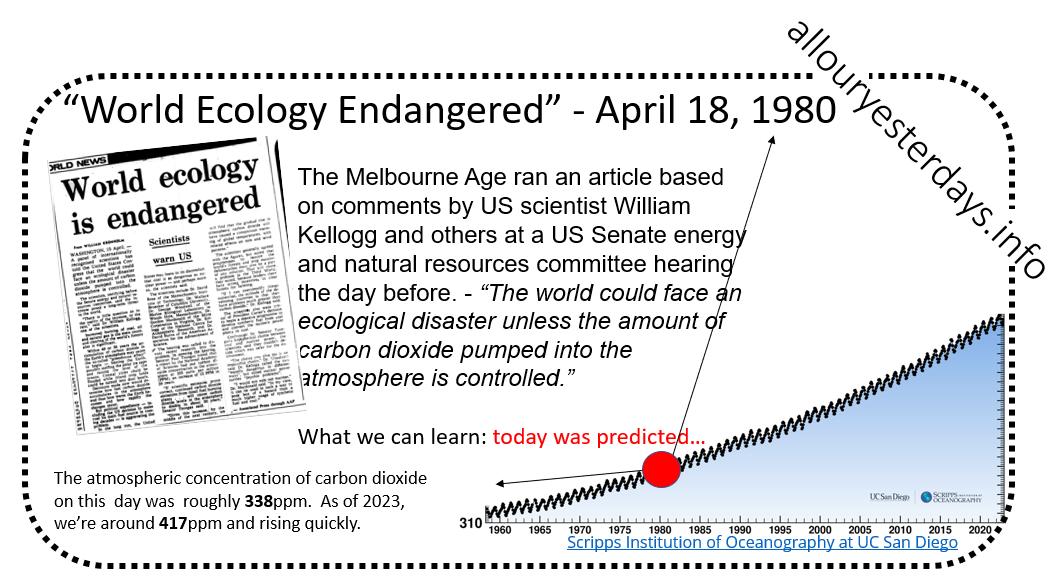
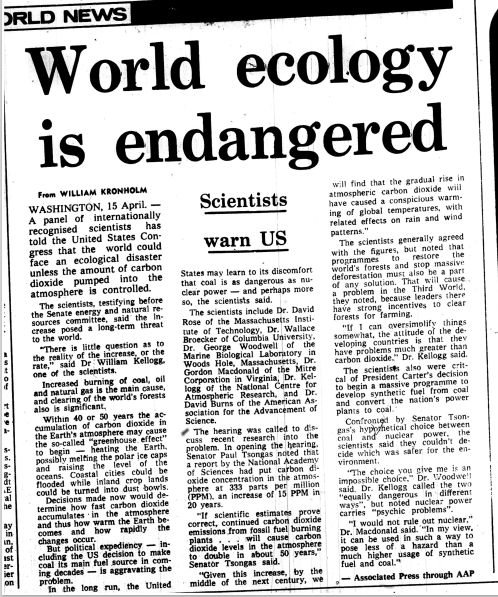
November 17, 1980 – International meeting about carbon dioxide build up.

On this day in 1980 an international gathering of scientists took place in Villlach, Austria.

“The first major initiative to result from the establishment of the WCP was an international conference on climate change, held in Villach, Austria, from 17 to 22 November 1980. Under the chairmanship of Professor Bert Bolin of the University of Stockholm, the delegates issued a warning that the accumulation of greenhouse gases posed a great risk to the earth’s natural equilibria; they declared that the issue consequently had to be addressed with some urgency. Although their pronouncement drew some attention, its political impact was negligible.”

(Rowlands,1995: 71-2)  

 https://library.wmo.int/doc_num.php?explnum_id=3173

[The amount of carbon dioxide in the atmosphere was 338.7ppm. At time of writing it was 419ishppm- but for what it is now,well, see here for the latest.]

Why this matters

This is part of the long slow growth of awareness and concern

What happened next.
One of the attendees was Australian scientist Graeme Pearman. Later that year, in September 1980, the Australian Academy of Science held a symposium about carbon dioxide build-up in Canberra.

In 1985 another Villach meeting set the international ball properly rolling, thanks to US Senators paying close attention…

And the emissions? Oh, they kept climbing.  Of course they did. I mean, we didn’t stop burning the fossil fuels, did we?

Categories
United Kingdom

November 17, 1968 – UK national newspaper flags carbon dioxide danger…

On this day, November 17 in 1968, the Observer ran a final story in its pollution inquiry,noting that “By the end of this century, we may have released enough carbon dioxide to raise the atmospheric temperature by two degrees centigrade.” [to be clear – this was a big overestimate, at least in the short-term]

17 Nov 1968 Observer article John Davy – significant mention of carbon dioxide greenhouse 

[The amount of carbon dioxide in the atmosphere was 323ppm. At time of writing it was 419ishppm- but for what it is now,well, see here for the latest.]

The context was this – 

By the late 1960s anyone with a smattering of scientific knowledge could see the trends. It wasn’t rocket science. You just needed eyes in your head and the willingness to think about uncomfortable futures.

Why this matters. 

We do not lack knowledge. We lack courage

What happened next?

From 1968 to 1972 a lot of international meetings and warm words.  

Categories
Australia Carbon Pricing

 November 16, 1994 – Industry lobbyists trot out “sky will fall” argument against emissions cuts. Again. Of course. As ever.

On this day, November 16 in 1994, in the midst of another flare up in the “should we put a price on carbon?” battles, the Aluminium industry released more “evidence”.

THE Commonwealth’s current targets for reducing greenhouse gas emissions will cost the economy almost $200 billion over the next decade, wiping out Australia’s aluminium industry in the process, a new study released yesterday claims.

Dwyer, M. 1994. Emission cuts ‘to kill aluminium industry’. The Australian Financial Review, 17 November, p.13.

[The amount of carbon dioxide in the atmosphere was 359ish ppm. At time of writing it was 419ishppm- but for what it is now,well, see here for the latest.]

The context was this – 

The fossil fuel lobby and its mates were determined to kill any carbon taxes/prices at birth. This was part of the effort.  Basically, find an economist willing to produce a “report” that shows the sky will fall, that the economy will collapse and we will all be reduced to living in mud huts and eating each other’s corpses if so much as a molecule less of coal/oil/gas is extracted.  Time the release of the “report”, give it to your tame mates in the media, then get tame mates in Parliament to quote the report and newspaper coverage. Bish bosh…

Why this matters. 

Think where we might have got to with political leaders with spine!!  We might be as much as 10 per cent less doomed than we are now!!

What happened next?

No carbon tax.  A carbon price in Australia didn’t kick in until July 2013. And then was killed off a year later.  Ha ha ha ha .

Categories
Science Scientists Sweden

November 15, 1958 – Academic Paper on “Changes in Carbon Dioxide Content of Atmosphere and Sea Due to Fossil Fuel Combustion” submitted

On this day, November 15, in 1958 one of the first papers about, well, our current problem, was submitted for publication.

1958 Bolin and Eriksson’s classic paper         “Changes in the Carbon Dioxide Content of the Atmosphere and Sea Due to Fossil Fuel Combustion” submitted.

[The amount of carbon dioxide in the atmosphere was 315ppm. At time of writing it was 421ishppm- but for what it is now,well, see here for the latest.]

The context was this – 

Through the 1950s, American and Swedish scientists (and others) were looking at carbon dioxide levels in the atmosphere and saying to themselves “now that’s interesting.”

Why this matters. 

We knew

What happened next?

Bolin? It became Bolin’s life work.  He shepherded the climate science agenda forward with skill and patience for decades. He was a key player all through the 1970s and 1980s. First chair of the IPCC.  Thank goodness for him he died when he did, before the farce of Copenhagen and so on.

Categories
Science United Kingdom

November 14, 1977 – Met Office boss forced to think about #climate change – first interdepartmental meeting…

On this day, November 14 in 1977,  John Mason the boss of the UK Meteorological Office, was forced to concede ground in his fight against climate science.

“Mason’s calling into existence of an ad hoc group of departmental chief scientists began as an attempt to keep a measure of control, from a sceptical Met Office point of view, on a topic that other bodies, national and international, were expanding active programmes of research. It was not an attempt to solve an issue rated by the Met Office as a priority or significant problem. It was nonetheless to turn into the channel for raising the issue of anthropogenic climate change at the highest levels of government. The first gathering of chief scientists and other government experts took place on 14 November 1977 at Bracknell.”

AGAR 2015

[The amount of carbon dioxide in the atmosphere was 333ppm. At time of writing it was 421ishppm- but for what it is now,well, see here for the latest.]

The context was this – 

Through the 1970s, scientists became more aware of – and alarmed about the possible long-term consequences of – carbon dioxide in the atmosphere.  But there was institutional resistance from those who dismissed it as just another lefty/hippy scare.

Why this matters. 

We need to remember that any new knowledge is seen through eyes used to old ways of seeing. And often those older eyes are right – not every “New Thing” matters.  But we have this inertia at the personal, organisational and societal level.  It will be the death of us.

What happened next?

In 1980 the Prime Minister was briefed, and dismissed it with the phrase “You want me to worry about the weather.”  That PM? Margaret Thatcher…

Categories
Australia Denial Fossil fuels

November 13, 2008 – Coal industry tries to get some ‘love’

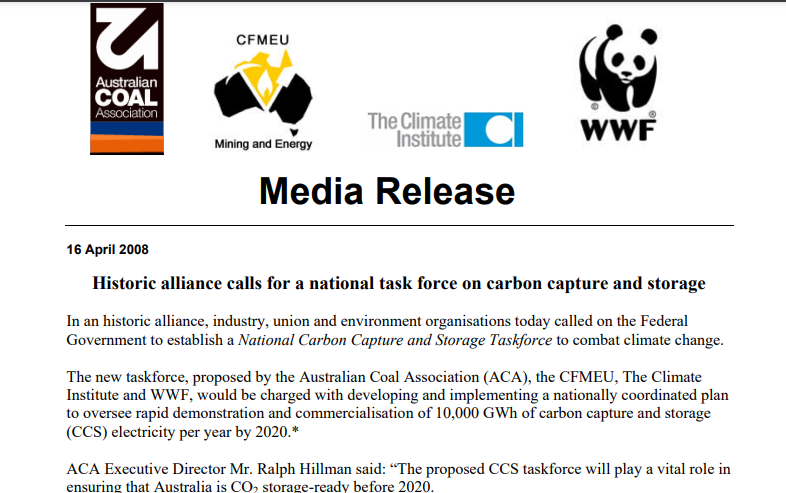
On this day, November 13, 2008, the Australian Coal Industry launches a propaganda (that’s what “public relations” is called when our official enemies do it) campaign, dangling the promise of “NewGenCoal.”

THE coal industry feels unloved. Its polling tells it Australians have no idea what, if anything, it is doing to reduce its greenhouse gas emissions – and most say they’ve never heard of carbon capture and storage.

So the coalminers want to convert us. Today the Australian Coal Association launches a $1.5million ad campaign – and a $1million website – to tell us what it’s doing to develop what it calls “NewGenCoal”.

Association executive director Ralph Hillman predicted that carbon capture and storage would be commercially viable by 2017, and said the industry was investing $1 billion to ensure coal a future as a low-emission technology.

Colebatch, T. 2008. Coal industry reaches out for love. The Age, 13 November, p.3.

(Check how they put land-clearing and intensive agriculture AHEAD of fossil fuels!)

On this day the atmospheric PPM for carbon dioxide was roughly 385.

Now it is 419ish- but see here for the latest.

Why this matters. 

We need to remember just how much effort (you might even say energy) goes into trying to polish the turds…  How much the fossil fuel industry sector invests in trying to keep its legitimacy, and having people think well of it…

For an overview of Australian coal industry efforts, see https://theconversation.com/recycling-rules-carnival-of-coal-is-a-blast-from-the-pr-past-45819

What happened next?

Prime Minister Kevin Rudd played politics, failed to get his terrible legislation through. The climate wars. The ACA was wound up in 2013 or so I think, but the coal lobby did a reverse takeover of the Minerals Council of Australia.  My proof?  Scotty from Marketing and that lacquered lump…