Categories
Australia Denial

November 29, 1990 and 1994 – Australian denial fools (Fred Singer and Brian Tucker)

Thirty-four and thirty years ago, on this day, November 29th, 1990/1994, two climate denialists who really ought to have known better (and did, before idiocy overtook them) were spouting their nonsens.

29 November 1990 Fred Singer The Greenhouse Effect and Global Warming: Fact or Fiction? Tasman Institute Seminar

and

29 November 1994 – Canberra Times piece IPA whining about greenhouse, wheeling out Brian Tucker, who had been head of the CSIRO’s Atmospheric Sciences Division.

The amount of carbon dioxide in the air was roughly 354ppm/359ppm. As of 2024 it is 423ppm, but check here for daily measures. 

The context is this: We have two examples of high status dickheads, one American, one Australian, denying the reality of climate change. What were both sort of relatively crucial moments in history. So in 1990, Ros Kelly had just come back from the Second World Climate Conference. The negotiations for a climate treaty were about to begin in earnest within a couple of months. In the second case, there was a battle going on about whether to have a carbon tax. And in both cases, the denialists will have said, “Oh, it’s all a scare. It’s all hysteria. Nothing should be done, needs to be done. And any action that is taken is merely rent seeking and appealing to silly ill informed portions of the electorate.” 

Gee, that went well didn’t it? And I want to say this again. Fuck you, and burn in hell you pricks. 

What do you think? Does this pass the ‘so what?’ threshold? Have I got facts wrong? Interpretation wrong? Please do comment on this post, unless you are a denialist, obvs.

Also on this day: 

November 29, 1973 – Australian politician warns of climate change

NOVEMBER 29, 1974 – SWEDISH PRIME MINISTER SAYS “RISK OF A CHANGED CLIMATE DUE TO HUMAN ACTIVITIES … [IS] OF UTTER IMPORTANCE”

November 29, 1988 – Australian parliamentarians taught climate

Categories
Australia

November 17, 1994 – “When consumption is no longer sustainable”…

Thirty years ago, on this day, November 17th, 1994,

“The fly in the ointment is the increasing insistence of our scientists that it can’t go on much longer. Just the latest unwelcome reminder of this came last week at a seminar on “Consumption and the Environment”, organised by the Australian National University’s Centre for Continuing Education on behalf of the Department of Environment, Sport and Territories.”

Gittins, R. 1994. When more is no longer sustainable. Sydney Morning Herald, 23 November, p.21.

[ALMOST CERTAINLY 17 November, in Sydney….

http://www.uow.edu.au/~sharonb/STS300/market/green/probarticle1.html

https://www.vgls.vic.gov.au/client/en_AU/vgls/search/detailnonmodal/ent:$002f$002fSD_ILS$002f0$002fSD_ILS:63151/ada?qu=Consumption+%28Economics%29&d=ent%3A%2F%2FSD_ILS%2F0%2FSD_ILS%3A63151%7EILS%7E2&ps=300&h=8

The amount of carbon dioxide in the air was roughly 359ppm. As of 2024 it is 423ppm, but check here for daily measures. 

The context was that by now we’ve had all of this nonsense about green consumerism and the “Green Consumer Guide” and all the rest of it. But populations are growing, wants and “needs” are growing. Advertising was continuing at a very great pace. And therefore, obviously comes the question of when does consumption en masse start to be unsustainable? And if you’ve heard of a guy called William Jevons, you will know that efficiency is not the be all and end all. And so it’s unsurprising, albeit depressing, that people were having these conversations all those years ago.

For the avoidance of doubt: the best consumption for most of us is less consumption. Obviously, when I say most of us, I mean most of us wealthy people in Europe. There are other places in the world where they desperately need to consume more, more health care, more protein, and more contraceptives, etc. That won’t happen. We are going to be the bacteria that eats everything in the petri dish. But that metaphor hides culpability. 

What we learn: We knew. We did not act. We are doomed.

What happened next? We kept hyper-consuming. 

What do you think? Does this pass the ‘so what?’ threshold? Have I got facts wrong? Interpretation wrong? Please do comment on this post, unless you are a denialist, obvs.

Also on this day: 

November 17, 1968 – UK national newspaper flags carbon dioxide danger…

November 17, 1980 – International meeting about carbon dioxide build up.

November 17, 2018 – XR occupy five bridges in London

Categories
Australia

November 10, 1994 – “profit or planet – choose one” (Victorian electricity)

Thirty years ago, on this day, November 10th, 1994,

Victorians should not rely on the state’s new competitive electricity companies to meet environmental aims, a senior power industry official has warned.

In a paper to be delivered in Sydney today, Dr Harry Schaap says the competitive system that Victoria and Australia are entering will no longer be able to devote so many resources to environmental challenges.

Dr Schaap is the manager of environmental affairs for Generation Victoria, owner of the state’s power stations, and one of two electricity industry representatives on the Council of Australian Governments’ National Greenhouse Advisory Panel. He will speak today at the annual conference of the Electricity Supply Association of Australia.

His comments may focus renewed attention on the possible environmental costs of Victoria’s electricity reforms and coming privatisation.

1994 Walker, D. 1994. Environment May Suffer In New Power Climate – Expert. The Age, 10 November, p.5.

[Faulkner too – see below]

The Federal Minister for the Environment, John Faulkner, has warned the electricity industry that its strides towards greater competitiveness may be working against a better environment, with cheaper prices encouraging consumers to use and waste more energy.

He also raised the threat of environmental levies — which could include a carbon tax — as a method of ensuring the industry cleans up its act.

Senator Faulkner’s speech to the Electricity Supply Association of Australia conference in Sydney on Thursday [10th November] came on the same day as a court challenge by Greenpeace over the construction of a new power station in the Hunter Valley was rejected.

Chamberlin, S. 1994. Danger in cheap power. Canberra Times, 13 November, p.6.

AND

1994 Redbank decision! Greenpeace Australia Limited v Redbank Power Company Pty Limited and Singleton Council, Decision on development application, [1994] NSWLEC 178, ILDC 985 (AU 1994), 10th November 1994, Land and Environment Court

Redbank gets waved through….

The amount of carbon dioxide in the air was roughly 359ppm. As of 2024 it is 423ppm, but check here for daily measures. 

The context was Australia had ratified the UNFCCC treaty, which was to have its first meeting in Berlin in March of the following year (1995). Federal Environment minister John Faulkner was hoping he could go and boast about a carbon tax. Meanwhile, the electricity system was being privatised, and environmental regulations and goals were being stripped out of the privatisation plans. Of course.

What I think we can learn from this Today’s failures are consequences of failures thirty years previous. Cheerful thought, eh?

What happened next We failed. The carbon tax failed. The electricity system was privatised and emissions from it stayed sky high. Policy did not drive a rapid decarbonisation, which is what was required.

What do you think? Does this pass the ‘so what?’ threshold? Have I got facts wrong? Interpretation wrong? Please do comment on this post, unless you are a denialist, obvs.

Also on this day: 

November 10, 1988 – Activists demand even steeper emissions cuts than “Toronto.” Ignored, obvs. But were right…

November 10, 1995 – moronic “Leipzig Declaration” by moronic denialists

November 10, 1995 – Ken Saro-Wiwa and other Ogoni executed

Categories
Agriculture Food United Kingdom

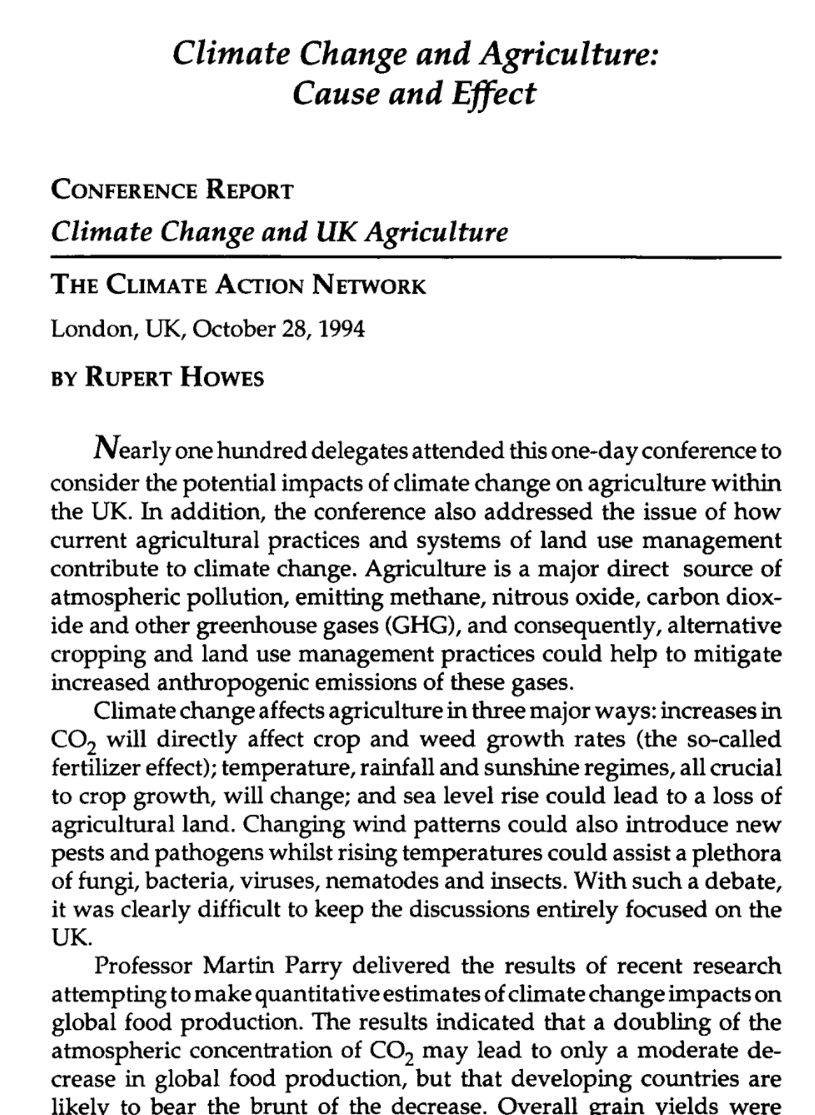
October 28, 1994 – UK agriculture and climate change workshop

Thirty years ago, on this day, October 28th, 1994, well, read it and weep

The amount of carbon dioxide in the air was roughly 359ppm. As of 2024 it is 422ppm, but check here for daily measures. 

The context was that there was a Climate Action Network and it was trying to get scientists and agriculture people and so forth thinking about the long-term impacts of climate change. The UK had ratified the UNFCCC, which would have its first meeting soon. And you know, agriculture was going to have to learn to adapt.

What we learn is we’ve been talking about adaptation for a very long time. It will be interesting to see how we do. Badly, I expect.

What happened next. Defra spent more money on climate change programmes and all the rest of it. But it’s not clear to me that anything meaningful is being done particularly that I could be wrong. And here we are.

https://lordslibrary.parliament.uk/impact-of-climate-change-and-biodiversity-loss-on-food-security

https://www.theguardian.com/environment/article/2024/jul/03/disastrous-fruit-and-vegetable-crops-must-be-wake-up-call-for-uk-say-farmers

https://www.theguardian.com/commentisfree/article/2024/may/08/british-farmer-food-climate-crisis-business

What do you think? Does this pass the ‘so what?’ threshold? Have I got facts wrong? Interpretation wrong? Please do comment on this post, unless you are a denialist, obvs.

Also on this day: 

October 28, 1906 – the birth of the Press Release

October 28, 1956 – New York Times reports “Warmer Climate on the Earth May Be Due To More Carbon Dioxide in the Air”

Categories
Activism Australia Carbon Pricing

October 2, 1994 – twenty years of boredom, for trying to change the system from within (Phillip Toyne becomes civil servant)

Thirty years ago, on this day, October 2nd, 1994, as the battle for a carbon tax heats up…

THE FRIENDS and enemies of Phillip Toyne, acquired during years of very public struggle over Aboriginal land rights and the environment, were in a stunned state at the ALP’s national conference in Hobart this week.

The news that one of the hardest nosed and most controversial among Australian activists had joined, of all things, the Commonwealth’s environment bureaucracy (at deputy secretary, level, no less), delighted and appalled in equal measure.. …..

Brough, J. 1994. What kind of pudding will Toyne make? Canberra Times, 2 October, p.9.

The amount of carbon dioxide in the air was roughly 359ppm. As of 2024 it is 422ppm, but check here for daily measures. 

The context was that Phillip Toyne had been a thorn in the side of the Hawke government. He, as the chair of the Australian Conservation Foundation, had also done really useful work on Aboriginal land rights. And now he was tempted to try to change the system from within by becoming a senior bureaucrat for John Faulkner, the Federal Environment Minister, who was publicly toying with the idea of introducing a carbon tax. 

What we learn is that people who try to change the system from within get sentenced to 20 months or years of boredom. And sometimes it works, sometimes it doesn’t. 

What happened next. Toyne was unsuccessful. I don’t know when he quit, but it was pretty clear after February 10 1995, that no meaningful action was going to happen on climate change in Australia, at least not at the federal level. Toyne died in 2015. Having fought the good fight. 

What do you think? Does this pass the ‘so what?’ threshold? Have I got facts wrong? Interpretation wrong? Please do comment on this post, unless you are a denialist, obvs

Also on this day: 

 October 2, 1927/64 – Svante Arrhenius and Guy Callendar die.

October 2, 1942 – Spaceflight!!

October 2, 2014 – Low emission technologies on their way, says Minerals Council of Australia

Categories
Australia Carbon Pricing

September 14, 1994 – Business told to brace for climate regulation/tax (which it then handily defeats)

Thirty years ago, on this day, September 14th, 1994

CANBERRA NOTEBOOK

Industry can expect tougher government action as a result of publication in the past week of Australia’s first inventory of greenhouse gas emissions. The Environment Minister, Senator John Faulkner, says he is working on a range of measures to take to Cabinet by December to help cut Australia’s gas emissions in line with international obligations.

Hooper, N. 1994. Greenhouse Action. BRW, 19 September, p.14.

and

A carbon tax, which could have a significant impact on Australia’s resources sector, will be examined as part of the Federal Government’s business tax reforms.

While it is not one of the Ralph report recommendations, a paper has been prepared by Treasury that is expected to be used by the Government when it begins negotiations with the Australian Democrats on the business tax reform package.

In negotiations to secure approval for the Government’s landmark business tax reforms, the Democrats are expected to push for a more systematic approach to Australia’s commitment to reduce greenhouse emissions under the Kyoto targets. This might involve a tax on emissions or other measures, such as greenhouse credits for tree plantations.

Dodson, L. and Lewis, S. 1999. Government puts carbon tax on agenda. The Australian Financial Review, 14 September, p.1.

The amount of carbon dioxide in the air was roughly 359ppm. As of 2024 it is 420ishppm, but check here for daily measures. 

Businesses told that they can expect regulation, that they should brace for it. 

The context was that the carbon tax idea that had been promulgated, put forward in the late 80s, early 90s And then defeated was on its way back. It seemed John Faulkner who was the Environment Minister for Keating was proposing attacks that would raise some funds, needed funds for Treasury and also pay for a little bit of research and development of solar power. Business knew that business groups would fight very hard; but they were realistic that things could go wrong and that they might end up with regulation or taxation. This of course might also have been a warning in order to whip up more interest and finance from potentially affected groups, so the troops were energised; who can say. 

What we can learn is that business fights dirty and hard, obvs.

What happened next Business won that round, and almost all of the rounds to follow. And the emissions kept climbing.

What do you think? Does this pass the ‘so what?’ threshold? Have I got facts wrong? Interpretation wrong? Please do comment on this post, unless you are a denialist, obvs.

Also on this day: 

 September 14, 1993 – scientists suffer backlash (not outa thin air though)

September 14, 2004 – Blair “shocked” by scientists warnings – “time is running out for tackling climate change”

Categories
Australia

July 11, 1994 – Australian Environment Minister admits not clear if Australia hitting targets (spoilers, it wasn’t)

Thirty years ago, on this day, July 11th, 1994, it turns out promises are easier than delivery

Environment Minister John Faulkner says the Federal Government won’t be able to tell if it can meet its targets on the reduction of greenhouse gas emissions until August….

On Monday’s ABC Lateline program, Senator Faulkner said the government will have a better idea when statistics on levels of greenhouse gas emissions are released in August.

Anon. 1994. Greenhouse performance uncertain. Green Week, July 15, p.5. [Lateline show will have been Monday 11th July]

The amount of carbon dioxide in the air was roughly 359ppm. As of 2024 it is 426ppm, but check here for daily measures. 

The context was Faulkner hadn’t been in his post long. And Australian climate policy was a complete freaking mess. Anyway, there wasn’t one, except for the meaningless National Greenhouse Response Strategy, which was a watered down consolation prize for the Ecologically Sustainable Development process. 

What we learn is that even on the most important issue of all time, there was an incredibly lackadaisical “yeah, whatever doesn’t matter” attitude. And this really is the fault of Paul Keating. As prime minister, that’s where the buck stops. 

What happened next is when the first emissions report did come out, it showed that surprise, surprise, emissions had not gone down, but continued to go up. And this was a problem both for the Rio stabilisation target of returning emissions to 1990 levels by 2000. But also, there was still supposed to be the “minus 20% by 2005” of the Toronto target, agreed in October 1990. Faulkner, then, proposed a carbon tax which was defeated. 

What do you think? Does this pass the ‘so what?’ threshold? Have I got facts wrong? Interpretation wrong? Please do comment on this post, unless you are a denialist, obvs.

Also on this day: 

July 11, 1989 – Australia says “sure, we’ll take #climate refugees.” Yeah, nah.

July 11, 1996 – Celebrity Death Match: Australian fossil fuels industry versus The World (Spoiler: world lost)

July 11, 2013- “don’t be evil” my fat arse….

Categories
Australia UNFCCC

June 28, 1994 – Australian Foreign Minister says “then again, maybe we won’t” on carbon cuts

Thirty years ago, on this day, June 28th, 1994, Gareth Evans mutters about leaving the UNFCCC

 AUSTRALIA may refuse to take on greenhouse gas reduction commitments if the economic impact on Australia was too high, the Minister for Foreign Affairs, Senator Evans, has warned.

Senator Evans told The Australian Financial Review that the option of Australia not accepting climate change commitments had been endorsed by Cabinet.

Gill, P. 1994. Australia may refuse to cut greenhouse gas levels: Evans. Australian Financial Review, 29 June, p.7.

The amount of carbon dioxide in the air was roughly 359ppm. As of 2024 it is 426ppm, but check here for daily measures. 

The context is that the headbangers and idiots could talk a good game where it mattered. But ultimately when push came to shove, they were all about fossil fuel extraction, selling, burning, getting rich. And Gareth Evans, the day after John Coulter gave Faulkner advice, was telling the Senate that Australia might well not honour the spirit of the United Nations Framework Convention on Climate Change, because it had perceived loopholes for itself. 

What we learn is that any political party will have at least two factions. These change membership and focus over time and they can be traced if you can be bothered to make the effort, though it’s really not worth the effort. Depends if you’re being paid to do it I guess. 

What happened next – the Keating government pushed the “we’re a special case” line quietly. When the Howard gang came in, in March 1996, that got dialled up to 11.

What do you think? Does this pass the ‘so what?’ threshold? Have I got facts wrong? Interpretation wrong? Please do comment on this post, unless you are a denialist, obvs.

Also on this day: 

June 28, 1982 – Secretary of State for Energy justifies flogging off public assets

June 28, 1988 – Greenies want deep emissions cuts. Doesn’t happen. #TorontoTarget

Categories
Australia

June 21, 1994 – “National Greenhouse Advisory Panel” established. Hilarity ensues.

Thirty years ago, on this day, June 21st, 1994, the Federal Government sets up an advisory body.

“Federal Environment Minister Senator John Faulkner announced the appointment of a panel to advise on greenhouse strategies amid growing friction between business and conservation groups. The panel was headed by Professor Paul Greenfield of Queensland University with representatives from consumer, conservationist, union, business and industry bodies.” 

The amount of carbon dioxide in the air was roughly 359ppm. As of 2024 it is 426ppm, but check here for daily measures. 

The context was that the National Greenhouse Advisory Panel was set up because greenhouse policy was a mess. The National Greenhouse Response Strategy had been published in December 1992, an immensely-watered down version replacement for the Ecologically Sustainable Development process, and it was clear that NGRS was a dead duck and irrelevant duck. Labor set this up, there was also the issue of the more immediate challenge of a carbon tax battle that was impending; a panel might provide useful ammunition and at worst case scenario it could be a Macmillan manoeuvre 

What we learn is that the birth of these sorts of panels usually has a backstory which is worth knowing – who set them up, why, what are the short term motivations? 

 What happened next The NGAP staggered on for a couple of years and then was basically dissolved without Howard even writing them a thank you letter because he is just a prick. Just a rude, stupid, destructive prick. 

What do you think? Does this pass the ‘so what?’ threshold? Have I got facts wrong? Interpretation wrong? Please do comment on this post, unless you are a denialist, obvs.

Also on this day: 

June 21, 1958 – Washington Post reports ‘world turning into a ‘greenhouse’

June 21, 2007 – ABC unleashes “Carbon Cops” on the world. ACAB – All Climate Activists Barf…

Categories
Australia Coal UNFCCC

March 21, 1994 – Singleton Council approves Redbank power station

Thirty years ago, on this day, March 21st, 1994, a local council in New South Wales, Australia says yes to another coal fired power station, on the day that the UNFCCC comes into farce. Sorry, force.

The amount of carbon dioxide in the air was roughly 359ppm. As of 2024 it is 425ppm, but check here for daily measures. 

The context was that Australia had a growing economy, and needed more electricity. The easiest way to do that was to dig up and burn coal. So we do the easiest thing. Councils are going to wave through the sorts of things because jobs, donations to parties, perks, a sense of normalcy.

And the UNFCCC being ratified and becoming law the same day? It’s just one of life’s historical ironies. The Greenpeace campaign against Redbank is also just not even historical footnote really is it? There you are. 

What happened next. Redbank pumped out seriously amounts of planet-cooking CO2. 

What do you think? Does this pass the ‘so what?’ threshold? Have I got facts wrong? Interpretation wrong? Please do comment on this post, unless you are a denialist, obvs.

References

Greenpeace Australia Ltd v Redbank Power Company Pty Ltd and Singleton Council [1994] NSWLEC 178, (1994) 86 LGERA 143, Land and Environment Court (NSW, Australia)

Chamberlain, P. 1994. Danger in cheap power. Canberra Times. November 13, p. 6

https://trove.nla.gov.au/newspaper/article/130537382

Also on this day: 

March 21, 1768 – Joseph Fourier born

March 21, 1994 – Yes to UNFCCC, yes to more coal-fired plants. Obviously. #auspol